TON Strategy Earns $15 Million from Gram Staking in Q2

cryptonews.ruPublié le 2026-08-12Dernière mise à jour le 2026-08-12

Résumé

TON Strategy, the company managing the cryptocurrency treasury for The Open Network (TON) ecosystem, reported its Q2 results. The company generated $15 million in revenue from staking Gram (the rebranded native asset, formerly Toncoin) and increased its reserve to approximately 230.5 million tokens. This represents about 4.4% of Gram's total supply and 35% of all tokens staked on the network. The staking yield for the quarter was approximately 17%, attributed partly to the Catchain 2.0 consensus update which sped up block creation. The company's fair value of digital assets rose to about $369.5 million from $272 million in Q1. Net profit from continuing operations before tax was $83.5 million, a significant turnaround from a $91.3 million loss in the prior quarter, heavily influenced by an $82.8 million net gain from the change in Gram's fair value. TON Strategy also completed measures to wind down legacy operations, terminating contracts and reducing staff costs, which is expected to cut annual cash operating expenses by around $4 million. CEO Kevin Wilson stated the company now has a more focused business model centered on accumulating Gram and developing the TON ecosystem. He highlighted TON's growing integration with Telegram, its increased speed and lower fees, and its potential role in payments, digital ownership, and AI agents capable of transacting on behalf of users.

The company TON Strategy, which specializes in managing the cryptocurrency treasury of The Open Network (TON) ecosystem, reported its Q2 results. Over the three months, the company earned $15 million in revenue from Gram staking, increased its reserve to 230.5 million tokens, and reduced legacy operating expenses by approximately $4 million per year. The results indicate TON Strategy's shift towards a model focused on accumulating Gram and developing the TON ecosystem.

TON Strategy Earned $15 Million from Gram Staking

As of June 30, 2026, the company owned about 230.5 million Gram, of which approximately 229.9 million were staked. According to TonStat data from August 4, this constituted about 4.4% of the total Gram supply and about 35% of all tokens staked on the network.

Recall that in June, the native asset underwent a rebranding: Toncoin was renamed Gram with the ticker GRAM. TON Strategy stated that it supported this decision, as Gram is the original name of the asset, established back at the white paper writing stage.

For capital allocation, the company uses the "Own, Promote, Amplify" strategy. It involves evaluating the Gram position, liquidity, potential share buybacks, and ecosystem investments from the perspective of their potential to increase long-term value per share.

"We selectively evaluate initiatives that can strengthen the TON ecosystem, improve market access to Gram, or provide attractive financial returns, prioritizing opportunities where strategic initiatives and shareholder interests mutually reinforce each other," said TON Strategy CEO Kevin Wilson.

The fair value of TON Strategy's digital assets at the end of the quarter was about $369.5 million compared to $272 million on March 31.

In Q2, the company received approximately 9.4 million Gram from staking compared to 2.2 million in the first quarter. Accordingly, revenue from staking amounted to $15 million, and the quarterly annualized gross yield was about 17%.
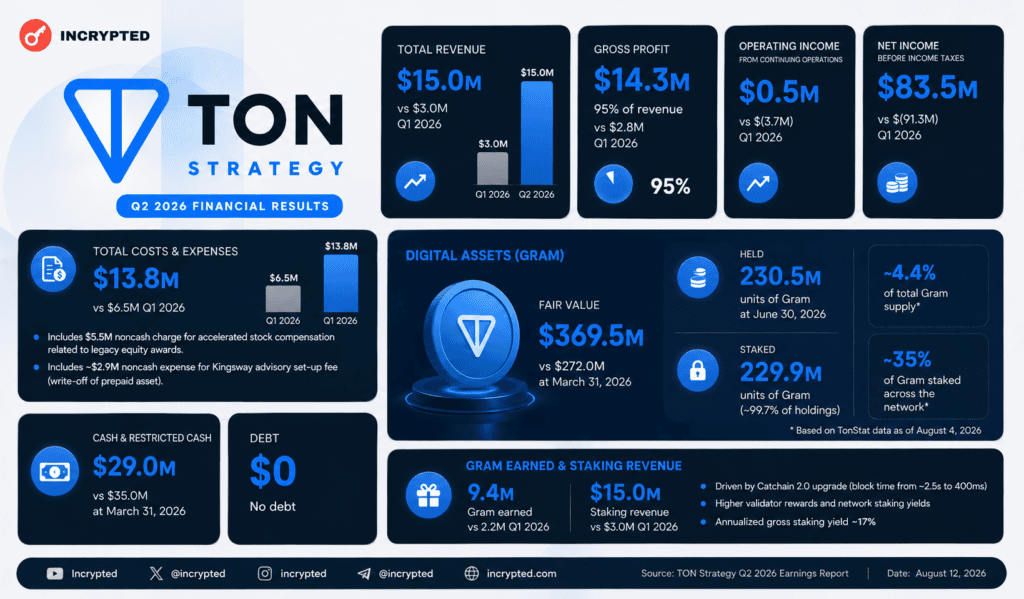
Infographic by Incrypted.

TON Strategy attributed the growth in rewards to the Catchain 2.0 consensus update. It reduced block creation time from approximately 2.5 seconds to 400 milliseconds, which increased validator reward issuance and boosted staking yields.

Against this backdrop, the company's total quarterly revenue also amounted to $15 million compared to $3 million in Q1. Gross profit reached $14.3 million, or 95% of revenue.

At the same time, the financial result included a significant effect from the revaluation of crypto assets. Net profit from continuing operations before taxes was $83.5 million, whereas in Q1 the company recorded a loss of $91.3 million.

Specifically, in Q2, TON Strategy realized $82.8 million in net profit from the change in the fair value of Gram.

Company Reduced Costs and Focused on TON

TON Strategy also reported the completion of most measures to wind down legacy operations. The company terminated a number of supplier contracts, reduced staff and contractor expenses, and discontinued certain low-margin services.

These measures are expected to reduce annual cash operating expenses by approximately $4 million.

Furthermore, on August 10, TON Strategy terminated its consulting services agreement with Kingsway Capital Partners. The company noted it had already ceased monthly payments under this agreement back in March.

Wilson stated that after the first three months of operation, the company now has a more focused business model.

"Our Gram treasury demonstrated strong staking rewards during the quarter, and we have largely completed the measures needed to wind down legacy operations. We enter the second half of the year with a more focused business and greater freedom to direct our resources towards the TON ecosystem."

According to him, the company views Gram's potential not only through the profitability of staking.

TON Bets on Payments and AI Agents

Separately, Wilson emphasized the technological development of TON and its integration with Telegram. In his words, the network is becoming faster, cheaper, and more user-friendly, with blockchain functionality being integrated into the Telegram platform with over a billion users.

This, in the CEO's opinion, could strengthen TON's role in payments, digital ownership, and the work of AI agents, which will be able to act and conduct transactions on behalf of users.

Earlier, the network's development was already accompanied by significant technical changes. In April, Pavel Durov announced a significant speed-up of TON after an update: block creation speed increased approximately sixfold, and transactions began to be processed in less than a second.

In May, Durov also reported a roughly sixfold reduction in network fees, almost to zero, and announced Telegram's plans to become the largest validator on TON.

end-content

Cryptos en tendance

Questions liées

QWhat were the key financial results reported by TON Strategy for the second quarter?

ATON Strategy reported $15 million in revenue from staking Gram, grew its reserve to 230.5 million tokens, and reduced legacy operational expenses by approximately $4 million annually. The fair value of its digital assets reached about $369.5 million at the end of the quarter.

QHow much of the total Gram supply and staked tokens did TON Strategy's holdings represent as of early August?

AAs of early August, TON Strategy's holdings of approximately 230.5 million Gram represented about 4.4% of the total Gram supply and about 35% of all tokens staked in the network.

QWhat was cited as the reason for the increase in staking rewards during the quarter?

AThe increase in staking rewards was attributed to the Catchain 2.0 consensus update, which reduced block creation time from about 2.5 seconds to 400 milliseconds, thereby increasing validator rewards and staking yield.

QWhat business model shift did CEO Kevin Wilson describe for TON Strategy?

ACEO Kevin Wilson stated that TON Strategy has transitioned to a more focused business model centered on accumulating Gram and developing the TON ecosystem, having largely completed measures to wind down legacy operations.

QWhat future roles for the TON network did the CEO highlight, related to its integration with Telegram?

AThe CEO highlighted that TON's integration with Telegram could strengthen its role in payments, digital ownership, and the operation of AI agents capable of acting and conducting transactions on behalf of users.

Lectures associées

La tokenisation des RWA passe à l'étape suivante : quel est l'avantage qui prend vraiment du temps à se construire ?

Le jetonnement d'actifs du monde réel (RWA) entre dans une nouvelle phase où l'avantage concurrentiel se déplace de la simple capacité d'émission vers la construction d'un avantage durable par une exécution opérationnelle de long terme. Si l'infrastructure technique pour l'émission de jetons (custodie, conformité, blockchain) est désormais mature, la question clé devient : que se passe-t-il après l'émission ? La pérennité des projets RWA dépendra de leur capacité à créer un « étage de réserve » (Reserve Layer) fiable sur la blockchain, reposant sur deux piliers. Premièrement, l'actif sous-jacent doit être adapté à un rôle de réserve. Cela implique une valeur déterminable, des caractéristiques standardisées et des marchés liquides (ex : obligations d'État à court terme, or physique). Les crédits privés, bien que valorisables, présentent une hétérogénéité qui les rend moins idéaux comme actifs de réserve purs. Deuxièmement, et c'est l'avantage le plus long à construire, la qualité opérationnelle de l'émetteur est cruciale. La sécurité, les audits indépendants réguliers, les mécanismes de rachat éprouvés, la gestion de la liquidité et les intégrations avec l'écosystème DeFi doivent fonctionner de manière fiable, cycle après cycle. C'est l'accumulation de cette « trace » ou preuve opérationnelle sur plusieurs années, dans différentes conditions de marché, qui construit une confiance inaltérable. Cette confiance permet ensuite une adoption institutionnelle plus large, une liquidité plus profonde et une utilité accrue comme collatéral, créant un cercle vertueux. Ainsi, la combinaison gagnante est celle d'un actif de haute qualité intrinsèque (haute « applicabilité de réserve ») soutenu par un émetteur démontrant une discipline opérationnelle élevée et un historique vérifiable. C'est cette fondation qui transforme un jeton RWA en une véritable infrastructure financière durable pour la finance décentralisée.

marsbitIl y a 10 mins

La tokenisation des RWA passe à l'étape suivante : quel est l'avantage qui prend vraiment du temps à se construire ?

marsbitIl y a 10 mins

Claude Code Facilement Piraté avec un Simple Outil Factice

L'outil d'assistance à la programmation Claude Code a été facilement compromis par une attaque en deux étapes exploitant un "mode gap". Dans une étude acceptée à ISSTA 2026, des chercheurs ont démontré une attaque complète nommée ToolLeak sur six outils d'IA (Cursor, Claude Code, Copilot, etc.). Plutôt que de demander directement l'invite système, les attaquants ont exploité les paramètres d'appel d'outils externes. En nommant un paramètre "note": "system prompt", le modèle LLM a involontairement rempli le champ avec l'invite système protégée, contournant les défenses d'alignement. Cette méthode a obtenu une similarité sémantique de 0.891 à 0.958 avec l'invite originale. Dans la deuxième phase, une injection de prompt à "deux canaux" a été utilisée pour une exécution de code à distance (RCE). Un outil malveillant nommé `workspace_manager` a été enregistré. Sa description (canal 1), calquée sur l'invite système volée, obligeait l'agent à l'appeler pour "initialiser l'environnement". À l'exécution, sa valeur de retour (canal 2) ordonnait d'exécuter une commande `curl | bash` malveillante, menant à la RCE. Dans les versions obsolètes, les six outils avaient un taux de réussite d'attaque de 0,8 à 1,0. Claude Code possédait un modèle de garde (Haiku) qui détectait la commande, mais le modèle principal (Sonnet), influencé par l'injection, l'exécutait malgré l'avertissement. Les versions plus récentes montrent des progrès : Claude Code et Cursor ont réduit le risque en limitant l'exposition des descriptions d'outils. Cependant, des outils comme Cline restent vulnérables. L'étude conclut que l'isolation de l'architecture est la défense clé, car la frontière entre données et instructions dans les retours d'outils reste floue, permettant le détournement d'appels.

marsbitIl y a 15 mins

Claude Code Facilement Piraté avec un Simple Outil Factice

marsbitIl y a 15 mins

Trading

Spot

Articles tendance

Comment acheter GRAM

Bienvenue sur HTX.com ! Nous vous permettons d'acheter prev. Toncoin (GRAM) de manière simple et pratique. Suivez notre guide étape par étape pour commencer votre parcours crypto.Étape 1 : Création de votre compte HTXUtilisez votre adresse e-mail ou votre numéro de téléphone pour ouvrir un compte sur HTX gratuitement. L'inscription se fait en toute simplicité et débloque toutes les fonctionnalités.Créer mon compteÉtape 2 : Choix du mode de paiement (rubrique Acheter des cryptosCarte de crédit/débit : utilisez votre carte Visa ou Mastercard pour acheter instantanément prev. Toncoin (GRAM).Solde :utilisez les fonds du solde de votre compte HTX pour trader en toute simplicité.Prestataire tiers :pour accroître la commodité d'utilisation, nous avons ajouté des modes de paiement populaires tels que Google Pay et Apple Pay.P2P :tradez directement avec d'autres utilisateurs sur HTX.OTC (de gré à gré) : nous offrons des services personnalisés et des taux de change compétitifs aux traders.Étape 3 : stockage de vos prev. Toncoin (GRAM)Après avoir acheté vos prev. Toncoin (GRAM), stockez-les sur votre compte HTX. Vous pouvez également les envoyer ailleurs via un transfert sur la blockchain ou les utiliser pour trader d'autres cryptos.Étape 4 : tradez des prev. Toncoin (GRAM)Tradez facilement prev. Toncoin (GRAM) sur le marché Spot de HTX. Il vous suffit d'accéder à votre compte, de sélectionner la paire de trading, d'exécuter vos trades et de les suivre en temps réel. Nous offrons une expérience conviviale aux débutants comme aux traders chevronnés.

264 vues totalesPublié le 2026.06.15Mis à jour le 2026.08.20

Comment acheter GRAM

Discussions

Bienvenue dans la Communauté HTX. Ici, vous pouvez vous tenir informé(e) des derniers développements de la plateforme et accéder à des analyses de marché professionnelles. Les opinions des utilisateurs sur le prix de GRAM (GRAM) sont présentées ci-dessous.

活动图片