JPMorgan backs crypto bill as Donald Trump vows to ‘not sign other bills’ – What now?

ambcryptoPublié le 2026-07-11Dernière mise à jour le 2026-07-11

Résumé

The House-passed Digital Asset Market Clarity Act of 2025 faces an uncertain future despite gaining significant backing from JPMorgan, a major shift for the traditionally crypto-skeptical bank. According to BitGo CEO Mike Belshe, this support is crucial as regulatory uncertainty has been the largest obstacle to institutional adoption. Should the bill pass, it could simplify market entry for institutional investors, potentially leading to wider cryptocurrency uptake. However, approval odds on Polymarket have dropped to 45%. Supporters, including Rep. French Hill and former CFTC Chairman Michael Selig, are pushing for a Senate vote before the August recess to force a compromise. Ethereum co-founder Joseph Lubin also supports the legislation. Yet, Democratic Senator Elizabeth Warren criticizes the current draft as enabling sanctions evasion. A further complication is former President Donald Trump's vow not to sign other bills until the SAVE America Act is passed, pushing the CLARITY Act's next deadline to August 7th.

The House passed its version of the Digital Asset Market Clarity Act of 2025 nearly a year ago, but the bill is still in a tight spot. However, Mike Belshe, CEO of BitGo, recently pointed out that JPMorgan has shown full support for the CLARITY Act.

He said,

Let that sink in. The world’s largest bank — long crypto-skeptical — is now publicly supporting crypto market structure legislation. This is a different ballgame.

AD

What does this mean for the market?

Belshe emphasized that JPMorgan’s backing of the CLARITY Act is important because regulatory uncertainty has long been the largest obstacle. So banks, asset managers, pension funds, and investment advisers are likely to be encouraged to get ready for increased crypto participation.

Should the bill pass, it might make it simpler for institutional investors to confidently join the market, which could lead to a wider uptake of cryptocurrencies.

This occurs as the approval odds on Polymarket have dropped to 45%, a 20% decrease from 74% two months ago.
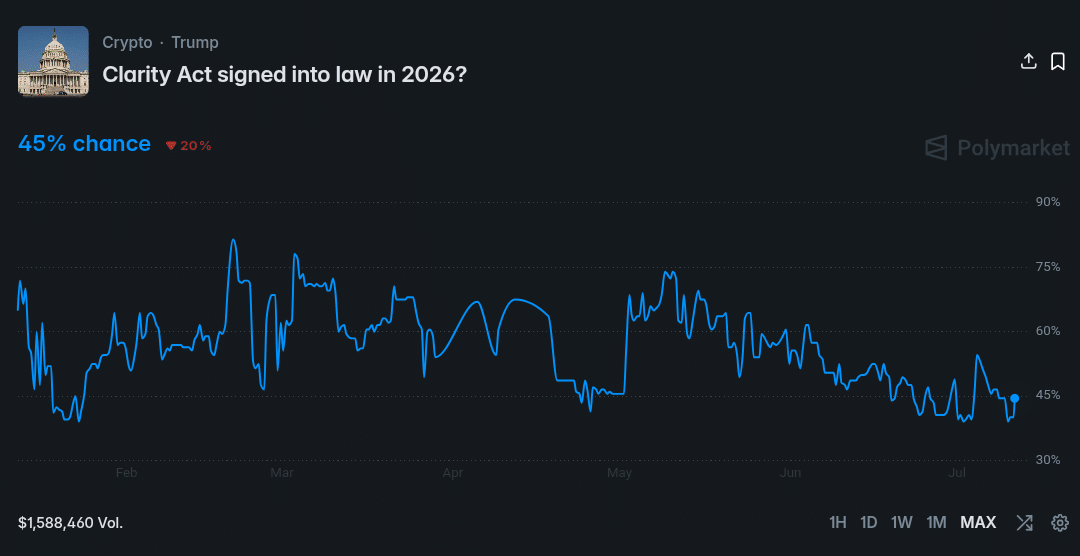
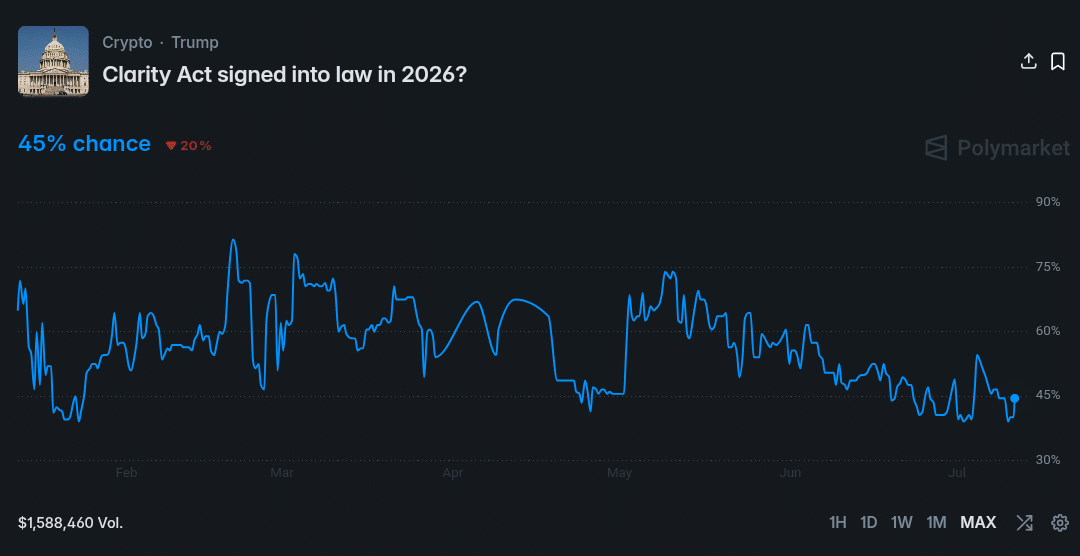
Source: Polymarket

Others supporting the passage of the CLARITY Act

However, regarding the approval, the community still appears to be in favor.

For instance, Rep. French Hill is arguing that the best way to force lawmakers to reach a compromise is to give them a clear deadline to vote on the CLARITY Act before Congress starts its August recess.

Rather than leaving these activities in a regulatory gray area, Hill believes the CLARITY Act would subject them to defined standards and said,

I’ve encouraged Senate leadership to put it on the floor. I think if you schedule a floor date here in the month of July, that will cause these final meetings, these final discussions to take place. You’ve got to have a deadline in Congress to get people to move and find consensus.

Supporters net increases

Not only this, the bill is also supported by Michael S. Selig, the 16th Chairman of CFTC, who said,

The Clarity Act, talking to this future proof notion of making sure that crypto is here to stay.

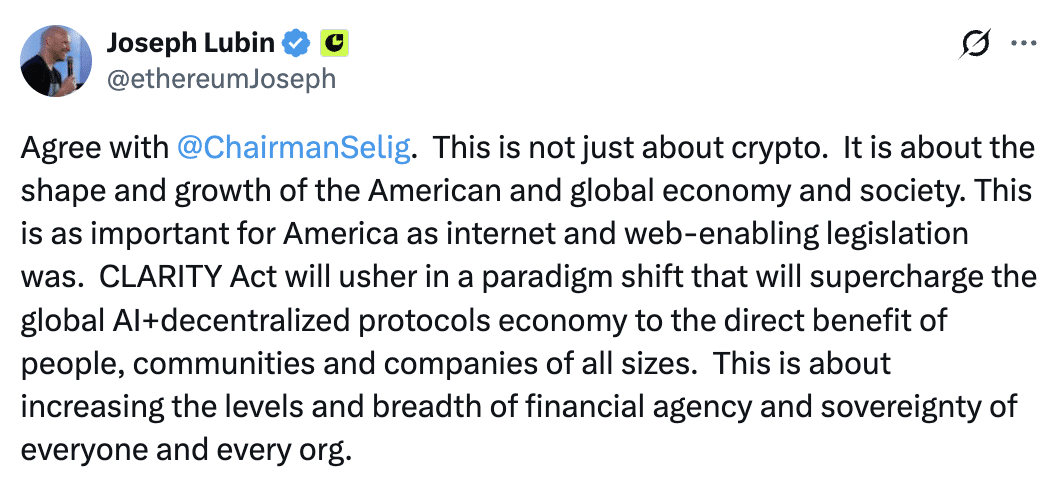
Echoing similar sentiments, Joseph Lubin, Ethereum’s co-founder, added,
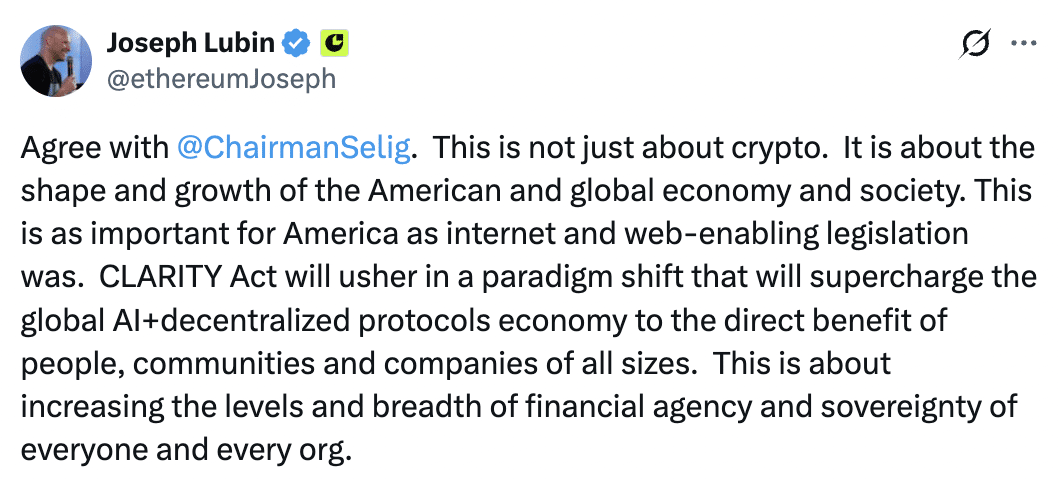
Source: Joseph Lubin/X

In fact, Democratic Senator Elizabeth Warren, who has been a stern supporter of the bill, recently put it best when she said,

As currently drafted, the CLARITY Act is a ticket to sanctions evasion.

However, Trump has stated that he will “not sign other bills” until Republicans in Congress have passed the SAVE America Act. As a result, the CLARITY Act is now awaiting a new deadline of the 7th of August to advance.


Final Summary

  • JP Morgan, supporting the bill, has ignited fresh optimism for the approval of the CLARITY Act.
  • Though the Polymarket odds have fallen to the 45% Senators, CFTC chairman, Ethereum co-founder, and many others are demanding the bill’s approval.


Cryptos en tendance

Questions liées

QAccording to the article, what is the significance of JPMorgan's public support for the CLARITY Act?

AAccording to Mike Belshe, CEO of BitGo, JPMorgan's support is highly significant because it signals a major shift from a long-time crypto-skeptical stance. It indicates that regulatory uncertainty, a major obstacle, might be addressed, which could encourage banks, asset managers, and institutional investors to prepare for greater participation in the crypto market.

QWhat is the current approval probability for the CLARITY Act on Polymarket, and how has it changed?

AThe current approval odds on Polymarket have dropped to 45%. This represents a 20% decrease from a probability of 74% recorded two months ago.

QWhat strategy did Representative French Hill propose to advance the CLARITY Act?

ARep. French Hill argued that setting a clear deadline for a vote on the CLARITY Act before Congress's August recess is the best way to force lawmakers to reach a compromise and find consensus.

QWho are some of the notable figures mentioned as supporting the passage of the CLARITY Act?

ASupporters mentioned include Michael S. Selig, the 16th Chairman of the CFTC; Joseph Lubin, co-founder of Ethereum; and Democratic Senator Elizabeth Warren, who has been a stern supporter, though she has also voiced specific concerns about the bill's current draft.

QWhat is the main political obstacle currently facing the CLARITY Act, as stated in the article?

AThe main political obstacle is that former President Donald Trump has stated he will "not sign other bills" until Republicans in Congress have passed the SAVE America Act. This has put the CLARITY Act in a tight spot, with its next advancement deadline set for August 7th.

Lectures associées

Gate Research Institute : La vague de « Wall Streetisation » des produits financiers cryptographiques, concurrence ou fusion ?

Le titre de l'article est : "Gate Institute : La vague de 'Wall Street-isation' des produits financiers cryptos, est-ce une compétition ou une fusion ?" Résumé en français (environ 1400 caractères) : Il y a dix-sept ans, Bitcoin fut créé avec une vision décentralisée et anti-establishment financier. Aujourd'hui, paradoxalement, son adoption massive passe souvent par des ETF émis par des géants comme BlackRock. Cet article analyse cette "Wall Street-isation" apparente des actifs cryptos : les institutions traditionnelles s'emparent-elles du pouvoir d'émission, de tarification, de garde et de distribution ? La réalité est plus nuancée. C'est une convergence à double sens. D'un côté, les plateformes cryptos comme Gate.io étendent leurs services aux actions traditionnelles (états-uniennes, hongkongaises, sud-coréennes), aux CFD et aux produits tokenisés, offrant un compte unifié. De l'autre, des courtiers traditionnels comme Robinhood intègrent les cryptomonnaies et explorent la tokenisation d'actions sur blockchain. Cette fusion vise à créer le "super-compte" financier de demain, où actions, cryptos, ETF et obligations tokenisées (RWA) coexistent dans une même interface, comblant les faiblesses de chaque écosystème. Les RWA, notamment les obligations d'État tokenisées, agissent comme une couche intermédiaire unificatrice. En conclusion, Wall Street n'a pas conquis la crypto, et la crypto n'a pas contourné Wall Street. Ils construisent ensemble une nouvelle forme de marché des capitaux, plus efficace et mondial, où l'idéal décentralisé persiste dans les protocoles, tandis qu'une expérience utilisateur unifiée émerge à l'interface.

marsbitIl y a 9 mins

Gate Research Institute : La vague de « Wall Streetisation » des produits financiers cryptographiques, concurrence ou fusion ?

marsbitIl y a 9 mins

S&P Dow Jones s'associe à Pantera pour lancer un indice crypto, le Bitcoin exclu car il ne « génère pas de revenus »

L'indice S&P Pantera Digital Asset Index, lancé par S&P Dow Jones Indices en partenariat avec Pantera Capital, exclut le Bitcoin ainsi que les memecoins. Le critère principal d'inclusion exige que les protocoles génèrent des revenus vérifiés sur plusieurs trimestres et redistribuent de la valeur à leurs détenteurs de jetons, s'inspirant ainsi des exigences de viabilité financière du S&P 500. Sur les 18 actifs numériques composant l'indice (liste complète non publique), les cinq principales pondérations sont Ethereum (ETH), BNB, Solana (SOL), Tron (TRX) et Hyperliquid (HYPE). Tous les protocoles sélectionnés génèrent collectivement un revenu annuel dépassant 30 milliards de dollars. Pantera justifie l'exclusion du Bitcoin en le qualifiant d'actif monétaire déjà accessible via des ETF dédiés, et souligne son absence de revenus de protocole. L'objectif est de fournir aux institutions un benchmark distinct pour les actifs numériques "utilitaires" générateurs de revenus. Bien que cet indice ne soit pour l'instant qu'un benchmark, des discussions sont en cours pour créer des produits d'investissement tels qu'un ETF. Ce lancement intervient dans un contexte où une majorité d'institutions expriment une préférence pour les produits d'investissement régulés afin d'accéder à la classe d'actifs numériques.

marsbitIl y a 13 mins

S&P Dow Jones s'associe à Pantera pour lancer un indice crypto, le Bitcoin exclu car il ne « génère pas de revenus »

marsbitIl y a 13 mins

Trading

Spot

Articles tendance

Comment acheter BILL

Bienvenue sur HTX.com ! Nous vous permettons d'acheter Billions Network (BILL) de manière simple et pratique. Suivez notre guide étape par étape pour commencer votre parcours crypto.Étape 1 : Création de votre compte HTXUtilisez votre adresse e-mail ou votre numéro de téléphone pour ouvrir un compte sur HTX gratuitement. L'inscription se fait en toute simplicité et débloque toutes les fonctionnalités.Créer mon compteÉtape 2 : Choix du mode de paiement (rubrique Acheter des cryptosCarte de crédit/débit : utilisez votre carte Visa ou Mastercard pour acheter instantanément Billions Network (BILL).Solde :utilisez les fonds du solde de votre compte HTX pour trader en toute simplicité.Prestataire tiers :pour accroître la commodité d'utilisation, nous avons ajouté des modes de paiement populaires tels que Google Pay et Apple Pay.P2P :tradez directement avec d'autres utilisateurs sur HTX.OTC (de gré à gré) : nous offrons des services personnalisés et des taux de change compétitifs aux traders.Étape 3 : stockage de vos Billions Network (BILL)Après avoir acheté vos Billions Network (BILL), stockez-les sur votre compte HTX. Vous pouvez également les envoyer ailleurs via un transfert sur la blockchain ou les utiliser pour trader d'autres cryptos.Étape 4 : tradez des Billions Network (BILL)Tradez facilement Billions Network (BILL) sur le marché Spot de HTX. Il vous suffit d'accéder à votre compte, de sélectionner la paire de trading, d'exécuter vos trades et de les suivre en temps réel. Nous offrons une expérience conviviale aux débutants comme aux traders chevronnés.

335 vues totalesPublié le 2026.05.07Mis à jour le 2026.06.02

Comment acheter BILL

Discussions

Bienvenue dans la Communauté HTX. Ici, vous pouvez vous tenir informé(e) des derniers développements de la plateforme et accéder à des analyses de marché professionnelles. Les opinions des utilisateurs sur le prix de BILL (BILL) sont présentées ci-dessous.

活动图片