Robinhood Chain Goes Viral in One Week: Memes Bring Traffic, Stablecoins Boost TVL

marsbitPublié le 2026-07-10Dernière mise à jour le 2026-07-10

Résumé

Robinhood Chain, a new Arbitrum-based Layer 2 blockchain, has seen explosive growth in its first week. This surge was driven by a combination of viral memecoin trading and a major stablecoin deposit, though the latter contributes the most to its Total Value Locked (TVL). Active addresses soared from near zero to nearly 200,000, with daily DEX volume peaking at nearly $400 million. The integration of the Solana-based launchpad Pump.fun significantly lowered the barrier for memecoin trading, fueling activity with tokens like CASHCAT, which saw a 1320% price surge. Contrary to the public focus on memes, the primary driver of the chain's TVL, which reached approximately $234 million, was a ~$50 million deposit of Ethena's USDG stablecoin into the Morpho lending protocol. This single event caused a 160% TVL increase. Morpho underpins Robinhood's Earn product, offering yield on stablecoins. While the chain was originally launched with a focus on tokenized Real-World Assets (RWAs), this segment remains a minor part of the ecosystem at around $12.8 million. The initial growth is thus characterized by speculative memecoin trading and yield-seeking stablecoin deposits, while its core RWA narrative is still in early development.

Written By: The Defiant Team

Compiled By: Saoirse, Foresight News

This week, a combination of Memecoin hype, integration with the Pump.fun platform, and an application announcing its migration from Solana to this new, just-week-old blockchain have collectively driven a surge in on-chain activity for Robinhood Chain. Notably, however, the largest single inflow of funds on the chain came from stablecoin staking, not Memecoin trading.

According to a network dashboard data published by Entropy Advisors on Dune Analytics: this Layer-2 network built on Arbitrum has seen its cumulative address count approach 200,000, with a total protocol value locked (TVL) of approximately $234 million.

The public chain officially opened mainnet access to the public on July 1st, meaning nearly all of this growth has occurred within its first week of operation, and on-chain activity has continued to accelerate in recent days.
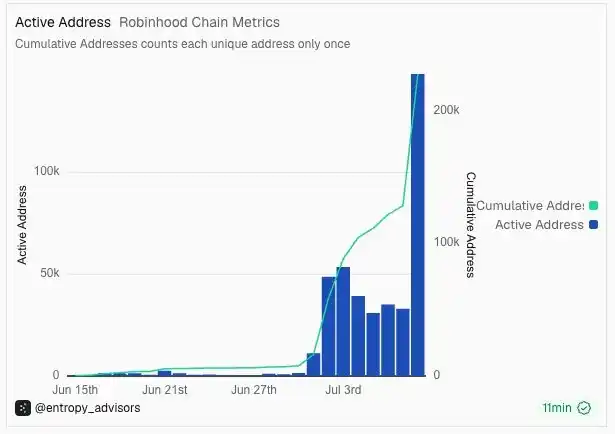
Robinhood Active Address Count. Data Source: Dune Analytics

CEO Makes a Complete 180-Degree Turn in Official Stance

The strategic shift began at the highest level of management. On the evening of July 7th, CEO Vlad Tenev posted on platform X: 'We built Robinhood Chain to be the best public chain for real-world assets (RWA)... But this chain is also great for memecoins.'

This statement overturned his view from just days earlier. On July 2nd, the day the mainnet launched, he stated in a CNBC interview that memecoins were largely a dead end. In his view, tokens lacking practical application value struggle to sustain long-term, and tokenized real-world assets represent a more sustainable path for the crypto industry.

When Robinhood formally launched the mainnet at its London keynote presentation 'Robinhood Presents: The World is Flat,' it consistently positioned the chain as infrastructure for tokenized stocks and various real-world assets; integrations with Uniswap, Chainlink, Alchemy, and BitGo were completed on launch day.

Pump.fun Channels a Large Number of Traders

On July 8th, the token launch platform Pump.fun, born in the Solana ecosystem, announced support for trading Robinhood Chain tokens, significantly lowering the barrier for traders to participate in the chain's Memecoins.

The platform's official account posted on platform X: 'You can now trade Robinhood Chain tokens on the Pump.fun app! No cross-chain bridge needed, seamless trading with SOL, the platform supports all popular Robinhood chain tokens.'

Pump.fun co-founder Alon Cohen stated that this update was merely an extension of the platform's existing multi-chain trading tools, not an independent new business line. He posted: 'Pump.fun is not just for launching platform-native tokens, it supports all cross-chain trading. You can trade Robinhood tokens now, zero fees via the Solana route.'

World Project Migrates Out of Solana Ecosystem

Robinhood Chain successfully lured project resources from the Solana ecosystem. The on-chain prediction market World launched on Solana on July 1st, usable directly within the Phantom wallet. Now, the project's official team has announced a full migration to this new public chain.

The project team announced on platform X on July 8th: 'World has decided to migrate from Solana to Robinhood Chain.' The team stated this strategic adjustment was made after careful evaluation over the past 24 hours and expressed gratitude to the Solana Foundation and community.

CASHCAT Ignites Memecoin Rally

The hottest token currently is CASHCAT, named after Robinhood's early stock trading-era mascot 'Cash Cat,' with the token trading on Uniswap V3 deployed on Robinhood Chain.

CoinGecko data shows that on July 8th, CASHCAT traded around $0.1373, marking a 24-hour surge of 1320%, with a market cap approaching $137 million and a 24-hour trading volume of approximately $194 million; the price fluctuated between $0.0089 and $0.1475 during the day.

User Base Expands Rapidly from Zero

Setting aside the Memecoin rally, on-chain monitoring data shows growth across all fronts of the ecosystem. Active addresses during the June testnet phase were nearly zero, but daily active addresses surged to tens of thousands in early July, with cumulative unique addresses nearing 200,000.

Decentralized exchange trading volume has performed impressively, with the single-day peak on July 7th approaching $400 million, with the vast majority of trades executed via Uniswap V3, V4, and PancakeSwap V3. Simultaneously, on-chain fees remain low, with Gas prices around 0.021 Gwei and an average transaction fee of just $0.005.
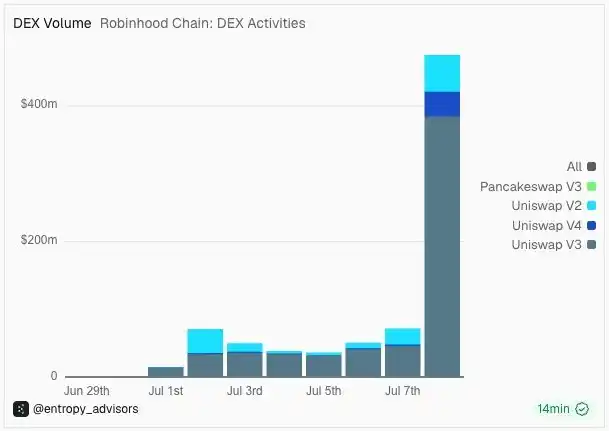
Robinhood Chain DEX Trading Volume. Data Source: Dune Analytics

Core Driver of TVL Surge is Ethena Stablecoin, Not Memecoins

Although market attention is focused on Memecoin speculation, the most critical factor driving the surge in Robinhood Chain's total value locked (TVL) was a deposit of stablecoin funds. Ethena injected approximately $50 million into the USDG pool managed by Steakhouse Financial within the lending protocol Morpho. Morpho is the underlying protocol for Robinhood's on-chain savings product, Robinhood Earn, which can offer an annualized yield of about 7% for USDG.

DefiLlama data shows this capital inflow directly propelled the protocol's TVL to a single-day increase of over 160%. Morpho hosts the vast majority of statistically trackable DeFi liquidity on the chain, with stablecoins (primarily USDG) constituting the bulk of on-chain asset value.
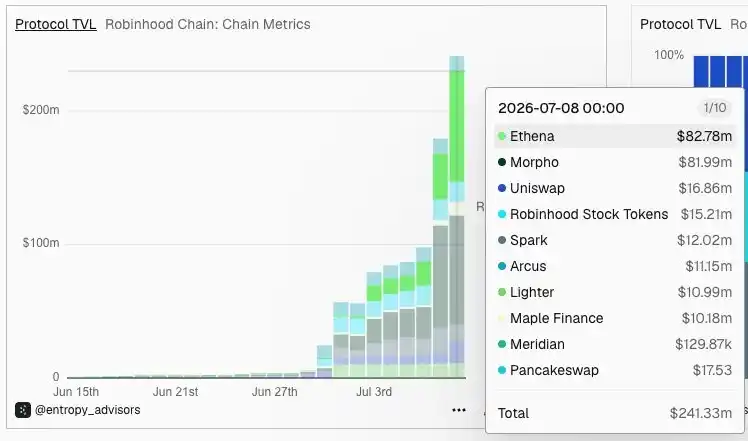
Robinhood Chain Total Value Locked. Data Source: Dune Analytics

The data reflects two parallel development paths for the public chain: institutional stablecoin capital and lending business solidify the underlying capital base; the retail Memecoin frenzy fueled by Pump.fun continues to drive up transaction counts and active users. Confusing the relationship between the two would severely overstate the contribution of Meme trading to the total value locked metric.

RWA Business Remains a Minimal Proportion

Despite Robinhood Chain's emphasis on the RWA narrative, the current scale of its tokenized real-world asset business is extremely low. The total value of tokenized assets like U.S. Treasuries, stocks, ETFs, and commodities is only about $12.8 million, far less than the TVL supported by stablecoins and lending funds.

The stock tokens launched by Robinhood are tokenized debt certificates that track the price of U.S. stocks and ETFs but do not grant holders shareholder voting rights. The products are available in over 120 countries globally and are not offered to users within the United States.

This gap summarizes the state of Robinhood Chain in its first week: speculative trading and stablecoin deposits seeking yield provide the initial liquidity and on-chain activity, while the chain's initially planned core sector—tokenized securities business—remains in a slow starting phase.

Cryptos en tendance

Questions liées

QWhat are the key factors driving the rapid increase in activity on Robinhood Chain within a week of its launch?

AThe key factors are the Meme coin trading frenzy, integration with the Pump.fun platform, and the migration of the World project from Solana. Additionally, a significant inflow of stablecoin capital into the Morpho lending protocol provided a major boost to Total Value Locked (TVL).

QHow did CEO Vlad Tenev's public stance on Meme coins change after the launch of Robinhood Chain?

AInitially, shortly after the mainnet launch on July 2nd, Vlad Tenev stated on CNBC that Meme coins were 'basically dead' and emphasized tokenized real-world assets (RWA) as a more sustainable path. However, by July 7th, he reversed this stance on X, declaring that Robinhood Chain was also 'really good for Meme coins.'

QWhat is the significance of the integration with Pump.fun for the Robinhood Chain ecosystem?

AThe integration with Pump.fun significantly lowered the barrier for traders to participate in Meme coin trading on Robinhood Chain. It allows users to trade Robinhood Chain tokens directly on Pump.fun without needing a cross-chain bridge, using SOL with zero transaction fees through Solana channels.

QAccording to the data, what is the primary driver behind the surge in Robinhood Chain's Total Value Locked (TVL), and why is this distinction important?

AThe primary driver of the TVL surge was a large stablecoin deposit, specifically around $50 million from Ethena into the USDG pool on the Morpho lending protocol. This is important because it highlights that the foundational capital and scale of the chain come from institutional stablecoin and lending activity, not from the more visible Meme coin trading frenzy, which would otherwise exaggerate the contribution of speculation to the TVL metric.

QWhat does the current data reveal about the state of Robinhood Chain's originally intended core business of Real World Assets (RWA) compared to its current activity?

AThe data shows that the tokenized real-world asset (RWA) business, such as tokenized US treasuries, stocks, and ETFs, is currently minimal, with a total value of only about $12.8 million. This is vastly overshadowed by the capital from stablecoin deposits and lending. The article concludes that while speculative trading and yield-seeking stablecoins are driving initial liquidity and activity, the chain's core RWA narrative is still in its very early stages.

Lectures associées

L'affaire de divorce de Chey Tae-won finalisée : Révélations sur les lignes cachées de succession derrière le conglomérat de mille milliards de SK Hynix

L'affaire de divorce de Chey Tae-won, président du groupe SK, s'est conclue par un jugement historique, mettant en lumière les complexités successorales derrière le géant SK Hynix, dont la valorisation a dépassé 1 000 billions de wons. Contrairement aux scénarios traditionnels de succession des chaebols sud-coréens, qui privilégient l'aîné masculin, les trois enfants de Chey Tae-won suivent des trajectoires distinctes et modernes. L'aînée, Chey Yun-jeong, considérée comme la successeure la plus probable, occupe un poste de direction au sein de SK Inc. et dirige des projets stratégiques dans la biopharmacie, alliant formation scientifique et compétences en consulting. La seconde fille, Chey Min-jeong, ancienne officière de marine et ex-employée de SK Hynix aux États-Unis, a fondé une startup dans la santé numérique et épousé un ancien officier du Corps des Marines américain, incarnant les dimensions géopolitiques de l'industrie des semi-conducteurs. Le fils cadet, Chey In-geon, bien que suivant un parcours académique et professionnel classique (Brown University, McKinsey), reste discret et ne détient aucun rôle opérationnel visible au sein du groupe. Leur héritage est marqué par le divorce très médiatisé et coûteux de leurs parents, mais aussi par la transformation de SK Hynix en un acteur mondial de l'ère de l'IA. La succession ne se résume plus à une simple transmission d'actions ou de titre ; elle exige des héritiers qu'ils prouvent leurs compétences dans un paysage où la technologie, la politique internationale et l'innovation disruptive redéfinissent les règles du pouvoir.

marsbitIl y a 4 mins

L'affaire de divorce de Chey Tae-won finalisée : Révélations sur les lignes cachées de succession derrière le conglomérat de mille milliards de SK Hynix

marsbitIl y a 4 mins

2 mois pour passer de 8,8 à 68 milliards d'euros d'évaluation ! La plus grande plateforme de transit d'IA, OpenRouter, sur le point d'être rachetée

**Résumé en français :** Stripe, le géant du paiement en ligne, négocierait l'acquisition d'OpenRouter, une place de marché et couche d'IA de type "routeur" ou "agrégateur", pour près de 100 milliards de dollars. Cette valorisation représente une multiplication par près de sept par rapport à l'évaluation d'OpenRouter il y a deux mois (13 milliards de dollars). Fondée en 2023 par Alex Atallah (cofondateur d'OpenSea), OpenRouter agit comme un intermédiaire crucial pour les développeurs d'applications d'IA. Sa plateforme permet d'accéder via une seule API à plus de 400 grands modèles de langage (comme GPT, Claude, et de nombreux modèles open source) et choisit automatiquement le modèle le plus adapté à chaque tâche en fonction du coût, des performances et de la vitesse. Cela permet aux applications en aval de réduire leurs factures de "réflexion" (inference) sans que l'utilisateur final ne voie la différence. Pour Stripe, cette acquisition stratégique s'inscrit dans une volonté de devenir l'infrastructure de paiement et de gestion de la consommation pour l'économie de l'IA. Fin 2025, Stripe avait déjà acquis Metronome, une plateforme de facturation à l'usage pour l'IA. En combinant OpenRouter (choix du modèle) et Metronome (facturation précise), Stripe cherche à offrir une solution intégrée pour le routage, la mesure et le paiement de la consommation d'IA, consolidant ainsi son rôle de "caisse" et de "centre de régulation" de cette nouvelle économie.

链捕手Il y a 14 mins

2 mois pour passer de 8,8 à 68 milliards d'euros d'évaluation ! La plus grande plateforme de transit d'IA, OpenRouter, sur le point d'être rachetée

链捕手Il y a 14 mins

D'OpenSea à OpenRouter : le scénario de la « sortie en haut de cycle » d'Alex Atallah se répète ?

**OpenRouter, la plateforme d'agrégation de modèles d'IA fondée par Alex Atallah, pourrait être rachetée par Stripe pour près de 100 milliards de dollars**, selon le Wall Street Journal. Cette transaction potentielle, si elle se concrétise, marquerait le deuxième succès d'Atallah à construire une entreprise valorisée à des dizaines de milliards, après avoir cofondé la place de marché NFT OpenSea. OpenRouter, décrit comme le "Stripe de l'IA", sert de point d'accès unifié à plus de 400 modèles d'IA pour environ 10 millions d'utilisateurs. Sa croissance a été fulgurante, passant d'une valorisation de 1,3 milliard de dollars en mars 2026 à une évaluation potentielle de 100 milliards aujourd'hui. L'article souligne un parallèle avec le parcours d'Atallah chez OpenSea, qu'il a quittée avant le refroidissement du marché NFT. Aujourd'hui, face à une concurrence croissante dans l'agrégation de modèles d'IA et à une activité essentiellement basée sur des frais de plateforme (5-5,5%), la vente à un géant comme Stripe pourrait apparaître comme un choix stratégique pour "sortir au sommet". La valeur réelle d'OpenRouter pour un acquéreur résiderait moins dans ses revenus actuels que dans les vastes quantités de données d'utilisation réelle de l'IA qu'elle a accumulées. Ces informations sur les performances, les préférences des développeurs et la dynamique du marché sont un atout unique. La transaction, si elle aboutit, pose la question : s'agit-il d'une juste reconnaissance de la valeur des infrastructures d'IA ou d'un possible signal de sommet pour le secteur ?

链捕手Il y a 31 mins

D'OpenSea à OpenRouter : le scénario de la « sortie en haut de cycle » d'Alex Atallah se répète ?

链捕手Il y a 31 mins

Trading

Spot

Articles tendance

Comment acheter ONE

Bienvenue sur HTX.com ! Nous vous permettons d'acheter Harmony (ONE) de manière simple et pratique. Suivez notre guide étape par étape pour commencer votre parcours crypto.Étape 1 : Création de votre compte HTXUtilisez votre adresse e-mail ou votre numéro de téléphone pour ouvrir un compte sur HTX gratuitement. L'inscription se fait en toute simplicité et débloque toutes les fonctionnalités.Créer mon compteÉtape 2 : Choix du mode de paiement (rubrique Acheter des cryptosCarte de crédit/débit : utilisez votre carte Visa ou Mastercard pour acheter instantanément Harmony (ONE).Solde :utilisez les fonds du solde de votre compte HTX pour trader en toute simplicité.Prestataire tiers :pour accroître la commodité d'utilisation, nous avons ajouté des modes de paiement populaires tels que Google Pay et Apple Pay.P2P :tradez directement avec d'autres utilisateurs sur HTX.OTC (de gré à gré) : nous offrons des services personnalisés et des taux de change compétitifs aux traders.Étape 3 : stockage de vos Harmony (ONE)Après avoir acheté vos Harmony (ONE), stockez-les sur votre compte HTX. Vous pouvez également les envoyer ailleurs via un transfert sur la blockchain ou les utiliser pour trader d'autres cryptos.Étape 4 : tradez des Harmony (ONE)Tradez facilement Harmony (ONE) sur le marché Spot de HTX. Il vous suffit d'accéder à votre compte, de sélectionner la paire de trading, d'exécuter vos trades et de les suivre en temps réel. Nous offrons une expérience conviviale aux débutants comme aux traders chevronnés.

480 vues totalesPublié le 2024.12.12Mis à jour le 2026.06.02

Comment acheter ONE

Discussions

Bienvenue dans la Communauté HTX. Ici, vous pouvez vous tenir informé(e) des derniers développements de la plateforme et accéder à des analyses de marché professionnelles. Les opinions des utilisateurs sur le prix de ONE (ONE) sont présentées ci-dessous.

活动图片