Founder of Baixing.com: The Notion That Large Language Models Will Devour Everything, I Believe Half of It

marsbitPublié le 2026-07-07Dernière mise à jour le 2026-07-07

Résumé

Founder of Baixing.com: I Only Half-Believe the Saying “Large Language Models Will Devour Everything” Author: Wang Jianshuo, Founder of Baixing.com Many proclaim that large models are everything, but the author is skeptical. He argues that such sweeping claims often stem from a limited understanding of the future. Drawing parallels to past technologies like electricity and the internet—which were predicted to “devour everything” but didn’t—he suggests that large language models (LLMs) are better seen as a foundational base. Like electricity, this base is essential for modern development, but its real value emerges only when applied to specific scenarios through various “machines” or “tools” (e.g., Claude Code for programming, Claude Design for design). The author acknowledges that LLMs may indeed replace many existing software systems built on rigid rules, workflows, and forms (e.g., CRMs, SaaS tools), as these are precisely what LLMs excel at processing. However, he emphasizes that beyond software, elements like customer data, execution capabilities (e.g., booking a flight), trust, and physical-world interactions will not be “devoured.” Instead, he foresees that after streamlining existing software, LLMs will open up a larger space for innovative, next-generation applications. These new tools will likely feature fluid interfaces and rely less on fixed rules, unleashing greater creativity. The author cautions against short-sightedness, recalling how in 2004 many believed ...

Author: Wang Jianshuo, Founder of Baixing.com

Many people readily proclaim, "Large models are everything." I don't quite buy it.

Every time I hear phrases like "devour everything," I feel it's mostly because our understanding of the future hasn't reached that level, hence we casually throw out such a broad statement. Otherwise, how could one thing devour everything? Take the internet—it's been shouting about devouring everything for years, has it truly devoured everything now? So which one is it, the internet devours everything, or large models devour everything? Both are devouring, leaving nothing behind?

So I'd rather put it differently: it is a very important foundation. Without this foundation, the whole world can't develop, just like the internet without its underlying backbone network, or like using electricity without power plants. That, I acknowledge.

But after the foundation is in place, that's where the real excitement happens above.

Take electricity. As soon as electricity was generated, what was the first application people saw? The light bulb. Thomas Edison lit the first one, and it just kept shining, shining, shining. If the world stopped there, with only a light bulb, then I could completely say: the power plant is the core of the whole world, the power plant devours everything.

But that's not how things went. Later came motors, to drive machines; and then you find that once a fundamental thing like electricity exists, countless appliances grow on top of it to utilize it. Washing machines are for washing clothes, televisions are for watching TV, vacuum cleaners are for vacuuming—they are all applications of electricity. Without electricity, none of these things would exist. But if you say "electricity devours everything," I don't believe it.

It's the same with large models. They provide foundational intelligence. But this intelligence must be placed into a specific, scenario-oriented "machine" or "device" before it can play its role and truly change the world.
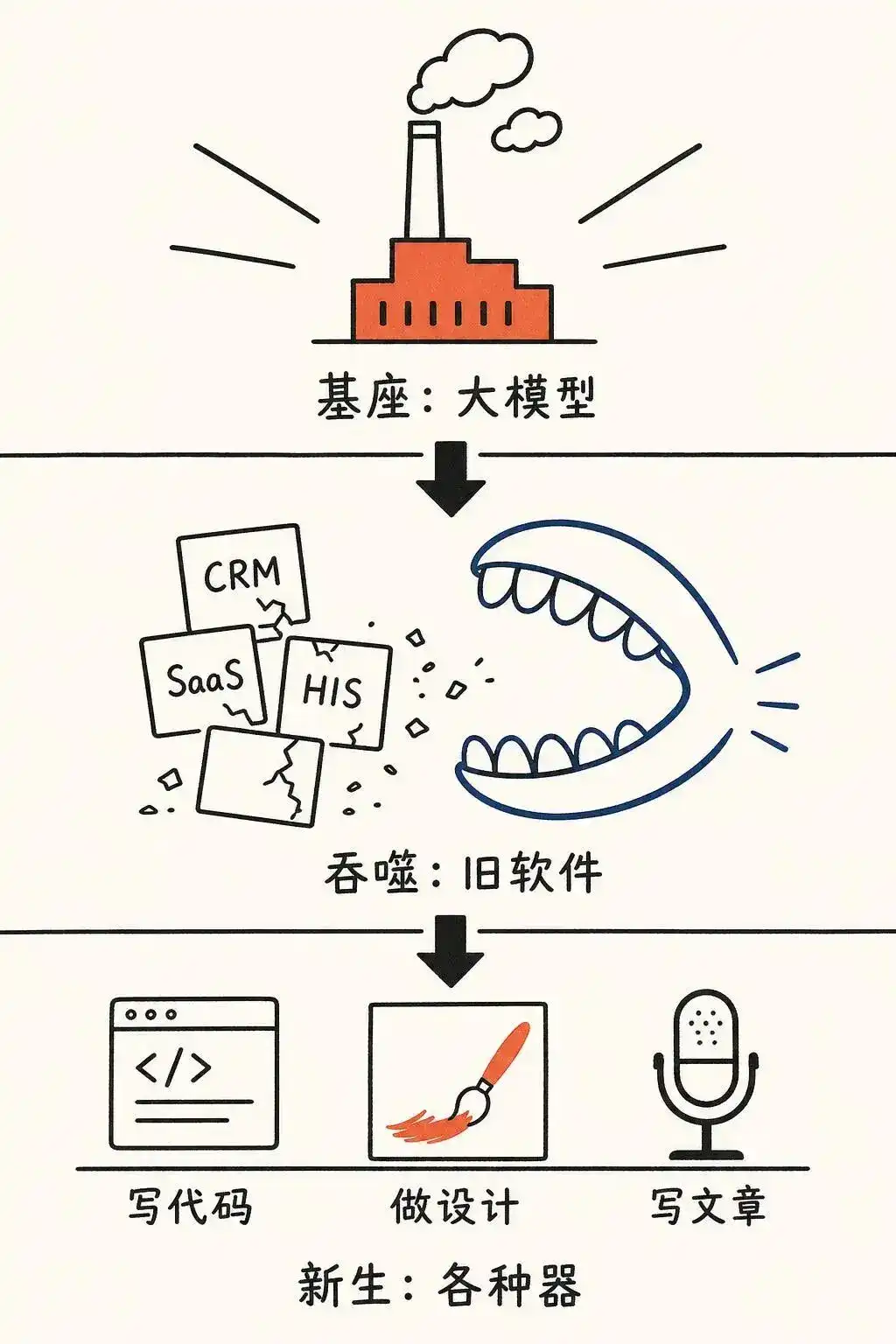
Claude Code is for writing code, Claude Design is for design, VoiceDrop is for writing articles. Using the same large model, placed into different devices, solves completely different problems.

With only electricity, only water, without a washing machine, clothes still can't be washed. Imagine, a power plant produces a massive amount of electricity, electricity is very powerful, and then what? Without a washing machine, can this pile of electricity wash clothes by itself?

Intelligence is great, but most things in the world require the combination of multiple elements to work, just as a washing machine needs to combine elements like electricity, water, and even a tub; large models might be able to replace a lot in the field of software, but application scenarios in the world that require only one element are not many.

Here's a current example. Now we have large models, but having just a large model isn't enough. There needs to be a layer above it called Harness—this layer has only recently emerged—it interacts with code, and finally forms something truly usable. A large model by itself can't write code. Of course, the core of Claude Code, frankly, I could write it with a little over fifty lines; a bit longer with a few more lines, and it can run and write programs. But you have to see: with only a large model and without this outer layer, it's still not easy to use—that is, the intelligence of a large model, if not combined with the code execution capabilities provided by the operating system, relying on the large model for calculations isn't economical, and sometimes even impossible.

The core value of this interface layer is to help us put that intelligence, which is like electricity or water, into a specific application scenario, turning it into a machine that can solve specific problems.

Now, of course, the logic behind "devour everything," I don't completely disbelieve it either.

What it primarily refers to is existing software. So far, we have built up a very, very large layer of software—things pieced together by many rules, forms, buttons, workflows, a lot of it. Massive numbers of filters, fixed templates, a bunch of backend operations, many SaaS detection features. And all the various things we used to know as "M" systems, whether CRM, or HIS (hospital information system), all sorts of so-called "systems," "software," and the like, a whole pile.

This layer, I believe large language models will indeed devour quite a bit of.

Why? Because these original software programs were, by nature, clear, computer-executable instructions, solidified and repeatedly executed—we call this software. And this is precisely what large language models are most adept at chewing through.

But.

Within this layer, besides software, there are many other things. Customer information. Execution capabilities—like when you book a flight ticket, the actual capability to move a plane, to transport a person from here to there. Also trust. Many things in the physical world. These, I don't think will be devoured.

After devouring that layer, it actually opens up a much larger space—the new type of software on top of it.

The interface of the new software will certainly be flow-based, it likely won't solidify as many rules as before. After handing all those rules to AI, think about it, the CRM we could achieve like Salesforce before, that was already the pinnacle of human effort, using all possible strength. But if this part becomes relatively easier to solve, then what everyone will do next is to unleash even more imagination and possibilities on top of it—and that part is precisely what we haven't seen yet.

This is where we often make mistakes. When a new technology arrives, because we can't see the bigger road beyond it, we can only stare at the part in front of us. The leaf blocks the view, obscuring the mountain.

Let alone this kind of trend judgment. I remember back in 2004, a group of friends were complaining, saying that the entire internet could no longer produce companies bigger than Sina, Sohu, and NetEase, that the internet was nearly over, and they would monopolize everything. And look how many years have passed since then? The world turned upside down. We would be crying at our own shortsightedness back then.

So my proposition is this: Are large models important? Yes, they are the foundation, the main driving force in recent times. But once they become stable, continuously provided things, then various kinds of "machines" and "devices" on top are needed to solve specific problems. That thick layer—where it's used, how it's used—is precisely the mainstream of the second wave of this trend.

The phrase "devour everything" is too imprecise. In this world, which thing, which social form, which technology has ever truly devoured everything?

Finding opportunities in the places it does devour—that's the truly important thing.

Cryptos en tendance

Questions liées

QWhat is the core viewpoint of the author, the founder of Baixing.com, regarding the statement 'Large language models will devour everything'?

AHe believes it only half. He views large language models as a crucial foundational platform, like electricity or the internet, but argues that they alone cannot 'devour everything.' True value and transformation come from applying this foundational intelligence to specific scenarios through various 'machines' or applications built on top of it.

QHow does the author use the analogy of electricity to explain the role of large language models?

AThe author compares large language models to electricity. Electricity itself is a foundational utility (like a power plant), but it doesn't 'devour everything.' Its real-world impact comes from the diverse array of appliances (like washing machines, TVs) built on top of it to solve specific problems. Similarly, LLMs provide base intelligence, but they need to be integrated into specific applications (like Claude Code for programming) to be truly useful and transformative.

QAccording to the article, what specific layer of existing technology does the author believe large language models are likely to 'devour' or replace?

AThe author believes large language models are likely to replace a significant portion of existing, rule-based, fixed-template software systems, such as many CRM, HIS, and various SaaS applications. These systems are composed of clear, computer-executable instructions, which is precisely what LLMs are good at handling and generating.

QWhat does the author identify as elements that will NOT be 'devoured' by large language models, even as software systems change?

AThe author identifies several elements that will not be devoured: customer information, execution capabilities (like physically moving people or goods), trust, and many aspects of the physical world. These components are essential and exist alongside or beyond the software logic that LLMs might replace.

QWhat is the 'second wave' of the AI浪潮 (wave/tide) that the author predicts will follow the establishment of large language models as a stable foundation?

AThe author predicts the 'second wave' will be focused on the thick layer of applications built *on top* of the large language model foundation. This involves creating the various 'machines' and 'tools' that leverage the base intelligence to solve concrete, specific problems in different domains. This application layer is where the next major phase of innovation and opportunity lies.

Lectures associées

Zuckerberg commence à miser sur les marchés prédictifs, tandis que les pays asiatiques les considèrent encore comme des jeux d'argent

Les marchés prédictifs, autrefois conceptuels, connaissent une croissance significative avec un volume mensuel atteignant 140 milliards de dollars. Leur principe est simple : des contrats se règlent à 1 dollar si un événement se produit, 0 dollar sinon, le prix reflétant ainsi la probabilité en temps réel. Cette croissance est validée par l'entrée de Meta avec son projet « Arena ». Leur mécanisme repose sur « la peau dans le jeu » : les participants risquent leur propre capital, garantissant la crédibilité de leurs informations. Ils surpassent souvent les sondages traditionnels en précision, comme démontré lors d'élections ou pour les prévisions de taux d'intérêt. Alors que les marchés occidentaux les intègrent dans le système financier régulé (ex. : décision de justice aux États-Unis), la plupart des pays d'Asie les assimilent encore au jeu d'argent, entraînant trois problèmes majeurs : une fuite des capitaux vers des plateformes offshore non régulées, une perte de souveraineté sur des données informationnelles précieuses, et un abandon de la protection des utilisateurs. L'enjeu pour l'Asie n'est donc plus de bloquer ces marchés, mais d'engager une discussion constructive pour les encadrer de manière responsable, transformer les données générées en actifs nationaux et regagner un leadership cédé à l'étranger.

Foresight NewsIl y a 2 mins

Zuckerberg commence à miser sur les marchés prédictifs, tandis que les pays asiatiques les considèrent encore comme des jeux d'argent

Foresight NewsIl y a 2 mins

Au-delà de la clé privée : comment protéger les frontières de sécurité du Web3, du portefeuille et des L2 à la chaîne d'approvisionnement ?

Le mois de juin a été marqué par une série d'incidents de sécurité dans l'écosystème crypto, démontrant que les risques ne se limitent plus à la protection des clés privées, mais s'étendent à l'ensemble du parcours d'interaction sur la chaîne. L'attaque contre le portefeuille SecondFi (ex-Yoroi) sur Cardano a exposé l'importance cruciale de l'implémentation cryptographique sous-jacente. Un défaut dans la génération des signatures a permis à des attaquants de déduire des clés privées à partir de données de transaction publiques, sans nécessiter la compromission des phrases de récupération. Cet incident souligne la nécessité pour les composants critiques des portefeuilles d'être open-source pour un examen par la communauté. La sécurité des réseaux de couche 2 (L2) a également été mise à l'épreuve. Des attaques contre d'anciens déploiements d'Aztec ont exploité des incohérences dans les circuits de preuve à connaissance nulle (ZK), tandis qu'un incident sur Taiko a résulté d'une clé privée de l'environnement d'exécution de confiance (SGX) exposée publiquement. Une panne sur Base a, quant à elle, rappelé que la sécurité inclut également la disponibilité du réseau et la possibilité pour les utilisateurs de s'en retirer. Enfin, l'incident sur Polymarket a illustré la menace des attaques par la chaîne d'approvisionnement des services tiers. Le compromission d'un fournisseur a conduit à l'injection d'un script malveillant dans l'interface web, volant des fonds d'utilisateurs sans que les contrats intelligents principaux ne soient vulnérables. En conclusion, la sécurité dans le Web3 moderne exige une approche holistique. Les utilisateurs sont invités à adopter de bonnes pratiques : isoler les actifs à long terme (portefeuille matériel), utiliser des portefeuilles dédiés aux interactions DApp avec de petits montants, examiner attentivement les autorisations de signature et se méfier des interfaces web anormales. La défense doit évoluer de la simple protection d'une clé privée vers la sécurisation de l'ensemble du parcours de transaction.

marsbitIl y a 1 h

Au-delà de la clé privée : comment protéger les frontières de sécurité du Web3, du portefeuille et des L2 à la chaîne d'approvisionnement ?

marsbitIl y a 1 h

OpenAI pourra-t-il finalement réaliser des bénéfices ?

OpenAI et Anthropic, valorisés près de mille milliards de dollars, voient leurs revenus croître rapidement, mais aucun n'est encore rentable. L'article analyse la rentabilité des fournisseurs de grands modèles linguistiques, en se concentrant sur le marché des API. Le marché des API présente une structure de concurrence monopolistique : de nombreux acteurs, une faible concentration, et une forte élasticité-prix de la demande. Bien que la demande explose, les barrières à l'entrée sont relativement basses, entraînant une expansion rapide de l'offre et une concurrence féroce qui empêche la rentabilité. Même avec un avantage technologique temporaire, il est difficile pour un acteur de maintenir des profits excessifs à long terme. À terme, les pertes pourraient conduire à une consolidation du marché vers une structure oligopolistique. Cependant, la rentabilité future reste incertaine, dépendant du type de concurrence (par les prix ou par les quantités) entre les oligopoles. L'article conclut que le simple fait de « vendre des tokens » via des API ne garantit pas une rentabilité durable. Les investisseurs doivent donc examiner attentivement les valorisations. Pour les fournisseurs de modèles, la clé du succès réside dans la différenciation, par exemple via le modèle « IA+ » (intégration de l'IA dans des produits existants) ou des contrats sur mesure, qui peuvent renforcer l'adhésion des clients et le pouvoir de fixation des prix. Parallèlement, les plateformes agrégatrices d'API pourraient, grâce aux effets de réseau, développer des barrières commerciales plus solides.

marsbitIl y a 1 h

OpenAI pourra-t-il finalement réaliser des bénéfices ?

marsbitIl y a 1 h

Trading

Spot

Articles tendance

Comment acheter PEOPLE

Bienvenue sur HTX.com ! Nous vous permettons d'acheter ConstitutionDAO (PEOPLE) de manière simple et pratique. Suivez notre guide étape par étape pour commencer votre parcours crypto.Étape 1 : Création de votre compte HTXUtilisez votre adresse e-mail ou votre numéro de téléphone pour ouvrir un compte sur HTX gratuitement. L'inscription se fait en toute simplicité et débloque toutes les fonctionnalités.Créer mon compteÉtape 2 : Choix du mode de paiement (rubrique Acheter des cryptosCarte de crédit/débit : utilisez votre carte Visa ou Mastercard pour acheter instantanément ConstitutionDAO (PEOPLE).Solde :utilisez les fonds du solde de votre compte HTX pour trader en toute simplicité.Prestataire tiers :pour accroître la commodité d'utilisation, nous avons ajouté des modes de paiement populaires tels que Google Pay et Apple Pay.P2P :tradez directement avec d'autres utilisateurs sur HTX.OTC (de gré à gré) : nous offrons des services personnalisés et des taux de change compétitifs aux traders.Étape 3 : stockage de vos ConstitutionDAO (PEOPLE)Après avoir acheté vos ConstitutionDAO (PEOPLE), stockez-les sur votre compte HTX. Vous pouvez également les envoyer ailleurs via un transfert sur la blockchain ou les utiliser pour trader d'autres cryptos.Étape 4 : tradez des ConstitutionDAO (PEOPLE)Tradez facilement ConstitutionDAO (PEOPLE) sur le marché Spot de HTX. Il vous suffit d'accéder à votre compte, de sélectionner la paire de trading, d'exécuter vos trades et de les suivre en temps réel. Nous offrons une expérience conviviale aux débutants comme aux traders chevronnés.

610 vues totalesPublié le 2024.12.12Mis à jour le 2026.06.02

Comment acheter PEOPLE

Discussions

Bienvenue dans la Communauté HTX. Ici, vous pouvez vous tenir informé(e) des derniers développements de la plateforme et accéder à des analyses de marché professionnelles. Les opinions des utilisateurs sur le prix de PEOPLE (PEOPLE) sont présentées ci-dessous.

活动图片