Opinion: The AI Bubble in Stocks Has Arrived. Why I'm Turning to Bet on Bitcoin?

marsbitPublié le 2026-07-02Dernière mise à jour le 2026-07-02

Résumé

This article argues that the AI-driven stock market surge shows clear signs of a bubble. The author, citing Howard Marks' cycle theory, presents a checklist of behaviors signaling a market top—excessive optimism, easy capital, and the belief "no price is too high"—and finds the current AI stock mania matches most criteria. Consequently, the author has sold AI-related ETFs and shifted focus to accumulating Bitcoin within a $50k-$60k range, viewing it as a scarcer asset with a wider margin of safety amid high equity valuations. The piece contrasts the narrow, frothy AI rally with what it sees as a more rational long-term opportunity in Bitcoin, especially given indicators like high CAPE ratios and selective risk appetite. The author's personal strategy involves holding significant cash, with capital allocated across trading, long-term accumulation (primarily BTC), and illiquid investments.

Author:Investing Beanstock

Translation:Deep Tide TechFlow

Deep Tide's Guide: AI stocks are soaring, but this trader is actually selling tech stocks and turning to bottom-fish Bitcoin. He used Howard Marks's cycle theory to examine the current market point by point and found that AI already meets almost all the characteristics of a "bubble top." For investors, this article provides a calm framework for cycle positioning, helping you judge whether it's time to be greedy or fearful now.

The stock market is experiencing an AI-driven, frenzied bull market, which should come as a surprise to no one.

Not being positioned feels downright stupid—because capital expenditure (CAPEX) will only continue to rise, and the forward valuations of all these stocks will only become crazier.

I won't comment on specific stocks or indices; banks and financial media worldwide are already providing blanket coverage. I'm more interested in figuring out—or at least trying to decipher—what stage of the market we're in. Not just in cryptocurrency, but across the entire financial markets.

To do this, I drew heavy inspiration from one of my favorite books: Howard Marks's *Mastering the Market Cycle*.

Most people understand cycles as a series of events. Most also understand that these events typically follow each other in a regular sequence: an upswing is followed by a downswing, and then eventually a new upswing. But to fully understand cycles, this isn't enough. Events in a cycle shouldn't just be seen as one following another; more importantly, each event *causes* the next to happen.
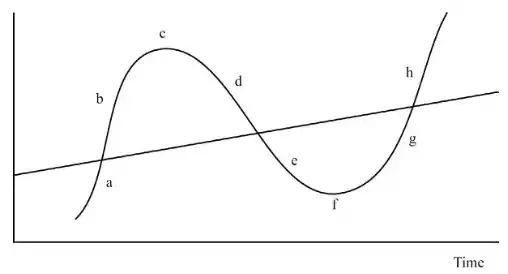
The straight line = the midpoint. The market's pendulum is the wavy line oscillating around the midpoint. Together they form the market cycle, driven by various market forces that cause it to deviate from the midpoint from time to time.

The movement of cyclical phenomena can be easily recognized in several stages:

a: Recovery from an overly depressed low extreme or "trough" towards the midpoint.

b: Continuing past the midpoint to swing towards the high extreme or "peak."

c: Reaching the peak.

d: Correcting downward from the peak back to the midpoint or mean.

e: Continuing the downward movement past the midpoint towards a new low.

f: Reaching the trough.

g: Recovering from the trough back to the midpoint.

h: The cycle repeats.

So Where Are We Now?
Is this a bubble? I think it's quite evident at this point that AI indeed *is* a bubble. According to Marks, a bubble is signaled when the sentiment that "price doesn't matter" is strong.

In a bubble, investors often conclude that you can make money by borrowing (using leverage) to buy the frenzied asset. No matter what your borrowing rate or funding fee is, the asset will surely appreciate faster than that.

"No price is too high" is the ultimate ingredient of a bubble, a fairly obvious signal that the market has gone too far.

There are actually conflicting schools of thought, believing the market can stay far above its intrinsic value and still reward multiples due to the frenzy.

What to Do?

Since we can't be sure when the bubble will burst, in my view, we have two clear approaches to portfolio allocation.

Dollar-Cost Averaging (I mean real DCA, no timing, you just buy in boring, mechanical dribs and drabs. The more batches you split into, the smoother your final cost basis, that's the whole point.)

Heavy cash allocation, but still allowing yourself to participate in the market through tactical/satellite positions, like active trading.

I personally prefer the second method. But that's because I actively monitor the markets day in and day out; I rely on my own market experience and intuition to navigate all this.

DCA isn't a bad method either. But it does require one to truly extend their time horizon. Not 1 or 3 years, but at least 5 years to really see results. Most people DCA for a few weeks, or try to DCA while also timing, and it backfires. If you plan to DCA into a particular investment, make sure you fully understand that business/industry, and then just stick to it in a super boring, repetitive way and go on with your life.

In my 2025 review and reflection post, I mentioned allocating 25% of my portfolio to passive ETFs, including QQQ, SOXQ, XAR, URA, and UFO. I think a large part of the gains came from QQQ and SOXQ, but I sold all of it in May because I believe the market had swung far past the midpoint.

I also said I was overall bearish on crypto until early 2026 (which turned out right), I managed to keep a lot of cash, and am now patiently deploying a portion into BTC. The target accumulation range is $50k–$60k, so I've already started allocating as of writing this.

"Crypto Is Dead, Pivot to AI"

Honestly, my only regret is not allocating more to speculative private market exposure in Anthropic and xAI. I think frontier models still offer the purest AI exposure, compared to public market "picks and shovels" types, like the GPU/semiconductor/storage narrative. Since those are already consensus, I don't think chasing them now offers asymmetric upside. That ship sailed a long time ago. Stocks like MU are up almost 10x in a year, and stocks like SNDK basically move like memecoins. Upside might still be there, but downside risk looks worse.

But the CAPEX! Yes, this might translate into real incremental value in the future, but it's still speculative. Overly speculative, excess money all funneling into the same thing, I've seen this movie before.

Is it disappointing to miss a big chunk of the AI bull run? Sure, it stings a bit. But I still have exposure, and it's doubled. I really don't think it's responsible to tell someone AI stocks are truly worth buying at today's valuations, unless they *really* know what they're doing and are in it for the long term (most aren't, they're here for quick money).

Market Sanity Checklist

Now, let's go back to how Marks judges if we are near/approaching a market top:

The economy is growing; economic reports are positive.

Corporate profits are rising and beating expectations.

The media only reports good news.

The securities markets are strong.

Investors are becoming increasingly confident and optimistic.

Risk is perceived as scarce and mild.

Investors believe taking risks is the necessary path to profits.

Greed drives behavior.

Demand for investment opportunities exceeds supply.

Asset prices exceed intrinsic value.

Capital markets are wide open; raising money or rolling over debt is easy.

Defaults are rare.

Skepticism is low, confidence is high, meaning risky trades can be made.

No one can imagine things going wrong. No favorable development seems impossible.

Everyone assumes things will get better forever.

Investors ignore the possibility of loss, only worry about missing out.

No one can think of a reason to sell, and no one is forced to sell.

There are more buyers than sellers.

If the market dips, investors are happy to buy.

Prices reach new highs.

The media celebrates this exciting event.

Investors become euphoric and carefree.

Equity holders marvel at their own cleverness; perhaps they'll buy more.

Those who stayed on the sidelines feel regret; therefore, they capitulate and buy.

^ This means:

Future returns are low (or negative).

Risk is high.

Investors should forget about missed opportunities, only worry about losing money.

This is a time for caution!

So, how many of these do you think the current stock market is exhibiting?

On the flip side of the "market top" checklist, the opposite scenario can also manifest:

The economy slows; reports are negative.

Corporate profits are flat or falling, missing expectations.

The media only reports bad news.

The market is weak.

Investors become worried and despondent.

Risk is perceived as everywhere.

Investors believe taking risks is just a way to lose money.

Fear dominates investor psychology.

Demand for securities is less than supply.

Asset prices are below intrinsic value.

Capital markets are closed; it's hard to issue securities or refinance debt.

Defaults surge.

Skepticism is high, confidence is low, meaning only safe trades can be made, or none at all.

No one thinks improvement is possible. No outcome seems too negative to happen.

Everyone assumes things will get worse forever.

Investors ignore the possibility of missing opportunities, only worry about losing money.

No one can think of a reason to buy.

There are more sellers than buyers.

"Don't try to catch a falling knife" replaces "buy the dip."

Prices reach new lows.

The media focuses on this depressing trend.

Investors become despondent and panicked.

Equity holders feel stupid and disillusioned. They realize they don't really understand the reasons behind their investments.

Those who didn't buy (or who sold) feel vindicated and are praised for their cleverness.

Those who held capitulate and sell at depressed prices, furthering the downward spiral.

^ This means:

Implied future returns are sky-high.

Risk is low.

Investors should forget about the risk of losing money, only worry about missing opportunities.

This is a time to be aggressive!

Based on the checklist above, I do think BTC is exhibiting many of these (especially in the Saylor/MSTR situation). So I do feel BTC presents a more attractive investment prospect compared to today's high-flying AI stocks.

However, note that the above progressions are simplified, they may not even appear in the same order, nor necessarily appear in every market cycle, but these behaviors are real, they are indeed elements that rhyme in markets over decades.
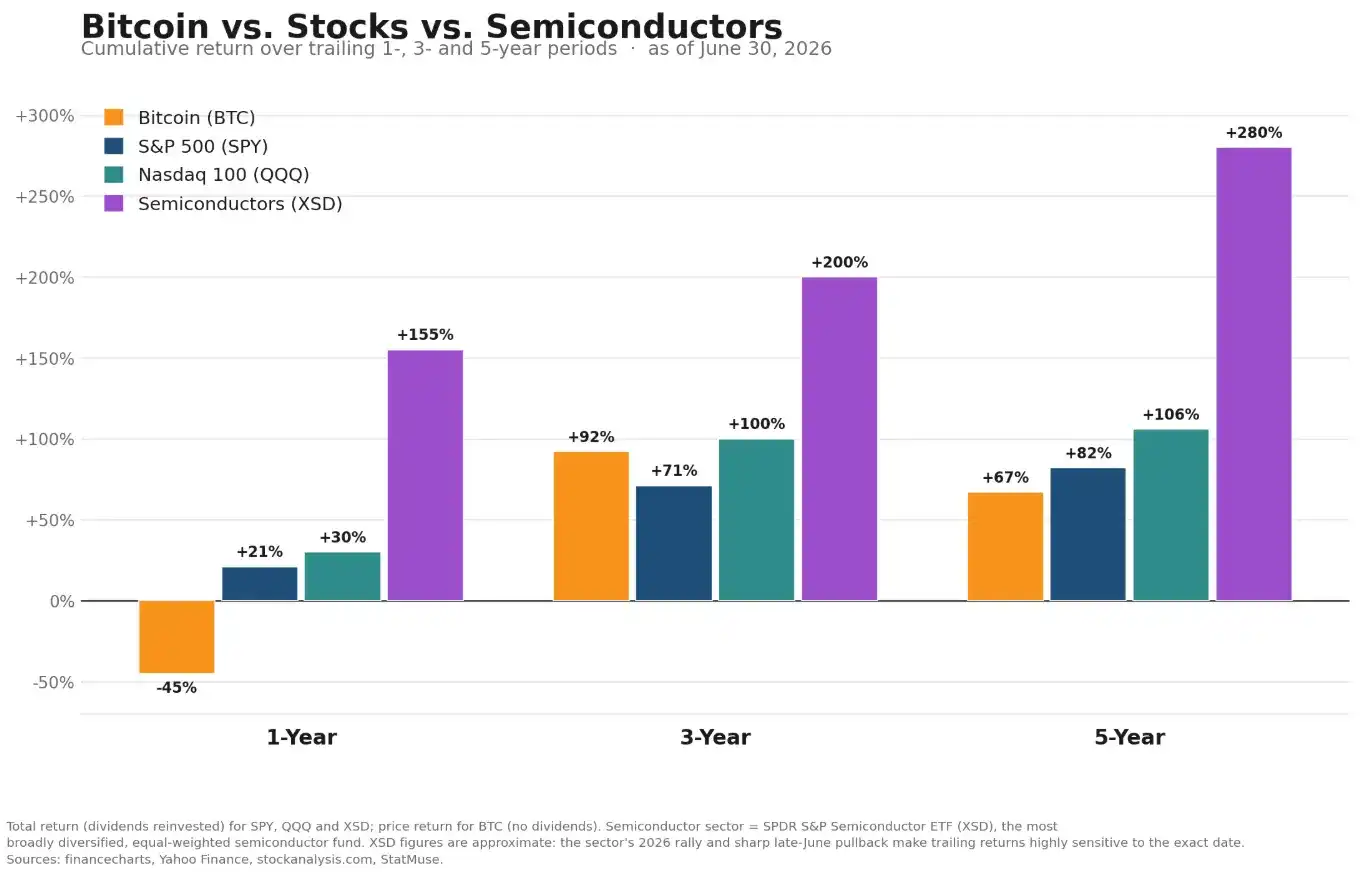
The AI revolution has clearly benefited tech stocks, especially semiconductors over 1/3/5 year periods.

But investing is never done by looking in the rearview mirror (unfortunately, most people do and take reference from the past), advantage emerges where people ignore/dismiss it. We need to look at "what happens 1 to 10 years from now," not what today's environment is.

Looking at the chart above, saying you're a crypto investor and you should have invested in stocks would look silly.

Based on the above chart, if you chose stocks, statistically speaking, the likelihood of future underperformance is high.

Also, reading this in 2026 might sound like a joke now, but based on past lessons from cycles and an understanding of forward return/valuation fundamentals, I do think BTC will outperform stocks over the next few years.

The Most Dislocated Macro Environment Ever

We are also in one of the most dislocated, irrational market environments ever.

Under new Fed Chair Wash, interest rates are currently at 3.5–3.75%, and he's also publicly struck a hawkish tone. But rates aren't compressing; stocks instead keep rising, all because AI will cure cancer and everyone will make infinite money forever, right?

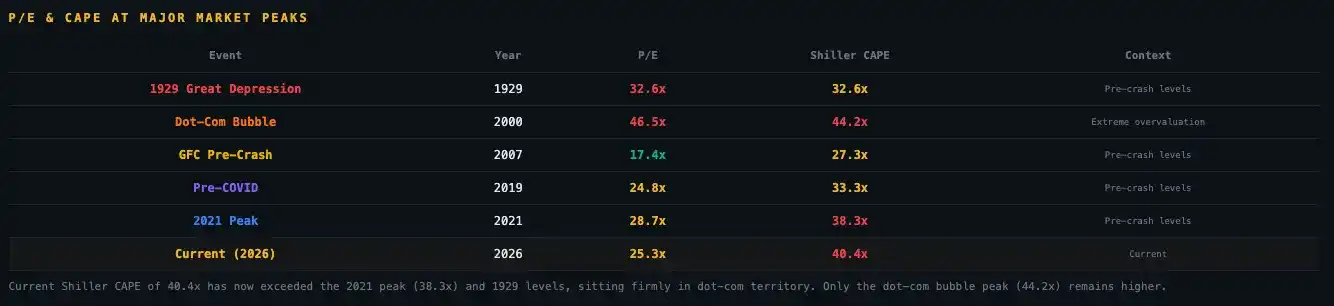
The Shiller CAPE ratio for stocks has broken above 40 for the first time, the first time since the peak of the dot-com bubble era. US stock market capitalization is now near 2x its GDP, valuations are higher than during the 2000 bubble.

Multiple expansions during a tightening cycle, this is textbook definition of dislocation.

This dislocation is primarily driven by a three-engine narrative/liquidity machine.

AI CAPEX supercycle: Large hyperscale cloud providers spending up to $725 billion in 2026, nearing $1 trillion, now accounting for over 30% of the entire S&P 500.

Late-cycle fiscal stimulus: Lower corporate and personal taxes/tariff rebates boosting nominal earnings, even as the Fed tightens.

Passive index fund flows: Index funds mechanically funnel every 401(k) dollar into the largest market cap companies, regardless of price. Boomers are now forced to buy these hyperscale cloud provider stocks at all-time highs, and they continue.

Risk Appetite Is Selective

Today capital is rushing into AI/semiconductors, while everything else including Bitcoin (last cycle's darling) is barely growing or bleeding. This is not a universally greedy market, but one funneling all capital into a single narrative (AI and its related verticals).

In 2025, AI-related stocks accounted for roughly 80% of the entire US stock market gains. Behind these all-time highs, market breadth is extremely narrow, most stocks aren't even contributing to the rally (unless you're AI-related).

Cracks Are Forming

The entire edifice assumes AI CAPEX can be met with real demand, and that energy-driven inflationary shocks will subside/not matter. Core PCE rose from 3% to 3.3%, oil prices surged from $57 to $113 during the Iran war then fell to $76, this is exactly why rate cuts were ruled out.

Cracks have already shown.

In the last full week of June, South Korea's KOSPI halted trading twice, Samsung and SK Hynix fell 12% in a single day, a warning of seller count versus remaining buyers.

Dalio also said his bubble gauge is near 1929 and 2000 levels, Buffett... still holds a record $381 billion in cash. Prices have become dependent on narrative, positioning, and leverage, there really isn't much margin of safety left.

My Personal Plan

Considering all of the above, here's how I, as a capital allocator, think about the whole picture.

Please note this is highly tailored to my own life situation, investment goals, and personality. Please do your own research, none of this constitutes financial advice.

I currently split my capital into 3 distinct buckets and manage accordingly based on a specific bucket.

Trading capital (highest risk, highest volatility, highest variance)

Long-term accumulation capital (buy-and-hold type I don't intend to sell)

Illiquid capital (private equity – SPVs, alternative investments)

How to allocate capital to which bucket is highly dependent on market environment and liquidity.

Right now, I keep most cash for Bucket 2. I've drastically reduced allocation to Bucket 1 due to deteriorating market edge. In crypto, I currently only deem BTC, HYPE, and LIT worth holding. Looking at stocks is playing musical chairs. Given current valuations, long-term allocation to stocks also doesn't make sense.

For Bucket 3, the amount is mostly fixed, about 20% of my net worth. Given its illiquidity and years needed to realize full returns, this bucket remains largely unchanged for the foreseeable future.

As of writing, I'm mostly cash (>80%), with allocation weights across the 3 buckets at 10%, 70%, 20% respectively.

Under Bucket 2, I've made 4 buys of spot BTC so far, average price around $59k. I'm also interested in certain ETFs, which I'll disclose when I decide on a long-term allocation.

In summary, nothing too fancy. More like fishing, waiting for that big fish. I don't mind catching a few small ones before the big one comes, but the point is to keep fishing, stay focused, and not give up.

Perpetual DEX Airdrop Farming Still an Edge

Although my trading decreased in June, I think one massively undervalued edge in crypto is perpetual DEX farming, especially Variational.
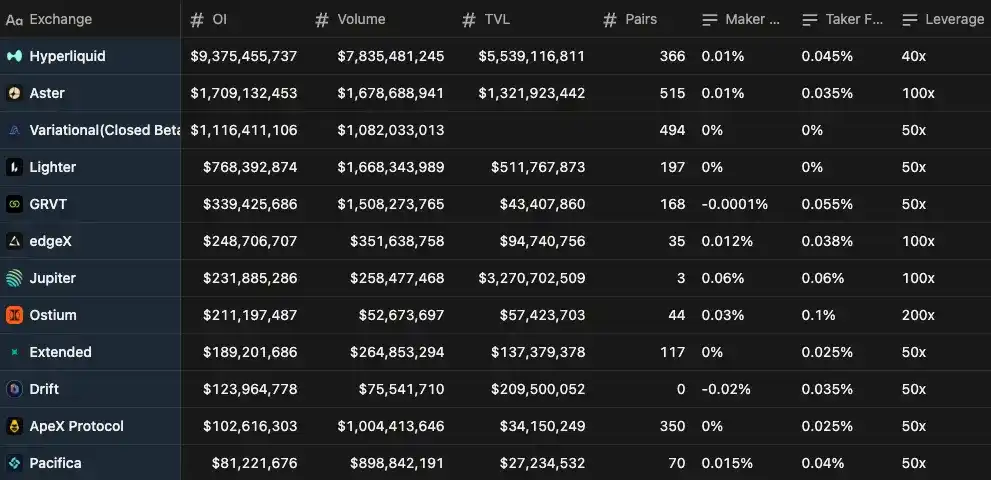
Though primarily driven by airdrop incentives, it's still ranked top 3 among perpetual DEXs, excluding the clear market leader Hyperliquid.

Variational is still in private beta, meaning you need an invite to use. What's special? It's an RFQ-based perpetual DEX, theoretically meaning they can list all sorts of pairs (even the most obscure) and still have deep liquidity, unlike order books that need crazy bootstrapping.

I mainly use it to trade commodities like crude oil, gold, silver, copper, and some other pairs. Focusing on open interest and holding long-term gets the most efficient points.
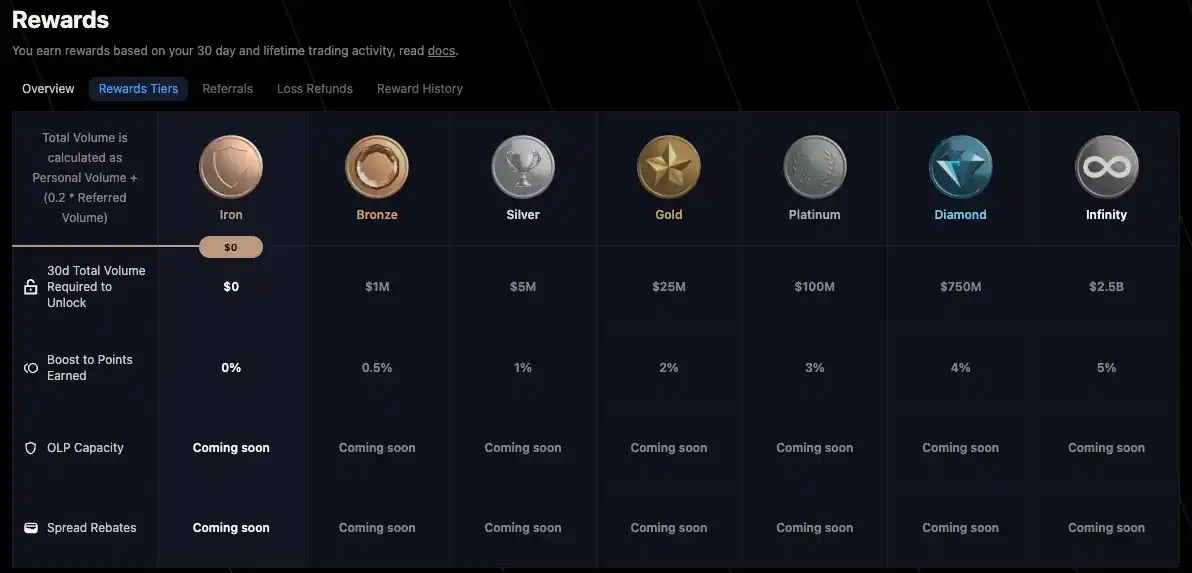
Referrals get a 15% points boost, my code automatically grants you SILVER tier for 90 days upon sign-up.

Other platforms I'm still farming with significant point allocation are:

The TGE target for all mentioned perpetual DEXs is Q3 2026.

I think the fear around STRC is overdone. But this financial engineering does alter investor behavior around it. Unwillingness to allocate until Saylor finishes selling $1B of BTC is now a key "bottom signal."

At $58k BTC price, I think valuations are reasonable. It's even below the 200-day moving average now.

This means H2 2026 could be a significant period for long-term accumulators. I do think there will be one last capitulation and heavy forced selling (including Saylor), likely coinciding with stocks starting to weaken.

While this isn't a pure BTC bullish post, I think among all assets that exist today, BTC offers one of the widest margins of safety, even if the ultimate low is about 15–20% down from here.

Think about it, in a long-term stagflation environment, scarce assets perform best. It was gold in the past, an asset outside the monetary system that existed for millennia.

I think ten years from now, accumulating BTC today will be seen as one of the most rewarding moments in a long time.

While stocks will indeed rise over time in the future, at this moment, I can't justify buying at such high valuations and am happy to watch from the sidelines until it comes back to earth.

What do you think? How are you thinking about capital allocation now?

Cryptos en tendance

Questions liées

QAccording to the author, what are the two main portfolio allocation methods suggested for dealing with the current market, which one does he prefer, and why?

AThe author suggests two methods: 1) DCA (Dollar-Cost Averaging) in a true, non-timing, mechanical way. 2) Being heavy on cash while allowing participation through tactical/satellite positions like active trading. He personally prefers the second method. The reason is that he actively monitors the market daily and relies on his market experience and intuition to navigate it. He finds DCA requires a genuine long-term horizon (at least 5 years) and strict discipline, which most people lack as they often try to time the market within it.

QBased on Howard Marks' framework from 'The Cycle', what key characteristics does the author believe the current AI-driven stock market is exhibiting that signal a potential bubble top?

AThe author believes the AI-driven market exhibits many characteristics from Howard Marks' 'market top' checklist. Key ones include: prices seeming irrelevant ('no price is too high'), the belief that leverage is a sure path to profit, widespread investor confidence and optimism, greed driving behavior, asset prices exceeding intrinsic value, easy capital raising, low skepticism, high confidence enabling risky trades, and investors worrying more about missing out (FOMO) than losing money. He argues the market shows 'price doesn't matter' sentiment, a hallmark of a bubble.

QWhy does the author view Bitcoin as a more attractive investment prospect compared to high-flying AI stocks at this moment?

AThe author views Bitcoin as more attractive because he believes it is exhibiting many characteristics from the *opposite* side of Howard Marks' checklist—the one indicating a market bottom or undervalued state. He implies BTC shows signs like fear dominating investor psychology, prices potentially below intrinsic value, high skepticism, low confidence, and investors worrying about losing money rather than missing gains. He also cites BTC trading below its 200-day moving average around $58,000, offering a wider 'margin of safety' and reasonable valuation, especially in a potential long-term stagflation environment where scarce assets historically perform well.

QWhat are the three main drivers the author identifies as creating the current 'dislocated' and 'irrational' macro market environment?

AThe author identifies three main drivers: 1) The AI Capital Expenditure Supercycle, with hyperscalers spending massively (projected $725B in 2026), now representing over 30% of the S&P 500. 2) Late-cycle fiscal stimulus, including tax and tariff rebates boosting nominal profits even as the Fed tightens policy. 3) Passive index fund flows, where funds mechanically funnel retirement savings (like 401(k)s) into the largest market-cap companies regardless of price, forcing buying at historic highs.

QHow has the author personally allocated his capital across different 'buckets' based on the current market outlook, and what is he specifically accumulating in his 'long-term accumulation' bucket?

AThe author has allocated his capital into three buckets: 1) Trading capital (highest risk), 2) Long-term accumulation capital (buy-and-hold), and 3) Illiquid capital (private equity/SPVs). Given the current market, he has significantly reduced allocation to bucket 1 due to poor market edge. He holds most of his cash for bucket 2 (>80% cash overall). His current weightings are approximately 10% for bucket 1, 70% for bucket 2, and 20% for bucket 3. Within bucket 2 (long-term accumulation), he is specifically accumulating spot Bitcoin, having made four buys at an average price of around $59,000.

Lectures associées

Q-Day : Le compte à rebours avant que l'informatique quantique ne mette fin aux cryptomonnaies ?

**Q-Day et la Cryptographie : La Menace Quantique sur les Cryptomonnaies** L'avènement de l'ordinateur quantique tolérant aux fautes (CRQC) représente une menace existentielle pour les cryptomonnaies en raison de sa capacité à casser les algorithmes de chiffrement asymétrique actuels (comme ECDSA) via l'algorithme de Shor. Le "Q-Day", point critique où cette capacité devient pratique, est estimé entre 2035 et 2045. Les blockchains, par leur nature immuable et décentralisée, sont particulièrement vulnérables. Le risque est immédiat pour les actifs dont la clé publique est déjà exposée sur la chaîne (ex : certaines anciennes adresses Bitcoin). La migration vers la cryptographie post-quantique (PQC), comme les algorithmes basés sur les réseaux (ML-KEM/DSA) ou les hachages (SLH-DSA), est donc urgente. Cependant, cette transition est extrêmement complexe : * **Pour Bitcoin** : Le défi principal est la gouvernance et la gestion sociale des UTXO historiques à risque. Une mise à jour progressive par soft fork est privilégiée, mais elle se heurte à l'inflation de la taille des signatures PQC et à un dilemme éthique sur le gel éventuel des actifs non migrés. * **Pour Ethereum** : La migration nécessite une refonte à plusieurs niveaux (comptes, consensus, couche de données). La stratégie repose sur l'agilité cryptographique, l'abstraction de compte pour les utilisateurs et des solutions techniques comme leanXMSS couplé à un zkVM pour compresser les grandes signatures. La fenêtre d'action confortable est estimée à 5-8 ans. L'industrie doit se coordonner à l'échelle de l'écosystème (protocoles, portefeuilles, bourses). La menace quantique n'anéantira pas la blockchain, mais force une reconfiguration fondamentale de ses bases cryptographiques, testant sa résilience technique et sociale.

marsbitIl y a 6 h

Q-Day : Le compte à rebours avant que l'informatique quantique ne mette fin aux cryptomonnaies ?

marsbitIl y a 6 h

Compte à rebours pour Q-Day : L'informatique quantique va-t-elle mettre fin aux cryptomonnaies ?

La cryptographie moderne est vulnérable face aux ordinateurs quantiques, en particulier l'algorithme de Shor, menaçant les systèmes actuels comme RSA et ECC. Le « Q-Day », moment où les ordinateurs quantiques pourront casser ces cryptosystèmes, est estimé entre 2035 et 2045. La cryptographie post-quantique (PQC) se développe, avec des algorithmes comme ML-KEM, ML-DSA et SLH-DSA normalisés par le NIST, pour garantir une sécurité durable. Dans le domaine de la blockchain, le Bitcoin et l'Ethereum sont particulièrement exposés. Pour Bitcoin, le risque principal concerne les UTXO dont la clé publique est déjà exposée sur la chaîne. La migration vers des algorithmes PQC se heurte à des défis techniques (signatures plus volumineuses) et à un dilemme de gouvernance concernant les fonds dormants. Ethereum, grâce à son agilité cryptographique et à l'abstraction de compte, pourrait adopter une approche plus graduelle, notamment via ses L2. La transition ne sera pas uniquement technique, mais nécessitera un large consensus social et une coordination à l'échelle de l'écosystème. Le véritable enjeu n'est pas l'absence de solutions, mais la capacité de l'écosystème à migrer de manière coordonnée avant que les risques quantiques ne deviennent une réalité économique. La fenêtre d'action confortable est estimée à 5-8 ans.

链捕手Il y a 7 h

Compte à rebours pour Q-Day : L'informatique quantique va-t-elle mettre fin aux cryptomonnaies ?

链捕手Il y a 7 h

Trading

Spot

Articles tendance

Qu'est ce que DOGE M

Doge Matrix ($doge m) : La Nouvelle Génération de Cryptomonnaie Axée sur la Communauté Introduction Dans le paysage en constante évolution des cryptomonnaies, de nouveaux projets émergent constamment, chacun visant à capturer l'intérêt des investisseurs et des passionnés. L'un des derniers entrants dans ce domaine est Doge Matrix, représenté par le symbole boursier $doge m. Ce projet a attiré l'attention grâce à ses racines dans la culture des mèmes populaire entourant Dogecoin, établissant sa place dans l'espace web3. Cet article vise à fournir une analyse complète de Doge Matrix, couvrant son aperçu, son créateur, ses investisseurs, sa fonctionnalité, sa chronologie et ses aspects notables. Qu'est-ce que Doge Matrix ($doge m) ? Doge Matrix est un projet de cryptomonnaie axé sur la communauté qui semble s'appuyer sur l'attrait généralisé de Dogecoin, une monnaie numérique connue pour sa mascotte Shiba Inu et ses origines de mème. Bien que les objectifs globaux de Doge Matrix ne soient pas largement définis, il se caractérise par un engagement à exploiter l'implication et le soutien de la communauté. Contrairement aux cryptomonnaies traditionnelles qui mettent souvent l'accent sur l'utilité ou la valeur intrinsèque à travers des technologies sous-jacentes, Doge Matrix se positionne dans un espace qui embrasse le phénomène culturel des cryptomonnaies, attirant particulièrement ceux qui résonnent avec l'éthique des actifs basés sur des mèmes. S'appuyant sur les forces de la communauté Dogecoin, Doge Matrix opère comme partie d'un écosystème plus large, invitant à la participation et à l'engagement des utilisateurs qui partagent un intérêt pour la cryptomonnaie et le paysage numérique. Qui est le Créateur de Doge Matrix ($doge m) ? L'identité du créateur de Doge Matrix reste inconnue. Ce manque de transparence n'est pas un phénomène rare dans l'espace des cryptomonnaies, où certains projets sont lancés sans révéler l'identité de leurs fondateurs. L'absence d'informations concernant l'équipe fondatrice peut soulever des questions parmi les investisseurs potentiels sur la responsabilité et la direction du projet. Qui sont les Investisseurs de Doge Matrix ($doge m) ? À l'heure actuelle, il n'existe pas d'informations publiques détaillant les investisseurs ou les fondations d'investissement qui soutiennent Doge Matrix. Le projet semble s'appuyer principalement sur le soutien de la communauté plutôt que sur des investissements institutionnels. Ce modèle s'aligne avec la nature axée sur la communauté de l'initiative, favorisant un environnement où la direction du projet est façonnée par ses participants plutôt que dictée par quelques investisseurs financiers. Comment Fonctionne Doge Matrix ($doge m) ? Les spécificités concernant les mécanismes opérationnels de Doge Matrix sont quelque peu vagues, reflétant une tendance plus large des projets dans l'espace des mèmes où les fonctionnalités innovantes ne sont pas toujours clairement articulées. Néanmoins, Doge Matrix semble conçu pour s'intégrer dans l'écosystème de cryptomonnaie existant en encourageant la participation des utilisateurs tout en s'appuyant sur les références culturelles familières associées à Dogecoin. Ses caractéristiques potentiellement uniques dérivent des interactions communautaires plutôt que des avancées technologiques, mettant l'accent sur les expériences partagées et la collaboration entre les détenteurs de jetons. Bien que les innovations exactes n'aient pas été explicitement décrites, le projet semble créer un espace où les membres de la communauté peuvent s'engager, partager des idées et propulser le potentiel du projet en avant. Chronologie de Doge Matrix ($doge m) Réfléchir à la chronologie du projet révèle des événements notables qui ont défini son parcours jusqu'à présent : 25 novembre 2024 : Doge Matrix a atteint sa valeur la plus élevée de tous les temps, marquant une étape significative dans son histoire précoce. 1er janvier 2025 : À l'inverse, Doge Matrix a atteint sa valeur la plus basse de tous les temps, illustrant la volatilité souvent associée aux cryptomonnaies, en particulier dans les premières étapes du cycle de vie d'un projet. En cours : Le projet continue d'être activement échangé et soutenu par sa communauté, bien que des jalons ou objectifs futurs spécifiques n'aient pas encore été divulgués. Points Clés sur Doge Matrix ($doge m) Focalisation sur la Communauté Au cœur de Doge Matrix se trouve un engagement envers l'engagement communautaire. Le projet prospère sur le principe de collaboration et d'objectifs partagés parmi ses membres, soulignant l'importance de l'effort collectif. Contrairement aux projets centralisés qui ont souvent une structure de leadership définie, Doge Matrix présente actuellement une approche plus fluide de la gouvernance, où la voix de chaque membre de la communauté compte. Volatilité Le marché des cryptomonnaies est notoire pour sa volatilité, et Doge Matrix ne fait pas exception. Son historique de prix reflète des fluctuations significatives entre des valeurs élevées et basses, ce qui est typique de nombreuses nouvelles cryptomonnaies mais souligne les risques associés à l'investissement dans des jetons émergents. Manque d'Informations Détailées L'une des caractéristiques les plus frappantes de Doge Matrix est la rareté d'informations détaillées concernant ses fondements technologiques et ses mécanismes opérationnels. Cette ambiguïté nécessite que les investisseurs potentiels effectuent une diligence raisonnable approfondie avant de s'engager avec le projet. Conclusion En résumé, Doge Matrix ($doge m) illustre une nouvelle vague de projets de cryptomonnaie qui s'appuient fortement sur l'engagement communautaire et la pertinence culturelle. Bien qu'il manque certains détails—tels qu'un leadership clair, des objectifs définis et une fonctionnalité détaillée—le projet a réussi à susciter l'intérêt au sein de la communauté crypto, tirant parti de l'attrait établi de la culture des mèmes. Comme pour tout investissement dans l'espace des cryptomonnaies, comprendre les risques inhérents et mener des recherches approfondies est essentiel pour les participants potentiels. Doge Matrix se dresse comme un rappel de la nature dynamique, parfois imprévisible de l'industrie crypto, marquée par une évolution constante et un enthousiasme pour les initiatives axées sur la communauté.

417 vues totalesPublié le 2025.02.03Mis à jour le 2025.02.03

Qu'est ce que DOGE M

Qu'est ce que $M

Comprendre Mantis ($M) : Une nouvelle ère dans l'interopérabilité inter-chaînes Dans le paysage en constante évolution du Web3 et des cryptomonnaies, de nouveaux projets s'efforcent d'offrir des solutions innovantes visant à améliorer l'expérience utilisateur et à élargir les possibilités fonctionnelles au sein de l'écosystème financier décentralisé. Un tel projet qui attire l'attention est Mantis ($M), un protocole pionnier fondé sur les principes de l'interopérabilité inter-chaînes et des règlements basés sur l'intention. Cet article explore les aspects essentiels de Mantis, y compris sa fonctionnalité de base, ses créateurs, son soutien à l'investissement, ses caractéristiques innovantes et ses jalons critiques. Qu'est-ce que Mantis ($M) ? Mantis est décrit comme un protocole de règlement d'intention multi-domaines qui simplifie les interactions inter-chaînes, permettant aux utilisateurs d'exécuter des transactions financières complexes sur diverses plateformes blockchain de manière transparente. Le protocole fonctionne à travers trois couches principales : Expression de l'intention : Les utilisateurs peuvent exprimer leurs objectifs de transaction en utilisant un langage naturel facilité par le DISE LLM, un modèle de langage AI avancé. Par exemple, un utilisateur pourrait exprimer le souhait d'échanger de l'Ethereum (ETH) contre du Solana (SOL) avec une tolérance de glissement spécifique de 1 %. Exécution : Cette couche utilise un réseau de solveurs qui rivalisent pour satisfaire les intentions des utilisateurs. Les transactions sont exécutées à l'aide de mécanismes tels que la Coïncidence des Désirs (CoWs) et les Enchères de Flux de Commandes (OFAs), qui garantissent que les demandes des utilisateurs sont satisfaites de manière optimale. Règlement : Tirant parti du protocole de Communication Inter-Blockchain (IBC), Mantis permet des transactions inter-chaînes atomiques, permettant aux utilisateurs d'opérer sur diverses chaînes prises en charge, y compris Ethereum, Solana et Cosmos. Mantis est conçu pour introduire une génération de rendement native pour les actifs inactifs, utilisant des preuves cryptographiques pour maintenir l'intégrité des transactions tout au long du processus. Créateurs et Équipe de Développement Mantis a été conçu par la Composable Foundation, une organisation axée sur la recherche, reconnue pour son accent sur les solutions d'interopérabilité blockchain. Cette fondation collabore avec des institutions académiques de renom, y compris l'Université de Harvard et l'Université de Lisbonne, contribuant à des efforts de recherche et développement approfondis qui informent l'architecture et la fonctionnalité de Mantis. L'engagement de la Composable Foundation à favoriser l'innovation dans l'espace blockchain positionne Mantis comme une solution robuste pour la demande croissante d'interopérabilité entre plusieurs réseaux blockchain. Investisseurs et Soutien Bien que les détails spécifiques concernant les investisseurs individuels n'aient pas été divulgués publiquement, Mantis bénéficie d'un soutien substantiel de diverses entités, y compris : Subventions écosystémiques des chaînes activées par l'IBC, qui soutiennent la croissance et l'intégration du protocole au sein des écosystèmes de finance décentralisée. Partenariats stratégiques avec des fournisseurs d'infrastructure qui améliorent les capacités réseau de Mantis et ses stratégies de déploiement. Financement via le trésor de la Composable Foundation, garantissant un soutien financier durable pour le développement continu et les coûts opérationnels. Ces efforts collaboratifs reflètent un consensus parmi les parties prenantes sur l'importance d'améliorer la fonctionnalité inter-chaînes et le potentiel d'utilité des innovations infrastructurelles de Mantis. Innovations Clés Mantis se distingue par plusieurs innovations pionnières qui améliorent sa fonctionnalité et son utilité : Intentions Agnostiques aux Chaînes : Les utilisateurs peuvent initier des transactions depuis n'importe quelle chaîne prise en charge tout en se réglant sur une autre. Cette flexibilité donne du pouvoir aux utilisateurs, favorisant une interaction accrue entre différentes plateformes. Interface Alimentée par l'IA : L'intégration du DISE LLM permet aux utilisateurs de réaliser des opérations DeFi complexes en utilisant un langage naturel, simplifiant ainsi les interactions et rendant la technologie blockchain accessible à un public plus large. Capture de MEV Inter-Domaines : Mantis crée un marché interne pour la valeur extractible maximale (MEV) à travers des compétitions entre solveurs. Cette approche innovante permet une plus grande efficacité et extraction de valeur dans des transactions complexes. Couche de Règlement Modulaire : Le protocole prend en charge diverses méthodes de vérification, y compris les preuves à connaissance nulle et les rollups optimistes, fournissant un cadre polyvalent qui peut s'adapter aux technologies blockchain émergentes. Chronologie Historique Le développement de Mantis est marqué par plusieurs jalons critiques qui tracent sa trajectoire et sa croissance : | Année | Jalons | |————|————————————————————————-| | 2022 | Développement du concept initial au sein de la division de recherche de la Composable Foundation. | | T3 2024 | Lancement du testnet avec des capacités de pontage entre Solana et Ethereum. | | T1 2025 | Événement de Génération de Token (TGE) anticipé en parallèle du lancement du mainnet. | | T2 2025 | Intégration attendue du DISE LLM et expansion des capacités inter-chaînes. | | H2 2025 | Soutien prévu pour plus de 15 chaînes grâce à de nouvelles mises à niveau de l'IBC. | Cette chronologie décrit l'évolution de Mantis, des discussions conceptuelles à la mise en œuvre active et aux phases de croissance futures. Stratégie de Croissance de l'Écosystème La stratégie de Mantis pour la croissance de l'écosystème comprend plusieurs initiatives conçues pour encourager la participation des utilisateurs et l'engagement des développeurs : Système de Crédits : Les utilisateurs peuvent gagner des crédits de protocole en fournissant de la liquidité et en participant à des programmes de parrainage. Ces crédits sont échangeables contre des incitations à l'avenir, favorisant une communauté d'utilisateurs robuste. Kit de Développement Logiciel Modulaire (SDK) : Cet ensemble d'outils permet aux développeurs de créer des applications basées sur des modèles axés sur l'intention utilisant l'infrastructure de Mantis, promouvant ainsi l'innovation au sein de son écosystème. Modèle de Gouvernance : À mesure que le protocole mûrit, les détenteurs de tokens $M auront une voix dans la gouvernance du protocole, leur permettant de voter sur les mises à niveau et les changements proposés, renforçant ainsi l'engagement communautaire et la décentralisation. Mantis représente une avancée significative dans le domaine de l'architecture inter-chaînes. En intégrant de manière transparente des algorithmes AI avancés avec un cadre de règlement robuste, Mantis cherche à s'attaquer aux problèmes de fragmentation au sein des écosystèmes multi-chaînes. Son approche innovante privilégie l'amélioration des expériences utilisateur tout en respectant les principes fondamentaux de décentralisation et de sécurité, établissant une nouvelle norme pour l'interopérabilité future des technologies blockchain. Alors que Mantis continue son parcours de croissance et de mise en œuvre, il promet d'être un projet à surveiller de près dans le paysage compétitif du Web3 et de la finance décentralisée. Avec son accent sur le franchissement des frontières et l'élévation de l'engagement des utilisateurs, Mantis est prêt à devenir une partie intégrante des développements futurs dans l'espace des cryptomonnaies.

70 vues totalesPublié le 2025.03.18Mis à jour le 2025.03.18

Qu'est ce que $M

Comment acheter M

Bienvenue sur HTX.com ! Nous vous permettons d'acheter MemeCore (M) de manière simple et pratique. Suivez notre guide étape par étape pour commencer votre parcours crypto.Étape 1 : Création de votre compte HTXUtilisez votre adresse e-mail ou votre numéro de téléphone pour ouvrir un compte sur HTX gratuitement. L'inscription se fait en toute simplicité et débloque toutes les fonctionnalités.Créer mon compteÉtape 2 : Choix du mode de paiement (rubrique Acheter des cryptosCarte de crédit/débit : utilisez votre carte Visa ou Mastercard pour acheter instantanément MemeCore (M).Solde :utilisez les fonds du solde de votre compte HTX pour trader en toute simplicité.Prestataire tiers :pour accroître la commodité d'utilisation, nous avons ajouté des modes de paiement populaires tels que Google Pay et Apple Pay.P2P :tradez directement avec d'autres utilisateurs sur HTX.OTC (de gré à gré) : nous offrons des services personnalisés et des taux de change compétitifs aux traders.Étape 3 : stockage de vos MemeCore (M)Après avoir acheté vos MemeCore (M), stockez-les sur votre compte HTX. Vous pouvez également les envoyer ailleurs via un transfert sur la blockchain ou les utiliser pour trader d'autres cryptos.Étape 4 : tradez des MemeCore (M)Tradez facilement MemeCore (M) sur le marché Spot de HTX. Il vous suffit d'accéder à votre compte, de sélectionner la paire de trading, d'exécuter vos trades et de les suivre en temps réel. Nous offrons une expérience conviviale aux débutants comme aux traders chevronnés.

707 vues totalesPublié le 2025.07.02Mis à jour le 2026.06.02

Comment acheter M

Discussions

Bienvenue dans la Communauté HTX. Ici, vous pouvez vous tenir informé(e) des derniers développements de la plateforme et accéder à des analyses de marché professionnelles. Les opinions des utilisateurs sur le prix de M (M) sont présentées ci-dessous.

活动图片