dogwifhat jumps 16% – but massive resistance stands in WIF’s path to more gains

ambcryptoPublié le 2026-06-28Dernière mise à jour le 2026-06-28

Résumé

Dogwifhat (WIF) surged 16% in 24 hours, marking a potential rebound after a 38% year-to-date decline. However, the rally faces a major obstacle: a persistent descending resistance line that has rejected price advances three times previously. While key indicators like Accumulation/Distribution and the Money Flow Index signal strong buying pressure and capital inflow, WIF must achieve a confirmed breakout and close above this resistance to sustain its upward momentum. Additionally, liquidation data suggests limited near-term upside and room for further downside. The token's outlook hinges on decisively overcoming this key technical barrier.

dogwifhat [WIF] is staging a comeback after spending most of the year subdued, with the memecoin down 38% on a year-to-date basis yet up 16% over the past day.

Market analysis shows that a stronger rally could still take shape once the asset overcomes the key structural level that could keep its price from staging a surge.

A descending resistance line caps WIF’s rally

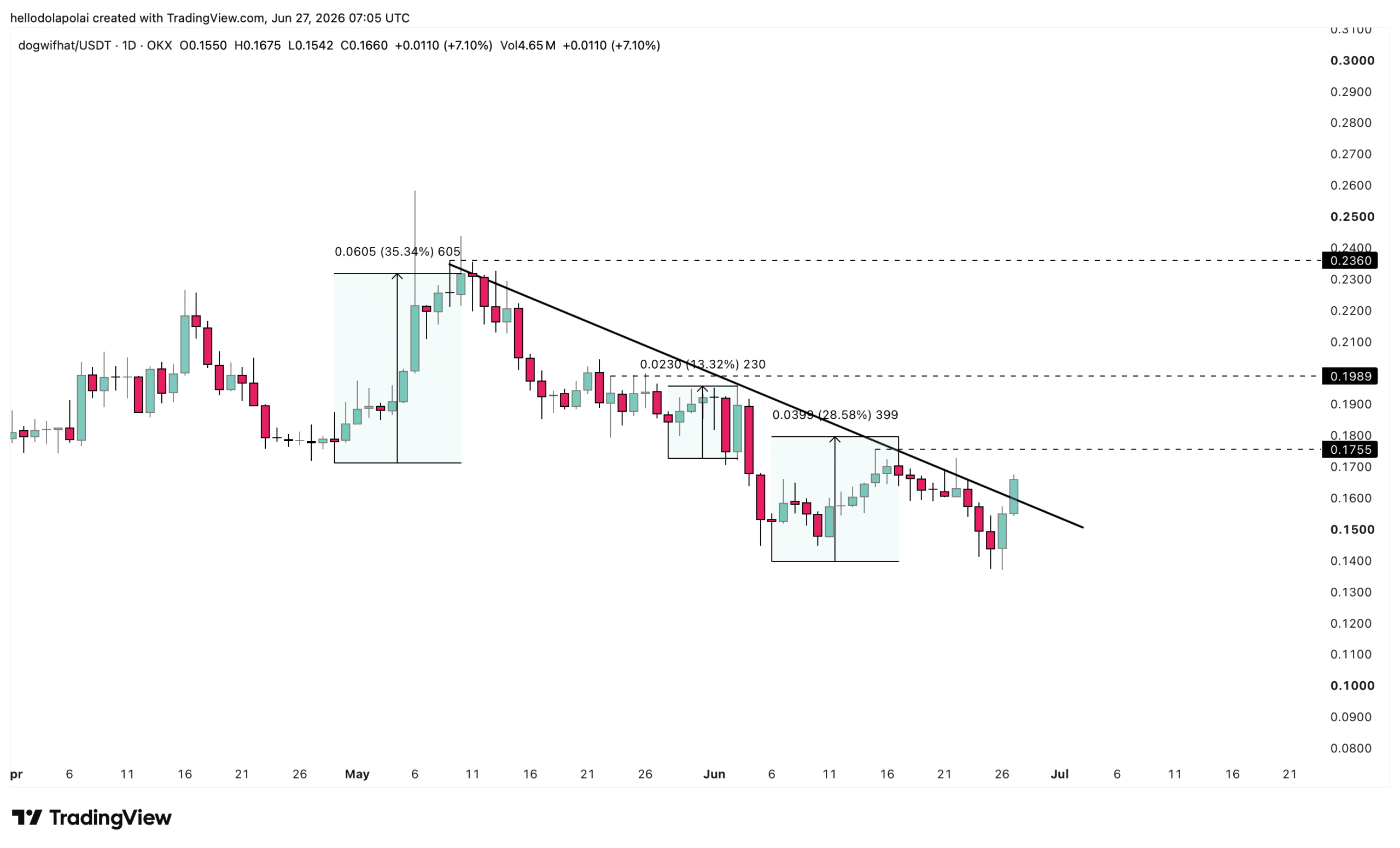
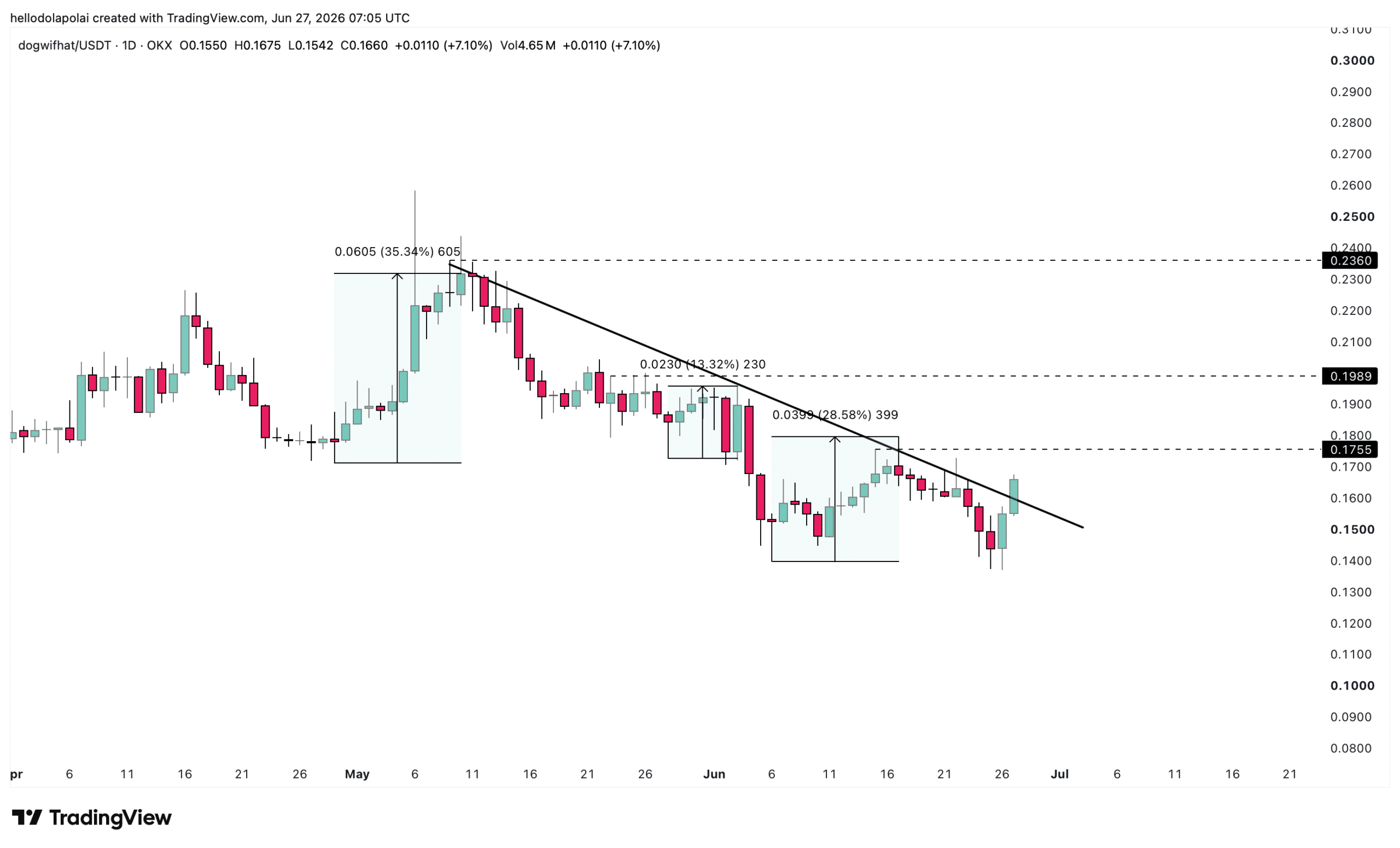
The major obstacle standing between WIF and a sizeable rally remains the descending resistance line that price has only marginally crossed.

The breakout cannot be confirmed as bullish yet. WIF’s price has not closed above the descending line, nor has it continued along the bullish path it began carving out days earlier.
Source: TradingView

For context, this same resistance has repeatedly capped WIF’s advances and forced the token to trade lower thrice in a row, even though each run leading into the level delivered double-digit gains.

A failure to push higher would leave WIF trudging beneath the resistance line for an extended period, adding to the 48 days it has already spent trading below this barrier.

Capital and buying indicators back WIF

WIF stands a strong chance of a major upswing, with the key indicators that track capital flow and buying activity all pointing in the same direction.

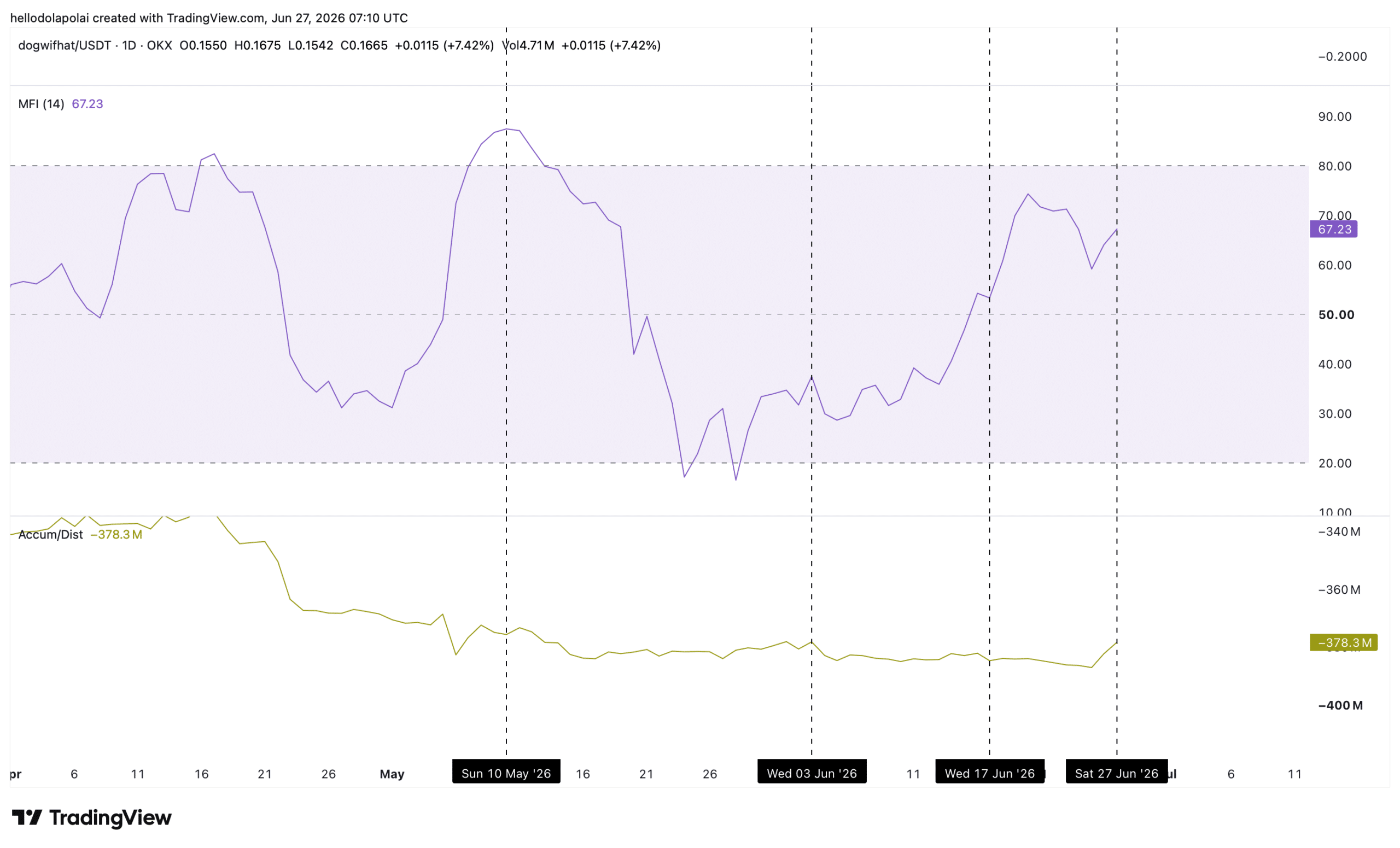
The accumulation/distribution indicator is showing a powerful upswing, which implies sustained buying, while total volume has settled at around 378 million WIF traded over the past 24-hour window.

Adding to this, the money flow index—which measures the movement of capital into and out of an asset—is surging upward at a reading of 67, signaling that more capital has flowed into WIF. More importantly, that reading sits in the bullish zone above 50, suggesting investors are actively buying.
Source: TradingView

The pattern worth noting appears at the vertical lines marking the points where price failed to breach the resistance mentioned earlier, where both indicators rallied into the level together—unlike previous instances in which one indicator rose while the other lagged, or one sat in overvalued territory.

A continued upward move would meaningfully reshape the outlook for WIF, since it would confirm a close above the resistance and establish a sustained bullish pattern.

Liquidation clusters limit WIF’s upside

The liquidation chart shows that WIF’s possible upside is limited, based on the arrangement of its clusters, which mark the levels where unfilled orders sit.

The downside below the current price level extends even further, suggesting WIF could still fall well beneath its present position despite the bullish momentum on display.

An important caveat applies here, as the liquidation heatmap offers only a glimpse rather than an extended view across a broader price spectrum. That leaves it unknown whether more buy orders sit beyond what the chart currently displays.


Final Summary

  • WIF has bounced 16% in a day after a rough year down 38%, and the signals that track buying activity suggest investors are stepping back in.
  • The rally isn’t safe yet, as WIF still needs to firmly clear a price ceiling that has rejected it three times before, and there’s room for it to slip lower first.

Questions liées

QWhat is the current short-term performance of the dogwifhat (WIF) token mentioned in the article?

AAccording to the article, dogwifhat (WIF) has jumped 16% over the past day.

QWhat is identified as the major obstacle preventing WIF from a stronger rally?

AA descending resistance line is identified as the major obstacle. The price has not confirmed a bullish breakout as it hasn't closed above this line, which has rejected price advances three times before.

QWhat do the Accumulation/Distribution indicator and Money Flow Index suggest about buying activity for WIF?

AThe Accumulation/Distribution indicator shows a powerful upswing, implying sustained buying. The Money Flow Index is surging at a reading of 67, which is above 50, signaling that more capital is flowing into WIF and investors are actively buying.

QAccording to the article, what does the liquidation heatmap suggest about WIF's potential price movement?

AThe liquidation heatmap suggests that WIF's possible upside is limited by the arrangement of liquidation clusters. It also indicates that the downside below the current price level extends further, meaning WIF could still fall well beneath its present position despite the current bullish momentum.

QWhat two key points are summarized at the end of the article regarding WIF's outlook?

AFirst, WIF has bounced 16% with buying indicators suggesting investor interest is returning. Second, the rally isn't safe yet as WIF needs to firmly clear a key price resistance level that has rejected it three times, and there is room for the price to slip lower first.

Lectures associées

Upbit s'affole : une contre-attaque précipitée pour regagner des parts sur le marché des stablecoins

Upbit lance une campagne de promotion limitée (26 juillet au 9 août) en supprimant les frais de transaction (0,05%) pour les stablecoins sur son marché en won sud-coréen, tout en listant rapidement de nouveaux stablecoins comme RLUSD et USDG. Cette offensive, perçue comme une réaction tardive, vise à reconquérir des parts de marché perdues au profit de Coinone, qui a capté une large part des échanges grâce à sa politique de frais nuls permanents sur l'USDC depuis octobre 2025. L'analyse des données montre que les stablecoins servent principalement de canal pour les transferts transfrontaliers de capitaux depuis la Corée du Sud, avec des sorties nettes continues. La promotion d'Upbit a initialement boosté le volume quotidien moyen de 162%, principalement porté par l'USDT, mais l'effet s'est estompé dès la deuxième semaine. Les nouveaux stablecoins listés n'ont attiré qu'un intérêt éphémère. Cette stratégie semble à court terme, car une fois les frais rétablis, Upbit risque de reperdre les volumes acquis. L'enjeu est cependant stratégique dans un contexte de régulation imminente (projet de loi sur les actifs numériques) et d'intégration au sein de Naver Financial, où les stablecoins pourraient devenir un pilier pour les futurs écosystèmes de paiement. Upbit pourrait ainsi chercher à consolider sa position comme plaque tournante de distribution des stablecoins USD en prévision de ces évolutions.

marsbitIl y a 1 h

Upbit s'affole : une contre-attaque précipitée pour regagner des parts sur le marché des stablecoins

marsbitIl y a 1 h

Les développeurs d'Ethereum vont réduire 66 propositions liées à la mise à niveau Hegotá

Les développeurs d'Ethereum examinent actuellement 66 propositions afin de les réduire dans le cadre de la définition du périmètre de la prochaine mise à jour majeure, Hegotá. Plusieurs de ces propositions visent à intégrer davantage de fonctionnalités de confidentialité au protocole. Pour l'instant, seule la proposition FOCIL (Fork-choice enforced inclusion lists) est officiellement programmée pour Hegotá. Cependant, d'autres propositions comme les Frame Transactions (EIP-8141) et Keyed Nonces (EIP-8250) sont également considérées comme cruciales pour "débloquer la confidentialité native", permettant aux applications de confidentialité de fonctionner sans intermédiaires. L'objectif de FOCIL est de renforcer la résistance à la censure du réseau, tandis que les autres propositions fourniraient des éléments de base pour les applications axées sur la vie privée. Les développeurs visent à livrer Hegotá l'année prochaine. Les prochains appels des développeurs fondamentaux (core devs) joueront un rôle clé dans la trajectoire de développement d'Ethereum pour 2027. Parallèlement, les développeurs se préparent à déployer d'abord Glamsterdam, une mise à jour majeure prévue pour la seconde moitié de 2026, destinée à améliorer l'extensibilité, renforcer la couche 1 et rendre le réseau plus facile à utiliser.

cointelegraphIl y a 2 h

Les développeurs d'Ethereum vont réduire 66 propositions liées à la mise à niveau Hegotá

cointelegraphIl y a 2 h

Le Nasdaq va être ouvert 23 heures par jour, à qui va-t-il prendre des parts de marché ?

Le Nasdaq prévoit de lancer en décembre 2026 une session de négociation d'actions de 23 heures sur 5 jours, couvrant notamment la journée asiatique. Cette extension vise principalement à capter les ordres qui se reportent actuellement sur les plateformes de nuit (ATS), les systèmes internes des courtiers et d'autres bourses hors des heures normales. L'analyse des transactions nocturnes existantes montre que l'activité est concentrée sur un nombre limité d'ETF (notamment sur le S&P 500) et de grandes valeurs technologiques (comme Tesla, Nvidia), utilisés pour la gestion des risques macroéconomiques. L'objectif du Nasdaq est de rapatrier cette liquidité, de renforcer la découverte des prix pour ces actifs clés et, à plus long terme, de consolider le rôle des marchés américains comme point d'entrée pour la tarification des actifs mondiaux pendant la journée asiatique. Cette réforme entraînera des coûts accrus pour l'ensemble de l'infrastructure financière (compensation, tenue de marché, conformité), qui pourraient se répercuter sur les investisseurs via des spreads élargis. Elle offre une réactivité accrue face aux événements, mais la liquidité réduite en dehors des heures de pointe peut conduire à des prix moins fiables. Alors que les places comme Londres ou Hong Kong étudient aussi des prolongations, la concurrence porte moins sur la durée d'ouverture que sur la captation des flux d'ordres globaux et le pouvoir de définir les prix de référence internationaux.

marsbitIl y a 2 h

Le Nasdaq va être ouvert 23 heures par jour, à qui va-t-il prendre des parts de marché ?

marsbitIl y a 2 h

Trading

Spot
活动图片