Semiconductor Stock Rebound: Is the Technical Correction Over or a Trend Reversal?

marsbitPublié le 2026-06-24Dernière mise à jour le 2026-06-24

Résumé

The core of recent semiconductor stock volatility is not about daily price swings, but rather the market questioning whether AI-driven semiconductor pricing has entered a new phase. Following a sharp sell-off in Korean stocks on June 23rd, led by Samsung and SK Hynix, a subsequent rebound is seen more as a technical positioning adjustment rather than a confirmed trend reversal. The key variable is HBM (High Bandwidth Memory), essential for AI chips. Its supply-demand imbalance granted memory makers significant pricing power. The current market focus is on whether this dynamic remains strong enough to justify elevated valuations. All eyes are on Micron's upcoming earnings report. The critical factor is not whether results meet already high expectations, but whether the company's guidance confirms that AI memory pricing power, order visibility, and future margins are still expanding. Micron's outlook will serve as a crucial test for the broader AI semiconductor chain, including Samsung, SK Hynix, and other infrastructure players. The recent bounce appears to be a pre-earnings positioning repair. For it to evolve into a sustained uptrend, concrete evidence is needed that the AI infrastructure expansion cycle's fundamentals—particularly for high-end memory—remain robust and can continue to surpass elevated market expectations. The risk is that strong demand alone may not be sufficient if future guidance hints at peaking momentum or increasing supply-side pressures.

TL;DR

On June 23, the South Korean stock market experienced severe selling, with the Kospi closing down about 10%, trading suspended for 20 minutes at one point, and Samsung Electronics and SK Hynix both falling over 12%. A day later, according to media reports, Samsung Electronics rebounded by about 8.5% during intraday trading, and sentiment in Asian tech stocks showed some recovery.
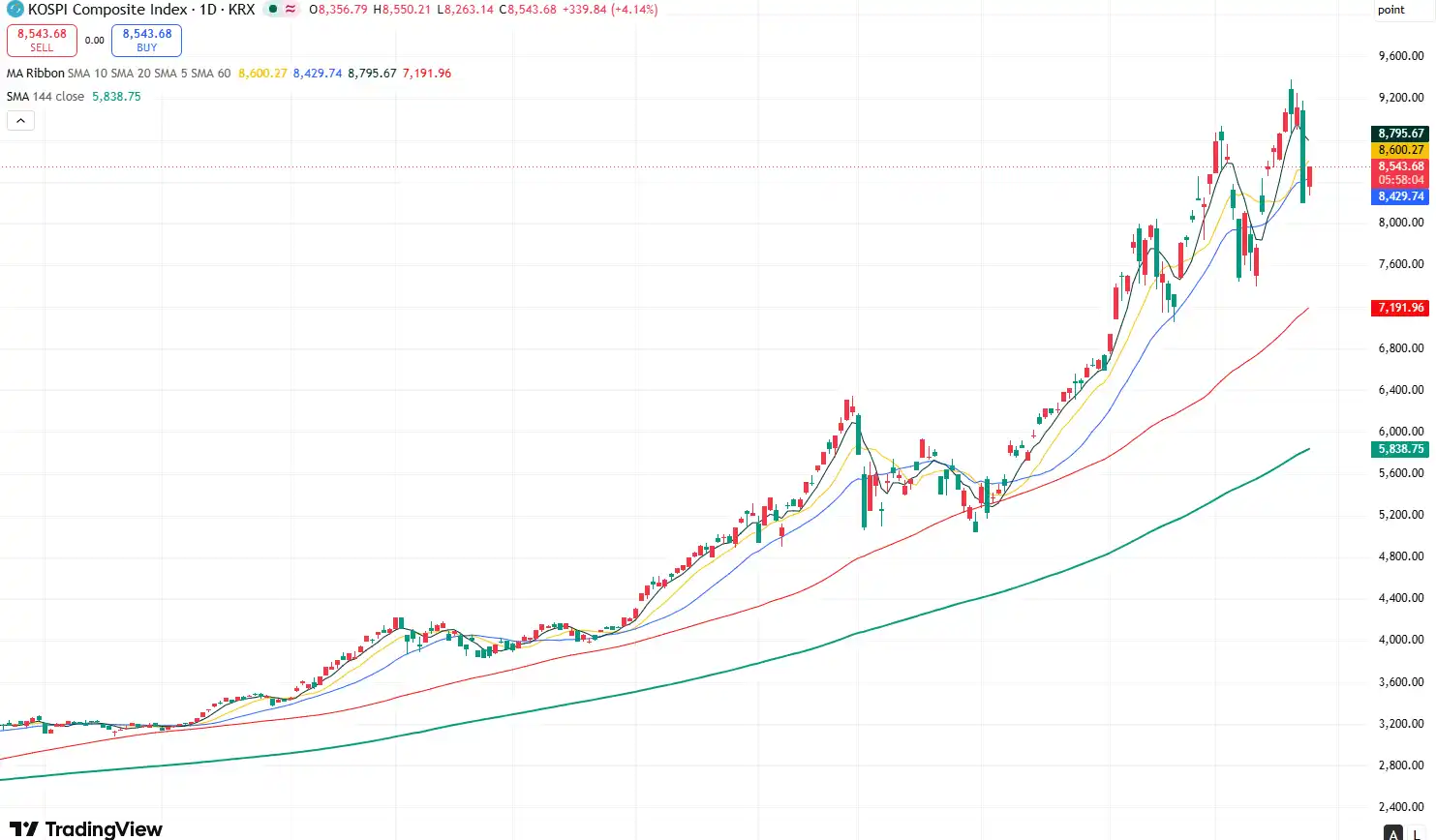
The core of this round of volatility is not the single-day rise and fall, but that semiconductor stocks have entered a new pricing phase after the crowding of AI trades. Over the past year, the expansion of AI infrastructure has linked South Korean memory stocks, U.S. stocks like Micron, NVIDIA, and TSMC on the same chain. As long as AI server expansion continues, high-end memory will remain tight, memory manufacturers' profit expectations will continue to be revised upward, and related semiconductor stocks will still be seen as beneficiaries of the same wave of AI capital expenditure cycle.

What the market now needs to confirm is whether this round of correction is merely a technical release or an early signal of a trend reversal. Samsung's potential shareholder return expectations have provided emotional repair for the Korean market, but a more direct stress test comes from the earnings season, especially from Micron. The company will announce its FY2026 Q3 financial results after the U.S. market closes on June 24, with the conference call scheduled for 14:30 Mountain Time. What investors are looking at is not whether the last quarter was good, but whether the pricing power of AI memory can continue to expand, thereby supporting the valuation of the entire semiconductor chain.

HBM (AI chip high-bandwidth memory) is the core variable in this round of market activity. AI chips need to process massive amounts of data in an extremely short time, regular memory isn't fast enough, making HBM a critical component for high-end GPUs and AI servers. Over the past two years, the supply shortage of HBM has given Micron, Samsung Electronics, and SK Hynix rare pricing power again, making memory stocks one of the most elastic segments in the AI semiconductor trade.

Strong demand has already been heavily traded by the market. Whether the rebound after the plunge can continue does not depend on "whether the AI story is still there," but on whether the semiconductor chain can continue to prove that order visibility, memory prices, subsequent guidance, and profit margins remain sufficiently strong. Micron is one verification point, but what the market truly cares about is whether this AI semiconductor theme can continue to bear the high expectations.

Post-Crash Rebound, More Like Position Repair

This round of volatility first reflects positioning, not a sudden disappearance of demand. Korean tech stocks performed strongly from 2025 to 2026, with AI memory becoming one of the market's most crowded themes. When heavyweight stocks like Samsung Electronics and SK Hynix come under simultaneous pressure, index-level declines can be amplified, and the entire Asian tech sector can easily be repriced in sync.

The selling on June 23 was precisely the concentrated release of this structure. Media reports indicated the Kospi closed down about 10%, with Samsung Electronics and SK Hynix both falling over 12%. For investors, this kind of drop already indicates one problem: AI semiconductor trading is no longer just about fundamentals; it has also become a positioning trade with high concentration and high expectations.

The rebound the next day cannot be directly interpreted as a bottom confirmation either. Samsung Electronics' rise partly stemmed from market expectations for potential shareholder returns. Samsung's previously announced shareholder return policy for 2024-2026 is to return 50% of its three-year free cash flow and maintain a fixed annual dividend of 9.8 trillion Korean Won. If 50% of the three-year free cash flow exceeds the total regular dividend amount, the company will return the balance.

Based on this, the market and media have estimated that if the chip super-cycle significantly boosts free cash flow, Samsung's potential total return or buyback capacity could reach about 90 trillion Korean Won. However, this is not a new buyback plan already announced by the company, merely a projection based on the existing policy framework. It can improve short-term risk appetite but cannot alone prove that AI semiconductor demand has not cooled.

Therefore, the rebound in Korean tech stocks looks more like positioning repair after a plunge, not confirmation that the trend has already turned upward again. For semiconductor stocks, the real issue isn't whether they can rebound, but whether they can find new fundamental support after rebounding. If it's only about shareholder return expectations, short covering, and sentiment repair, the rally may remain at the level of a technical rebound; if earnings reports continue to prove that AI server demand, HBM prices, and the capital expenditure chain are still strengthening, the market will reprice it as a continuation of the trend.

What can cut through the noise of sentiment are the upcoming earnings reports and conference calls. Micron is one of the more direct validators in this round of AI memory trading. It doesn't have Samsung's vast consumer electronics business, and its stock price more centrally reflects the memory cycle and AI server demand. Its earnings and guidance can answer the market's most pressing questions: Are AI server customers still scrambling for memory? Can prices still rise? Will capacity expansion begin to pressure future profit margins?

These questions don't belong only to Micron; they will also affect Samsung Electronics, SK Hynix, and broader AI infrastructure stocks. For the semiconductor stock rebound to upgrade from "technical covering" to "trend continuation," it requires the most sensitive link in the chain to continue providing strong signals.

Micron Needs to Prove Pricing Power Remains

The easiest numbers to see in the earnings report are revenue and EPS, but what's more important this time is whether the pricing logic behind these numbers can continue. For the entire semiconductor sector, Micron's significance lies not in the profitability of a single company, but in its ability to prove that AI memory supply and demand remain in a seller-favorable phase.

Micron's FY2026 Q2 revenue was $23.860 billion, with non-GAAP EPS at $12.20. The company's capital expenditure net for the quarter was $5.0 billion, and adjusted free cash flow was $6.9 billion. The company previously provided FY2026 Q3 guidance of revenue $33.5 billion, plus or minus $750 million, gross margin approximately 81%, non-GAAP EPS of $19.15, plus or minus $0.40.

This set of data explains why the market is willing to assign higher valuations to memory stocks. If HBM is pre-locked by customers and visibility is increased through long-term supply arrangements, memory manufacturers are no longer just traditional cyclical stocks but more like scarce suppliers in the expansion of AI infrastructure. Micron management and market reports have emphasized that HBM supply visibility is high, and high-end memory is transitioning from a common component to a strategic resource in AI capital expenditure.

For average investors, this can be understood as a supply-demand mismatch model. AI companies and cloud providers need to expand data centers, requiring more GPUs. GPUs need more HBM to perform. But HBM capacity expansion is slow, customer qualification cycles are long, and suppliers are concentrated, leading buyers to pre-commit volumes and sellers to gain stronger pricing power.

This is also why memory stocks affect broader semiconductor sentiment. NVIDIA represents AI computing demand, TSMC represents advanced process supply, while Samsung Electronics, SK Hynix, and Micron represent high-end memory constraints. When any of these links show changes in price, orders, or guidance, the market reassesses the pace of AI infrastructure expansion and profit distribution.

The key to Micron's earnings is not "whether this quarter remains strong," as the market already expects it to be strong. The incremental information lies in three areas: whether the Q3 results beat the company's previously high guidance, whether forward-quarter guidance continues to exceed the already elevated market expectations, and whether the shipment schedule for new products like HBM4 proceeds smoothly.

This is also why a good earnings report may not be enough. Over the past few quarters, the basis for AI memory stock gains has been consecutive beats. If Micron only meets expectations, or if the tone of the conference call shifts from supply tightness toward supply-demand balancing, the market may deem that valuation anchors need to be lowered. At that point, pressure wouldn't stay on MU stock alone but could spread to Samsung Electronics, SK Hynix, and other stocks traded as beneficiaries of the AI semiconductor cycle.

Strong Demand Also Brings Low Error Tolerance

Current evidence supports that demand has not yet been disproven, not that the cycle has ended. Micron's HBM supply visibility, strong performance last quarter, and continued expansion of AI infrastructure by cloud providers still point to the memory chain being in a high-activity phase. The rapid rebound in semiconductor stocks also indicates the market hasn't abandoned the AI demand theme.

But investors need to be wary of another layer of risk: strong fundamentals do not mean stock prices have no downside. Especially when valuations have baked in continued beats as the default assumption, the market's definition of bad news becomes harsher. In other words, semiconductor stocks might adjust not because demand disappears, but potentially because demand "doesn't get stronger."

In the past, the core risk for memory stocks was a downward price cycle. Now the risk is more complex. Customers are still ordering, but growth is no longer being revised upward—the stock may adjust first. HBM is still in short supply, but new capacity in 2027 cools price expectations—valuations may also drop first. Micron is still profitable, but rising capital expenditures compress future free cash flow—the market will similarly recalculate cycle quality.

This is precisely the key to judging whether it's a "technical correction ending" or a "trend reversal." A technical correction usually corresponds to release after positioning becomes crowded; as long as earnings and guidance continue to support the original logic, funds may return to the main theme. A trend reversal is different; it means the market begins to doubt future profit revision potential or believes the supply-demand relationship has shifted from extreme tightness toward balance.

The warning from the June 23 plunge lies here. It may not indicate that AI demand has peaked, but it shows the error tolerance of this trade chain has lowered. Foreign capital profit-taking in the Korean market, concentrated index weights, and crowded AI themes mean any signal not strong enough could be amplified into sector-wide volatility.

Samsung's potential shareholder returns should also be understood within this framework. Returning free cash flow benefits shareholders, but only if free cash flow can be sustainably generated. If chip profits continue to be revised upward, large dividends and buybacks will strengthen stock price support. If future capital expenditures intensify and cyclical profits are discounted anew, shareholder return expectations could also be downgraded.

So, this rebound looks more like a verification repair ahead of earnings. What investors are buying back is not certainty, but an option to wait for Micron and other semiconductor companies to provide stronger evidence. Only when fundamentals continue to exceed already high expectations does the rebound have a chance to shift from sentiment repair to trend continuation.

Valuation Anchor Lies in Guidance and 2027 Supply-Demand

After Micron's earnings release, the market's immediate reaction may still be to revenue, EPS, and gross margin, but what determines whether the AI semiconductor trade can continue expanding is management's tone regarding subsequent quarters.

If Q3 results beat guidance and forward guidance is revised upward again, it indicates customer orders, prices, and product mix are still improving, making the Korean tech stock plunge look more like a positioning clearance. Especially the HBM4 shipment schedule—if it proves Micron is increasing its share of high-end products—the market will continue to see it as a beneficiary of tight AI memory supply and also reinforce risk appetite for memory stocks like Samsung Electronics and SK Hynix.

Conversely, if management becomes cautious about 2027 supply-demand or capital expenditure rises faster than profit revisions, investors will reassess the quality of this cycle. The dangerous moment for the memory industry often isn't when demand disappears immediately, but when supply expansion begins to change future price expectations.

The current market's contradiction lies here: AI memory hasn't been disproven, but valuations have begun to demand higher-frequency, clearer evidence. Micron doesn't need to prove AI demand exists; the market already believes that. It needs to prove that demand intensity, supply constraints, and price elasticity are still sufficient to support the already high pricing.

This is also a common problem facing the entire semiconductor sector. NVIDIA, TSMC, memory manufacturers, and Asian tech stocks are all traded on the same AI infrastructure chain. As long as key links in the chain continue to beat expectations, the sector rebound can be interpreted as the correction ending; but if guidance starts turning cautious, or the market finds profit revisions can't keep up with valuations, the rebound may just be a technical repair before a trend weakens.

Until this answer emerges, the rebound in Asian tech stocks can only be seen as repair. For investors holding MU, Samsung Electronics, SK Hynix, and broader AI infrastructure stocks, daily ups and downs are not the main theme. Whether Micron can translate high supply visibility into higher guidance and strong demand into higher profit margins is the validation point for whether this semiconductor trade can continue.

Cryptos en tendance

Questions liées

QWhat is the core issue behind the recent volatility in semiconductor stocks, according to the article?

AThe core issue is not a single day's price movement, but that semiconductor stocks, after becoming a crowded AI trade, have entered a new pricing phase. The market is trying to determine if the recent correction is just a technical release of pressure or an early signal of a trend reversal.

QWhy is Micron's upcoming earnings report considered a crucial test for the AI semiconductor trade?

AMicron's report is a key test because it can validate whether the pricing power for AI memory (especially HBM) can continue to expand, thereby supporting the valuation of the entire semiconductor chain. The market needs to see strong order visibility, memory prices, future guidance, and margins to confirm the trend.

QWhat is HBM, and why is it a central variable in the current semiconductor market rally?

AHBM (High Bandwidth Memory) is high-speed memory for AI chips. It's crucial because AI chips need to process massive data quickly, and regular memory isn't fast enough. HBM's supply shortage over the past two years has given memory makers like Micron, Samsung, and SK Hynix significant pricing power, making them high-leverage plays in the AI semiconductor trade.

QWhy does the article describe the post-crash rebound in South Korean tech stocks as more of a 'positioning repair' rather than a confirmed trend reversal?

AThe rebound is seen as positioning repair because the initial sell-off reflected high concentration and crowded positioning in the AI memory trade. The subsequent bounce was partly driven by expectations of potential shareholder returns from Samsung and short-covering, not necessarily new fundamental evidence of sustained AI demand strength.

QWhat are the two main scenarios the article presents for interpreting the semiconductor stock rebound, and what determines which scenario is correct?

AThe two scenarios are: 1) A technical correction ending, where strong earnings and guidance continue to support the original AI logic. 2) A trend reversal, where the market starts doubting future profit growth or sees the supply-demand balance shifting from extreme tightness towards equilibrium. The key determinant is whether upcoming reports (like Micron's) provide stronger-than-expected evidence on order visibility, pricing, and future guidance.

Lectures associées

Récit d'un ancien employé de ByteDance : Comment, à partir de deux disques durs achetés sur Pinduoduo, j'ai multiplié mon investissement par six avec Seagate et gagné ma liberté financière ?

Un ancien employé de ByteDance partage comment l'observation d'une hausse anormale du prix des disques durs sur Pinduoduo l'a mené à investir dans Seagate Technology ($STX), réalisant un gain multiplié par six. En août dernier, en achetant deux disques durs pour stocker des données quantitatives, il remarque que leurs prix augmentent de façon continue et unidirectionnelle. Une enquête plus poussée révèle que cette hausse est due à une demande massive des centres de données pour l'IA, qui utilisent des disques durs de grande capacité (nearline) pour le stockage à long terme. Seagate, avec sa technologie HAMR, est bien positionné pour répondre à ce besoin. Après avoir vérifié les résultats financiers solides de Seagate, il investit initialement à environ 150$ par action. Il valide ensuite sa thèse en étudiant les déclarations 13F (portefeuilles institutionnels), observant une augmentation constante du nombre d'institutions détenant l'action sur plusieurs trimestres, signe d'un intérêt croissant des investisseurs professionnels. Cela le conduit à augmenter ses positions. En retrospect, l'action a atteint environ 965$, soit une multiplication par six par rapport à son prix d'achat initial. Il souligne l'importance de prêter attention aux signaux anormaux dans la vie quotidienne (comme des hausses de prix), d'en rechercher la cause structurelle, d'identifier l'entreprise cotée en bénéficiant, et de confirmer la tendance avec des données telles que les 13F. Il conclut en rappelant le biais du survivant et que ce récit ne constitue pas un conseil en investissement.

链捕手Il y a 1 h

Récit d'un ancien employé de ByteDance : Comment, à partir de deux disques durs achetés sur Pinduoduo, j'ai multiplié mon investissement par six avec Seagate et gagné ma liberté financière ?

链捕手Il y a 1 h

Trading

Spot

Articles tendance

Qu'est ce que USDC(WORMHOLE)

USD Coin (Wormhole) : Un aperçu complet Introduction Dans le monde en évolution rapide des cryptomonnaies, USD Coin (Wormhole), référencé comme $USDC(Wormhole), se distingue comme une solution pionnière dans le paysage DeFi (Finance Décentralisée). Fonctionnant sur plusieurs plateformes blockchain, y compris Solana, USD Coin (Wormhole) est plus qu'une simple représentation numérique du dollar américain. Il incarne l'esprit innovant de la finance moderne, permettant des transactions inter-blockchains sans effort et une interopérabilité améliorée entre divers écosystèmes blockchain grâce au protocole avancé Wormhole. Qu'est-ce que USD Coin (Wormhole) ? USD Coin (Wormhole) est une version tokenisée du dollar américain conçue pour faciliter des transactions sans friction à travers différents réseaux blockchain. Son objectif principal est de renforcer la liquidité et d'améliorer la fonctionnalité de l'écosystème DeFi. En tirant parti du protocole Wormhole, qui établit un réseau de communication inter-blockchain robuste, les utilisateurs peuvent transférer facilement des tokens USDC à travers différentes plateformes. Cette capacité inter-blockchain marque une avancée significative dans l'utilisation des cryptomonnaies, favorisant un écosystème plus interconnecté et efficace où les actifs peuvent circuler librement entre différentes blockchains. La proposition de valeur d'USD Coin (Wormhole) réside non seulement dans sa stabilité, étant adossée au dollar américain, mais aussi dans sa capacité à combler les lacunes entre des environnements blockchain disparates. Cette approche innovante favorise une plus grande participation parmi les utilisateurs et les développeurs, ouvrant la voie à de nouvelles applications passionnantes dans le domaine de la finance décentralisée. Qui est le créateur d'USD Coin (Wormhole) ? Les origines d'USD Coin (Wormhole) sont intimement liées au réseau Wormhole, qui a été développé par Jump Crypto. Bien que des créateurs individuels spécifiques ne soient pas largement documentés, Jump Crypto est notable pour son engagement à faire avancer la technologie blockchain et à soutenir ses applications dans la finance. En créant le réseau Wormhole, Jump Crypto a joué un rôle essentiel dans la promotion des transferts d'actifs inter-blockchains, améliorant l'efficacité et la diversité de l'utilisation des cryptomonnaies. Qui sont les investisseurs d'USD Coin (Wormhole) ? Le succès d'USD Coin (Wormhole) est soutenu par des investissements de plusieurs fonds et organisations notables dans le domaine des cryptomonnaies. Les investisseurs clés incluent : Coinbase Ventures : Un bras de capital-risque réputé soutenu par l'une des principales bourses de cryptomonnaies dans l'industrie, Coinbase Ventures fournit un capital essentiel et un soutien stratégique à des projets blockchain prometteurs. Arrington XRP Capital : Spécialisé dans les actifs numériques, Arrington XRP Capital reconnaît le potentiel de projets innovants comme USD Coin (Wormhole) et a investi en conséquence pour soutenir son développement. Jump Trading : En tant qu'organisation mère de Jump Crypto, Jump Trading apporte non seulement des investissements mais également une richesse d'expertise en technologie de négociation et en dynamique de marché pour renforcer le projet Wormhole. Comment fonctionne USD Coin (Wormhole) ? Le cadre opérationnel d'USD Coin (Wormhole) est conçu pour faciliter des transactions inter-blockchain efficaces, maximisant la sécurité et l'efficacité. Voici un aperçu simplifié de son fonctionnement : Blocage d'actifs : Lorsqu'un utilisateur souhaite transférer des USDC d'une blockchain à une autre, il bloque d'abord ses tokens sur la blockchain source. Ce processus garantit que les actifs sont sécurisés et sont prêts à être soit brûlés, soit déplacés plus tard. Création de tokens : Après le blocage des tokens, un montant équivalent de USDC est créé sur la blockchain de destination. Cela donne à l'utilisateur accès à ses fonds sur une nouvelle plateforme, reflétant la flexibilité que permet le protocole Wormhole. Transfert inter-blockchain : Le protocole Wormhole facilite efficacement l'ensemble du processus de transfert. Il garantit qu'une fois que les USDC sont créés sur la chaîne de destination, les tokens équivalents sont brûlés sur la chaîne source. Le résultat est un transfert sans couture de valeur entre deux environnements blockchain distincts. Cette méthodologie inter-blockchain assure que les transactions restent sécurisées et transparentes, augmentant considérablement la liquidité au sein des différents écosystèmes DeFi. Chronologie d'USD Coin (Wormhole) Comprendre l'évolution d'USD Coin (Wormhole) fournit un contexte vital pour sa signification dans l'arène des cryptomonnaies. Voici une chronologie mettant en évidence des jalons importants de l'histoire du projet : 2021 : Le projet Wormhole est lancé, établissant un cadre pour les transferts d'actifs inter-blockchains et préparant le terrain pour le développement d'USD Coin (Wormhole). 2022 : Le réseau Wormhole rencontre un défi significatif avec une violation de la sécurité qui entraîne un vol de 325 millions de dollars. Cependant, l'incident est ultérieurement abordé et remboursé par Jump Crypto, démontrant l'engagement du projet envers la sécurité et la transparence. 2023 : USD Coin (Wormhole) s'intègre au protocole de transfert inter-blockchain (CCTP) de Circle, renforçant ses capacités pour les transferts inter-blockchains et solidifiant davantage sa place au sein de l'écosystème DeFi. 2024 : Le développement continu et l'expansion du réseau Wormhole se poursuivent, visant à augmenter l'utilité et la portée d'USD Coin (Wormhole) ainsi qu'à améliorer son cadre opérationnel. Caractéristiques clés Le succès d'USD Coin (Wormhole) peut être attribué à plusieurs fonctionnalités clés qui le distinguent des autres offres de cryptomonnaies : Interopérabilité Inter-Blockchain Au cœur de USD Coin (Wormhole) se trouve sa capacité à faciliter des transferts sans couture à travers plusieurs réseaux blockchain. Cette interopérabilité sert de pierre angulaire pour la finance décentralisée, permettant à diverses plateformes d'interagir les unes avec les autres, accélérant ainsi l'évolution des services financiers. Sécurité Wormhole emploie un réseau de gardiens bien conçu, composé de validateurs de nœuds qui garantissent des transactions inter-blockchain sécurisées. Cette surveillance collective minimise le risque de fraude et rassure les utilisateurs que leurs actifs sont protégés lors des transferts inter-blockchain. Amélioration de la Liquidité En permettant aux USDC de circuler librement à travers différentes blockchains, USD Coin (Wormhole) améliore la liquidité dans l'écosystème DeFi. Cette liquidité accrue peut favoriser des échanges plus efficaces, contribuer à de meilleures stratégies de prix et améliorer les dynamiques de marché globales englobant divers actifs numériques. Conclusion USD Coin (Wormhole) est une innovation pivot dans l'espace blockchain, renforçant les capacités de la finance décentralisée (DeFi) et établissant un écosystème financier plus connecté. Avec son cadre robuste pour les transactions inter-blockchains, ses fonctionnalités de sécurité et son fort soutien d'investisseurs réputés, USD Coin (Wormhole) est bien positionnée pour jouer un rôle clé dans l'avenir des cryptomonnaies. Alors que le paysage de la finance numérique continue d'évoluer, USD Coin (Wormhole) embrasse non seulement l'avenir de l'interconnexion entre les réseaux blockchain mais réaffirme également le pouvoir de la tokenisation et de la technologie blockchain dans la transformation de notre perception et de notre utilisation de la valeur dans un monde numérique. En naviguant dans les complexités de la fonctionnalité inter-blockchain, elle démontre une approche sophistiquée pour favoriser l'inclusivité financière et l'innovation dans le monde des cryptomonnaies.

170 vues totalesPublié le 2024.04.03Mis à jour le 2024.12.03

Qu'est ce que USDC(WORMHOLE)

Qu'est ce que W$C

World$tateCoin ($W$C) : Une exploration complète du projet émergent de cryptomonnaie Introduction Dans le paysage en constante évolution des cryptomonnaies, World$tateCoin ($W$C) a émergé comme un projet visant à tirer parti des technologies web3 pour créer un écosystème numérique distinctif. Alors que les modèles traditionnels d'interaction en ligne subissent une transformation significative, World$tateCoin cherche à s'établir dans cette nouvelle génération naissante d'internet. Cet article explorera les complexités de World$tateCoin, fournissant un aperçu du projet, de ses objectifs et de son impact potentiel sur l’espace web3. Qu'est-ce que World$tateCoin ($W$C) ? World$tateCoin ($W$C) est conçu comme une cryptomonnaie qui facilite des transactions fluides dans un environnement web3. Destinée à créer une plateforme décentralisée où les utilisateurs peuvent interagir avec diverses applications web3, $W$C vise à rationaliser l'expérience utilisateur et à améliorer l'accessibilité aux services numériques. Bien que le projet aspire à devenir une partie intégrante du paysage web3, des informations détaillées sur ses objectifs spécifiques et ses cas d'utilisation demeurent limitées, soulevant des questions concernant son rôle et son utilité potentiels dans un contexte numérique en rapide évolution. L'essence du web3 tourne autour de la décentralisation et du renforcement du contrôle des utilisateurs sur leurs interactions en ligne. World$tateCoin entend s'aligner sur ces principes, bien que les applications spécifiques et les fonctionnalités de la monnaie soient encore en discussion au sein de la communauté. Qui est le créateur de World$tateCoin ($W$C) ? En explorant les origines de World$tateCoin, les informations concernant son créateur restent insaisissables. À l'heure actuelle, il n'existe aucune donnée publique identifiant les individus ou les organisations derrière le projet. Cette obscurité peut jeter une ombre d'incertitude sur la crédibilité du projet, mais l'engagement envers l'innovation au sein du cadre des cryptomonnaies pourrait être une force motrice pour son adoption future. L'absence de leadership identifiable peut entraîner des obstacles liés à la confiance et à la transparence, des éléments cruciaux pour établir une forte communauté dans l'espace crypto. Qui sont les investisseurs de World$tateCoin ($W$C) ? Les recherches actuelles ne révèlent aucun investisseur spécifique ou organisation de soutien impliquée dans World$tateCoin. Il n'est pas rare que les projets de cryptomonnaie émergents attirent des investissements discrets ou opèrent avec une structure financière minimaliste durant leur phase initiale. L'ambiguïté entourant les soutiens d'investissement et les méthodologies de financement pourrait affecter la durabilité et les perspectives de croissance du projet. Lors de l'évaluation de nouveaux projets dans le domaine des cryptomonnaies, les investisseurs recherchent généralement une transparence concernant le soutien financier et l'appui d'entités établies. L'absence de cette information pourrait nécessiter une approche prudente de la part des utilisateurs potentiels et des parties prenantes intéressées par l'avenir de World$tateCoin. Comment fonctionne World$tateCoin ($W$C) ? Les mécanismes opérationnels de World$tateCoin sont fondés sur les principes de décentralisation, une caractéristique fondamentale des technologies web3. En facilitant les transactions directement entre les utilisateurs sans intervention d'intermédiaires, $W$C est conçu pour améliorer la confiance et l'efficacité. Cependant, la documentation complète détaillant les caractéristiques uniques et le cadre opérationnel qui distinguent World$tateCoin des autres cryptomonnaies est remarquablement rare. Ce manque d'information complique la compréhension de la façon dont $W$C fonctionne dans l'écosystème web3 plus large et quelles propositions uniques il apporte aux utilisateurs et aux développeurs. Néanmoins, l'objectif fondamental de permettre des transactions décentralisées offre la promesse d'un paysage financier plus libéré, à condition que le projet réalise ses aspirations d'implémentation de mécanismes robustes et d'interfaces conviviales. Chronologie de World$tateCoin ($W$C) Construire une chronologie qui encapsule la progression historique de World$tateCoin pose des défis en raison de l'absence de documentation significative sur les événements clés et les jalons. Néanmoins, une séquence approximative de phases hypothétiques peut être envisagée, constituant un chemin à suivre pour le projet : Concept initial (Date inconnue) : Conceptualisation du cadre de World$tateCoin dans le contexte plus large des technologies web3. Phase de développement (Date inconnue) : Début du développement technique et des processus de codage. Engagement communautaire (Date inconnue) : Sensibilisation des utilisateurs potentiels et des parties prenantes pour susciter l'intérêt de la communauté envers le projet. Objectif de lancement (Date inconnue) : Annonce d'une date de lancement prévue, conditionnée par l'avancement des phases de développement et de test. En raison du manque de dates et de détails corroborés entourant ces phases, les parties prenantes devront rester vigilantes et engagées avec les communications du projet pour des mises à jour concernant son évolution. Sujets clés concernant World$tateCoin ($W$C) Alors que le projet se développe, certains sujets clés émergent, incarnant le potentiel et les aspirations de World$tateCoin : Décentralisation : La philosophie centrale qui motive le projet, visant à favoriser des interactions directes entre utilisateurs. Intégration Web3 : L'objectif de refléter les principes du web3 et de permettre un accès fluide des utilisateurs à une gamme de services numériques. Monnaie numérique : Positionnée comme une monnaie facilitant les transactions basées sur internet, World$tateCoin vise à injecter une liquidité supplémentaire sur le marché du web3. Défi de la rareté de l'information : L'absence notable d'informations détaillées concernant les fondations, les créateurs et les méthodes opérationnelles du projet, nécessitant une transparence accrue de la part des développeurs pour établir la confiance de la communauté. Conclusion World$tateCoin ($W$C) est positionné dans un terrain excitant mais incertain de l'intégration de la cryptomonnaie et du web3. Bien qu'il vise à cultiver un environnement décentralisé, la disponibilité limitée d'informations concernant ses créateurs, ses investisseurs et ses fonctionnalités spécifiques pose des défis pour les parties prenantes et les utilisateurs potentiels. Dans le monde dynamique des cryptomonnaies, la transparence, l'engagement et une communication bien structurée sont essentiels pour le succès de projets tels que World$tateCoin. Alors que le paysage continue d'évoluer, les parties prenantes seront impatientes de voir comment le projet peut consolider sa place dans le récit du web3 et contribuer à la transformation continue de l'écosystème numérique.

117 vues totalesPublié le 2024.04.05Mis à jour le 2024.12.03

Qu'est ce que W$C

Comment acheter W

Bienvenue sur HTX.com ! Nous vous permettons d'acheter Wormhole (W) de manière simple et pratique. Suivez notre guide étape par étape pour commencer votre parcours crypto.Étape 1 : Création de votre compte HTXUtilisez votre adresse e-mail ou votre numéro de téléphone pour ouvrir un compte sur HTX gratuitement. L'inscription se fait en toute simplicité et débloque toutes les fonctionnalités.Créer mon compteÉtape 2 : Choix du mode de paiement (rubrique Acheter des cryptosCarte de crédit/débit : utilisez votre carte Visa ou Mastercard pour acheter instantanément Wormhole (W).Solde :utilisez les fonds du solde de votre compte HTX pour trader en toute simplicité.Prestataire tiers :pour accroître la commodité d'utilisation, nous avons ajouté des modes de paiement populaires tels que Google Pay et Apple Pay.P2P :tradez directement avec d'autres utilisateurs sur HTX.OTC (de gré à gré) : nous offrons des services personnalisés et des taux de change compétitifs aux traders.Étape 3 : stockage de vos Wormhole (W)Après avoir acheté vos Wormhole (W), stockez-les sur votre compte HTX. Vous pouvez également les envoyer ailleurs via un transfert sur la blockchain ou les utiliser pour trader d'autres cryptos.Étape 4 : tradez des Wormhole (W)Tradez facilement Wormhole (W) sur le marché Spot de HTX. Il vous suffit d'accéder à votre compte, de sélectionner la paire de trading, d'exécuter vos trades et de les suivre en temps réel. Nous offrons une expérience conviviale aux débutants comme aux traders chevronnés.

320 vues totalesPublié le 2024.12.10Mis à jour le 2026.06.02

Comment acheter W

Discussions

Bienvenue dans la Communauté HTX. Ici, vous pouvez vous tenir informé(e) des derniers développements de la plateforme et accéder à des analyses de marché professionnelles. Les opinions des utilisateurs sur le prix de W (W) sont présentées ci-dessous.

活动图片