Can the US Maintain Its Credibility? Ray Dalio's Vision of a 'Tribute-Style' New Order

marsbitPublié le 2026-06-23Dernière mise à jour le 2026-06-23

Résumé

Bridgewater founder Ray Dalio links declining U.S. credibility and rising Chinese influence to a modern "tribute system" – a hierarchical order based on power differentials, economic interests, and diplomatic pressure rather than direct control. This shift, he argues, makes U.S. commitments appear negotiable, prompting Asian nations to reassess security and economic alignments. A key market vulnerability is the advanced semiconductor supply chain concentrated in East Asia, which produces the majority of the world's most advanced chips. Dalio suggests that even without direct conflict, uncertainties over commitments, shipping, or supply chain reshoring can trigger asset price volatility in tech stocks, Asian markets, and RMB-denominated assets. While not predicting immediate extreme events, he warns that policy swings, miscalculations, and non-military pressure could reshape regional order, with market reactions preceding any outright confrontation.

Bridgewater founder Ray Dalio has recently, in interviews and media reports, linked the decline in trust from US allies and the rise in China's strength to a modern version of a 'tribute-style order'. For the markets, this is not merely a historical analogy. If the US's commitments to allies and key regions are seen as more negotiable, while China alters the choices of neighboring countries through economic, financial, and diplomatic influence, the first factors priced into the market are likely to be regional risks, AI chip supply chains, RMB assets, and sentiment in Asian markets.
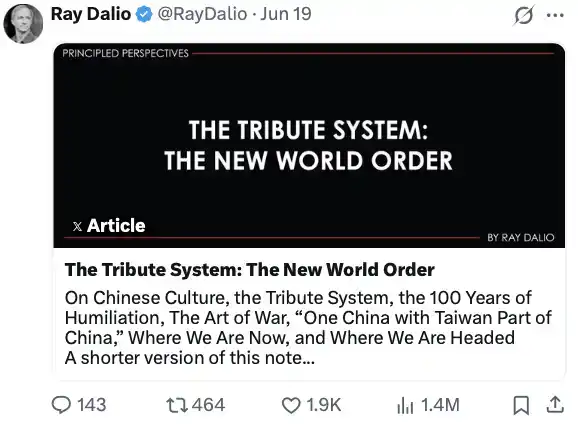
Dalio's assessment is sharp: as US relative deterrence declines and China's economic and financial influence rises, Asian countries may reassess who can provide security and economic order. He borrows the historical concept of the 'tribute system', referring not to simple direct control, but to a hierarchical relationship composed of power differentials, economic interests, diplomatic protocol, and pressure constraints.

One real-world focal point is East Asia's advanced semiconductor supply chain. Related regions hold key positions in the global manufacturing of advanced semiconductors, particularly AI-chip-related wafer fabrication. Public data widely indicates that this region produces over 60% of the world's semiconductors and over 90% of the most advanced chips. Even without extreme events, delays in commitments, shipping uncertainties, diplomatic pressure, or progress in supply chain self-sufficiency alone could be enough to cause related assets to fluctuate in advance.

US Commitments Becoming 'Negotiable' Is a Danger Signal in Dalio's Eyes

Dalio observes several recent events along the same line.

First is the Middle East conflict and risks in the Strait of Hormuz. Market reports surrounding Iran, energy transport, and the cost of US intervention are used by him as an analogy: the US public and government are increasingly unwilling to bear the cost of long-term, multi-front conflicts. This analogy is more of a macro investor's historical reference; it does not mean Middle East developments have already proven US decline. But it explains why a strait risk gets incorporated into narratives about shifts in Sino-US power.

Second is the pace of progress in some US external arrangements. According to reports from AP, *The Washington Post*, etc., planned arrangements involving around $14 billion have not yet been fully finalized. Concerned parties state they have not received suspension notices; a US acting Navy secretary stated that some external arrangements were delayed due to the Iran war and munitions needs. Trump also referred to related matters as a 'negotiating chip' in talks with China.

This is the part most sensitive to the market. If US commitments to key regions are understood by the outside world as negotiable, other Asian economies will reassess the reliability of US promises. Whether the related arrangements are ultimately implemented remains undecided, but 'uncertainty' itself already constitutes a signal.

Third is the change in tone from the US in Asian security forums. US Secretary of Defense Pete Hegseth's speech at the Shangri-La Dialogue on May 30th was interpreted by media compared to 2025 as toning down its hawkishness towards China, though he still emphasized the US would maintain a favorable balance of power in the Indo-Pacific and remain vigilant about China's military expansion. This may not represent a US withdrawal from Asia, but it deepens one question: when the US simultaneously faces pressures in the Middle East, Europe, and the Indo-Pacific, how much cost is it willing to bear for its regional commitments?

'Tribute-Style Order' Is Not a History Lesson, But an Explanation of Indirect Pressure

Dalio's argument sparks discussion because he does not explain China solely from a military perspective, but combines economics and finance, historical narratives, and political culture.

In his understanding, the traditional 'tribute system' was more like a set of regional order arrangements: surrounding states acknowledged power differentials in exchange for trade, protection, and stability; the central state maintained influence through rewards, punishments, protocol, and access rules, without frequently resorting to direct control.

This connects to the idea in *The Art of War* of 'subduing the enemy without fighting'. Truly effective pressure may not be firing shots, but forcing an opponent to adjust on their own in the face of economic, diplomatic, supply chain, and internal costs.

The advanced chip supply chain thus becomes the focal point of this logic. For global markets, key regions are where advanced chip production capacity is highly concentrated. Technology, capital, and regional order overlap here, amplifying any changes in pressure.

Dalio also notes that China's export profits, accumulation of capital surpluses, increased use of the RMB in trade and capital transactions, and the enhanced competitiveness of China's financial system will increase its appeal to neighboring countries. This is not equivalent to 'China's financial system has already replaced the US', but if more trade, financing, and supply chain arrangements revolve around China, regional economies' choices between security and economics will become more complex.

Advanced Chips Are the First Pressure Point Where Markets React

For investors, the most critical question is not 'will an extreme event immediately occur', but whether pressure will change asset prices before an extreme event happens.

Related regions produce the majority of the world's advanced chips. AI servers, cloud computing capital expenditures, semiconductor equipment, and consumer electronics supply chains are all highly tied to them. The AI chip supply chain does not only involve wafer fabrication but also includes HBM, advanced packaging, equipment, and materials. However, the most advanced process capacity is concentrated in key East Asian regions, which remains one of the most sensitive geopolitical risk exposures for global tech stocks.

This is also why Dalio emphasizes 'non-direct conflict'. Modern financial markets do not need to wait for the worst outcome to occur before adjusting. Shipping insurance, chip inventories, corporate capital expenditures, USD and RMB flows, and Asian equity, currency, and bond assets may all fluctuate as risk expectations change.

If China continues to advance self-sufficiency in advanced chips, the external constraints of key production capacity on the mainland supply chain may decrease; but in the short term, related regions remain a key link the global AI industry cannot bypass. The so-called 'threat-as-action' refers precisely to this: when critical capacity is concentrated in a high-pressure region, even just the possibility of blockade or sanctions is enough to affect global tech stock valuations and corporate procurement decisions.

The RMB and Chinese assets will also face dual impacts. On one hand, China's trade surplus and increased use in cross-border settlements will support the RMB internationalization narrative; on the other hand, if regional risks heat up, capital will also reassess the political risk and liquidity constraints of Chinese assets.

Policy Volatility and Miscalculation Are the Hardest Parts to Price

Dalio has not packaged his judgment as a definitive conclusion. His identity is that of a global macro investor; the advantage lies in observing historical cycles, monetary finance, and geopolitical shifts together; the limitation is also here—it's more of a macro scenario than an official policy roadmap.

US policy itself can be volatile. The Trump administration can treat some external arrangements as negotiating chips, but may also re-strengthen regional commitments under pressure from Congress, allies, or electoral politics. The open and contentious nature of US domestic politics increases short-term swings but may also create reverse constraints on key issues.

Internal regional factors will also influence the pace. Different approaches within regions emphasize communication, confrontation, and risk management differently. Election cycles around 2028, US midterms, and China's internal political schedule may all change the timing of actions by various parties.

Chip self-sufficiency is also not something that can be achieved by slogans alone. Advanced processes, equipment, materials, EDA software, and talent systems all require time. If China cannot significantly reduce external dependency in key links, the importance of East Asia's advanced chip capacity will only increase, and the cost of pressure maneuvers will be harder to control.

Indirect pressure does not equal low risk. The greater the reliance on deterrence, ambiguous signals, and diplomatic probing, the more prone the situation is to miscalculation. What the market fears may not be an extreme event suddenly occurring one day, but rather all parties repeatedly testing each other between commitments, exercises, blockades, sanctions, and negotiations, ultimately pushing the situation to a harder-to-manage point. What Dalio truly reminds investors is that changes in the Asian order may not begin with a clear conflict, but first manifest in wavering commitments, diplomatic alignment, chip anxiety, and shifts in capital flows.


Cryptos en tendance

Questions liées

QWhat is Ray Dalio's main concern regarding the changing world order?

ARay Dalio's main concern is a shifting global order where a perceived decline in the reliability of US commitments and the rise of China's economic/financial influence is leading to a modern 'tribute system' in Asia. This could cause regional instability, with financial markets reacting first to changes in risk, supply chains, and capital flows before any direct conflict occurs.

QAccording to the article, why are advanced semiconductor supply chains considered a primary pressure point?

AAdvanced semiconductor supply chains, particularly in a key East Asian region, are a primary pressure point because they produce over 90% of the world's most advanced chips. Their concentration in a geopolitically sensitive area makes global tech valuations and corporate investment decisions highly vulnerable to perceived risks of disruption, delay, or sanctions, even before any extreme events take place.

QHow does Ray Dalio use the historical concept of a 'tribute system' in his analysis?

ADalio uses the 'tribute system' concept not to suggest direct Chinese control, but as an analogy for a hierarchical regional order built on power differentials, economic benefits, diplomatic protocol, and pressure. It represents a scenario where neighboring countries might align with China based on economic and security calculations, with influence maintained through incentives, penalties, and access rather than outright military conquest.

QWhat are the specific examples the article gives of US commitments becoming 'negotiable'?

AThe article cites the delayed implementation of a planned $14 billion arrangement with a key partner, reports of its potential use as a 'negotiating chip' in US-China talks, and a perceived softening of rhetoric from the US Defense Secretary at a major Asian security forum. These instances create uncertainty about the cost and reliability of US security guarantees in Asia.

QWhat does the article suggest is the most difficult factor for financial markets to price in this situation?

AThe most difficult factor for markets to price is policy volatility and the risk of miscalculation. Both US and regional policies can swing due to domestic politics and election cycles. As各方 rely more on indirect pressure, deterrence, and ambiguous signals, the risk of an unintended escalation from repeated probes and counter-probes increases, creating an unstable environment that is hard to quantify.

Lectures associées

L'histoire complète de Blockstream, la licorne de la cryptographie, profondément impliquée dans de graves fraudes

Depuis le début de l'année, Blockstream, la société cofondée par le pionnier du Bitcoin Adam Back, est sous le feu des critiques. Une enquête publiée début juin par NatInfoSec accuse la société d'avoir potentiellement levé des milliards de dollars via des billets de mine (BMN) liés à des revenus miniers, mais soulève des doutes sur la réalité des fermes de minage et de la puissance de calcul sous-jacente, évoquant des caractéristiques de type schéma de Ponzi. Les principaux points d'accusation sont les suivants : 1. **Capacité de minage et de paiement douteuses** : Pour honorer ses obligations, Blockstream aurait besoin d'une puissance de calcul bien supérieure (20-45 EH/s) à celle affichée sur son tableau de bord (15 EH/s). Aucune preuve publique (connexions électriques, importations de matériel, parts de pool minier) ne corrobore l'existence d'une infrastructure à cette échelle. Les clauses contractuelles permettraient de plus d'utiliser des bitcoins provenant de sources non divulguées pour les paiements. 2. **Rendements élevés et risque** : Les billets offriraient des rendements fixes allant jusqu'à environ 20% par an, ce qui est considéré comme très élevé et difficile à justifier dans le secteur cyclique du minage de Bitcoin. 3. **Antécédents et divulgation concernant Chris Cook** : Christopher William Cook, ancien responsable des opérations minières de Blockstream et actuel PDG d'Exacore (une entité scindée), a été condamné en 2008 pour fraude postale. Ce passé judiciaire n'aurait pas été divulgué dans les documents d'offre des BMN. Des allégations portent également sur des déclarations trompeuses concernant son expérience professionnelle. 4. **Implications potentielles pour BSTR** : L'enquête soulève des questions sur l'entreprise Bitcoin Standard Treasury (BSTR), liée à Adam Back, qui prévoit une introduction en bourse via SPAC, s'interrogeant sur la divulgation des risques liés aux BMN et sur d'éventuels conflits d'intérêts dans sa structure. La recherche BitMEX a apporté des nuances, confirmant probablement les antécédents de Cook et s'interrogeant sur les rendements, mais estimant que d'autres accusations manquaient de preuves ou étaient trompeuses, notamment concernant la séparation juridique entre les BMN et BSTR. Le débat dans la communauté s'est concentré sur la **vérifiabilité** : les investisseurs et observateurs peuvent-ils indépendamment vérifier la puissance de calcul, les revenus miniers réels et la source des paiements ? Malgré les prises de position divergentes, des questions cruciales sur les BMN demeurent sans réponse claire : leur taille réelle et leurs limites de responsabilité, l'adéquation entre la puissance minière et les obligations, l'origine des rendements élevés, la traçabilité des paiements en BTC, et le rôle exact de Chris Cook. Blockstream n'a pas encore publié de réponse systématique à ces allégations.

marsbitIl y a 1 h

L'histoire complète de Blockstream, la licorne de la cryptographie, profondément impliquée dans de graves fraudes

marsbitIl y a 1 h

Le collectif Reddit qui avait "short-squeezé" Wall Street a-t-il trouvé le prochain GME ?

En juin 2024, l'action de Wendy's (WEN) a connu une hausse significative après la diffusion d'un post populaire sur le forum Reddit r/wallstreetbets intitulé "We need to save Wendy's". Cette dynamique rappelle le phénomène des meme stocks, comme celui de GameStop (GME) en 2021. Le post, jouant sur un running gag de la communauté (le fait de devoir travailler chez Wendy's après de mauvais trades), a généré un fort engouement retail, se traduisant par un volume d'échanges anormalement élevé et une hausse de prix. WEN présente certains ingrédients classiques d'un "short squeeze" potentiel : un taux de ventes à découvert élevé (environ 32% des actions en circulation) et une attention communautaire soutenue. Cependant, l'article nuance fortement la comparaison avec le squeeze historique de GME. La structure est jugée moins extrême : le taux de découvert est significatif mais loin des niveaux de GME (qui avait dépassé 100%), et il manque pour l'instant des preuves solides d'un "gamma squeeze" auto-entrenenu via les options. L'élan actuel semble davantage être un "meme pop" à court terme, alimenté par l'attention et un faible prix de l'action, plutôt qu'un mouvement de fond structurel. L'histoire montre que Wendy's, par sa notoriété et son lien avec la culture WSB, est propice à ce genre de vague, mais que la volatilité qui en découle est souvent temporaire. La durabilité de la hausse dépendra de la persistance de la discussion en ligne, des volumes d'échanges sur plusieurs jours et surtout de l'activité sur le marché des options, qui pourrait, ou non, amplifier mécaniquement la tendance.

marsbitIl y a 1 h

Le collectif Reddit qui avait "short-squeezé" Wall Street a-t-il trouvé le prochain GME ?

marsbitIl y a 1 h

La Corée du Sud cible 40 opérateurs de crypto non enregistrés dans un resserrement de la réglementation

L'unité de renseignement financier de Corée du Sud a signalé environ 40 fournisseurs de services d'actifs virtuels non enregistrés aux autorités policières, renforçant ainsi la réglementation du secteur. Selon la loi sud-coréenne, toutes les plateformes d'échange de cryptomonnaies doivent obtenir une certification ISMS et s'enregistrer auprès de la FIU avant d'opérer. Actuellement, seules 28 entités sont conformes. L'enquête a révélé que des plateformes étrangères contournaient la réglementation en ciblant des clients locaux via des messageries comme Telegram et KakaoTalk. Des changeurs privés convertissaient également des stablecoins en won pour des résidents étrangers, tandis que des créateurs de contenu promouvaient illégalement ces échanges. Cette action s'inscrit dans un effort plus large visant à aligner les normes de conformité sur les recommandations du GAFI. La Corée dudu Sud, représentée par le directeur de la FIU Lee Hyung-joo, plaide pour la suppression des seuils de transaction dans la règle de voyage, prévoyant des vérifications d'identité obligatoires pour toutes les transactions cryptographiques à partir d'août. Les autorités intensifient globalement leur surveillance en 2026, poursuivant les manipulations de marché et renforçant la collaboration inter-agences pour lutter contre le blanchiment d'argent et les transactions illégales.

TheNewsCryptoIl y a 2 h

La Corée du Sud cible 40 opérateurs de crypto non enregistrés dans un resserrement de la réglementation

TheNewsCryptoIl y a 2 h

Le géant de la cryptographie Blockstream au cœur d'une grave allégation de fraude - Récit complet

Le géant de la crypto Blockstream, fondé par le pionnier du Bitcoin Adam Back, est au cœur d'une polémique concernant ses obligations minières (BMN). Une enquête du compte NatInfoSec l'accuse de collecter des milliards de dollars auprès des investisseurs pour du minage, mais soulève de graves doutes sur l'existence réelle des infrastructures de minage nécessaires pour honorer ces engagements. Les principaux points d'interrogation portent sur : - L'inadéquation entre la puissance de calcul affichée (15 EH/s) et celle requise pour couvrir les obligations (estimée entre 35 et 45 EH/s). - L'impossibilité de vérifier cette puissance via les canaux publics habituels (réseaux électriques, importations, pools miniers). - Des rendements annuels fixes élevés, jusqu'à 20%, difficiles à justifier dans un secteur aussi volatil que le minage de Bitcoin. - Le passé pénal de Christopher William Cook, cadre clé des activités minières de Blockstream, condamné pour fraude en 2008. Cette information n'était pas divulguée dans les documents d'offre des BMN. - Des inquiétudes sur la source réelle des bitcoins versés aux investisseurs, certaines clauses contractuelles permettant d'utiliser des BTC provenant d'ailleurs que des mines. La controverse s'étend à la société Bitcoin Standard Treasury Company (BSTR), liée à Adam Back et en cours d'introduction en bourse, sur laquelle pèsent des questions de gouvernance et de divulgation des risques liés aux BMN. Si BitMEX Research a tempéré certaines accusations en soulignant le manque de preuves ou des erreurs d'interprétation, la communauté demande plus de transparence. Les questions centrales restent sans réponse claire : la taille réelle des engagements, la vérification indépendante de la puissance minière et des revenus, et l'origine des rendements promis. Blockstream n'a pas encore apporté de réponse systématique à ces allégations.

链捕手Il y a 3 h

Le géant de la cryptographie Blockstream au cœur d'une grave allégation de fraude - Récit complet

链捕手Il y a 3 h

Trading

Spot
Futures

Articles tendance

Comment acheter ORDER

Bienvenue sur HTX.com ! Nous vous permettons d'acheter Orderly (ORDER) de manière simple et pratique. Suivez notre guide étape par étape pour commencer votre parcours crypto.Étape 1 : Création de votre compte HTXUtilisez votre adresse e-mail ou votre numéro de téléphone pour ouvrir un compte sur HTX gratuitement. L'inscription se fait en toute simplicité et débloque toutes les fonctionnalités.Créer mon compteÉtape 2 : Choix du mode de paiement (rubrique Acheter des cryptosCarte de crédit/débit : utilisez votre carte Visa ou Mastercard pour acheter instantanément Orderly (ORDER).Solde :utilisez les fonds du solde de votre compte HTX pour trader en toute simplicité.Prestataire tiers :pour accroître la commodité d'utilisation, nous avons ajouté des modes de paiement populaires tels que Google Pay et Apple Pay.P2P :tradez directement avec d'autres utilisateurs sur HTX.OTC (de gré à gré) : nous offrons des services personnalisés et des taux de change compétitifs aux traders.Étape 3 : stockage de vos Orderly (ORDER)Après avoir acheté vos Orderly (ORDER), stockez-les sur votre compte HTX. Vous pouvez également les envoyer ailleurs via un transfert sur la blockchain ou les utiliser pour trader d'autres cryptos.Étape 4 : tradez des Orderly (ORDER)Tradez facilement Orderly (ORDER) sur le marché Spot de HTX. Il vous suffit d'accéder à votre compte, de sélectionner la paire de trading, d'exécuter vos trades et de les suivre en temps réel. Nous offrons une expérience conviviale aux débutants comme aux traders chevronnés.

317 vues totalesPublié le 2024.12.10Mis à jour le 2026.06.02

Comment acheter ORDER

Discussions

Bienvenue dans la Communauté HTX. Ici, vous pouvez vous tenir informé(e) des derniers développements de la plateforme et accéder à des analyses de marché professionnelles. Les opinions des utilisateurs sur le prix de ORDER (ORDER) sont présentées ci-dessous.

活动图片