Breaking: Google Gemini Co-Head Poached by OpenAI

marsbitPublié le 2026-06-18Dernière mise à jour le 2026-06-18

Résumé

In a significant industry move, Noam Shazeer, a former DeepMind researcher and co-lead of Google's Gemini project, has officially joined OpenAI as the Lead for Architecture Research. Shazeer is a legendary figure in AI, best known as a core author of the seminal 2017 paper "Attention Is All You Need," which introduced the Transformer architecture foundational to modern models like GPT and Gemini. Shazeer announced his move on social media, expressing excitement to join OpenAI's team while also thanking his former colleagues at Google. His career spans over 18 years at Google, where he contributed to key technologies including the Mixture of Experts (MoE) architecture, Mesh TensorFlow, and the LaMDA model. He left Google in 2021 to co-found the conversational AI company Character.AI, which achieved a multi-billion dollar valuation. In 2024, he returned to Google's DeepMind via a major technology licensing deal to help lead the Gemini project. His departure is viewed as a substantial loss for Google and a major talent acquisition for OpenAI, which is intensifying its competition with rivals like Anthropic. At OpenAI, Shazeer will focus on exploring next-generation AI model architectures and the evolution beyond the current Transformer paradigm. The move underscores the fierce competition for top AI research talent as companies race to develop advanced AI systems.

June 19, ZHIDONGSHE News, Today, Google DeepMind researcher and Gemini co-head Noam Shazeer has officially joined OpenAI, where he will serve as the Lead for Architecture Research. He will be responsible for exploring next-generation AI model architectures and driving the further evolution of the Transformer architecture.

Shazeer himself announced his move to OpenAI in a post on the overseas social platform X, stating: "I'm thrilled to join OpenAI and look forward to working with the exceptional team here."
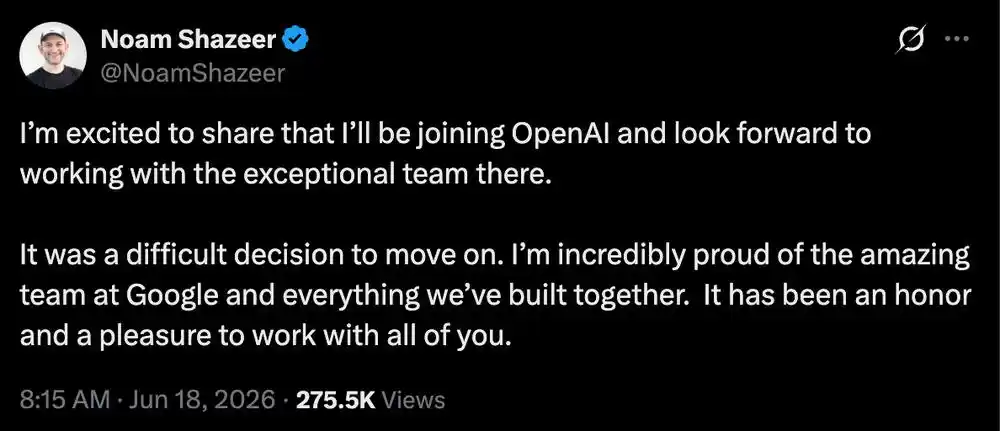
Simultaneously, he expressed gratitude to the Google team: "Leaving was a difficult decision. I'm immensely proud of the Google team and everything we've accomplished together. It has been a privilege to work with you all." A Google spokesperson, in a response to Reuters, stated that the company is grateful for Shazeer's significant contributions over the years and wishes him all the best in his future endeavors.

Noam Shazeer is one of the legendary figures in the AI field. He is one of the core authors of the seminal 2017 paper 'Attention Is All You Need', which first proposed the Transformer architecture, directly establishing the technical foundation for modern large models like the GPT series, Gemini, and Claude.
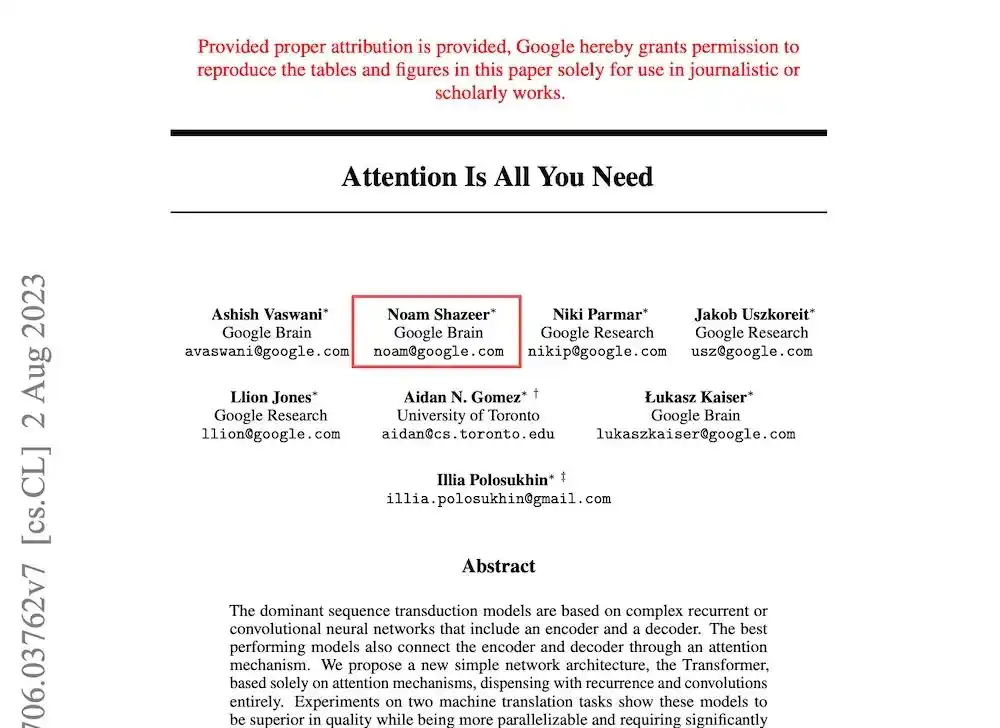
'Attention Is All You Need'

Before joining OpenAI, Shazeer had left Google in 2021 to found Character.AI. In fact, Shazeer is best known as the Co-founder and CEO of Character.AI.

This company bet on the "AI companionship"赛道 even earlier than the ChatGPT explosion, allowing users to engage in long-term conversations with various AI characters. It once became one of the fastest-growing consumer AI applications globally. By 2023, Character.AI's valuation had exceeded $1 billion (approximately RMB 6.765 billion).

In 2024, Google reached a technology licensing agreement with Character.AI valued at approximately $2.7 billion (about RMB 18.266 billion), bringing Noam Shazeer and part of the core team back into DeepMind. Noam Shazeer was appointed as a Gemini co-head, involved in the pre-training R&D of the next-generation Gemini models.

For OpenAI, which is fiercely competing with Anthropic, this is viewed externally as one of the most significant top-tier talent acquisitions in recent years. Following the announcement, OpenAI's senior leadership and several renowned researchers immediately left welcoming messages on X.

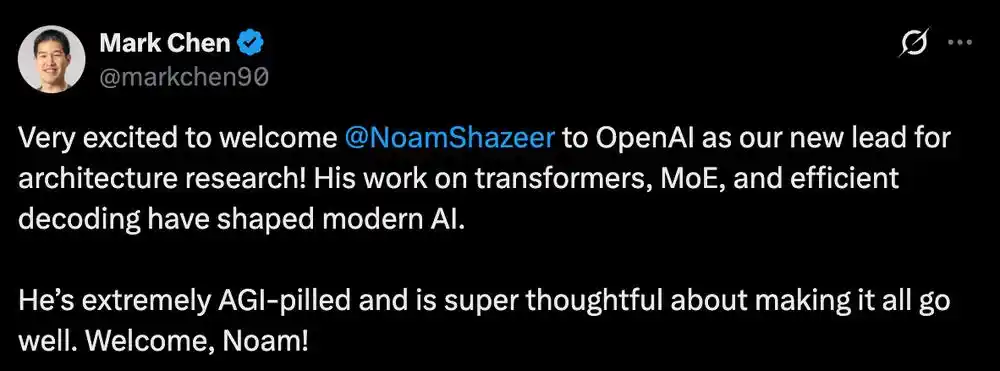
OpenAI's Chief Research Officer, Mark Chen, posted: "Very excited to welcome Noam Shazeer to OpenAI as our Lead for Architecture Research. His work on Transformers, MoE, and efficient decoding has shaped modern AI."
Subsequently, numerous AI researchers also offered congratulations in the comments section, including Google DeepMind researcher and Chinese member of the Gemini Thinking and Coding team, Yuchen Zhuang; OpenAI researcher and core contributor to the o-series reasoning models, Noam Brown; and former Microsoft AI VP, now OpenAI researcher, Sebastien Bubeck, among others.

Google DeepMind Chinese researcher Yuchen Zhuang

OpenAI o-series reasoning model core contributor Noam Brown

OpenAI researcher Sebastien Bubeck

Meanwhile, netizens lamented: "Losing a Transformer author and Gemini co-head is undoubtedly a heavy blow for Google."

01. Renowned Transformer Author, Worked at Google for Nearly 18 Years

From the perspective of the history of generative AI, Noam Shazeer has participated in nearly every key milestone. He joined Google in 2000, serving as a Software Engineer and later Principal Software Engineer, accumulating over 18 years of work experience.
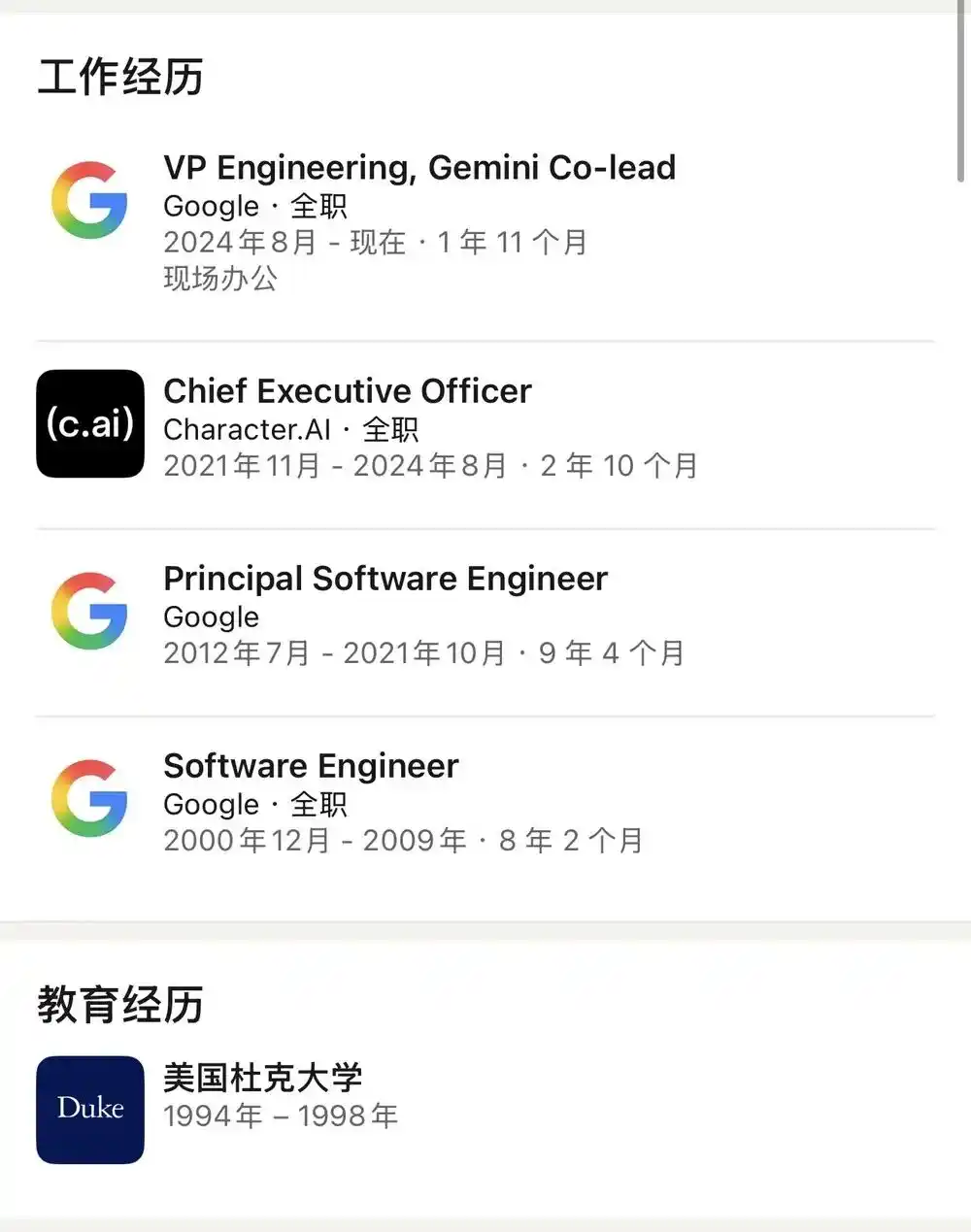
Noam Shazeer's Work Experience and Education Background (Source: LinkedIn)

In 2017, he, along with Ashish Vaswani, Jakob Uszkoreit, and six other Google researchers, co-authored the seminal paper 'Attention Is All You Need', proposing the Transformer architecture. Compared to the then-dominant RNN and LSTM models, the Transformer could process long text more efficiently and possessed greater scalability.

Over the past few years, models such as OpenAI's GPT series, Google's Gemini, Anthropic's Claude, as well as DeepSeek and Llama, are almost all built upon the Transformer architecture at their core. In other words, today's global wave of large models largely rests on the technical foundation laid by this paper.

However, the Transformer is just one of Noam Shazeer's many notable contributions.

During his tenure at Google, he also contributed to the advancement of numerous influential large model technologies. In 2017, as the first author, he proposed the Sparse Gated Mixture of Experts (MoE) architecture, providing crucial technical ideas for later models like GPT-4, Gemini, and DeepSeek-V3; in 2018, he participated in developing Mesh TensorFlow, providing foundational tools for super-large-scale Transformer training; subsequently, he was also involved in key project R&D such as the T5 model and Google's dialogue model LaMDA.

02. Left Google to Start a Company, Then Bought Back for $18.2B

In 2021, Shazeer left Google and co-founded Character.AI with Daniel De Freitas.

At that time, large language models had not yet experienced their "ChatGPT moment," but Character.AI was already pioneering efforts to bring chatbot products to the mass market, rapidly accumulating a large user base.

In 2024, Google reincorporated Shazeer and his core team into the DeepMind ecosystem through a cooperation deal worth approximately $2.7 billion (about RMB 18.266 billion). He subsequently became one of the key leaders of the Gemini project, participating in the pre-training of the next-generation Gemini models.

Shazeer's return coincided with a period of immense pressure on Google's AI business. ChatGPT had exploded in popularity, and Gemini was still in a catch-up phase. After returning to DeepMind, Shazeer participated in model R&D and eventually assumed the role of Gemini co-head, becoming one of the leading figures in Google's AI technology.

Following this, the Gemini 3 series models ranked at the forefront in multiple benchmark tests such as coding and reasoning, becoming a significant asset in Google's competition with OpenAI and Anthropic.

From Google researcher, to entrepreneur, to Gemini co-head, Shazeer has witnessed nearly every major turning point in Google's AI development over the past decade. Therefore, his departure from Google to join OpenAI is regarded by many industry insiders as one of the most significant talent loss events for Google in recent years.

03. OpenAI's Talent Battle Continues to Escalate

Shazeer's joining unfolds against the backdrop of increasingly fierce talent competition in the AI industry.

Over the past year, competition between OpenAI and Anthropic has continued to intensify. The two are not only competing over model capabilities but are also constantly vying for top researchers and core engineers.

The UK's Financial Times reported that OpenAI internally views Shazeer's addition as a major reinforcement. In the future, he will focus on researching new architectural directions beyond the Transformer, and on further enhancing model capabilities.

It's worth noting that the Transformer has dominated the AI field for nearly a decade. With the development of reasoning models, multi-agent systems, and world models, more and more researchers are beginning to ponder: Will the Transformer undergo its next major architectural upgrade?

And Shazeer is precisely one of the most qualified individuals to answer that question.

For Google, this means losing a Transformer author, a Gemini co-head, and one of its most seasoned AI architecture designers. For OpenAI, its laboratory welcomes someone who has personally shaped the modern AI technology stack.

04. Conclusion: A Significant Talent Move in the Transformer Era

As technology gradually approaches the frontier, top researchers themselves have become one of the scarcest resources. The trajectory of Noam Shazeer's career almost connects four key nodes: Transformer, Character.AI, Gemini, and OpenAI.

Now, this Transformer author's departure from Google and joining of OpenAI is not only a talent movement but also reflects the increasingly fierce competitive landscape among current AI giants.

Especially at a time when OpenAI and Anthropic are engaged in a white-hot competition over next-generation models, the enterprise market, and top research talent, and Google is also catching up through Gemini. Losing a Transformer founder and Gemini co-head at this juncture is undoubtedly a significant loss for Google.

For the entire industry, a subsequent question worth following is: When a Transformer author personally researches "architectures beyond the Transformer," where will the next generation of AI models head.

This article is from the WeChat public account "Zhixidongxi" (ID: zhidxcom), author: Jiang Yu, editor: Li Shuiqing

Questions liées

QWho is Noam Shazeer and what is his significance in the AI field?

ANoam Shazeer is a renowned AI researcher, a core author of the seminal 2017 paper 'Attention Is All You Need' which introduced the Transformer architecture, and the former co-lead of Google's Gemini project. His work laid the technical foundation for modern large language models like GPT, Gemini, and Claude.

QWhat new role did Noam Shazeer take at OpenAI and what will he be responsible for?

ANoam Shazeer joined OpenAI as the Lead for Architecture Research. He will be responsible for exploring next-generation AI model architectures and driving the further evolution of the Transformer architecture.

QWhat was the nature of the significant deal between Google and Character.AI involving Shazeer in 2024?

AIn 2024, Google reached a technology licensing deal with Character.AI valued at approximately $2.7 billion (RMB 18.266 billion). This deal brought Noam Shazeer and part of the core team back into Google DeepMind, where he was appointed co-lead of the Gemini project.

QWhy is Shazeer's move to OpenAI considered a significant loss for Google?

AShazeer's departure is considered a significant loss for Google because he is a Transformer author, a former Gemini co-lead, and one of its most senior AI architecture designers. Losing such a key figure in the midst of intense competition with OpenAI and Anthropic is a substantial setback.

QWhat broader industry trend does Shazeer's career move highlight according to the article?

AShazeer's move highlights the increasingly fierce competition for top-tier AI research talent among major tech companies like OpenAI, Google, and Anthropic. As technology pushes the frontier, these researchers themselves become among the most scarce and valuable resources.

Lectures associées

Ne vous focalisez pas uniquement sur les licenciements, la nouvelle architecture de la Fondation Ethereum mérite plus d'attention

L’Ethereum Foundation (EF) a réorganisé sa structure, réduisant ses effectifs d’environ 20% (54 personnes) et son budget annuel de 40%. Cette restructuration vise à recentrer ses ressources et sa mission sur les couches fondamentales et difficiles à externaliser du protocole Ethereum. La nouvelle organisation priorise clairement la **couche Protocole** (57 personnes), suivie de la couche d’Accès (34). L’EF concentre désormais ses efforts sur les attributs essentiels d’Ethereum : la sécurité, la résistance à la censure, la vie privée, l’évolution du protocole et les clients. Des enjeux techniques de long terme comme la **sécurité post-quantique**, le **zkEVM**, la vérification formelle et la finalité sont désormais structurés en équipes dédiées et responsabilisées. Cette refonte s’accompagne d’un objectif financier : passer d’une consommation annuelle moyenne de 15% des réserves à environ 5% d’ici 2030, pour assurer la pérennité de la fondation. Parallèlement, l’EF encourage l’émergence de « nœuds » externes dans l’écosystème, comme EthLabs, pour prendre en charge des domaines plus proches de l’adoption, des applications et du développement produit. Le signal est fort : l’EF abandonne le modèle « généraliste » pour se concentrer sur les problèmes techniques complexes et de long terme, tout en partageant la responsabilité de construire l’écosystème avec d’autres organisations. L’enjeu sera de maintenir une coordination efficace au sein de cette nouvelle structure multipolaire.

Foresight NewsIl y a 9 mins

Ne vous focalisez pas uniquement sur les licenciements, la nouvelle architecture de la Fondation Ethereum mérite plus d'attention

Foresight NewsIl y a 9 mins

Analyse de rapport : Au cœur de l'explosion du CPO, quelle stratégie déploie Coherent ?

L'analyste de J.P. Morgan Samik Chatterjee réitère sa recommandation « surpondérer » pour Coherent (COHR), estimant que le marché sous-évalue son potentiel de croissance. La thèse repose sur trois piliers : 1. **Transmetteurs pour centres de données :** La demande pour ses transmetteurs 1.6T, désormais standard, reste forte avec une dynamique de prix saine. La tendance vers le CPO (Co-Packaged Optics) devrait stimuler, et non remplacer, la demande de composants optiques haut de gamme. 2. **CPO et OCS, des opportunités sous-estimées :** COHR possède un avantage dans le CPO grâce à son portefeuille complet de composants optiques (lasers, isolateurs, etc.), lui permettant de capturer une plus grande valeur par puce. Pour l'OCS (Optical Circuit Switch), son approche par cristaux liquides présente des avantages en fiabilité et consommation face aux solutions MEMS, sur un marché potentiel de 4 milliards de dollars. 3. **Croissance industrielle et amélioration de la marge :** Le segment industriel maintient une croissance organique de 5 à 10%. Parallèlement, la société vise une marge brute supérieure à 42%, soutenue par les produits premium, la transition vers des plaquettes de 6 pouces réduisant les coûts, et le déploiement de nouvelles solutions comme les matériaux de refroidissement haute performance. La stratégie inclut également un quadruplement planifié de la capacité de production de composants InP (phosphure d'indium) et une intégration verticale dans les systèmes à laser pompe, où COHR détient une position dominante. En résumé, la position clé de Coherent dans l'infrastructure optique pour l'IA, couplée à ces moteurs de croissance, fonde la recommandation positive.

marsbitIl y a 33 mins

Analyse de rapport : Au cœur de l'explosion du CPO, quelle stratégie déploie Coherent ?

marsbitIl y a 33 mins

Après une réduction de 20% des effectifs, quels sont les points clés de la nouvelle structure de l'EF ?

L' Ethereum Foundation (EF) a annoncé une restructuration organisationnelle, incluant une réduction de 20 % de ses effectifs (soit 54 employés). L'objectif déclaré est d'aligner l'organisation sur son "Mandat" de 2026, en se concentrant sur les principes fondamentaux de CROPS (Censure-Resistance, Openness & Freedom, Privacy, Security) et en devenant plus agile. La nouvelle structure est organisée autour de cinq pôles principaux : 1. **Protocole** : Recherche fondamentale et développement du protège (sécurité post-quantique, zkEVM, etc.). 2. **Accès** : Garantir un chemin d'accès sans confiance et sans autorisation pour les utilisateurs. 3. **Utilisateur** : Représenter les besoins des utilisateurs finaux. 4. **Communauté** : Maintenir les liens avec les alliés open-source et les défenseurs des libertés. 5. **Institutionnel** : Engager les entreprises et les gouvernements tout en veillant au respect des valeurs d'Ethereum. L'EF souligne que cette réorganisation n'est pas motivée par une crise financière, mais par une volonté de recentrage stratégique. Des dispositions (indemnités supérieures au légal, aide au reclassement dans l'écosystème) sont prévues pour les employés concernés. Les observateurs notent cependant que ce changement intervient dans un contexte de pression sur la gouvernance de l'EF et de fragmentation de l'écosystème L2. L'impact réel sur le rythme des mises à jour du protocole, le financement des biens publics et l'orientation stratégique reste à clarifier, l'EF promettant plus de détails dans les semaines à venir.

marsbitIl y a 43 mins

Après une réduction de 20% des effectifs, quels sont les points clés de la nouvelle structure de l'EF ?

marsbitIl y a 43 mins

Le MEV bot le plus avancé volé de 7,5 millions de dollars : L'Approval, le risque mortel le plus négligé sur la blockchain ?

Un robot MEV sophistiqué sur Ethereum, Jaredfromsubway.eth, a été victime d'une attaque ciblée ayant entraîné une perte d'environ 7,5 millions de dollars. L'attaquant a déployé des pools de liquidités et des jetons factices pour piéger le robot, l'amenant à accorder des autorisations (Approvals) ERC-20 malveillantes. Ces autorisations ont ensuite été utilisées pour drainer ses fonds. Cet incident met en lumière le risque fondamental et souvent négligé des Approvals dans l'écosystème DeFi. Contrairement aux vulnérabilités de contrat intelligent, le risque lié aux autorisations est systémique. Une fois accordée, une autorisation permet à un contrat d'accéder aux jetons d'un utilisateur, potentiellement indéfiniment. Les pratiques courantes comme l'approbation illimitée ("unlimited approval") et le manque de révocation des autorisations inutilisées augmentent considérablement l'exposition des utilisateurs. Un contrat initialement légitime peut devenir une menace s'il est compromis ultérieurement. Pour atténuer ces risques, les utilisateurs doivent adopter le principe du moindre privilège, en n'autorisant que les montants strictement nécessaires, utiliser des portefeuilles distincts pour les interactions avec des DApps, et révoquer régulièrement les autorisations inutiles via des outils dédiés. Les portefeuilles, quant à eux, doivent renforcer leurs défenses en fournissant des alertes claires, une analyse lisible des transactions signées et des outils de gestion des autorisations intégrés. La sécurité en Web3 ne se limite pas à la protection des clés privées ; elle exige une vigilance constante sur les autorisations actives qui représentent un accès permanent aux actifs.

marsbitIl y a 47 mins

Le MEV bot le plus avancé volé de 7,5 millions de dollars : L'Approval, le risque mortel le plus négligé sur la blockchain ?

marsbitIl y a 47 mins

Trading

Spot
Futures
活动图片