AI Competition's New Battlefield: Long-term Memory Becomes the Pain Point, How Users Can Secure Their Own Context Ownership

marsbitPublié le 2026-06-02Dernière mise à jour le 2026-06-02

Résumé

A new front is emerging in the AI competition: user ownership of long-term memory and context. As AI models like ChatGPT evolve from chat tools into persistent digital assistants that learn user preferences and workflows, a critical question arises: who owns this accumulated "memory"? Currently, this personalized data is siloed within each platform (e.g., OpenAI, Anthropic, Google), creating a fragmented experience when users switch models. The article highlights ZetaChain's strategic pivot from blockchain interoperability to addressing this AI "memory" challenge. Its new focus is on building a "Private Memory Layer" and an "AI Consumer Layer." Through its consumer product Anuma, ZetaChain aims to give users encrypted, portable memory that can be used across different AI models. This system also envisions programmable, auditable permissions for AI agents and a framework where user knowledge can be monetized as shareable assets. Ultimately, ZetaChain's transformation reflects a broader infrastructure shift. The future bottleneck is less about raw model capability and more about continuous context, user-controlled identity, and permission management across multiple collaborating AI agents. The company's ZETA token is being repositioned as an "AI infrastructure token" to facilitate access, payments, and permissions within this proposed ecosystem. The core narrative advocates for returning control of personal context and AI relationships to users, rather than leaving them locke...

Author: Zen, PANews

You spent half a year training ChatGPT to understand your work habits, writing style, and long-term projects. It learned how you like to revise articles, which companies you often follow, and gradually came to understand your preferences for content structure, tone, and information density.

But one day, a newer, more powerful model appears. You open Claude, Gemini, or DeepSeek, and find yourself having to start all over again. The new model doesn't know you, isn't aware of the work context you've accumulated over the past months, and doesn't understand how you think, write, or make decisions.

Over the past two years, the most important competition in the AI industry revolved around "model capabilities." Whose reasoning was stronger, whose context window was longer, whose coding ability was better—these factors almost decided everything. But now, a new issue is emerging: AI is getting to know you better, but who exactly does this "understanding" belong to?

Role Shift: AI Transforms from Chat Tool to Personal Digital Assistant

In November 2022, the AI chatbot ChatGPT debuted, sparking a global chat craze. It reached 100 million monthly active users in just two months, becoming the fastest-growing consumer application in history. At that time, large language models were more like an "advanced search." Users asked AI questions, it generated instant answers, and when the conversation ended, the relationship also ended.

But in recent years, the role of AI has been undergoing a significant shift. As reasoning capabilities, coding abilities, and tool-calling functionalities have continuously improved, AI has begun to deeply integrate into real workflows. More and more people are using it to write code, organize information, analyze data, plan trips, manage schedules, and even for long-term participation in content creation and business decisions.

In many cases, users are no longer just "asking AI questions" but are engaging in long-term collaboration with AI. It starts to understand your working style, expression habits, and long-term goals, begins to consistently participate in the same project, the same workflow, and even gradually takes on some execution tasks. To some extent, AI is evolving from a one-time Q&A tool into a persistently available personal digital assistant.

And as model capabilities have significantly increased, the capabilities of top products have increasingly converged, and with AI being used long-term and extensively, new issues have begun to surface.
Once AI begins long-term collaboration, "memory"—the system storing and recalling past experiences to improve decision-making and overall performance—ceases to be just an inconsequential database. In many application scenarios, the bottleneck is no longer the model's reasoning level, but the capabilities related to long-term memory and context management. Cloudflare has also directly labeled agentic memory as one of the biggest challenges and fastest-developing areas in current AI infrastructure.

Leading AI companies have also realized that long-term memory is becoming part of the product experience. OpenAI has split ChatGPT's memory into saved memories and reference chat history. The former saves information users wish to retain long-term, while the latter allows ChatGPT to extract useful content from past conversations for subsequent personalized responses. Gemini has also begun learning user preferences based on prior conversations. Claude has introduced Memory and supports memory import and export.

Platform Silos Turn AI 'Memory' into a New Industry Battlefield

But the problem is that these memory capabilities are largely still confined to their respective platforms, belonging only to the platform's independent account systems and product environments—they remain isolated islands. Although Anthropic supports memory import/export, it currently functions more like a migration tool for Claude rather than a universal memory standard jointly adopted by various companies.

And this is precisely the gap ZetaChain aims to fill. After fully pivoting to AI, ZetaChain began extending the concept of "ownership," originally from the crypto world, further into AI memory and user context. What it hopes to build is not just a chat product, but a privacy memory layer (Private Memory Layer) independent of model platforms, allowing users to truly own their long-term memories, behavioral preferences, and AI context.
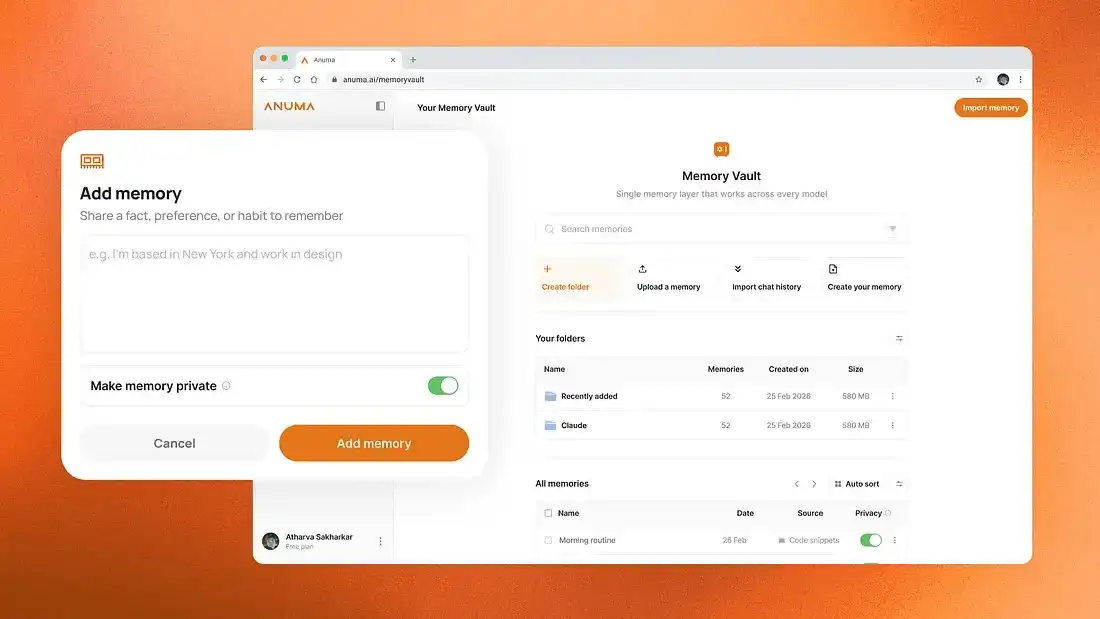
ZetaChain's consumer AI product, Anuma, advocates for users to own a set of encrypted private memory, supporting seamless use across mainstream AI models like ChatGPT, Claude, Gemini, etc. Users don't have to rebuild context, preferences, and work habits every time they switch models. Instead, users control access permissions and bring their historical memory to different models and agents.

As AI gradually accumulates users' usage preferences, writing habits, workflows, and historical conversations, the so-called "memory" will increasingly resemble a layer of "personality mirror." It not only determines whether a model's responses align with user preferences but may also determine whether the model, when making decisions on your behalf in the future, acts according to your habits and values.

Beyond giving users ownership of memory and allowing them to choose models with different strengths for different tasks, Anuma is also building a programmable, auditable, and revocable permission system. It allows AI agents to read records once, with permissions revocable at any time, and all permission changes can be recorded and tracked on-chain.

Moreover, users' memory and knowledge graphs can become assets that can be shared, authorized, and monetized without exposing raw data. This enables professional users such as investors, doctors, lawyers, and developers to encapsulate their expertise into agents, publish them to an Agent Marketplace, and earn revenue when others call upon them.

From Cross-Chain to Cross-AI Platform: Why Did ZetaChain Pivot?

What enables Anuma to achieve these functions is the underlying infrastructure, Private Memory Layer, developed by ZetaChain. As an infrastructure for AI-focused private memory, identity, permissions, payments, and agents, it aims to allow applications and agents to collaborate across models while users retain control.

ZetaChain had long focused on cross-chain interoperability infrastructure, with the core goal of solving asset and message transfer issues between different blockchains. Regarding the "unified multi-chain entry point," it built a considerable network and narrative. According to official data, there are 11.9 million unique addresses and 241 million transactions on its blockchain.

But after Anuma publicly launched on April 27th this year and surpassed 50,000 users in its first month, ZetaChain began deciding to fully pivot to AI, gradually phasing out its cross-chain interoperability business. Behind this pivot lies a relatively clear internal logic.
In the past, ZetaChain mainly dealt with the issue of incompatibility between different chains. In today's AI world, similar fragmentation exists. To some extent, digital assets are to blockchain what memory and context are to AI. Different models have their own closed memory systems; once users switch platforms, the long-accumulated context and behavioral preferences are often interrupted.

With developments in recent years, ZetaChain believes the biggest challenge it faces now is no longer cross-chain transfers between blockchains, but continuity between different models and agents, and the issue of user ownership over their own context.

a16z crypto previously mentioned in an analysis article that agents have begun to become economic participants, but they still lack portable identities, programmable payments, verifiable authorization, and the public coordination layer needed for cross-environment collaboration. Therefore, compared to many AI + Crypto projects awkwardly searching for application scenarios, ZetaChain's pivot logic is much smoother.

In business history, successful pivots by infrastructure companies are not uncommon. Such companies often don't simply switch tracks but chase new bottlenecks based on product logic. NVIDIA's most important initial narrative was graphics computing and gaming GPUs. But with the rise of AI, its GPU architecture ultimately became the core infrastructure for the entire AI industry. Infrastructure never revolves around the same constraint point forever, and true winners are often those who earliest identify that the "next constraint point" is emerging.

From Privacy Memory Layer to AI Consumer Layer

With the explosive development of AI, the future form of AI will clearly not be confined to chat windows but will gradually evolve into numerous long-term, collaborative AI assistants. Based on this judgment, after proposing the "Privacy Memory Layer" and attempting to solve how AI can understand users long-term, ZetaChain further proposed the concept of the "AI Consumer Layer," hoping to redefine the relationship between users and AI after AI works on behalf of users long-term.

In ZetaChain's vision, future AI won't just answer questions but will deeply participate in users' workflows and daily decisions. Different AI assistants will be responsible for different tasks—some handling code, others organizing finances, some planning schedules, and others participating long-term in content creation and research analysis. For these AIs to truly collaborate, they need to share the same set of long-term context, identity, and permission systems.

Therefore, the so-called "AI Consumer Layer" essentially attempts to integrate originally scattered capabilities into a unified framework. Among them, Memory handles long-term context, Permissions handles access control, Identity handles the identity system, Payments handles invocation and payments between AIs, and Agents are the AI networks that ultimately execute tasks on behalf of users.

This is why "ownership" has become the core concept ZetaChain repeatedly emphasizes.

Because in this system, whether users still own their context, permissions, and identities becomes paramount. For example, in the future, an AI responsible for code review could be temporarily authorized to read a GitHub repository; an AI handling tax organization could read tax filing materials once; an AI arranging travel could only access travel history and calendar permissions. Permissions would no longer be uniformly controlled by the platform but dynamically allocated by users and revocable at any time.

And this is precisely why blockchain is starting to reconnect with AI.

As more and more AIs simultaneously work on behalf of users, "who can access what," "whether permissions are revocable," and "whether invocations are traceable" will gradually become new infrastructure issues. And on-chain permission systems are naturally suited to handle this kind of multi-party collaboration.

'AI Infrastructure Token' ZETA Brings Utility Growth Alongside Pivot

Alongside ZetaChain's strategy adjustment, the functionality and utility of the ZETA token have also been adjusted. In the past, ZETA was more like a traditional public chain token, primarily serving Gas, validation, and cross-chain network security functions, with not much innovation in its mechanism design. But under the new narrative, ZETA will become an "AI Infrastructure Token," with its utility significantly enhanced.

According to ZetaChain's current description, ZETA will serve several purposes in the future:

Firstly, access permissions for AI models and Agents. Access to certain advanced models, specialized AI tools, or Agent services may require unlocking or payment of invocation fees using ZETA.

Secondly, payment settlement between Agents. ZetaChain mentions that future interactions between different AIs and applications will be completed via on-chain payments through the x402 protocol. Its goal is clear: if AIs in the future will automatically invoke other AIs, then machines also need a native payment system.
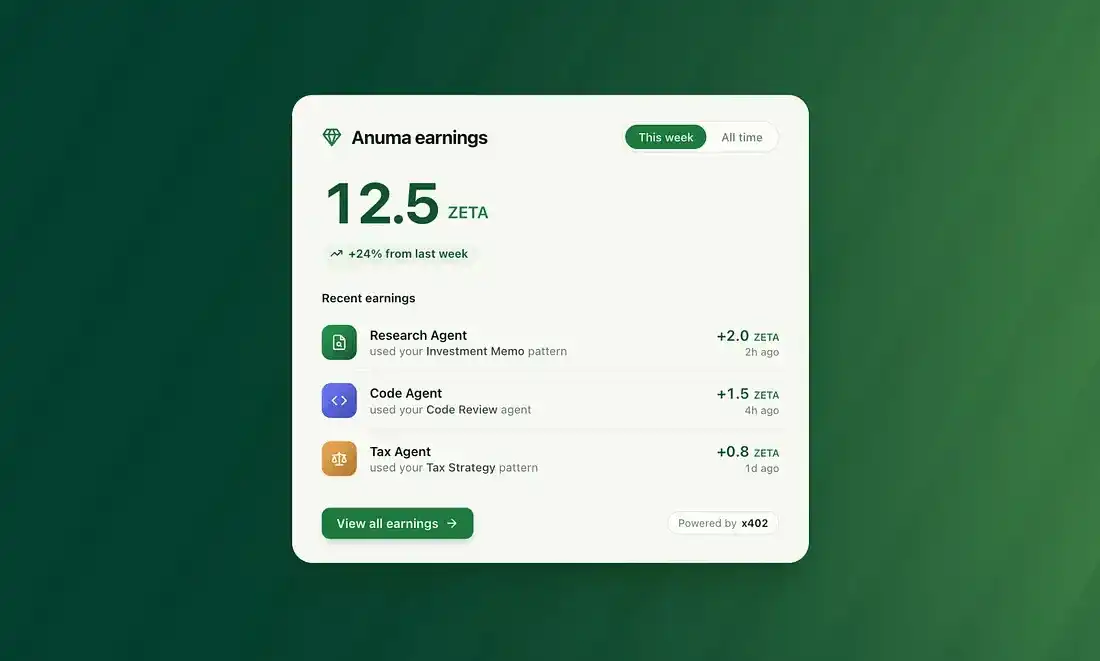
Thirdly, on-chain operations for permissions and memory updates. User modifications to permissions, access controls, and memory states may all become on-chain records in the future.

Fourthly, the creator economy. ZetaChain hopes that in the future, professionals like developers, researchers, lawyers, and doctors can encapsulate their knowledge into AI tools or Agents, earn revenue through invocations, with ZETA facilitating the flow of value.

However, it's important to note that this part currently remains largely at the narrative stage. Because the AI Agent economy itself is still far from mature, and truly large-scale "AI invoking AI" and "Agent autonomous payments" have not yet emerged. Concepts like x402, on-chain permissions, and AI identity currently belong more to pre-built infrastructure than to validated, large-scale demand.

But the reason ZetaChain and its product logic are noteworthy is not just because it's building an infrastructure paired with an AI product. More importantly, it attempts to redefine whether users' future memory, identity, context, and AI permissions belong to the platform or to users themselves. What ZetaChain wants to do, in essence, is to ensure these things are no longer controlled by platforms but returned to the hands of users.

Questions liées

QWhat is the core issue regarding AI 'memory' that the article identifies as a new competitive battleground?

AThe article identifies that AI 'memory' or long-term context is becoming a new competitive battleground. Currently, AI models like ChatGPT, Claude, and Gemini store user preferences, work habits, and project contexts, but this 'memory' is siloed within each platform. This creates a problem where users lose their accumulated context and personalized AI understanding when switching between different AI models or services.

QWhat problem does the company ZetaChain aim to solve with its 'Private Memory Layer'?

AZetaChain aims to solve the problem of fragmented and platform-owned AI memory. Its Private Memory Layer is designed to be a user-owned, encrypted layer for storing long-term memory, behavior preferences, and AI context. This allows users to take their personalized 'memory' and seamlessly use it across different AI models (like ChatGPT, Claude, Gemini) and agents, maintaining continuity without starting over on each platform.

QWhat major strategic shift did ZetaChain make, and what was the logical connection behind this shift?

AZetaChain made a major strategic shift from being a cross-chain interoperability infrastructure for blockchains to focusing entirely on AI. The logical connection is that the core problem of interoperability and fragmentation exists in both domains. Just as it previously solved the issue of assets and data being siloed on different blockchains, it now addresses the similar issue of user context and memory being siloed within different, closed AI platforms.

QAccording to the article, how does the role of AI assistants evolve in the future vision presented by ZetaChain?

AIn ZetaChain's future vision, AI assistants evolve from simple chat tools into a network of long-term, specialized digital assistants that deeply collaborate. Different AI agents will handle specific tasks (e.g., coding, finance, travel planning, content creation). For them to work together effectively, they will need to share a unified framework for long-term context (memory), user identity, permissions, and a native payment system for inter-agent transactions.

QWhat new utility is the ZETA token expected to gain following ZetaChain's转型 (transformation) to AI?

AFollowing its transformation, the ZETA token is expected to evolve into an 'AI infrastructure token' with significantly expanded utility. Its expected new uses include: 1) Access and payment for premium AI models and agent services. 2) Settlement for payments between different AI agents (via protocols like x402). 3) Facilitating on-chain operations for updating user permissions and memory access controls. 4) Powering a creator economy where professionals monetize their expertise by packaging it into AI agents or tools.

Lectures associées

Projection 2029 : Lorsque la cryptomonnaie deviendra « invisible », qui survivra à cette transformation financière ?

**Résumé de l'article : "Prévisions pour 2029 : Quand la cryptomonnaie devient 'invisible', qui reste dans ce changement financier ?"** L'article propose un scénario pour l'industrie cryptographique jusqu'en 2029. Il identifie trois problèmes clés : la valeur des tokens, l'intégration de nouvelles technologies et la transformation en infrastructure financière traditionnelle. Sa thèse centrale est que la principale contrainte du secteur est juridique, et non technique. **Évolution principale :** * **2026 :** La valeur migre vers les actifs réels. Les contrats perpétuels synthétiques sur actions non cotées (ex: SpaceX, OpenAI) sur des plateformes comme Hyperliquid deviennent des références de prix cruciales, démontrant une demande pour des actifs de qualité, contrairement à la plupart des crypto-actifs. * **2026-2027 :** Le secteur se scinde en deux. D'un côté, un marché spéculatif bruyant (paris sur l'IA). De l'autre, un marché institutionnel silencieux où la tokenisation d'actifs (fonds monétaires, crédit privé) se développe dans un cadre réglementaire. Les blockchains généralistes s'orientent majoritairement vers les services institutionnels. * **2028 :** Un événement déclencheur. Une cascade de liquidations sur le marché des contrats perpétuels synthétiques, sans ancrage tangible, révèle ses failles. La réponse réglementaire serait d'autoriser la **publicité et la négociation légales de parts secondaires d'entreprises privées** pour les investisseurs accrédités, fournissant ainsi l'ancrage de prix manquant. * **2029 :** L'industrie atteint sa "fin". Le marché spéculatif se réduit. Une nouvelle forme de "bull market" émerge, alimentée par le trading direct et légal d'actions privées de sociétés technologiques (biotech, robotique, IA) par des investisseurs particuliers accrédités. La valeur des tokens dépendra désormais exclusivement des droits qu'ils confèrent sur des actifs réels. Les fonctions d'infrastructure de règlement (stablecoins, blockchains) deviennent "invisibles", intégrées et banales, comme tout autre service financier de base. L'auteur conclut que l'industrie ne sera plus définie par la spéculation sur des tokens, mais par le **marché qu'elle a construit pour échanger des actifs réels**. Le test décisif de sa prédiction sera l'émergence, ou non, d'un canal légal d'accès pour les investisseurs particuliers aux actifs privés d'ici fin 2028.

marsbitIl y a 17 mins

Projection 2029 : Lorsque la cryptomonnaie deviendra « invisible », qui survivra à cette transformation financière ?

marsbitIl y a 17 mins

Les actions de Zhipu ont bondi de 47 % après l'interdiction américaine de Fable 5

Le 15 juin, l'action de Zhipu AI a grimpé de 47,6% à la Bourse de Hong Kong, clôturant en hausse de 32,82%. Cette forte réaction suit deux annonces récentes. Le 12 juin, Anthropic a suspendu l'accès mondial à ses modèles phares Claude Fable 5 et Claude Mythos 5 suite à une injonction du gouvernement américain sur les contrôles à l'exportation. Le lendemain, Zhipu a annoncé l'ouverture de son dernier modèle open-source, GLM-5.2, à tous les utilisateurs de son Coding Plan, avec une sortie prévue de l'API et des poids du modèle sous licence MIT la semaine suivante. Cet événement met en lumière un changement dans l'industrie de l'IA : au-delà des performances pures, la stabilité, l'accessibilité durable et le contrôle des modèles deviennent des critères essentiels, surtout lorsque l'IA s'intègre dans les flux de travail critiques. La suspension soudaine de Claude a perturbé de nombreux développeurs et entreprises qui en dépendaient, soulignant les risques liés à l'accès à des modèles propriétaires soumis à des juridictions uniques. La réponse du marché valorise ce nouveau paradigme. GLM-5.2, présenté comme un modèle « véritablement utilisable » avec un contexte de 1M de tokens optimisé pour les tâches de codage longues et complexes, représente une alternative ouverte et contrôlable. Les analystes estiment que cet incident pourrait accélérer l'adoption de modèles de base locaux et open-source par les entreprises cherchant à sécuriser leurs capacités d'IA. La concurrence évolue ainsi de « qui est le plus performant » vers « qui est le plus accessible et fiable sur le long terme ».

marsbitIl y a 24 mins

Les actions de Zhipu ont bondi de 47 % après l'interdiction américaine de Fable 5

marsbitIl y a 24 mins

Guide d'inscription et de publication d'articles pour la colonne PANews

**Guide d'inscription et de publication pour les contributeurs de PANews** Cette page explique comment devenir contributeur (créer une colonne) et publier des articles sur PANews. L'accent est mis sur les contenus approfondis liés à la Crypto, au Web3, aux données et aux analyses. Les contenus principalement promotionnels ou générés massivement par IA ne seront pas approuvés. **Pour créer une colonne :** * **Sur le site web :** Allez en bas de la page d'accueil, cliquez sur "申请专栏" (Demander une colonne). Connectez-vous avec votre numéro de téléphone ou e-mail (code de vérification, pas de mot de passe). Remplissez le nom de la colonne, la description, téléchargez un avatar et fournissez des liens vers vos articles déjà publiés. * **Sur mobile :** Dans la section "我的" (Moi), accédez à "投稿与创作" (Soumettre et créer) et suivez les étapes. **Pour publier un article :** 1. Connectez-vous sur le site et allez sur votre page personnelle. 2. Accédez au "创作者中心" (Centre de création). 3. Utilisez l'éditeur pour rédiger et publier votre article. **Ajouter une vidéo :** Seul l'intégration via code embed (iframe) est supportée (ex. : Bilibili). Collez le code dans l'éditeur via le bouton "插入/编辑媒体" (Insérer/modifier un média). Ajustez la taille si nécessaire (largeur 100%, hauteur 560px recommandés). **PANews Skills (Agent IA) :** PANews propose un ensemble d'outils IA (PANews Skills) pour automatiser certaines tâches. L'outil `panews-creator` permet notamment de gérer votre colonne et de publier des articles directement via des agents IA compatibles (comme Cursor, Claude, etc.). Pour l'utiliser, vous devrez récupérer un jeton d'authentification (`sessionid`) depuis les outils de développement de votre navigateur après vous être connecté à votre compte PANews. **Rappel important :** Privilégiez les analyses de fond. Les contenus publicitaires (PR) doivent passer par la voie commerciale.

marsbitIl y a 34 mins

Guide d'inscription et de publication d'articles pour la colonne PANews

marsbitIl y a 34 mins

J'ai construit un poste de travail d'investissement personnel avec l'IA

Ces dernières semaines, j'ai exploré le « Vibe Coding », utilisant des modèles d'IA comme Codex, Claude et DeepSeek pour développer rapidement des outils personnalisés. Frustré par la nécessité de consulter plusieurs applications pour suivre mes actifs (actions, crypto, etc.), j'ai construit un tableau de bord unifié affichant l'ensemble de mon portefeuille et ses performances. Cet outil intègre désormais une surveillance des mouvements brusques, une cartographie des investissements (visualisant les écosystèmes complets) et un journal de réflexion. J'ai également créé un moniteur pour les marchés de prédiction (comme Polymarket), rassemblant les paris sur des événements futurs (valorisations d'entreprises, etc.) pour analyser leurs probabilités face à l'actualité. Un petit back-office pour gérer mes publications et un outil de mise en forme automatique pour différents plateformes complètent cet ensemble. L'essentiel n'est pas la sophistication des outils, mais la capacité nouvelle à matérialiser rapidement une idée. L'IA permet à tout investisseur de construire progressivement ses propres systèmes fondamentaux : observation d'actifs, surveillance de signaux, cartographie de secteurs et analyse rétrospective. Ce cycle rapide « idée → réalisation → utilisation → amélioration » change profondément la façon d'aborder la recherche et la gestion d'investissements pour les particuliers.

marsbitIl y a 49 mins

J'ai construit un poste de travail d'investissement personnel avec l'IA

marsbitIl y a 49 mins

Trading

Spot
Futures

Articles tendance

Comment acheter ZEN

Bienvenue sur HTX.com ! Nous vous permettons d'acheter Horizen (ZEN) de manière simple et pratique. Suivez notre guide étape par étape pour commencer votre parcours crypto.Étape 1 : Création de votre compte HTXUtilisez votre adresse e-mail ou votre numéro de téléphone pour ouvrir un compte sur HTX gratuitement. L'inscription se fait en toute simplicité et débloque toutes les fonctionnalités.Créer mon compteÉtape 2 : Choix du mode de paiement (rubrique Acheter des cryptosCarte de crédit/débit : utilisez votre carte Visa ou Mastercard pour acheter instantanément Horizen (ZEN).Solde :utilisez les fonds du solde de votre compte HTX pour trader en toute simplicité.Prestataire tiers :pour accroître la commodité d'utilisation, nous avons ajouté des modes de paiement populaires tels que Google Pay et Apple Pay.P2P :tradez directement avec d'autres utilisateurs sur HTX.OTC (de gré à gré) : nous offrons des services personnalisés et des taux de change compétitifs aux traders.Étape 3 : stockage de vos Horizen (ZEN)Après avoir acheté vos Horizen (ZEN), stockez-les sur votre compte HTX. Vous pouvez également les envoyer ailleurs via un transfert sur la blockchain ou les utiliser pour trader d'autres cryptos.Étape 4 : tradez des Horizen (ZEN)Tradez facilement Horizen (ZEN) sur le marché Spot de HTX. Il vous suffit d'accéder à votre compte, de sélectionner la paire de trading, d'exécuter vos trades et de les suivre en temps réel. Nous offrons une expérience conviviale aux débutants comme aux traders chevronnés.

242 vues totalesPublié le 2024.12.12Mis à jour le 2026.06.02

Comment acheter ZEN

Discussions

Bienvenue dans la Communauté HTX. Ici, vous pouvez vous tenir informé(e) des derniers développements de la plateforme et accéder à des analyses de marché professionnelles. Les opinions des utilisateurs sur le prix de ZEN (ZEN) sont présentées ci-dessous.

活动图片