Goldman Sachs Research Report Analysis: Chip Shortage to Persist Until 2028, Maintain Buy Recommendations

marsbitPublié le 2026-06-01Dernière mise à jour le 2026-06-01

Résumé

Goldman Sachs Research Report Summary: Memory Shortage Until 2028, Maintain Buy Recommendations Goldman Sachs' latest Asia-Pacific equities report, "The 720," forecasts a sustained memory chip upcycle extending into 2028, driven by strong AI server demand visibility, limited supply growth, and binding long-term agreements. The firm believes the market significantly underestimates the cycle's duration, as evidenced by low P/E ratios for memory stocks. Key sector calls include raising 12-month price targets for Samsung Electronics and SK Hynix, and upgrading Kioxia from Hold to Buy, citing higher and more sustainable peak profits over the next 2-3 years. The report also highlights the broader AI hardware supply chain benefiting from hyperscaler capex acceleration. Recommendations include: * MediaTek (Buy) for its data center/ASIC pivot. * Eoptolink (Buy) on 1.6T optical module ramp-up. * Biren (Buy) for its AI chip migration. * Huaqin (Buy, newly covered) for its shift from consumer electronics ODM to AI data centers. * Lenovo (Buy) on the AI PC refresh cycle. Other notable mentions include China property developers (under an optimistic scenario), BYD for its affordable city NOA strategy, and select Japanese semiconductor equipment makers. A macro theme notes the divergence between AI-boom beneficiaries (e.g., Korea, Taiwan) and energy-importing economies facing inflationary pressure. The report concludes with standard disclaimers, noting that price targets are f...

Author: Tidal Research

On June 1st, Goldman Sachs released its daily Asia-Pacific stock summary, "The 720," featuring a long list of names on the cover including Samsung, SK Hynix, Kioxia, MediaTek, Lenovo, and BYD. It appears to be a comprehensive shopping list, but a closer read reveals its absolute core: memory chips.
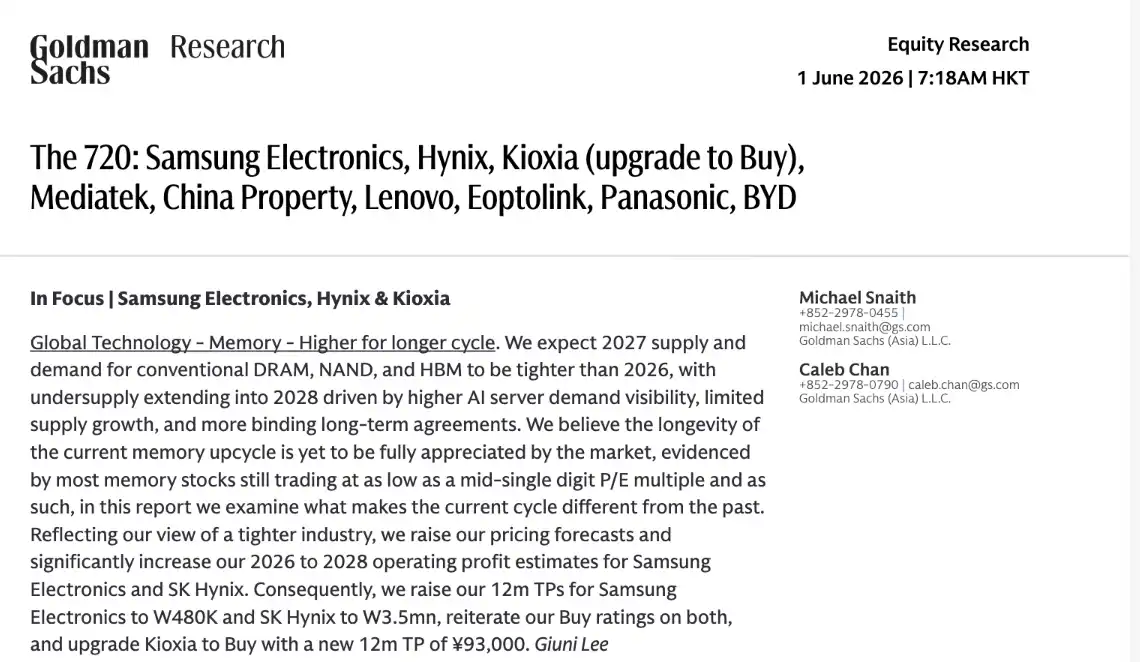
One of the most significant judgments in this Goldman Sachs report is that the current memory upcycle "will last longer" (higher for longer), with the shortage expected to persist all the way until 2028, a length vastly underestimated by the market. The evidence lies in valuations: most memory stocks are still trading at mid-single-digit price-to-earnings ratios, as if the market believes this is just another ordinary cyclical rebound, but Goldman Sachs sees it differently.

Below, we break it down by importance, concluding with a quick-reference table of targets.

Main Event: Memory Shortage to Last Until 2028, Three Companies Collectively Upgraded

Goldman Sachs compares this cycle to past ones and concludes this time is different. The reasons are threefold: higher visibility of AI server demand, limited supply growth, and increasingly firm long-term supply agreements (locking in orders and prices). Combined, these factors suggest that DRAM, NAND, and HBM supply-demand will be even tighter in 2027 than in 2026, with shortages extending into 2028.

The most intuitive evidence is Goldman's DRAM supply-demand chart. Negative numbers represent supply shortage; the deeper the deficit, the stronger the price support. Goldman has now revised its forecasts for 2026 to 2028 deeper into shortage territory. Specifically, the 2027 forecast was revised from an earlier -2.5% to -5.9%, more than doubling. In plain language: Goldman believes memory manufacturers will face increasing shortages in the next few years, meaning price increases can be sustained longer.

Regarding specific companies, three were collectively adjusted:

  • Samsung Electronics: 12-month price target raised to 480,000 KRW, Buy rating maintained.
  • SK Hynix: 12-month price target raised to 3.5 million KRW, Buy rating maintained.
  • Kioxia: Upgraded from Neutral to Buy, new price target set at 9,300 JPY.

Kioxia is the only rating upgrade in this report, and Goldman's logic is worth noting separately: it believes the profit peak of this cycle is higher than previously anticipated and can be maintained for two to three years, rather than surging and then falling back quickly. Based on this, Goldman has raised its operating profit forecasts for Kioxia for fiscal years 2027 to 2029 by 16% to 48% in one go and expects gross margins to remain at a high level around 80%. Predicting three years of sustainably high profits for a company in the strongly cyclical memory business is a very strong statement.

AI Computing Chain "Full Package": From Chips to Optical Modules to Data Centers

Beyond memory, this report touches upon nearly the entire AI hardware supply chain in China and Asia, unified by one main thread: global cloud hyperscaler capital expenditures are accelerating, and money is flowing down this chain.

  • MediaTek: Buy, price target set at 5,000 TWD. The highlight is its transition from mobile chips to data centers and custom ASICs (AI chips tailor-made for specific clients). The company's target is to achieve $2 billion in data center/AI ASIC revenue by 2026 and capture a 10% to 15% share of the $70-80 billion ASIC market by 2027.
  • Eoptolink: Buy, price target raised to 841 RMB. It manufactures optical modules, critical components for high-speed data transmission in AI data centers. Goldman is bullish on its 1.6T optical modules ramping up starting Q2 and accelerating in the second half, along with capacity expansion in Thailand. It raised profit forecasts for 2027 and 2028 by 5% and 6%, respectively.
  • Biren: Buy, price target raised to 70.7 HKD. A domestic Chinese AI chip manufacturer, its Bili166 product has received a first-tier security and reliability rating. Goldman expects it to turn profitable by 2027 as its product portfolio migrates to higher-performance, more expensive AI chips. Revenue forecasts for 2026 to 2030 were raised by 4% to 28%.
  • Huaqin: Buy, a newly covered target in this report. A-share price target set at 149 RMB, with simultaneous first-time coverage of its H-shares, target set at 127.76 HKD. The logic is its move from consumer electronics ODM into AI data centers, with expected revenue CAGR of 32% from 2025 to 2027.
  • Data Center Duo: GDS maintains Buy rating, but its ADR target is lowered to $49 (due to slower move-in rates, lower monthly service revenue, partially offset by higher valuation for overseas DayOne business); VNET maintains Buy rating, target raised to $16 (due to Q1 earnings beat, strong execution of capacity ramp-up, and removal of strategic investor overhang).
  • Lenovo: Buy, price target raised from 27 HKD to 31 HKD. The bet is on the AI PC refresh cycle. Goldman expects its notebook market share to expand to 28% by 2028, with AI notebook penetration reaching 66%, lifting overall average selling prices. Its profit forecasts for Lenovo's FY2027 and FY2028 are 22% and 25% higher than the Bloomberg consensus, indicating significant divergence.

Stocks Mentioned Outside the AI Main Theme

  • Chinese Real Estate (COLI, CR Land): Goldman is assessing the sustainability of the recent real estate sector rebound. It assumes an optimistic scenario where 15 key cities follow Shanghai and Shenzhen's property price recovery, leading to a 15% price increase by the end of 2028. Under this premise, it estimates cash profits for COLI and CR Land could expand by over 30% and over 50%, respectively, by 2028. Using a sum-of-the-parts valuation, Goldman suggests further upside potential of 52% for COLI and 76% for CR Land, maintaining a positive view on these stronger state-owned developers. Key point: this calculation is based on an optimistic assumption, not the base case forecast.
  • BYD: Buy, price target set at 137 RMB / 134 HKD. The highlight is its "Tianshen Eye B" City Navigation Guided Pilot (City NOA) becoming a 12,000 RMB option across its lineup at its Intelligent Driving Strategy Conference, making its entry-level City NOA-equipped model the cheapest in China at 78,800 RMB. It also unveiled its first self-developed 4nm intelligent driving chip, "Xuánjī A3," which is already in mass production. Goldman believes these engineering capabilities can boost high-end intelligent driving penetration, lower costs, and improve margins.
  • Japanese Semiconductor Equipment: Goldman maintains Buy ratings on Lasertec, Ebara, Disco, and Tokyo Electron. The only contrarian move was downgrading vacuum equipment manufacturer Ulvac (6728.T) from Buy to Neutral, lowering the target to 9,400 JPY, citing weak high-margin power semiconductor orders and slower-than-expected gross margin expansion.
  • Panasonic HD: Buy, price target raised from 4,000 JPY to 4,220 JPY, bullish on generative AI-related businesses (backup power, copper-clad laminate CCL, high-performance capacitors).
  • NTT: Buy, price target slightly raised from 176 JPY to 179 JPY, focusing on domestic IT service demand and the safety margin provided by a shareholder total return rate of around 5%.

A Macro Theme: AI Boom Clashes with Energy Crisis

Stringing together the individual stocks is Goldman's macro judgment: Emerging markets are being pulled in two by two opposing forces. On one side is the AI investment boom, and on the other is energy supply contraction due to the blockade of the Strait of Hormuz.

Tech-exporting economies like South Korea and Taiwan benefit from surging exports and current account surpluses; while energy-importing countries face rising inflation, weaker currencies, and fuel subsidies straining their finances. Goldman expects the Q4 average Brent crude price to be $90/barrel, continuing pressure on heavily oil-import-dependent economies. It recommends overweighting stocks in China, South Korea, Brazil, and South Africa. This line connects with the recent macro background of the Iran situation and oil prices.

Two other points directly affecting A-share capital flows:

Chinese imports surged 23.6% year-on-year in the first four months of this year, but Goldman believes this is a highly concentrated phenomenon, with gold and semiconductors accounting for about 65% of the import growth increment, not indicative of a continuous worsening of the external balance.

Regarding the CSI and CNI index semi-annual rebalancing, Goldman estimates it will trigger over $48 billion in two-way passive fund flows. The technology hardware & semiconductor and capital goods sectors are expected to see the largest inflows (approximately $3.1 billion and $1.4 billion, respectively), while healthcare and banks see the largest outflows. Newly added constituents "expected to receive the largest net passive inflows" include Huagong Tech, Yuanjie Tech, Huahong Semiconductor, GigaDevice, VeriSilicon, etc. For index rebalancing arbitrage funds, this is a clear signal.

Finally, as usual, Goldman left an Easter egg: 2026 World Cup winning probability forecast: Spain leads at 26%, followed by France at 19%, Argentina at 14%, Brazil at 8%, and England at 5%. The model penalized the defending champion Argentina; take it as a bit of fun.

Quick Reference Table of Targets
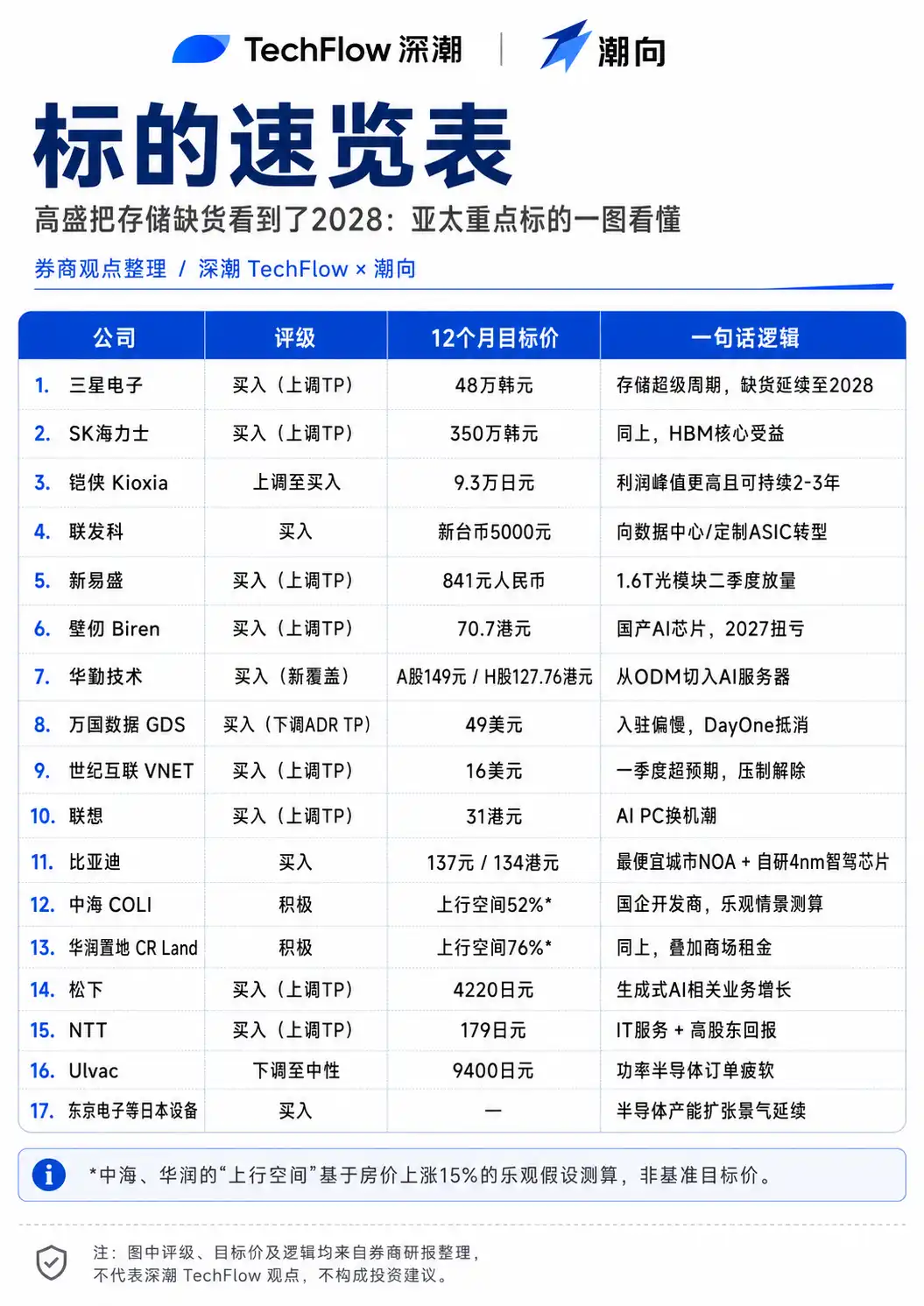
This article is TechFlow's compilation and interpretation of a third-party brokerage research report. The ratings, price targets, profit forecasts, and related judgments cited herein represent the views of the report's analysts and their affiliated institutions only. They do not represent the views of TechFlow and do not constitute any investment advice.

Please note the following three points when reading:

1. Price targets are analysts' expectations for a future period (typically 12 months). They are forecasts, not promises, and are subject to frequent adjustment based on company performance and market conditions.

2. Sell-side research reports are inherently bullish. It is common for brokerages to issue "Buy" ratings on covered companies, and some covered companies may have investment banking or other business relationships with the brokerage. A list predominantly featuring "Buy" ratings should be read with this inherent bias in mind.

3. The value of a research report lies in its mainline logic and the underlying assumptions it depends on, not any single price target. The logic for related targets holds only if the main theme holds; if the main theme is disproven, the entire chain of targets will come loose together. Focus on the logic, not just the price.

Markets involve risks; decisions should be made independently. This article should not be used as the basis for buying or selling any securities.
Questions liées

QAccording to the Goldman Sachs report, what is the core reason for the prolonged shortage in the memory chip sector until 2028?

AThe report cites three core reasons: higher visibility of AI server demand, limited supply growth, and increasingly binding long-term supply agreements (LTA) that lock in orders and prices. The combination of these factors leads to a projected tighter supply-demand situation for DRAM, NAND, and HBM in 2027 than in 2026, extending the shortage into 2028.

QWhich memory company received a rating upgrade from Goldman Sachs in this report, and what was the key rationale?

AKioxia received a rating upgrade from Neutral to Buy. The key rationale is Goldman Sachs' belief that the profit peak in this cycle will be higher and more sustainable than previously thought, lasting two to three years. Consequently, they significantly raised Kioxia's operating profit forecasts for FY2027 to FY2029 by 16% to 48% and expect its gross margin to remain around a high level of 80%.

QWhat is the primary macro theme Goldman Sachs uses to connect the various stock recommendations in the report?

AThe primary macro theme is that emerging markets are being pulled in two opposite directions. On one side is the AI investment boom, benefiting tech-exporting economies. On the other side is energy supply contraction due to the blockade of the Strait of Hormuz, which pressures energy-importing countries with higher inflation, weaker currencies, and strained finances. This leads to a recommended overweight stance on stocks in China, South Korea, Brazil, and South Africa.

QBesides memory chips, what other major sector or theme did Goldman Sachs focus on for its stock recommendations, and name one related company.

ABesides memory chips, Goldman Sachs focused extensively on the AI compute hardware supply chain. One related company is MediaTek. The report highlights its transition from mobile chips to data centers and custom AI ASICs, with a company target of $2 billion in data center/AI ASIC revenue in 2026 and aiming for a 10%-15% share of the $70-80 billion ASIC market by 2027.

QWhat important disclaimer does the article provide regarding the investment ratings and target prices mentioned from the Goldman Sachs report?

AThe article states that the ratings, target prices, profit forecasts, and related judgments cited are solely the views of the Goldman Sachs analysts and represent the position of their institution. They do not represent the views of the publishing platform (Shenchao TechFlow) and do not constitute any investment advice. It reminds readers that target prices are predictions subject to change, that sell-side research has a natural bullish bias, and that the value lies in the core logic and its underlying assumptions, not just the price targets.

Lectures associées

Changement de cap mondial chez a16z : Le capital-risque devient le « moteur » de l'alliance technologique américaine

L’annonce de Ben Horowitz marque un virage stratégique majeur dans la globalisation d’a16z. Le fonds ne se contente plus de rechercher des projets à l’étranger, mais s’inscrit dans un cadre plus large de compétition technologique et de coopération entre alliés, explicitement lié au leadership technologique des États-Unis et de leurs partenaires. Dans un contexte où l’IA, la robotique, la cybersécurité et les chaînes d’approvisionnement deviennent des enjeux de compétition nationale, le rôle des VC évolue. A16z renforce ses capacités pour aider ses startups à naviguer dans des environnements complexes, mêlant marchés, régulations et géopolitique. Les initiatives clés incluent : l’ouverture d’un bureau à Tokyo, la nomination d’Anne Neuberger (ancienne responsable gouvernementale) comme associée chargée des affaires mondiales pour conseiller sur la politique et la géopolitique, et la transformation de l’équipe relations investisseurs en une équipe « Partenaires Mondiaux » pour faciliter les connexions et le déploiement international des entreprises. L’objectif reste de soutenir les meilleures entreprises technologiques partout dans le monde (plus de 100 investissements internationaux à ce jour), mais avec une mission élargie : être un organisateur reliant les startups aux capacités nationales, aux ressources industrielles et au réseau des alliés, contribuant ainsi à la compétitivité technologique des États-Unis et de leurs alliés.

marsbitIl y a 6 mins

Changement de cap mondial chez a16z : Le capital-risque devient le « moteur » de l'alliance technologique américaine

marsbitIl y a 6 mins

Kalshi, MTS et les ambitions d'a16z

Les marchés prédictifs, représentés par Kalshi, émergent comme un domaine clé en 2025, attirant fonds d'investissement, acteurs de la cryptomonnaie et médias. Leur importance dépasse la simple spéculation. Leur évolution conceptuelle remonte à Hayek (l'utilisation de la connaissance dans la société) et à Robin Hanson (mécanisme LMSR pour inciter à la révélation d'informations), avec l'idée utopique d'une « futarchie ». L'intérêt de a16z, qui a investi dans Kalshi (évalué à 220 milliards de dollars), va au-delà du modèle économique. Leur thèse centrale est que les marchés prédictifs offrent un « sentiment de présence » et une forme d'« anti-cynisme » dans un monde moderne où les individus se sentent déconnectés. En pariant sur des événements mondiaux, l'utilisateur devient un « observateur superlatif », investi et influençant la perception collective. Cela s'inscrit dans la vision de « nouveaux médias » de a16z : un écosystème médiatique complet et rapide qui « s'approprie la timeline », comme le démontre MTS (Monitoring The Situation), un média en continu sur Twitter. Kalshi ajoute à ce dispositif une autorité unique car ses prix reflètent des paris en argent réel, lui conférant un pouvoir de « distorsion de la réalité » pour définir la vérité et l'importance des événements. C'est ce pouvoir, rarement détenu par une entreprise privée, qui justifierait sa valorisation faramineuse et en ferait une pièce maîtresse de l'empire médiatique de a16z.

链捕手Il y a 7 mins

Kalshi, MTS et les ambitions d'a16z

链捕手Il y a 7 mins

Comprendre la réalité du commerce, des paiements et des infrastructures des Agents

**Interprétation de la réalité des agents, des paiements et des infrastructures commerciales** Au cours de l'année passée, l'auteur a travaillé sur l'infrastructure de l'économie des agents, interagissant avec Stripe, Visa, Coinbase, Google et des dizaines de startups. La conclusion est claire : il n'existe pas encore de demande réelle, et les startups font face à des problèmes structurels. Stripe a enregistré peu de transactions d'agents malgré un fort intérêt. Visa impose des seuils de revenus et des processus KYC extrêmement restrictifs, accessibles uniquement aux géants comme Amazon. Les chiffres d'utilisation des agents sur la blockchain (comme via le protocole x402) sont largement gonflés par des transactions de test. **Agent vs Commerçant** : L'expérience d'achat par agent (IA) est souvent inférieure au commerce électronique traditionnel pour les achats visuels (vêtements, électronique). L'interface conversationnelle est un recul par rapport aux interfaces riches. La demande actuelle des marchands est défensive : ils veulent être "trouvables" par les agents par crainte de rater une future tendance. Les cas d'usage convaincants sont limités (commande de nourriture, navigation dans des interfaces complexes), mais nécessitent une distribution de masse détenue par les géants. **Agent vs API** : Les développeurs utilisent déjà massivement des API (calcul, données). Le problème du coût des micro-transactions est souvent résolu par du prépaiement. Le véritable obstacle est que les grands fournisseurs SaaS privilégient les contrats enterprise. Les opportunités pour les nouveaux systèmes de paiement (comme les stablecoins) se situent dans la longue traîne des services, un marché plus restreint. **Agent vs Agent** : Ce modèle est encore théorique, sans volume significatif. Il impliquerait des transactions ultra-rapides entre entités non humaines, avec des montants variables et des règlements multipartites. C'est un pari à long terme sur une infrastructure dédiée, mais ce n'est pas le marché actuel. **Agent vs Finance** : C'est la seule catégorie avec une demande existante et une volonté de payer. Intégrer l'IA dans les workflows financiers existants (gestion de portefeuille, DeFi) est une évolution naturelle et crée de nouvelles capacités. Cependant, la concurrence est rude face aux institutions établies, régulées et bien connectées. **Le véritable enjeu** : Les grandes entreprises construisent par stratégie défensive et ont les moyens d'attendre. Pour les startups, il est crucial de se concentrer sur le marché actuel. Le problème fondamental n'est pas le paiement, mais la **coordination** entre agents et humains : vérifier le travail, s'accorder sur les résultats, puis régler. Le paiement n'est qu'une partie de la solution de coordination. Ce sont les entreprises qui résoudront le problème de la coordination à grande échelle qui domineront, en intégrant le paiement, et non l'inverse. L'expérience de l'auteur l'a conduit vers un autre segment de marché, actif, en croissance et encore mal desservi, en dehors de ces quatre catégories.

marsbitIl y a 9 mins

Comprendre la réalité du commerce, des paiements et des infrastructures des Agents

marsbitIl y a 9 mins

Wall Street connaît sa pire chute depuis 2025, la réévaluation des valorisations des actions technologiques déclenchée par trois catalyseurs

Le marché boursier américain a subi son pire effondrement depuis 2025 le 5 juin, avec le Nasdaq chutant de 4,18 %. Trois facteurs principaux ont déclenché cette vente massive, en particulier dans les actions technologiques. Premièrement, les perspectives trimestrielles de Broadcom concernant ses revenus liés aux puces IA, bien qu'en forte croissance, ont été inférieures aux attentes les plus optimistes. Cela a semé le doute sur le rythme de croissance exponentielle de l'IA, conduisant à une forte correction dans tout le secteur des semi-conducteurs. Deuxièmement, des données sur l'emploi américain bien plus solides que prévu ont renforcé les craintes que la Réserve fédérale (Fed) ne se contente pas de reporter les baisses de taux, mais pourrait même envisager de les augmenter. Cette hausse des taux d'intérêt pèse sur la valorisation des actions de croissance. Troisièmement, l'ombre persistante de l'inflation, alimentée par la guerre en Iran et des prix du pétrole élevés, limite la marge de manœuvre de la Fed. Ces trois éléments combinés ont ébranlé simultanément les récits de "croissance illimitée de l'IA", de "politique monétaire accommodante" et d'"inflation maîtrisée". Il s'agit davantage d'une réévaluation sévère des valorisations que d'un effondrement du récit de l'IA. Les prochaines décisions de la Fed, les résultats des entreprises technologiques et l'évolution de la situation géopolitique seront déterminants pour la suite du marché.

marsbitIl y a 4 h

Wall Street connaît sa pire chute depuis 2025, la réévaluation des valorisations des actions technologiques déclenchée par trois catalyseurs

marsbitIl y a 4 h

Trading

Spot
Futures

Articles tendance

Comment acheter CHIP

Bienvenue sur HTX.com ! Nous vous permettons d'acheter USD.AI (CHIP) de manière simple et pratique. Suivez notre guide étape par étape pour commencer votre parcours crypto.Étape 1 : Création de votre compte HTXUtilisez votre adresse e-mail ou votre numéro de téléphone pour ouvrir un compte sur HTX gratuitement. L'inscription se fait en toute simplicité et débloque toutes les fonctionnalités.Créer mon compteÉtape 2 : Choix du mode de paiement (rubrique Acheter des cryptosCarte de crédit/débit : utilisez votre carte Visa ou Mastercard pour acheter instantanément USD.AI (CHIP).Solde :utilisez les fonds du solde de votre compte HTX pour trader en toute simplicité.Prestataire tiers :pour accroître la commodité d'utilisation, nous avons ajouté des modes de paiement populaires tels que Google Pay et Apple Pay.P2P :tradez directement avec d'autres utilisateurs sur HTX.OTC (de gré à gré) : nous offrons des services personnalisés et des taux de change compétitifs aux traders.Étape 3 : stockage de vos USD.AI (CHIP)Après avoir acheté vos USD.AI (CHIP), stockez-les sur votre compte HTX. Vous pouvez également les envoyer ailleurs via un transfert sur la blockchain ou les utiliser pour trader d'autres cryptos.Étape 4 : tradez des USD.AI (CHIP)Tradez facilement USD.AI (CHIP) sur le marché Spot de HTX. Il vous suffit d'accéder à votre compte, de sélectionner la paire de trading, d'exécuter vos trades et de les suivre en temps réel. Nous offrons une expérience conviviale aux débutants comme aux traders chevronnés.

325 vues totalesPublié le 2026.04.21Mis à jour le 2026.06.02

Comment acheter CHIP

Discussions

Bienvenue dans la Communauté HTX. Ici, vous pouvez vous tenir informé(e) des derniers développements de la plateforme et accéder à des analyses de marché professionnelles. Les opinions des utilisateurs sur le prix de CHIP (CHIP) sont présentées ci-dessous.

活动图片