Kalshi and Coinbase Receive CFTC Approval, Ushering in the Most Regulation-Friendly Era for the Crypto Industry?

marsbitPublié le 2026-05-30Dernière mise à jour le 2026-05-30

Résumé

The U.S. Commodity Futures Trading Commission (CFTC) took two landmark actions on May 29. It approved Kalshi's application to list a Bitcoin perpetual futures contract and issued a no-action letter to Coinbase Financial Markets. This allows Coinbase to offer certain perpetual futures products to U.S. customers through a subsidiary, with digital assets permitted as collateral. These moves, coupled with a new CFTC policy statement, provide a clearer regulatory pathway for perpetual contracts in the U.S., moving them from a regulatory gray area. CFTC Chair Mike Selig stated this is a key step for U.S. crypto leadership but noted the policy is not yet permanent. The article explains that CFTC's previous reluctance stemmed from legal ambiguities, as perpetual contracts lack an expiration date. However, such contracts dominate global crypto derivatives, accounting for ~78% of centralized exchange volume in 2025, forcing U.S. regulators to adapt to competition from offshore platforms like Hyperliquid. The approvals offer two compliance paths: Kalshi's direct listing and Coinbase's model using foreign futures. This is expected to attract institutional capital back to regulated U.S. venues, stimulate the launch of more products like ETH perpetuals, and enhance U.S. competitiveness in the global crypto derivatives market. The author suggests this may signal a "regulatorily friendly" era for crypto.

Author: Ma He, Foresight News

On May 29th, the U.S. Commodity Futures Trading Commission (CFTC) announced two landmark actions on the same day: it formally approved the Bitcoin perpetual contract submitted by KalshiEX, LLC (Kalshi). Additionally, the CFTC issued a no-action letter to Coinbase, allowing Coinbase to offer certain perpetual futures products to U.S. customers through its subsidiary.

The CFTC also released a "Policy Statement on the Listing of Perpetual Contracts," providing a clear guidance framework for the listing of perpetual products on regulated markets. This combination of actions signifies a crucial step away from the longstanding regulatory gray area for U.S. crypto derivatives, moving toward a compliant path for genuine perpetual contracts.

Kalshi and Coinbase Both Receive Regulatory Approval

The CFTC's review determined that Kalshi's Bitcoin perpetual contract complies with the core principles of the Commodity Exchange Act and Designated Contract Market (DCM) regulations, including the depth and liquidity of the underlying Bitcoin spot market, contract design, and risk management capabilities. The approval order requires Kalshi to maintain ongoing compliance and clarifies that the perpetual contract design "may not be suitable for all asset classes," encouraging other market participants to engage with regulators and submit formal applications for perpetual products based on different underlying assets.

Furthermore, the CFTC's Division of Market Participants issued an interpretive letter and a no-action letter to the registered futures commission merchant Coinbase Financial Markets (CFM), permitting it to offer crypto options and perpetual contracts listed on Deribit to U.S. users. The letter confirms that these perpetual contracts can be classified as foreign futures under CFTC Regulation 30.1. Under specified conditions, the CFTC stated it would not recommend enforcement action against CFM for transferring customer-held digital commodities and payment stablecoins to its foreign broker affiliate for margin purposes, where the affiliate may exercise rehypothecation rights over such customer assets.

Previously, the U.S. market lacked genuine perpetual contracts (with no expiration date). Coinbase Derivatives had self-certified and launched "perpetual-style" futures in July 2025 (with contract terms up to 5 years), designed to mimic perpetual economic characteristics but still retaining an expiration date. Today's approval and no-action letters provide a dual compliance pathway for "true perpetuals": Kalshi follows the standard DCM futures route, while Coinbase reaches U.S. customers via the foreign futures + crypto collateral route.

Mike Selig

CFTC Chairman Mike Selig emphasized in his statement that perpetual contracts are important tools for risk management and price discovery in the global crypto asset market. Introducing true perpetual contracts in the U.S. is a significant step toward establishing the U.S. as a global crypto hub. He noted that the CFTC has established a workable regulatory framework for crypto asset perpetual contracts and will maintain market integrity by limiting excessive leverage, market volatility, and systemic risk.

Selig also acknowledged that the CFTC's current regulatory stance has not yet been formalized into a permanent rule, and future policies may adjust as the regulatory environment evolves.

The Trillion-Dollar Market Opportunity

So, why had the CFTC not approved true Bitcoin perpetual contracts until now?

Perpetual contracts were considered a "novel" product within the traditional commodity futures framework. They lack an expiration date and final settlement, which conflicts with the conventional understanding under the Commodity Exchange Act that traditional futures "must have an expiration date and a convergence mechanism." The CFTC internally debated whether to classify them as futures or swaps, as different classifications entail entirely different regulatory requirements (including clearing, margin, reporting obligations, etc.). This legal ambiguity made it difficult for platforms to secure a solid compliance path.

Furthermore, concerns about their high leverage and speculative nature, along with fears of market manipulation, have kept the CFTC's approach cautious.

BTCPERP, as a perpetual contract tracking the Bitcoin spot price, has no fixed expiration date. It uses a funding rate mechanism for periodic settlements between long and short positions to maintain a tight peg between the contract price and the spot price.

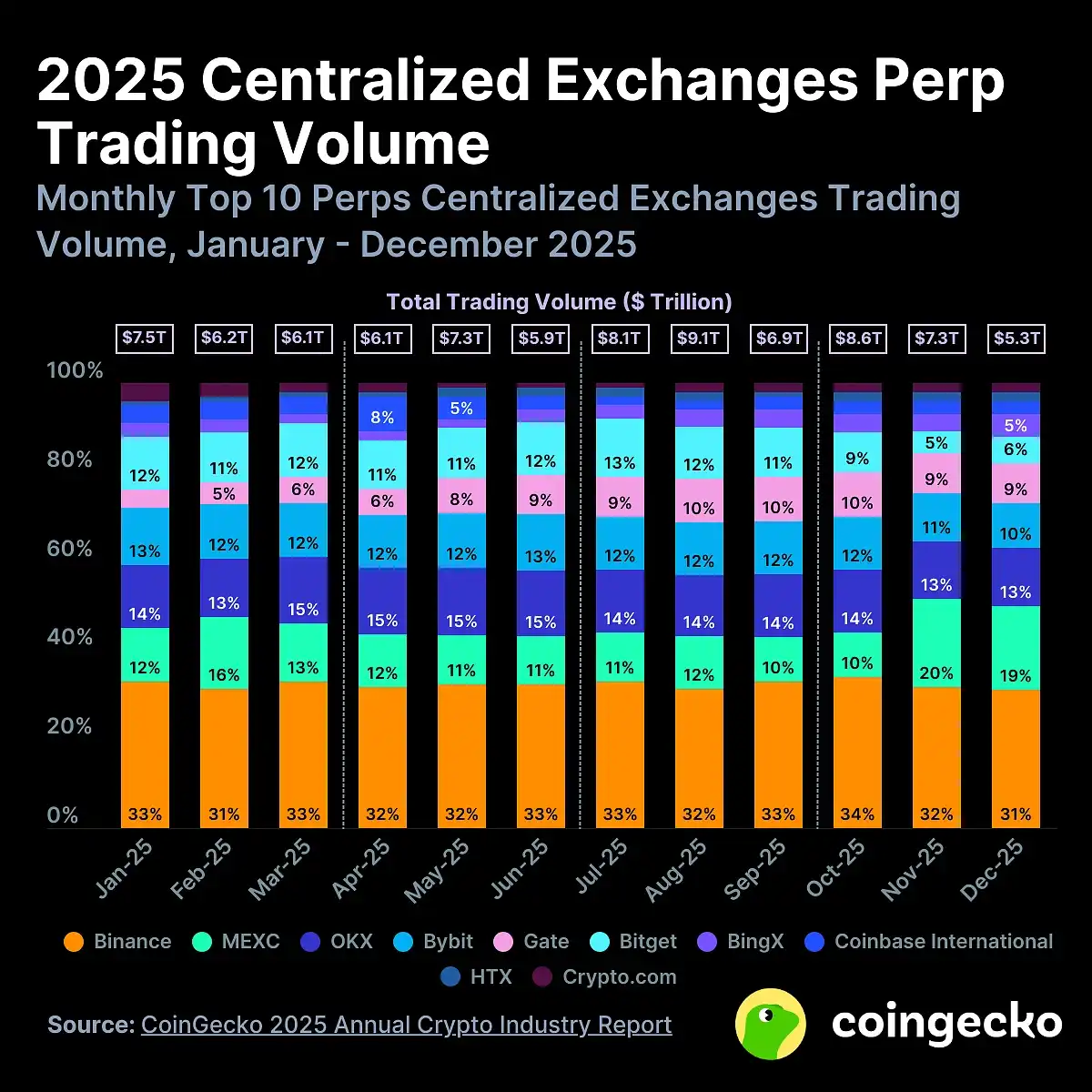
Perpetual contracts have long dominated the global crypto derivatives market. According to CoinGecko's 2025 annual report, the cumulative trading volume of crypto derivatives on centralized exchanges globally was approximately $85.7 trillion, with perpetual contracts accounting for about 78%. In 2025, the cumulative volume of perpetual contracts on decentralized exchanges reached about $6.7 trillion (a 346% year-over-year increase).
Ironically, while traditionalist regulators in Washington debated compliance, offshore decentralized perpetual platforms like Hyperliquid had already extended their reach to S&P 500, crude oil, and gold through on-chain synthetic assets. By the end of May 2026, Hyperliquid's perpetual trading volume had risen to $586.12 billion, and according to Allium on-chain data, the total open interest for Hyperliquid's network-wide derivatives also hit a record high of nearly $60 billion at the end of May. An increasing number of individuals and institutions are choosing to trade on its platform.
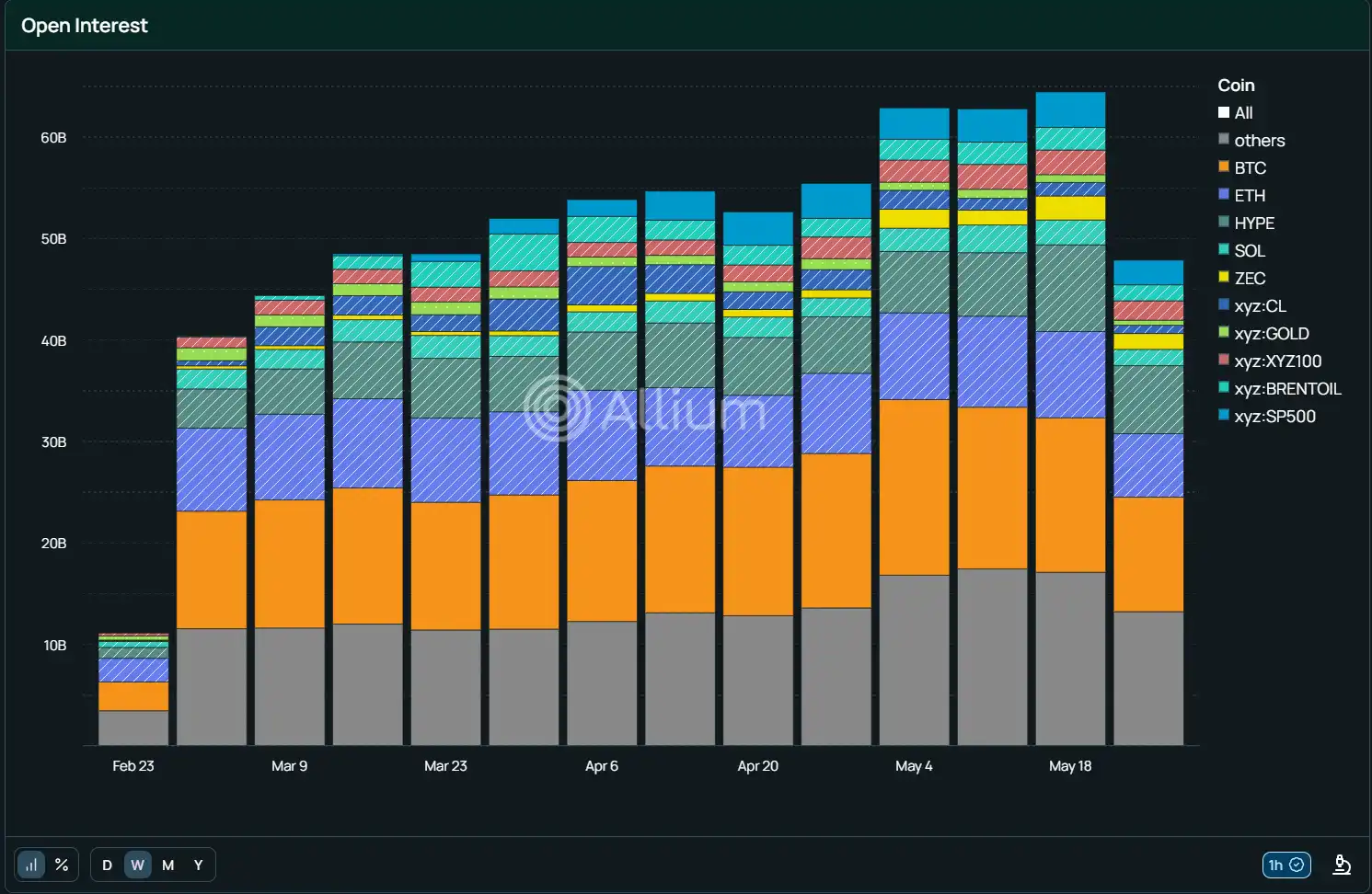
Hyperliquid Latest Open Interest

This unprecedented approval by the CFTC is not just an accommodation to the crypto market; it is a necessary "onshore defense battle" forced upon the compliant world by the innovative pressure from offshore "everything-as-a-perpetual-asset."

In contrast, while regulated Bitcoin futures like those on CME provide stable hedging tools for institutions, their leverage and trading characteristics differ from the perpetual products favored by retail/professional traders.

This approval by the CFTC undoubtedly opens a new battleground for Kalshi in the prediction market. The boundary between prediction markets and traditional crypto derivatives markets has completely blurred; Kalshi can leverage its compliant event-settlement logic to tap into the perpetual capital pool originally belonging to centralized exchanges. For Coinbase, the trading volume and revenue from its perpetual contracts will likely be reflected concretely in its next financial report.

U.S. traders previously relied heavily on offshore platforms, facing custody risks, regulatory uncertainty, and barriers to institutional access. The release of this regulatory policy, which supports crypto collateral, will attract traditional institutions like hedge funds and family offices to participate. Traders can hold leveraged positions long-term to hedge spot exposure without frequent operations; it will also attract some offshore traffic back to U.S. compliant channels.

Simultaneously, the approval for Kalshi and Coinbase will stimulate the accelerated launch of other products like ETH perpetuals, forming a more complete crypto derivatives matrix. In the long term, this policy may enhance the U.S.'s competitiveness in the global crypto derivatives ecosystem, attracting more capital, talent, and infrastructure, creating favorable conditions for deeper integration between crypto assets and traditional finance.

Now may indeed be the most regulation-friendly era for the crypto industry.

Questions liées

QWhat were the two major actions taken by the CFTC on May 29th regarding crypto derivatives?

AOn May 29th, the CFTC officially approved Kalshi's application to list a Bitcoin perpetual contract, and issued a no-action letter to Coinbase Financial Markets, allowing it to offer certain perpetual futures products to U.S. customers through a foreign affiliate.

QWhy was the approval of a 'true' Bitcoin perpetual contract in the U.S. considered a significant step?

AIt was significant because, under the traditional Commodity Exchange Act framework, perpetual contracts (with no expiry date) conflicted with the conventional definition of futures. The approval moves crypto derivatives from a regulatory gray area towards a clear, compliant path for truly perpetual products within the U.S.

QAccording to the article, what percentage of global centralized crypto derivatives trading volume do perpetual contracts represent?

AAccording to CoinGecko's 2025 annual report data cited in the article, perpetual contracts accounted for approximately 78% of the cumulative trading volume on global centralized crypto derivatives exchanges.

QWhat does CFTC Chairman Mike Selig say is an important step in making the U.S. a global crypto hub?

ACFTC Chairman Mike Selig stated that introducing true perpetual contracts in the United States is an important step in advancing the U.S. as a global crypto hub.

QHow does the article characterize the CFTC's approval in relation to offshore platforms like Hyperliquid?

AThe article characterizes the CFTC's approval as a defensive move 'onshore,' a compromise by the regulated world in response to the innovation and growth of offshore platforms that have already popularized perpetual contracts for a wide range of assets, including traditional ones like the S&P 500.

Lectures associées

Anthropic lance son IPO : miracle commercial ou bulle d'évaluation ?

Anthropic, l'une des principales entreprises d'IA, a déposé une demande d'introduction en bourse (IPO) secrète, visant une introduction dès octobre. Sa valorisation pré-IPO est estimée à 965 milliards de dollars, approchant le seuil des 1 000 milliards. Contrairement à la bulle Internet des années 2000, les investisseurs soulignent que sa valorisation repose sur des fondamentaux commerciaux solides et une croissance des revenus sans précédent. Le chiffre d'affaires annuel récurrent (ARR) d'Anthropic est passé de 1 milliard de dollars début 2025 à 47 milliards en mai 2026, avec un objectif de 100 milliards d'ici fin d'année. L'entreprise a atteint sa première rentabilité opérationnelle au deuxième trimestre 2026. Avec environ 3 000 employés, sa productivité par tête dépasse 10 millions de dollars. Sa clientèle comprend de grandes entreprises telles que Netflix, Spotify et Salesforce, et son produit Claude Code domine le marché de la programmation assistée par IA. L'auteur soutient que cette valorisation élevée reflète une transition économique plus profonde : le passage d'une économie basée sur le "carbone" (ressources humaines) à une économie mixte "carbone-silicium", où la puissance de calcul et l'intelligence artificielle deviennent des moteurs essentiels de productivité et de compétitivité. L'IPO d'Anthropic symboliserait donc l'ancrage de ce nouveau paradigme.

链捕手Il y a 44 mins

Anthropic lance son IPO : miracle commercial ou bulle d'évaluation ?

链捕手Il y a 44 mins

Near fait son retour sur la scène de l'IA : Transformation en blockchain publique après des difficultés de paie, les Agents et la confidentialité deviennent les nouvelles opportunités de croissance

Near, fondé en 2017 par Illia Polosukhin (co-auteur de l'article Transformer) et Alexander Skidanov, est né d'un problème pratique : une startup IA ne pouvait pas payer ses développeurs internationaux en raison des limites des systèmes de paiement transfrontalier. Cette contrainte a conduit à la création d'une blockchain performante. Après des débuts difficiles dans un paysage concurrentiel, Near a trouvé un nouvel élan en 2024, recentrant sa stratégie sur l'IA et l'abstraction inter-chaînes via son système "Near Intents". Ce mécanisme permet aux utilisateurs (ou aux agents IA) d'exprimer simplement leur intention de transaction (ex: échanger du BTC contre de l'ETH sur une autre chaîne), tandis qu'un réseau de "solveurs" calcule et exécute le meilleur parcours. Cette innovation a généré plus de 200 milliards de dollars de volume transfrontalier et plus de 33 millions de dollars de frais. Parallèlement, Near a introduit des "Intentions Confidentielles" pour les échanges privés, répondant à la demande croissante de confidentialité en DeFi. Ces transactions, qui masquent les montants et les directions avant règlement, représentent déjà plus de 40% du volume récent sur le réseau, attirant les gros investisseurs mais soulevant aussi des questions potentielles de régulation. Ainsi, Near revient à ses racines liées à l'IA, en combinant abstraction des chaînes, intents et confidentialité pour se positionner dans l'économie des agents intelligents et construire un nouvel écosystème.

marsbitIl y a 3 h

Near fait son retour sur la scène de l'IA : Transformation en blockchain publique après des difficultés de paie, les Agents et la confidentialité deviennent les nouvelles opportunités de croissance

marsbitIl y a 3 h

Des "CROPS" d'Ethereum à l'IA : ce que Vitalik souligne sans cesse, ces "variables lentes", qu'est-ce que c'est ?

Ces dernières semaines, Vitalik Buterin a introduit et mis en avant le concept de **CROPS**. Il s'agit d'un cadre de valeurs fondamentales pour Ethereum, défini dans un document de l'Ethereum Foundation (EF Mandate), qui guide le développement à long terme du protocole. CROPS est l'acronyme de : * **C**ensorship Resistance (Résistance à la censure) * **C**apture Resistance (Résistance à la capture) * **O**pen Source (Open source) * **P**rivacy (Vie privée) * **S**ecurity (Sécurité) Pour Ethereum, il ne s'agit pas seulement d'être rapide et peu coûteux, mais de fournir une infrastructure où les utilisateurs peuvent détenir des actifs, interagir et se coordonner sans dépendre d'une plateforme unique, sans céder le contrôle final et sans être arbitrairement bloqués. L'intérêt de CROPS s'amplifie avec l'essor de l'**IA**, en particulier des agents autonomes. Ces derniers risquent de devenir le principal intermédiaire pour les opérations numériques des utilisateurs, y compris la gestion d'actifs sur la blockchain. Si ces agents fonctionnent dans des "boîtes noires" centralisées, ils pourraient compromettre la vie privée, la sécurité et le contrôle des utilisateurs. C'est pourquoi Vitalik évoque désormais la convergence entre le **"CROPS Ethereum access layer"** et le **"CROPS AI"**. L'objectif est de développer des outils où l'accès aux données de la blockchain (via des RPC) et l'utilisation de modèles d'IA (comme les LLM) puissent se faire de manière **privée, vérifiable et décentralisée**. Des technologies comme les preuves à connaissance nulle (ZK) pourraient permettre d'utiliser des services distants sans révéler ses informations personnelles ou ses intentions. En résumé, CROPS n'est pas un simple slogan mais un principe directeur crucial. Il pose une question essentielle pour l'ère de l'IA : alors que les systèmes numériques deviennent plus puissants et autonomes, **les utilisateurs peuvent-ils conserver la souveraineté sur leurs actifs, leurs données et leurs actions ?** La réponse, pour Ethereum et l'écosystème Web3, passe par la construction d'infrastructures et d'expériences utilisateur alignées sur ces valeurs de résistance, d'ouverture, de vie privée et de sécurité.

marsbitIl y a 3 h

Des "CROPS" d'Ethereum à l'IA : ce que Vitalik souligne sans cesse, ces "variables lentes", qu'est-ce que c'est ?

marsbitIl y a 3 h

Trading

Spot
Futures

Articles tendance

Comment acheter ERA

Bienvenue sur HTX.com ! Nous vous permettons d'acheter Caldera (ERA) de manière simple et pratique. Suivez notre guide étape par étape pour commencer votre parcours crypto.Étape 1 : Création de votre compte HTXUtilisez votre adresse e-mail ou votre numéro de téléphone pour ouvrir un compte sur HTX gratuitement. L'inscription se fait en toute simplicité et débloque toutes les fonctionnalités.Créer mon compteÉtape 2 : Choix du mode de paiement (rubrique Acheter des cryptosCarte de crédit/débit : utilisez votre carte Visa ou Mastercard pour acheter instantanément Caldera (ERA).Solde :utilisez les fonds du solde de votre compte HTX pour trader en toute simplicité.Prestataire tiers :pour accroître la commodité d'utilisation, nous avons ajouté des modes de paiement populaires tels que Google Pay et Apple Pay.P2P :tradez directement avec d'autres utilisateurs sur HTX.OTC (de gré à gré) : nous offrons des services personnalisés et des taux de change compétitifs aux traders.Étape 3 : stockage de vos Caldera (ERA)Après avoir acheté vos Caldera (ERA), stockez-les sur votre compte HTX. Vous pouvez également les envoyer ailleurs via un transfert sur la blockchain ou les utiliser pour trader d'autres cryptos.Étape 4 : tradez des Caldera (ERA)Tradez facilement Caldera (ERA) sur le marché Spot de HTX. Il vous suffit d'accéder à votre compte, de sélectionner la paire de trading, d'exécuter vos trades et de les suivre en temps réel. Nous offrons une expérience conviviale aux débutants comme aux traders chevronnés.

551 vues totalesPublié le 2025.07.17Mis à jour le 2026.06.02

Comment acheter ERA

Discussions

Bienvenue dans la Communauté HTX. Ici, vous pouvez vous tenir informé(e) des derniers développements de la plateforme et accéder à des analyses de marché professionnelles. Les opinions des utilisateurs sur le prix de ERA (ERA) sont présentées ci-dessous.

活动图片