Predicting Market True and False Gambling Gods: Debunking the 8300x Miracle; Price Manipulation Nets $230,000

Odaily星球日报Publié le 2026-01-19Dernière mise à jour le 2026-01-19

Résumé

This article exposes two controversial cases on the prediction market platform Polymarket, highlighting issues of manipulation and deception. The first case involves a trader, ascetic, who claimed an 8,300x return—turning $12 into over $100,000 through 16 consecutive successful bets on Bitcoin's short-term volatility. However, he was accused by another trader, Moses, of operating a "Sybil farm"—using hundreds of accounts with small initial deposits to artificially create the illusion of a miraculous winning streak. Moses provided evidence of multiple accounts with similar trading patterns, suggesting the story was a fabricated marketing ploy. The second case details a more sophisticated manipulation: a trader known as a4385 exploited low liquidity during weekend trading to profit $233,000. He heavily bought "Yes" shares in a 15-minute XRP price prediction market, driving up the price of the shares. Then, just minutes before the market settled, he purchased $1 million worth of XRP on Binance, artificially inflating its price by 0.5% to ensure his Polymarket bet would win. After settlement, he quickly sold the XRP. This maneuver, with a minimal cost of around $6,200 in fees and slippage, effectively drained the liquidity from automated trading bots on Polymarket, one of which lost its entire annual profit of $160,000. The article concludes by warning users to be cautious and discerning, as not all spectacular gains are genuine, and platform rules can be exploited for manipu...

Original|Odaily Planet Daily(@OdailyChina)

Author|Wenser(@wenser 2010)

As a hot sector that has continued to rise since the beginning of the year, the prediction market is no stranger to wealth creation miracles.

But behind the miracles, is it a true spectacle achieved through careful timing and nimble maneuvering, or a false hype of artificial fraud and obfuscation? This requires onlookers to have a discerning eye. Recently, a Polymarket trader on X claimed to have achieved an "8300x miracle," betting from a $12 principal to over $100,000, but was quickly exposed for multi-account fraud and traffic炒作; another trader, through price manipulation of XRP, netted $230,000 in the "15-minute price prediction" section, executing a one-sided harvest against Polymarket's betting bots.

On the stage of betting for and against, some want to dance with lies, while others exploit rule loopholes for clever plunder. In the bet of right and wrong, there is no unbeatable strategy, only flexible tactics.

The 8300x Miracle from $12 to $100,000: Polymarket's Living Billboard VS Trader's Fraud Scheme

The story begins with a post "self-reporting a journey from a $12 principal to $100,000 in profit, achieving an 8300x return".

On January 16th, trader ascetic posted saying that through "all-in bets on short-term Bitcoin volatility", they doubled their principal 16 times consecutively, ultimately achieving the milestone of going from $12 to $100,000 in profit. Simultaneously, they emphasized that they "also specifically shared their betting strategy and the reasoning behind it" during the betting process.

Subsequently, they posted a link to their Polymarket account in the comments,直言 such wealth creation miracles can only happen on Polymarket (Odaily Planet Daily Note: Does it feel familiar? Platforms where traders previously used similar expressions include but are not limited to OpenSea, Blur, Pump.fun, Hyperliquid, Aster, etc.).

The comments section then上演 a "Polymarket community member's adrenaline-fueled狂欢", with countless people congratulating them,甚至 Polymarket Global Growth Lead LeGate commented: "Congrats bro! I think you deserve it! Congrats on the @PolymarketTrade badge!" (Odaily Planet Daily Note: This account is for the Polymarket active trader community.)

If you thought this would be a常规 "overnight wealth炫耀 post", then you might have underestimated the drama level of the situation.

Soon, the wind direction of this "Polymarket 8300x return miracle" event took a sharp turn for the worse.

From Betting Miracle to Fraud Scheme: 8300x Return Data Questioned

On January 16th itself, a trader named Moses, who自称 "ranked 515th in Polymarket trading for 2025", posted质疑 trader ascetic's account data, saying: "Did you ever wonder why his account balance was $3000 in the first post? The answer is simple: he operates a massive 'sybil farm'. He didn't start with $12, but with hundreds of accounts, each funded with $10 to $20. Once one account reached $2900, he started posting. Since then, he has made seven trades, all wins.

But note, he bets his entire stack every time. Real traders don't do this. He's just chasing clout, doing whatever it takes to get there.

Failing to get enough volume, he also seems to use other accounts to fake trade to get the price he wants.

Before blindly believing 'influencers', please do your own research. The attached image shows some of his failed sybil accounts that only made it to $1000 max."

Subsequently, Moses added in the comments that all accounts were created 7 months ago and consistently participated in random markets, all starting the same challenge on the same day 2 months ago. The entire "$10 to $100k" story is fake!

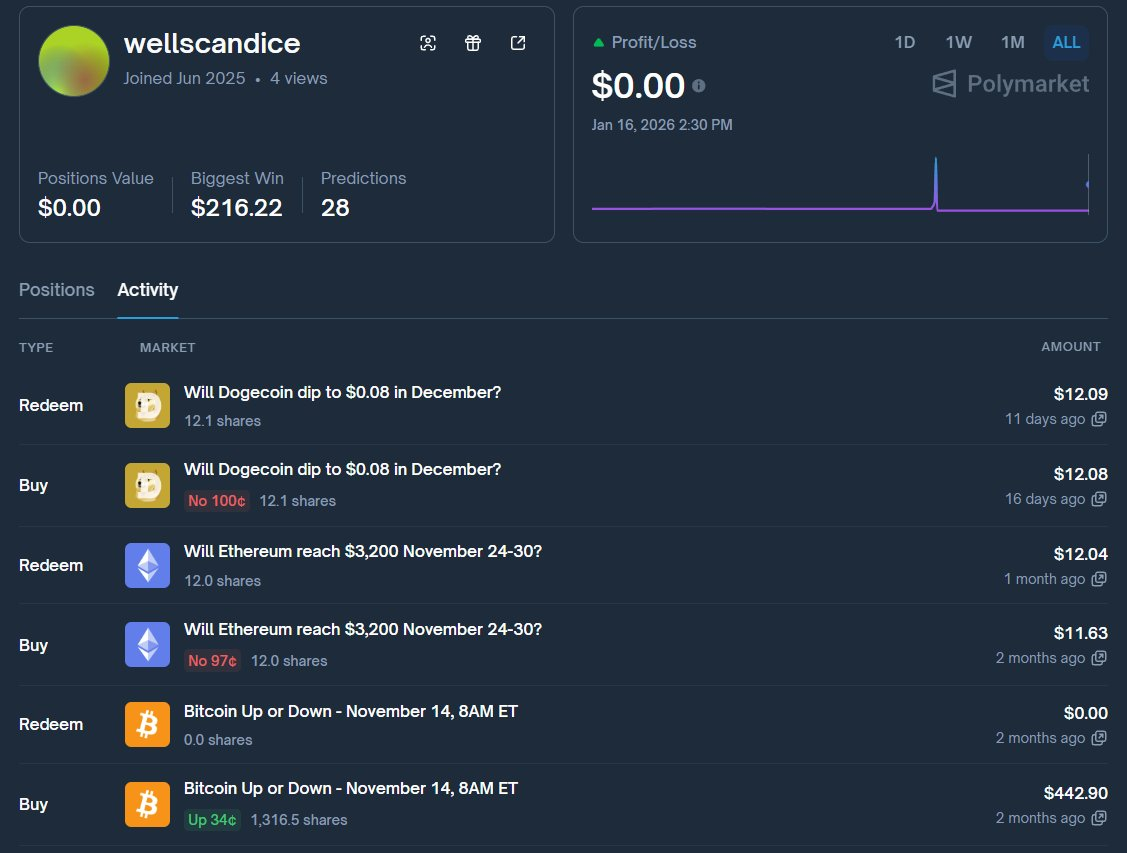
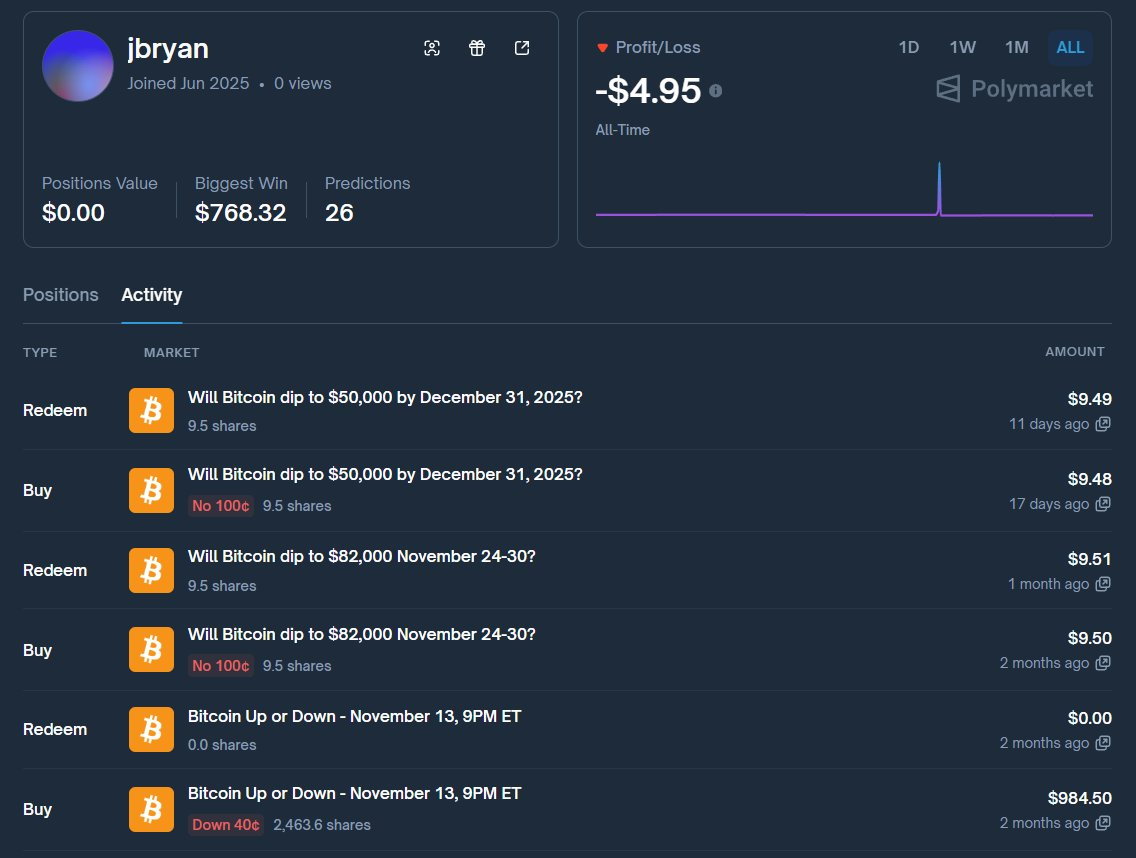
Not only that, he also posted screenshots and links to the corresponding sybil account homepages:

  • Account one: https://polymarket.com/@brockmatthew;
  • Account two: https://polymarket.com/@wellscandice;
  • Account three: https://polymarket.com/@jbryan.
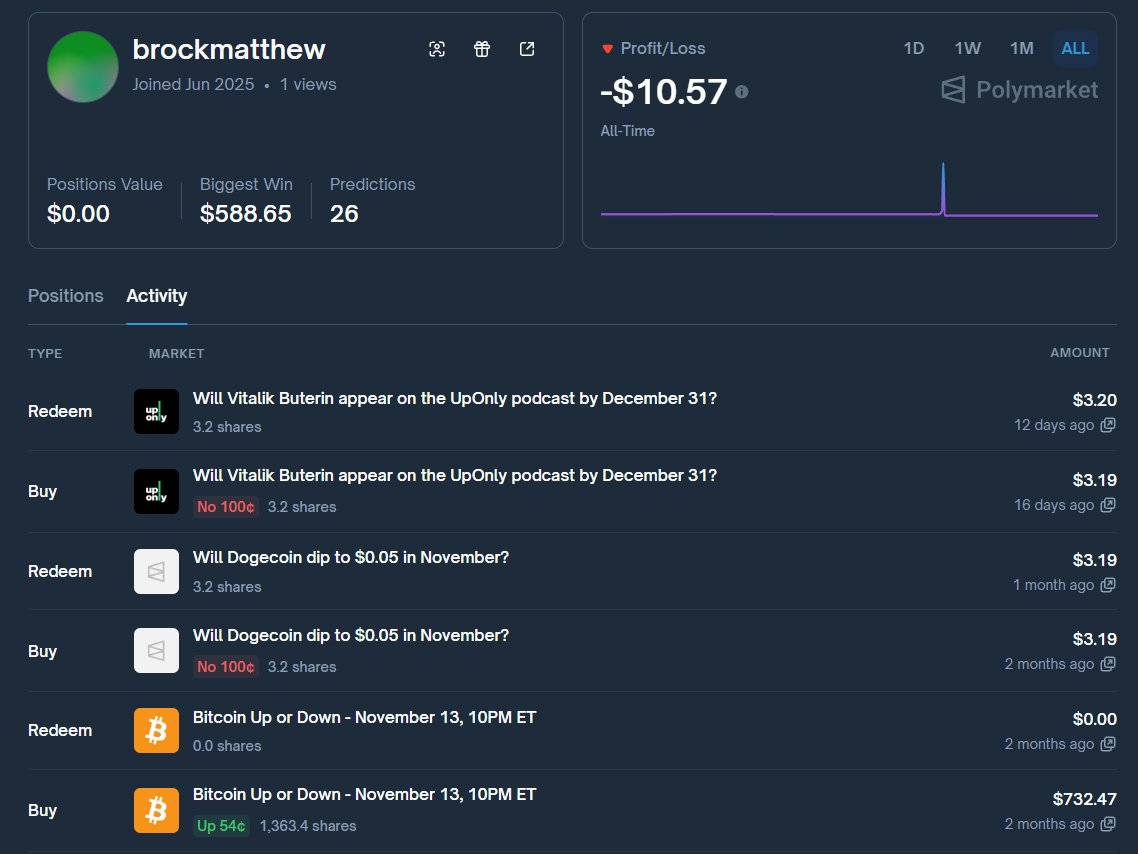
Although ascetic later responded in the comments that the wallets and accounts mentioned by Moses were unrelated to them, and some ZSC DAO (a Polymarket trader community) members also voiced support, calling Moses's actions a cyber attack, the association between the bot-like reply content on ascetic's previous tweet and their Polymarket account and numerous accounts with similar behavioral traces still greatly reduced the credibility of this "8300x return miracle".

Someone in the comments also mentioned it was hard to understand the reason for doing this, as "7 consecutive winning bets" itself is already impressive; but随后 someone pointed out this was still a game of "bot-style wide net".

Somewhat ironically, Moses's own bio also reads "The Road from $1 to $1M", whether it's a real record or a personal goal, we don't know.

Compared to the hard-to-judge ascetic, the following case of a trader who made $230,000 in profit through price manipulation in the XRP "15-minute price prediction market" might be more worthy of study by whale players.

Trader Uses Binance Spot to Counter-Harvest Prediction Market: $1M Principal Nets $230K Profit

On January 18th, Polymarket trader PredictTrader posted exposing a trader's操作 worthy of a "Wolf of Wall Street" drama—by harvesting liquidity from trading bots, he made $233,000 in just a few hours, and it hadn't even attracted大规模 market attention yet.

The timing chosen by this trader, a4385, was also extremely clever—it was Saturday evening, market liquidity was low, and Binance spot order book liquidity was also relatively thin.

In the "XRP Up/Down — Jan 17, 12:45-1:00 PM ET" market, he heavily bought "Yes" shares.

His counterparties were the more common "individual market makers" on Polymarket—various trading bots. (Odaily Planet Daily Note: Market making on Polymarket is relatively simple, with low entry barriers for individual developers, trading bots are very popular now). By 10 minutes into the event, XRP was down about 0.3% from the opening price, but he had pushed the "Yes" shares up to 70%. The trading bots saw a profit opportunity, unaware they were falling into the price trap set by this trader, and proceeded to sell him more "Yes" shares.

Ultimately, the trader bought $77,000 worth of "Yes" shares at an average price of 48%.

Then, just 2 minutes before the event settled, a wallet on Binance bought about $1 million worth of XRP spot, pushing its price up about 0.5%; seconds after the event settled, this $1 million spot was quickly sold off.

In other words, the cost of this price manipulation event was—approximately 0.25% one-way trade slippage + fees.

Using a Binance VIP Level 4 account (0.06%) (easy to obtain) and 0.25% two-way slippage, the total cost is approximately $6,200, the actual operating cost could be even lower. By repeating the same operation multiple times, exploiting the weekend liquidity loophole, this trader借此 emptied multiple bot wallets.

Some bots were shut down in time, while others weren't quick enough to react and lost all their funds—including @aleksandmoney, who lost their entire year's profit (about $160,000).

a4385 Polymarket account link: https://polymarket.com/profile/0x506bce138df20695c03cd5a59a937499fb00b0fe

At the end of the article, we hope that traders betting for and against, passionately battling on the prediction market, can distinguish fact from appearance. Sometimes, the truth is not always objective, while the standards and rules判定 by the platform are man-made.


Cryptos en tendance

Questions liées

QWhat was the alleged 8300x return story on Polymarket, and what was the controversy surrounding it?

AA trader named ascetic claimed to have turned $12 into over $100,000 in profit through 16 consecutive successful bets on Bitcoin's short-term volatility, achieving an 8300x return. However, another trader, Moses, accused ascetic of running a 'Sybil farm' with hundreds of accounts, each starting with $10-$20, and only publicizing the one account that succeeded. Moses provided links to several accounts with similar creation dates and trading patterns to support the fraud allegation.

QHow did a trader allegedly manipulate the XRP price on Binance to profit on Polymarket?

AA trader, identified as a4385, manipulated the 'XRP Up/Down - 15-minute' market on Polymarket. They heavily bought 'Up' shares, pushing their price to 70% even though XRP was down 0.3%. Then, just two minutes before the market's resolution time, a wallet (likely controlled by them) bought ~$1 million of XRP spot on Binance, artificially pumping its price by ~0.5%. After the Polymarket market resolved in their favor, the XRP was quickly sold. The cost was minimal (estimated 0.25% slippage + fees), but the profit was $233,000, effectively draining liquidity from automated trading bots on Polymarket.

QWhat role did trading bots play in the XRP price manipulation scheme on Polymarket?

ATrading bots, which act as personal market makers on Polymarket, were the counterparties that sold the 'Up' shares to the manipulator, a4385. These bots, seeing a profitable opportunity to sell high-priced 'Up' shares against a falling XRP price, provided the liquidity that the manipulator needed. They failed to anticipate the upcoming artificial price pump on Binance and were consequently 'harvested' for their liquidity, with one bot, @aleksandmoney, reportedly losing its entire annual profit of ~$160,000.

QHow did the Polymarket community and officials initially react to the '8300x miracle' claim?

AInitially, the Polymarket community reacted with celebratory comments and congratulations. Polymarket's Global Head of Growth, LeGate, even congratulated the trader ascetic and awarded them a PolymarketTrade badge, seemingly endorsing the achievement as a legitimate success story for the platform before the fraud allegations surfaced.

QWhat is the core warning or lesson the article implies about prediction markets like Polymarket?

AThe article warns that not all spectacular gains are genuine. It highlights that these platforms can be susceptible to fraud, such as multi-account schemes (Sybil attacks), and sophisticated manipulation, where traders with significant capital can exploit market mechanics and liquidity providers (like bots) for profit. It advises participants to be discerning, conduct their own research, and understand that platform rules and judgments are ultimately man-made and can be gamed.

Lectures associées

Venus Protocol Intègre des Actions Tokenisées comme Collatéral de Prêt sur BNB Chain

Venus Protocol intègre désormais des actions tokenisées comme garantie pour les prêts sur la BNB Chain, élargissant ainsi les cas d'utilisation des actifs du monde réel (RWA) dans le marché du crédit DeFi. **Points clés :** * Des actions tokenisées d'entreprises comme Apple, Tesla et Microsoft sont acceptées comme collatéral dans des pools de prêt isolés. * Ces actifs seraient adossés à 1:1 à des actions réelles détenues par des dépositaires régulés. * Les déposants peuvent emprunter des stablecoins ou du BNB contre ces garanties. Cette initiative permet aux détenteurs d'accéder à des liquidités sans vendre leurs positions sous-jacentes, rapprochant le crédit DeFi du financement sur marge traditionnel. Elle représente également une étape dans la compétition des blockchains pour attirer l'activité RWA. Cependant, ce collatéral introduit un profil de risque différent des actifs crypto-natifs, dépendant d'entités régulées hors-chaîne, de garde d'actifs et de processus de rachat. La gestion de l'évaluation des garanties, notamment avec des horaires de marché traditionnels, constitue un autre défi. Dans le contexte actuel du marché, cette intégration s'inscrit dans les tendances majeures que sont la tokenisation des actifs réels et la recherche d'une liquidité moins spéculative. Son succès dépendra de l'adoption réelle, de la fiabilité des custodians et des oracles de prix, ainsi que de la clarté des règles opérationnelles.

bitcoinistIl y a 1 h

Venus Protocol Intègre des Actions Tokenisées comme Collatéral de Prêt sur BNB Chain

bitcoinistIl y a 1 h

Le Triangle impossible est en réalité un faux problème

L'auteur conteste la pertinence du "trilemme" classique (décentralisation, scalabilité, sécurité) pour les blockchains. Il propose que les vrais freins à l'adoption massive sont la légitimité (environnement réglementaire) et le manque de confidentialité par défaut. La blockchain est définie comme un ordinateur partagé, lent et cher, dont la seule valeur unique est de fonctionner sans propriétaire ni permission. Seul l'argent natif (comme les stablecoins) est un actif adapté, car sa simple inscription au registre constitue sa valeur. Le marché actuel ne sert qu'une niche ("les gens assez aisés"). Les gros capitaux institutionnels restent à l'écart, principalement à cause des risques opérationnels et de deux défauts structurels : 1. **Légitimité** : L'absence de permission, essentielle, crée des zones grises réglementaires. Des progrès législatifs récents (ex: loi GENIUS) commencent à combler ce fossé. 2. **Transparence** : Celle-ci est présentée comme une vertu, mais constitue en réalité une taxe. Elle expose chaque transaction, position et paiement, permettant le MEV (extraction de valeur maximale) et décourageant toute entité sérieuse de révéler sa trésorerie au monde. L'auteur souligne l'ironie d'un système fondé sur la cryptographie qui ne protège pas la vie financière des utilisateurs. La solution réside dans une **confidentialité par défaut avec des preuves de conformité** (via des preuves à connaissance nulle - ZK). Cela permet de prouver un fait (solvabilité, respect des limites, KYC) sans révéler les données sous-jacentes, combinant ainsi protection individuelle et vérifiabilité pour les auditeurs et régulateurs. Cette évolution, purement améliorative, pourrait enfin attirer les milliers de milliards de capitaux institutionnels et faire de la blockchain l'infrastructure financière qu'elle était censée être.

marsbitIl y a 11 h

Le Triangle impossible est en réalité un faux problème

marsbitIl y a 11 h

L'impossible trilemme est un faux problème

L'industrie de la cryptographie a construit le système de cryptographie le plus puissant de l'histoire, mais son principal échec est l'absence de confidentialité financière par défaut. Chaque transaction, paiement et portefeuille est diffusé publiquement. La blockchain est essentiellement un ordinateur partagé, lent et coûteux, dont la seule valeur réside dans son absence de propriétaire unique et sa résistance à la censure. Pendant des années, le débat s'est concentré sur le "trilemme" (décentralisation, évolutivité, sécurité), qui est aujourd'hui largement résolu. Le vrai frein à l'adoption massive n'est pas là. La véritable contrainte est double : la légitimité juridique et le manque de confidentialité. Les fonds sont l'actif natif de la blockchain, mais les grands capitaux institutionnels restent à l'écart car l'environnement est perçu comme trop risqué et non conforme. La transparence totale de la chaîne n'est pas une vertu, mais une taxe. Elle expose les utilisateurs au MEV (Maximum Extractable Value), où les transactions sont espionnées et exploitées avant leur règlement, drainant des milliards de dollars de valeur. La plus grande ironie est que ce système, bâti sur la cryptographie, n'applique pas le chiffrement aux activités financières des utilisateurs, contrairement à la communication qui l'a adopté il y a des décennies. La solution n'est pas un anonymat total, mais une confidentialité prouvable et conforme. Les technologies cryptographiques modernes (comme les preuves à connaissance nulle) permettent de vérifier la solvabilité, la conformité KYC ou les limites de risque sans révéler les données sous-jacentes. Cela préserve les avantages de l'auditabilité tout en éliminant l'exposition permanente. En combinant un cadre réglementaire émergent (comme le GENIUS Act) et une confidentialité par défaut avec des mécanismes de divulgation vérifiable, la blockchain peut effectuer une mise à niveau pure. Elle cesse d'être un "tableur public coûteux" pour devenir une machine partagée qui confirme la véracité des transactions sans en divulguer le contenu. C'est le pont qui permettra aux capitaux institutionnels et à la finance traditionnelle de rejoindre la chaîne, débloquant ainsi les milliers de milliards de dollars qui attendent. Le système cryptographique le plus puissant apprend enfin à garder un secret, et cela change tout.

链捕手Il y a 11 h

L'impossible trilemme est un faux problème

链捕手Il y a 11 h

Des puces optiques en pleine expansion de production collective

La demande de puces photoniques connaît une croissance exponentielle, stimulée par les besoins en interconnexion optique des centres de données d'IA. Une course mondiale aux capacités de production est engagée. Aux États-Unis, Coherent étend sa ligne de production de semi-conducteurs InP de 6 pouces au Texas, soutenue par un financement et un investissement stratégique de Nvidia. Nokia développe ses capacités de test et d'emballage avancés en Pennsylvanie. Le japonais JX Advanced Metals prévoit d'augmenter sa production de substrats InP par 7 à 10 fois. En Europe, IQE et Tower Semiconductor ont conclu un accord d'approvisionnement à long terme pour les plaquettes InP, illustrant la tendance à l'intégration hétérogène des composants InP performants dans les plateformes silicium-optique matures. En Chine, l'expansion est rapide. Suzhou TFC Optical Communication (Solstice) investit 12 milliards de dollars dans un projet d'expansion. San'an Photonics possède une capacité de production mensuelle de 2 750 plaquettes pour les puces InP. Yunnan Germanium a lancé un projet pour augmenter la production de tranches de monocristal InP. La chaîne d'approvisionnement chinoise se consolide de la matière première au module. Malgré les débats sur les délais de déploiement du CPO (Co-Packaged Optics), l'augmentation globale de la consommation de contenu optique (moteurs photoniques, lasers) est incontestable, tirée par la demande croissante de bande passante dans l'IA. Le paysage futur impliquera probablement plusieurs architectures (silicium-optique, VCSEL, MicroLED) coexistant pour différentes distances et besoins. Cette frénésie d'expansion mondiale, des États-Unis et du Japon à l'Europe et la Chine, représente un pari collectif de l'industrie des semi-conducteurs sur l'avenir photonique de l'informatique à haute performance.

marsbitIl y a 13 h

Des puces optiques en pleine expansion de production collective

marsbitIl y a 13 h

Trading

Spot
Futures

Articles tendance

Comment acheter GODS

Bienvenue sur HTX.com ! Nous vous permettons d'acheter Gods Unchained (GODS) de manière simple et pratique. Suivez notre guide étape par étape pour commencer votre parcours crypto.Étape 1 : Création de votre compte HTXUtilisez votre adresse e-mail ou votre numéro de téléphone pour ouvrir un compte sur HTX gratuitement. L'inscription se fait en toute simplicité et débloque toutes les fonctionnalités.Créer mon compteÉtape 2 : Choix du mode de paiement (rubrique Acheter des cryptosCarte de crédit/débit : utilisez votre carte Visa ou Mastercard pour acheter instantanément Gods Unchained (GODS).Solde :utilisez les fonds du solde de votre compte HTX pour trader en toute simplicité.Prestataire tiers :pour accroître la commodité d'utilisation, nous avons ajouté des modes de paiement populaires tels que Google Pay et Apple Pay.P2P :tradez directement avec d'autres utilisateurs sur HTX.OTC (de gré à gré) : nous offrons des services personnalisés et des taux de change compétitifs aux traders.Étape 3 : stockage de vos Gods Unchained (GODS)Après avoir acheté vos Gods Unchained (GODS), stockez-les sur votre compte HTX. Vous pouvez également les envoyer ailleurs via un transfert sur la blockchain ou les utiliser pour trader d'autres cryptos.Étape 4 : tradez des Gods Unchained (GODS)Tradez facilement Gods Unchained (GODS) sur le marché Spot de HTX. Il vous suffit d'accéder à votre compte, de sélectionner la paire de trading, d'exécuter vos trades et de les suivre en temps réel. Nous offrons une expérience conviviale aux débutants comme aux traders chevronnés.

211 vues totalesPublié le 2024.12.13Mis à jour le 2026.06.02

Comment acheter GODS

Discussions

Bienvenue dans la Communauté HTX. Ici, vous pouvez vous tenir informé(e) des derniers développements de la plateforme et accéder à des analyses de marché professionnelles. Les opinions des utilisateurs sur le prix de GODS (GODS) sont présentées ci-dessous.

活动图片