Xianyu, China's Version of the Folk Dark Web

marsbitPublié le 2026-01-08Dernière mise à jour le 2026-01-08

Résumé

The article "Xianyu: China's Folk Dark Web" explores the unconventional and often hidden digital marketplace on Xianyu, a second-hand goods platform, where users trade restricted or sensitive services through coded language and images to evade oversight. It details how cryptocurrencies like USDT are traded using veiled terms, and how services such as fake overseas IDs (e.g., Palau, Nigeria) for bypassing KYC checks on exchanges are sold. The piece highlights the case of a wealthy crypto influencer selling low-cost tutorial services to recruit users for commission-based schemes. Beyond crypto, Xianyu serves as a hub for accessing restricted AI tools like ChatGPT, Claude, and Gemini. Sellers exploit policy loopholes (e.g., student or military discounts) to offer accounts and subscriptions at low prices, making advanced AI models accessible to many Chinese users despite regional barriers. The platform also hosts absurd yet real services, such as hiring elderly people to confront employers over unpaid wages or providing fake death certificates to cancel flight tickets. These transactions reveal a raw, pragmatic side of internet culture where users seek solutions outside formal channels. However, the article warns of risks: some listings openly trade personal KYC-verified exchange accounts, potentially enabling fraud or money laundering. While Xianyu embodies grassroots ingenuity in circumventing restrictions, it also becomes a space where convenience blurs into ethi...

Author: San\Laoda | Deep Tide TechFlow

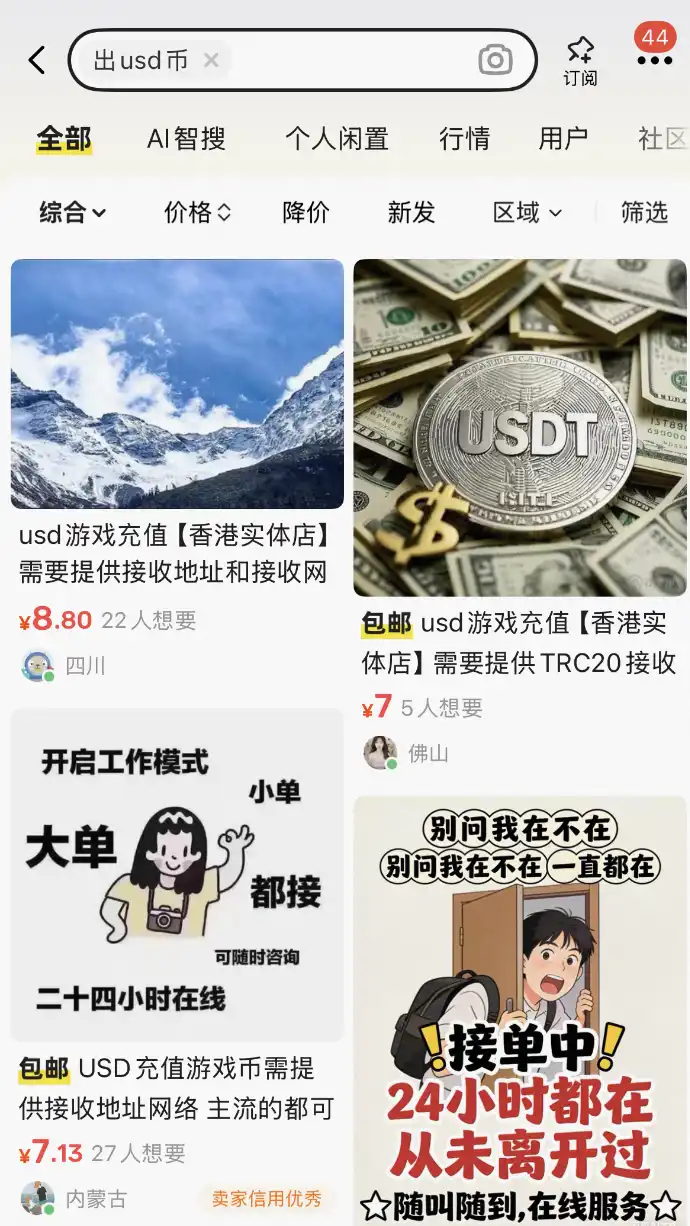
Search for "USDT" on Xianyu, and the page is blank. But change the keyword to "Sell USD Coin", and a hidden digital black market instantly unfolds.

Sellers use various homophones, code words, and images to evade platform supervision. "Those who know, know" is the passphrase here. Some hide contact information in the corners of images, while others directly post screenshots of exchange logos to prove they are "insiders".
Crypto assets, highly sensitive and strictly restricted in public discourse, haven't truly disappeared. Instead, they've been disguised and folded into a more下沉 (down-market) platform.

"Buy/Sell USDT", "Step-by-step guide to downloading exchange apps", "Overseas ID for exchange KYC", "Binance alpha tutorial"... Here, you can almost buy a one-stop service for crypto guidance.

The digital black market extends far beyond crypto-related content: discounted air tickets, hotel bookings, reservations at热门 (hot) restaurants, concert内场 (inner field/vip) tickets, Soldier AI verification...

On social media, there's a saying:

"You can buy almost anything on Xianyu."

This is not an exaggeration.

The Hidden Crypto Business

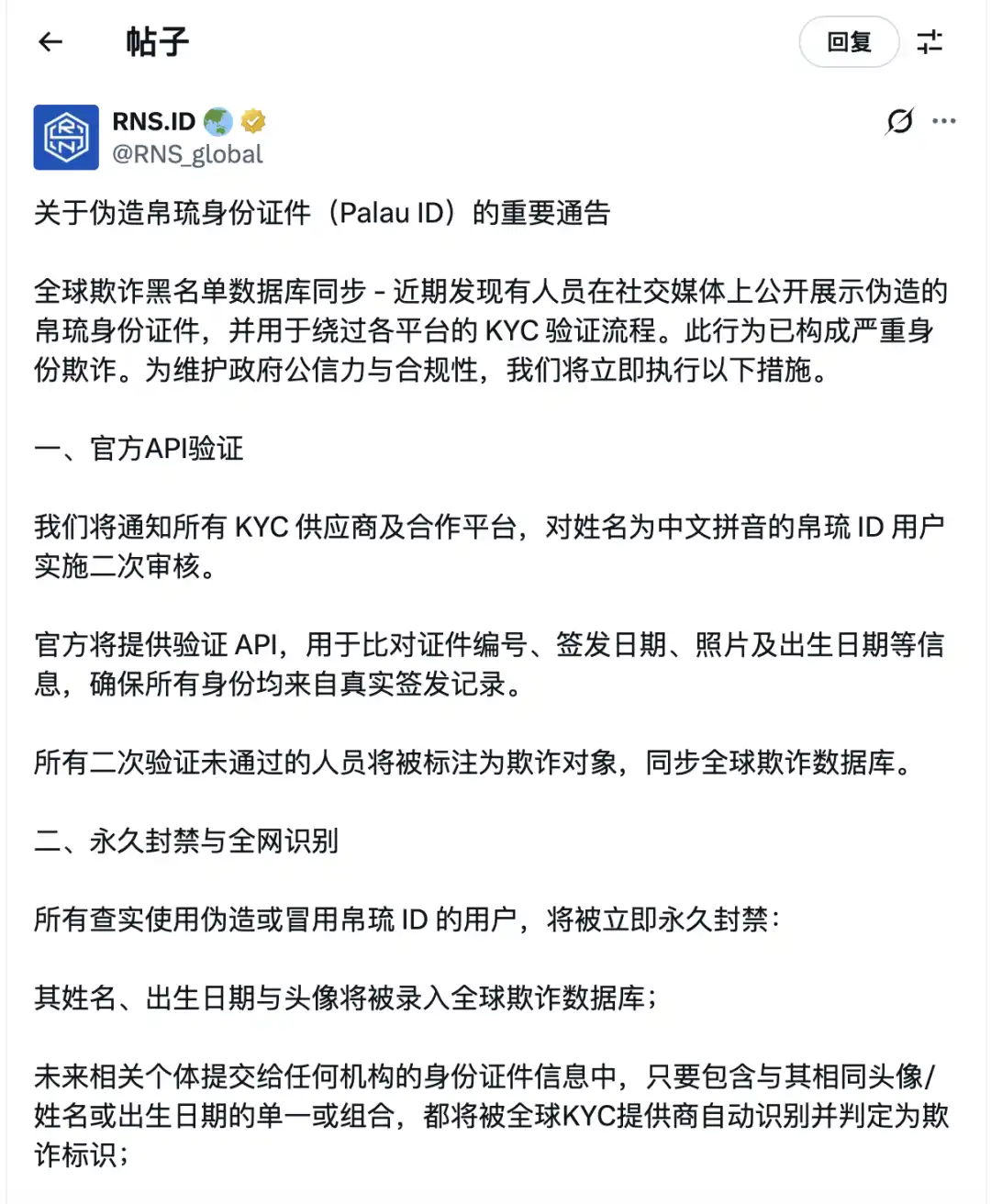
In October 2025, the official X account of the Palau Republic's digital residency program rarely issued an announcement in Chinese.

"Recently, it has been discovered that individuals are publicly displaying forged Palau ID documents on social media and using them to bypass KYC verification processes on various platforms. This behavior constitutes serious identity fraud." RNS.ID officially announced that it would implement secondary reviews for all Palau ID users with Chinese pinyin names. Users failing verification would be marked as fraud objects and synchronized to global fraud databases.
Why would this Pacific island nation's government specifically release a Chinese announcement? The answer lies in Xianyu's search results.

Entering keywords like "overseas identity" or "Palau ID" reveals an underground network for trading fake documents. Prices range from tens to hundreds of RMB, promising "100% pass rate for major exchange verification".
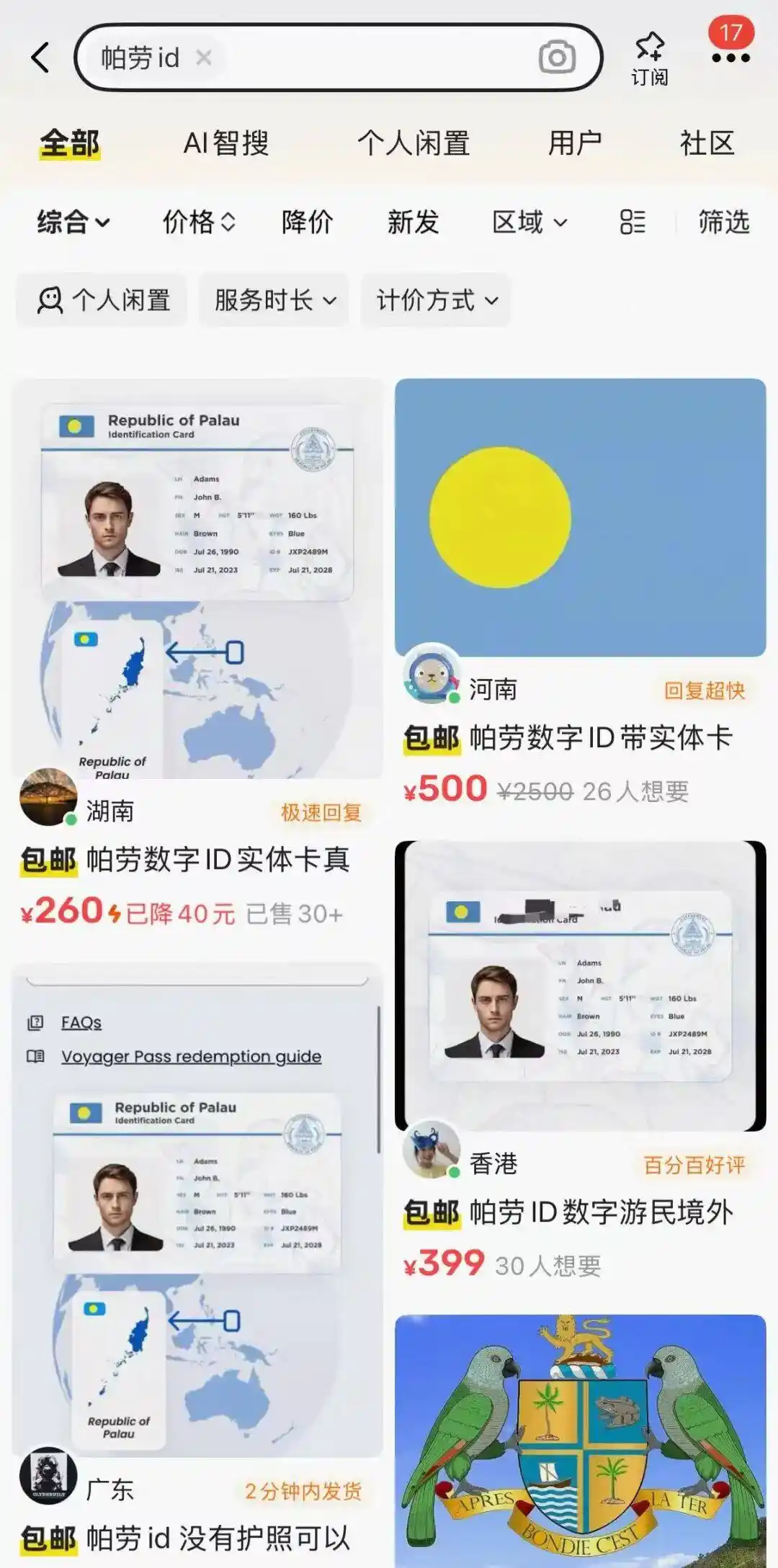
Besides Palau, documents from Dominica, Nigeria, the Philippines, and other countries are also hot commodities. The quality of these fake documents is constantly improving, with sellers offering customization services, using the buyer's real photos to ensure they pass facial recognition.

Beyond selling fake KYC documents, the Xianyu crypto black market has more zero-cost virtual services.

On Xianyu, an account named "Shenzhen Xiaoxia" once sold a 30-minute guidance service for downloading and installing Binance and OKX for 10 RMB. (Note: Currently delisted)

"Xiaoxia" is not a nobody; in the crypto world, this is a thunderous name, a top-tier KOL.

Not long ago, news of him buying Shenzhen's top luxury mansion, CITIC Xinyue Bay, while 60 million RMB in debt, was widely circulated in the industry.

Why would a crypto billionaire personally do "customer service" business for 10 RMB per order on Xianyu?

The 10 RMB tuition fee is just bait; the real income comes from referral commissions. Every user who registers through his link can bring him a share of the transaction fees in the future. An active user might generate hundreds or even thousands of RMB in revenue per month.

This 10 RMB business is an extremely low-cost fishing rod. The other end of the rod connects to a vast, sustainably monetizable pool of traffic.

If "Xiaoxia's" business is an open scheme, more sellers are doing a purer form of "chipping away at the wall" of information asymmetry.

A product priced at 88 RMB, "Binance Alpha Beginner Tutorial", offers one-on-one online lessons, promising "hand-holding guidance, worry-free and effort-saving". The so-called "Alpha" usually refers to activities launched by platforms like Binance that allow users to earn potential airdrop rewards by completing tasks.

The methods for participating in these activities are already open secrets on platforms like X and YouTube, where countless bloggers share detailed guides for free. But for most domestic users, the wall built by language, internet environment, and information channels is very real.

One buyer commented, "The seller is very helpful, much more convenient than figuring it out myself."

AI "Arsenal"

If crypto trading is just a small "darkroom" opened up in this folded space of Xianyu, then the trade surrounding AI is a truly massive,全民参与的 (nationwide participating) "digital arsenal".

When names like ChatGPT and Claude exploded globally, an invisible wall also rose. Complex registration processes, network environment issues, and the barrier of credit card payments kept the vast majority of curious Chinese users out. They could see the绚烂烟火 (brilliant fireworks) of the new world but couldn't find the entrance.

Xianyu unexpectedly became the folk path绕过高墙 (bypassing the high wall).

The "arms dealers" here offer全套服务 (full-service packages) from入门到精通 (beginner to master).

The most basic commodity is "accounts" – a ready-made GPT or Claude account, priced from tens to over a hundred RMB, often with follow-up monthly top-up services.

Which overseas AI applications and large models are hottest in the market? Just look at Xianyu.

In 2025, when the AI app Manus (now acquired by Meta for $2 billion) burst onto the scene, beta access codes were extremely scarce. On Xianyu, the price of beta codes soared from a few hundred RMB initially to thousands, even tens of thousands overnight. At its peak, someone even listed an astronomical price of "one hundred thousand RMB", which contributed to Manus's massive出圈 (breakout into mainstream awareness).

Currently, the hottest AI products on Xianyu are Gemini and ChatGPT.

The $20 monthly subscription fee for the Plus version is enough to dampen the enthusiasm of many ordinary people.

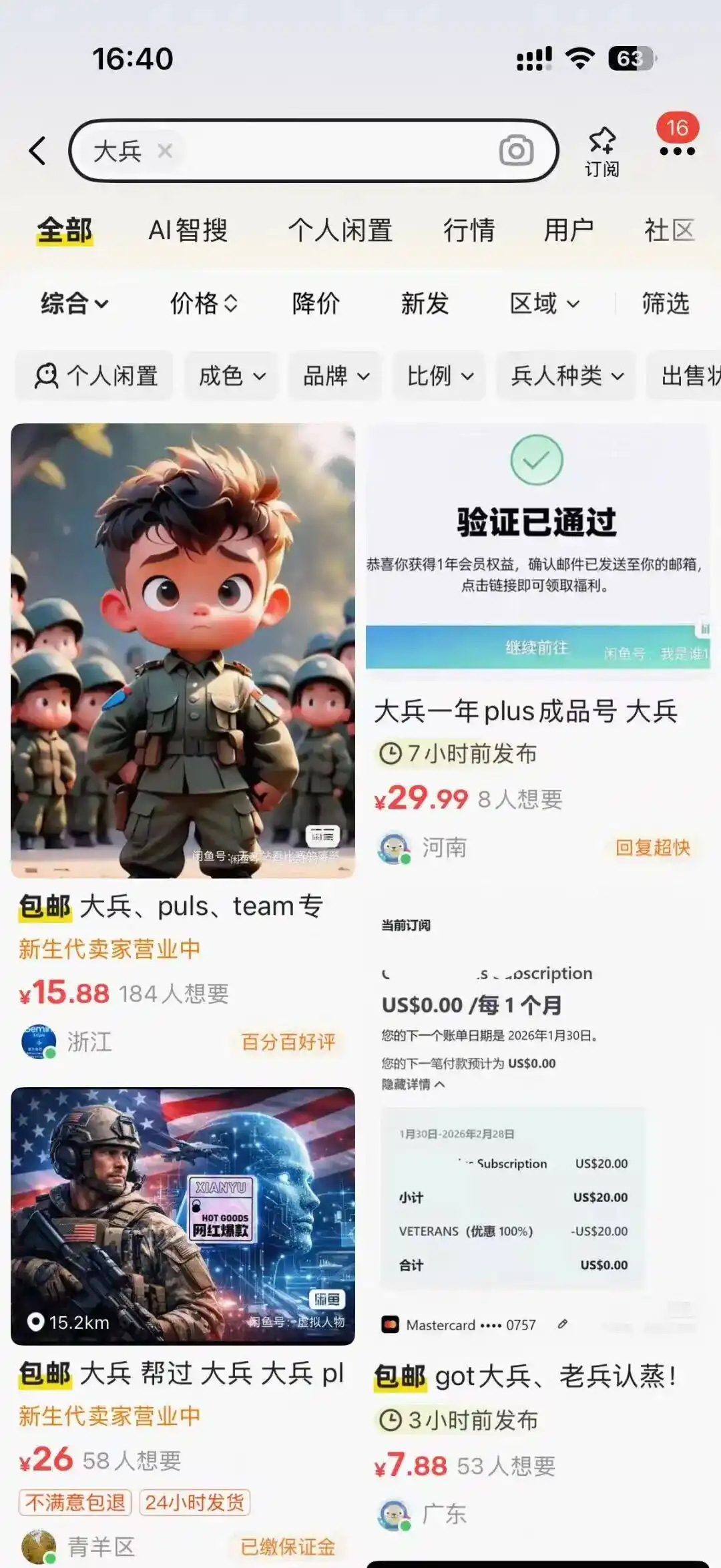
However, Google offers a one-year free福利 (benefit) for students, and OpenAI launched a福利活动 (benefit campaign) for US military veterans and active-duty personnel, offering a free year of ChatGPT Plus. This small act of policy goodwill was developed by a group of敏锐的卖家 (keen sellers) on Xianyu into a规模化 (scaled) business.

Search for "大兵" (soldier) on Xianyu, and a peculiar cyber spectacle unfolds. Product covers feature various cartoon soldiers or tough guy images, with product names full of默契的黑话 (tacit understanding slang): "Soldier help get verified!", "Soldier one-year plus ready-made account", priced from a few RMB to几十块 (dozens of RMB).
One Xianyu user mentioned on social media: "Xianyu is currently the largest AI training base in the Chinese-speaking world. Without Xianyu, most Chinese people simply couldn't use top-tier international AI models."

This statement is full of contradictions, yet incredibly realistic.

Xianyu, a platform originally meant for trading second-hand goods, thus inadvertently assumed the role of "enlightener" and "popularizer" for top-tier international AI models in China.

Buying Everything

Whether it's crypto trading or AI services, this is still just the tip of the iceberg of Xianyu's digital black market.

"Humanity's development of Xianyu is less than one percent," someone commented, calling Xianyu the Chinese version of the dark web.

The "dark" of Xianyu doesn't solely refer to blackness, but more to the absurdity. A large number of捞偏门 (unconventional/edge) and "underground industries" rarely seen in daily life have taken root and sprouted on the platform.

Some products are so abstract, even匪夷所思 (unimaginable), that they become a source of amusement on social media.

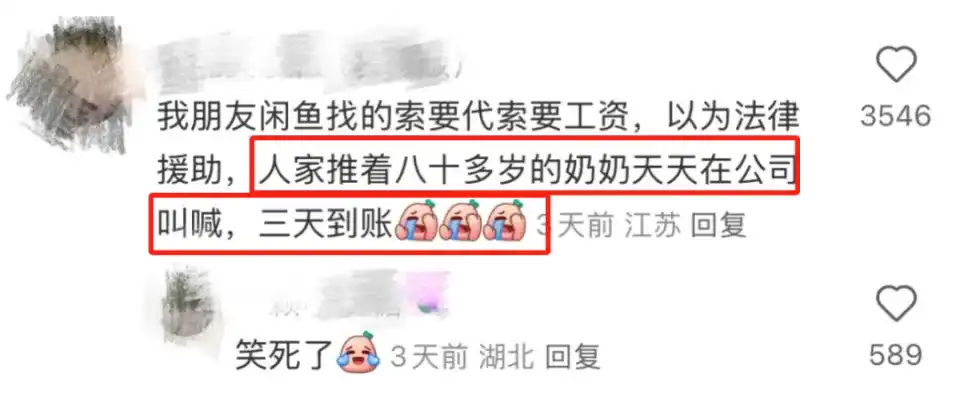
What should a worker do if maliciously owed wages?

Someone went on Xianyu and found low-cost legal aid. Unexpectedly, the merchant directly sent out an over-80-year-old grandma to fight, employing tactics like crying, making a scene, and threatening suicide. The wages arrived in three days.
Someone wanted to refund an airline ticket and sought help on Xianyu, directly receiving a "death certificate".

On Xianyu, we see not just needs and transactions, but perhaps the most authentic field research of the Chinese internet.

In this field grows the most vigorous "wild wisdom".

It doesn't follow the elegant rules of the commercial world,信奉 (believing in) only the highest principle of "solving problems". When正规渠道 (official channels) cannot meet demand, or the cost is too high,民间创造力 (folk creativity) gushes out in a raw, even darkly humorous way.

Xianyu's digital black market presents a真实切片 (real slice) of contemporary Chinese society. Here, there is no glossy brand packaging, but there are the most authentic slices of human nature: speculation, cutting corners, laziness, despair, and the instinct to survive in the cracks of the rules.

However, when the path to solving problems slides into deeper gray areas, the subject of the transaction reaches its endpoint: the person themself.

If hiring an old lady is renting "someone else's performance", then the most dangerous business on Xianyu is renting out "your own identity".

"Selling新人 (newbie), exchange", "Stably recycling exchange accounts, KYC passed, long-term cooperation", "Long-term buying新人扫码注册 (newbie scan code registrations)"... These notices赤裸地 (nakedly) package and sell a person's KYC identity in the digital world. The seller's rhetoric is highly seductive, with some包装 (packaging) this behavior as being a "digital landlord", misleading users into thinking they are merely activating "idle assets" to easily achieve "lying down and earning".

However, an account rented or sold by a novice could become a tool for telecom fraud or money laundering gangs.

From buying a tutorial, to buying an account; from hiring someone to solve your troubles, to renting yourself out to trouble itself. This bizarre chain of transactions ultimately forms a terrifying closed loop.

We start by using money to buy convenience, and end up walking all the way to exchanging ourselves for money.

This fantastical digital soil is both the "folk infrastructure" for ordinary people to bypass barriers and obtain resources, and a dark forest潜伏着 (lurking with) countless traps. It proves in the most extreme way that any suppressed demand will not disappear, but will only emerge in corners untouched by rules, in more primitive and dangerous ways.

Here, convenience and cost are tagged with the same price. You think you're just taking a shortcut, only to find that the end of the shortcut might also be a cliff.

Original article link

Questions liées

QWhat is the main theme of the article about Xianyu?

AThe article portrays Xianyu (Idle Fish) as a Chinese version of a 'folk dark web,' a platform where users trade a vast array of restricted, gray-market, and bizarre goods and services using coded language to evade oversight, from crypto assets to AI tools and even personal identities.

QAccording to the article, how is Xianyu used for cryptocurrency-related activities?

AUsers on Xianyu trade cryptocurrency-related services using coded terms like '出 USD 币' instead of 'USDT' to avoid detection. Services include selling fake foreign IDs for KYC verification, providing guides for downloading exchange apps, and offering paid tutorials for activities like Binance's 'Alpha' tasks, capitalizing on information barriers for Chinese users.

QWhat role does Xianyu play in the distribution of international AI tools in China?

AXianyu acts as a major unofficial distribution channel, or 'AI training base,' for international AI models in China. Sellers provide services like selling pre-registered accounts for tools like ChatGPT and Claude, monthly top-ups, and even exploiting free access programs (e.g., for students or US military personnel) to sell subsidized or free accounts to the general public.

QWhat are some of the more extreme or 'bizarre' services mentioned as being available on Xianyu?

AThe article cites extremely unconventional services, such as hiring elderly people to perform emotional protests to recover unpaid wages, obtaining fake 'death certificates' to cancel flight tickets, and most dangerously, the buying and selling of personal verified digital identities (KYC) for exchanges, which can be used for illicit activities like fraud and money laundering.

QWhat is the ultimate risk or 'dangerous loop' the article warns about regarding transactions on Xianyu?

AThe article warns that the transaction chain can form a dangerous loop where users start by using money to buy convenience (e.g., a tutorial) but may end up selling their own personal identity and security for money.出租 (renting out) one's own verified digital identity for cash makes individuals complicit in and vulnerable to serious crimes like fraud and money laundering, turning them from consumers into commodities.

Lectures associées

Le mystérieux grand modèle « Ox Alpha » fait le buzz, gratuit pour un temps limité

Le monde des grands modèles de langage (LLM) est en effervescence avec l'apparition d'Ox Alpha, un modèle anonyme surnommé « Niu Lai » par les internautes chinois. Proposé gratuitement et temporairement sur OpenRouter, il dispose d'un contexte de 1 million de tokens et prend en charge texte, images et vidéos. Son évaluation sur des tâches d'ingénierie logicielle réelles (benchmark DeepSWE) montre des performances impressionnantes, avec un taux de réussite initial de 80% sur un sous-ensemble de tests, rivalisant ainsi avec les meilleurs modèles de codage actuels. Bien que d'autres tests aient rapporté un score d'environ 63%, son fort potentiel est établi. Son origine fait l'objet de vives spéculations. Plusieurs indices techniques pointent vers une version non publiée de GLM-5.3 (probablement GLM-5.3 Flash ou sa variante multimodale) développée par Zhipu AI : alignement parfait du comptage de tokens visuels et textuels avec GLM-5V-Turbo/GLM-5.3, comportements de refus et style de réponse similaires. L'entreprise n'a cependant pas confirmé. Parallèlement, un autre modèle anonyme nommé « korrine » apparaît sur Code Arena, suscitant des hypothèses le liant à Kimi, Qwen ou MiMo. Cette tendance au test anonyme (« sous couverture ») permet aux développeurs d'évaluer objectivement les capacités des modèles, sans biais de marque, et de les soumettre à des tests de stress en conditions réelles avant un lancement officiel, tout en générant du buzz marketing. La performance d'Ox Alpha, s'il s'agit bien d'un modèle « Flash » (version allégée), laisse entrevoir un potentiel encore plus élevé pour les versions complètes à venir.

marsbitIl y a 43 mins

Le mystérieux grand modèle « Ox Alpha » fait le buzz, gratuit pour un temps limité

marsbitIl y a 43 mins

Bitwise CIO Matt : Si vous avez actuellement une configuration crypto de 0 %, cela équivaut à être activement baissier sur le marché

Matt Hougan, CIO de Bitwise, analyse la dynamique actuelle du marché cryptographique malgré une baisse de 50% depuis les sommets. Il souligne l'engagement persistant de Wall Street, citant le lancement de fonds tokenisés par BlackRock malgré les retards réglementaires comme le CLARITY Act. Hougan estime que ce projet de loi restera dans un état d'incertitude, mais que l'industrie avancera sans lui, soutenue par les grandes institutions financières. Il observe un changement de comportement du Bitcoin, désormais résistant aux mauvaises nouvelles, signe pour lui de la fin d'un marché baissier. Concernant l'investissement, il explique que le DCA (moyenne par coût) est une assurance comportementale, mais qu'une entrée immédiate est justifiée pour les rendements absolus, anticipant une reprise. Hougan note que les grandes plateformes de gestion de patrimoine (Wells Fargo, UBS) considèrent désormais la crypto comme une classe d'actifs à part entière, se focalisant sur le long terme. Il met en avant les opportunités de la gestion d'actifs on-chain et du thème de la tokenisation d'actifs réels (RWA), bénéfiques pour Ethereum, Solana et Chainlink. Son conseil principal : une allocation de 5% en crypto est un "repas gratuit", améliorant significativement les rendements sans augmenter la volatilité globale du portefeuille. À l'inverse, une allocation de 0% n'est pas une position neutre, mais un pari actif très baissier sur l'avenir de cette classe d'actifs.

marsbitIl y a 46 mins

Bitwise CIO Matt : Si vous avez actuellement une configuration crypto de 0 %, cela équivaut à être activement baissier sur le marché

marsbitIl y a 46 mins

À l'instant, le premier match de tennis humain-machine au monde s'est déroulé, un robot a effectué un sauvetage limite, laissant Zheng Jie stupéfaite

Le premier match de tennis humain-robot au monde a eu lieu lors des deuxièmes Jeux mondiaux des robots humanoïdes, diffusé en direct par la télévision centrale de Chine. Le robot humanoïde "Galaxy Star仔" de Galaxy General Robotics a affronté la championne de tennis Zheng Jie en simple, après avoir participé à un double mixte. Le robot a démontré des capacités remarquables : déplacement agile, échanges fluides, service à plus de 100 km/h, et récupération de balles difficiles. Il a même réussi à se relever rapidement après une chute. Cette performance représente un point de rupture dans l'intelligence incarnée, testant en temps réel les limites de la perception, de la prise de décision, du contrôle moteur et de l'adaptation dans un environnement physique dynamique et imprévisible, bien plus complexe que les jeux de stratégie comme les échecs ou le Go. Cette réussite s'appuie sur le modèle d'intelligence incarnée "Galaxy AstraBrain", qui intègre dans une même architecture les fonctions de décision de haut niveau ("cerveau") et de contrôle moteur fin ("cervelet"), éliminant ainsi les délais de communication. Le robot a été entraîné en deux étapes : d'abord par apprentissage à partir de données imparfaites de joueurs humains, puis par un entraînement intensif en simulation où plusieurs agents s'affrontaient, permettant l'émergence autonome de compétences comme le sauvetage extrême ou la technique pour se relever. Cet événement "AstraTennis" marque le passage de l'IA d'un monde numérique à la maîtrise du monde physique, symbolisant les avancées de la Chine dans l'ère de la symbiose carbone-silicium.

marsbitIl y a 1 h

À l'instant, le premier match de tennis humain-machine au monde s'est déroulé, un robot a effectué un sauvetage limite, laissant Zheng Jie stupéfaite

marsbitIl y a 1 h

Soudain, DeepSeek annonce des tarifs creux le week-end, travailler le samedi et dimanche deviendrait plus avantageux ?

DeepSeek a annoncé une modification de sa tarification par période de pointe et creuse pour ses API, effective à partir du 23 août. Désormais, les week-ends (samedi et dimanche) seront entièrement facturés au tarif creux, sans distinction d'heure. Cette décision, généralement bien accueillie par les développeurs qui peuvent ainsi réduire leurs coûts en exécutant des tâches batch le week-end, suscite également des inquiétudes parmi les salariés. En effet, certaines industries, comme celle des mini-séries, ont déjà commencé à ajuster les horaires de travail pour profiter des périodes de calcul AI moins chères. Des cas sont rapportés où des entreprises modifient les plannings, voire imposent du travail le week-end, pour optimiser les dépenses en tokens. Les raisons de ce changement tarifaire font débat. Une hypothèse avance que les prix de pointe correspondent aux périodes d'entraînement des modèles par DeepSeek, libérant la capacité de calcul le week-end. D'autres remettent en cause cette logique, arguant que l'entraînement des modèles est hautement automatisé. Alors que la nouvelle grille tarifaire est en vigueur, la question des impacts à long terme sur l'organisation du travail et des potentielles économies réelles, compte tenu des coûts de coordination supplémentaires, reste ouverte.

marsbitIl y a 1 h

Soudain, DeepSeek annonce des tarifs creux le week-end, travailler le samedi et dimanche deviendrait plus avantageux ?

marsbitIl y a 1 h

Dans les paiements par IA, le plus grand outsider est peut-être Coinbase, qui a donné un portefeuille aux Agents

Alors que les débats sur les protocoles de paiement AI se concentrent souvent sur les géants comme Visa ou Stripe, Coinbase émerge comme un acteur majeur sur le terrain, devenant la plus grande plateforme opérationnelle pour les paiements d'agents. Les données de 2026 révèlent que plus de 90% des transactions d'agents sur chaîne ont lieu sur Base (sa couche 2), 99% des transactions commerciales d'agents sont réglées en USDC, et plus de 97% utilisent le protocole x402. La clé du positionnement de Coinbase réside dans le lancement des "Agentic Wallets" en février 2026. Plutôt que de simplement connecter les agents aux réseaux de paiement existants, cette infrastructure fournit aux agents une identité financière propre, leur permettant de détenir des actifs (comme des stablecoins) et d'effectuer des transactions autonomes, micro-débitées et fréquentes entre machines. Cela résout les problèmes des cartes (frais élevés, autorisations manuelles, traçabilité floue) pour ce type de flux. Coinbase contrôle un écosystème fermé pour ces paiements : la chaîne Base, le protocole x402, les portefeuilles dédiés et les actifs comme l'USDC. Ce qui semblait être une convergence fortuite de ses investissements antérieurs dans l'infrastructure blockchain s'est révélé être un avantage décisif lorsque l'économie des agents a explosé. La leçon est que l'adoption dans les paiements AI peut moins dépendre de la bataille des standards que de la disponibilité immédiate d'une infrastructure utilisable. Coinbase, en ayant ses pièces déjà en place, a capturé la première vague de demande réelle.

marsbitIl y a 2 h

Dans les paiements par IA, le plus grand outsider est peut-être Coinbase, qui a donné un portefeuille aux Agents

marsbitIl y a 2 h

Trading

Spot
活动图片