Trump–Saudi Tokenized Hotel Deal Puts the Spotlight Back on $SUBBD Token

bitcoinistPublié le 2025-11-20Dernière mise à jour le 2025-11-20

Résumé

Quick Facts: ➡️ The Trump–Dar Global Maldives project shows tokenization moving into marquee real‑estate deals backed by state‑aligned capital. ➡️...

Trusted Editorial content, reviewed by leading industry experts and seasoned editors. Ad Disclosure

Quick Facts:

  • ➡️ The Trump–Dar Global Maldives project shows tokenization moving into marquee real‑estate deals backed by state‑aligned capital.
  • ➡️ Vision 2030 and Saudi initiatives around digital assets signal long‑term policy support for tokenized funding structures.
  • ➡️ SUBBD token applies similar tokenization mechanics to creator income, bundling AI tools, payments, and token‑gated access in one stack.
  • ➡️ As tokenized assets normalize, demand should grow for platforms that let both humans and AI agents monetize on‑chain.

The Trump Organization and Saudi Arabia’s Dar Global have turned a niche thesis into headline reality.

Their new Trump International Hotel Maldives will be financed through what both groups call the world’s first tokenized hotel development project. Here, investors will buy digital shares in the construction phase itself.

The announcement coincided with Crown Prince Mohammed bin Salman’s commitment of up to $1T in US investments and deeper capital‑markets ties with Washington.

Like the US, Saudi policy is moving in the same direction. Under the Vision 2030 program, regulators have encouraged digital asset infrastructure, including pilots to tokenize equity markets and build domestic digital currency frameworks with international partners such as WhiteBIT.

This is big news because tokenization goes beyond theory. A G20 government is aligning tourism, real estate, capital markets, and crypto under one policy umbrella.

Once sovereigns normalize tokenized property and securities, retail users will expect tokenized access everywhere, including content, media, and creator economies.

This is where SUBBD ($SUBBD) sits. Instead of tokenizing hotels or office towers, the project applies the same on‑chain ownership logic to content, creator‑fan relationships, and AI‑driven digital identities.

Tokenization and the Race to On‑Chain Revenue Streams

The Maldives deal is part of a broader pivot. Tokenized real‑world assets, or RWAs, have already crossed tens of billions of dollars in value, with tokenized US Treasuries alone valued at $8.41B. The difference now is who is driving the narrative: nation‑states and major brands, not only crypto natives.
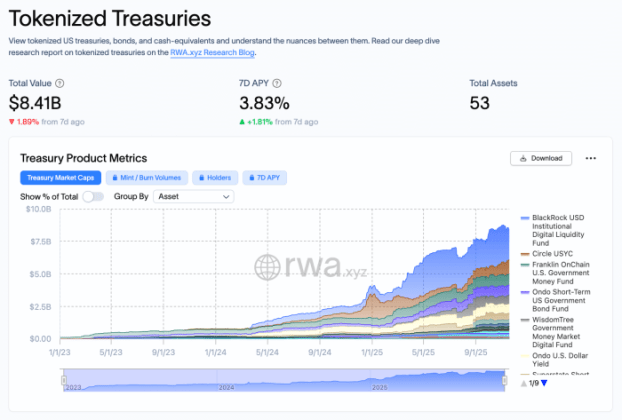
US tokenized treasuries via RWA.xyz.

Saudi Arabia is positioning itself as a regional tokenization hub. Alongside its hospitality experiments, it has encouraged a growing cluster of blockchain firms, with several thousand Web3 companies reportedly registered and year‑over‑year growth outpacing traditional tech segments.

For investors, that shift changes the risk profile of on‑chain projects.

Tokenization is becoming a standard funding and distribution mechanism for everything from luxury villas to equity markets. In that environment, infrastructure and applications that help creators tokenize their own output start to look less like speculative side bets and more like the way of the future.

While several projects already target this creator tokenization lane, SUBBD ($SUBBD) aims for a wider surface.

How $SUBBD Turns Tokenization Into An AI‑Native Creator Stack

Most Web2 content platforms are effectively centralized tax authorities.

Major subscription hubs can keep 30% or more of gross revenues, while niche creator platforms routinely push effective take‑rates toward 50% to 70% once payment processors and promotional fees are included.

That margin structure leaves little room for experimentation with AI tools, multi‑currency payments, or region‑agnostic access.

SUBBD ($SUBBD) attacks those frictions from three angles.

First, it uses Ethereum smart contracts for payments and access control, so subscription and pay‑per‑view revenue flows directly to creators’ wallets, with platform fees programmable and transparent.

Next, it embeds AI assistants, voice cloning, and AI influencer engines directly into the stack, allowing creators to scale interactions and content output without hiring additional staff.

Finally, it tokenizes access, not only content, so fans can stake, earn XP multipliers, and unlock loyalty tiers through on‑chain behavior.

The benefits of joining the SUBBD Token presale.

📖 Go on a deep dive into the project in our ‘What is SUBBD Token’ page.

The tokenomics tie that activity together. As a $SUBBD holder, you can stake for a targeted 20% APY in the first year, with additional benefits including access to exclusive livestreams, behind‑the‑scenes content, and platform discounts.

As staking evolves toward utility‑driven rewards, XP multipliers, and loyalty incentives are designed to direct tokens toward active users rather than passive yield seekers, aligning creator success with fan engagement.

Presale traction suggests that the narrative is resonating. The token presale has already raised over $1.3M, with tokens currently priced at $0.057.

💰 Want to buy $SUBBD Token? Head on to our comprehensive SUBBD Token buying guide.

You can HODL the tokens too if you prefer. Based on our SUBBD Token Price Prediction, $SUBBD has the potential to hit a high of $0.48 by the end of 2026, making it an even more compelling reason to invest in the project.

If you are following the Trump–Dar Global experiment, the through‑line is clear: tokenization is moving from exotic edge case to default infrastructure.

Projects like SUBBD ($SUBBD) attempt to extend that infrastructure to the $85B‑plus content creation market, targeting the same investor appetite for on‑chain cash flows but routing it through human and AI creators instead of steel and concrete.

Join the SUBBD Token presale today.

Disclaimer: This article does not constitute investment advice, tax guidance, or a recommendation to buy, sell, or hold any asset.

Authored by Bogdan Patru, Bitcoinist — https://bitcoinist.com/subbd-token-gains-traction-as-trump-saudi-announce-tokenized-hotel-plan

Editorial Process for bitcoinist is centered on delivering thoroughly researched, accurate, and unbiased content. We uphold strict sourcing standards, and each page undergoes diligent review by our team of top technology experts and seasoned editors. This process ensures the integrity, relevance, and value of our content for our readers.

As a crypto writer, Bogdan’s responsibilities are split between researching and writing articles and entertaining the team with his humor bordering on the politically incorrect, an aspiring Bill Burr, if you will. Thanks to his 12+ years of writing experience in just as many fields, including tech, cybersecurity, modelling, fitness, crypto, and other topics-that-shall-not-be-named, he's become a genuine asset to the team. While his position as a senior writer at PrivacyAffairs thought him valuable lessons about the power of self-management, his entire writing career was and is an exercise in self-improvement. Now, he's ready to sink his teeth into crypto and teach people how to take control of their own money on the blockchain. With fiat as an eternally devaluing currency, Bitcoin and altcoins seem like the best-fitting alternative for Bogdan. Bogdan’s biggest professional accomplishment, aside from securing a position as a main writer for Bitcoinist, was his 5-year run as a writing manager at Blackwood Productions, where he coordinated a team of four writers. During that time, he learned the value of teamwork and that of creating a working environment that breeds efficiency, positivity, and friendship.

Lectures associées

Upbit s'affole : une contre-attaque précipitée pour regagner des parts sur le marché des stablecoins

Upbit lance une campagne de promotion limitée (26 juillet au 9 août) en supprimant les frais de transaction (0,05%) pour les stablecoins sur son marché en won sud-coréen, tout en listant rapidement de nouveaux stablecoins comme RLUSD et USDG. Cette offensive, perçue comme une réaction tardive, vise à reconquérir des parts de marché perdues au profit de Coinone, qui a capté une large part des échanges grâce à sa politique de frais nuls permanents sur l'USDC depuis octobre 2025. L'analyse des données montre que les stablecoins servent principalement de canal pour les transferts transfrontaliers de capitaux depuis la Corée du Sud, avec des sorties nettes continues. La promotion d'Upbit a initialement boosté le volume quotidien moyen de 162%, principalement porté par l'USDT, mais l'effet s'est estompé dès la deuxième semaine. Les nouveaux stablecoins listés n'ont attiré qu'un intérêt éphémère. Cette stratégie semble à court terme, car une fois les frais rétablis, Upbit risque de reperdre les volumes acquis. L'enjeu est cependant stratégique dans un contexte de régulation imminente (projet de loi sur les actifs numériques) et d'intégration au sein de Naver Financial, où les stablecoins pourraient devenir un pilier pour les futurs écosystèmes de paiement. Upbit pourrait ainsi chercher à consolider sa position comme plaque tournante de distribution des stablecoins USD en prévision de ces évolutions.

marsbitIl y a 2 h

Upbit s'affole : une contre-attaque précipitée pour regagner des parts sur le marché des stablecoins

marsbitIl y a 2 h

Les développeurs d'Ethereum vont réduire 66 propositions liées à la mise à niveau Hegotá

Les développeurs d'Ethereum examinent actuellement 66 propositions afin de les réduire dans le cadre de la définition du périmètre de la prochaine mise à jour majeure, Hegotá. Plusieurs de ces propositions visent à intégrer davantage de fonctionnalités de confidentialité au protocole. Pour l'instant, seule la proposition FOCIL (Fork-choice enforced inclusion lists) est officiellement programmée pour Hegotá. Cependant, d'autres propositions comme les Frame Transactions (EIP-8141) et Keyed Nonces (EIP-8250) sont également considérées comme cruciales pour "débloquer la confidentialité native", permettant aux applications de confidentialité de fonctionner sans intermédiaires. L'objectif de FOCIL est de renforcer la résistance à la censure du réseau, tandis que les autres propositions fourniraient des éléments de base pour les applications axées sur la vie privée. Les développeurs visent à livrer Hegotá l'année prochaine. Les prochains appels des développeurs fondamentaux (core devs) joueront un rôle clé dans la trajectoire de développement d'Ethereum pour 2027. Parallèlement, les développeurs se préparent à déployer d'abord Glamsterdam, une mise à jour majeure prévue pour la seconde moitié de 2026, destinée à améliorer l'extensibilité, renforcer la couche 1 et rendre le réseau plus facile à utiliser.

cointelegraphIl y a 3 h

Les développeurs d'Ethereum vont réduire 66 propositions liées à la mise à niveau Hegotá

cointelegraphIl y a 3 h

Le Nasdaq va être ouvert 23 heures par jour, à qui va-t-il prendre des parts de marché ?

Le Nasdaq prévoit de lancer en décembre 2026 une session de négociation d'actions de 23 heures sur 5 jours, couvrant notamment la journée asiatique. Cette extension vise principalement à capter les ordres qui se reportent actuellement sur les plateformes de nuit (ATS), les systèmes internes des courtiers et d'autres bourses hors des heures normales. L'analyse des transactions nocturnes existantes montre que l'activité est concentrée sur un nombre limité d'ETF (notamment sur le S&P 500) et de grandes valeurs technologiques (comme Tesla, Nvidia), utilisés pour la gestion des risques macroéconomiques. L'objectif du Nasdaq est de rapatrier cette liquidité, de renforcer la découverte des prix pour ces actifs clés et, à plus long terme, de consolider le rôle des marchés américains comme point d'entrée pour la tarification des actifs mondiaux pendant la journée asiatique. Cette réforme entraînera des coûts accrus pour l'ensemble de l'infrastructure financière (compensation, tenue de marché, conformité), qui pourraient se répercuter sur les investisseurs via des spreads élargis. Elle offre une réactivité accrue face aux événements, mais la liquidité réduite en dehors des heures de pointe peut conduire à des prix moins fiables. Alors que les places comme Londres ou Hong Kong étudient aussi des prolongations, la concurrence porte moins sur la durée d'ouverture que sur la captation des flux d'ordres globaux et le pouvoir de définir les prix de référence internationaux.

marsbitIl y a 3 h

Le Nasdaq va être ouvert 23 heures par jour, à qui va-t-il prendre des parts de marché ?

marsbitIl y a 3 h

Trading

Spot
活动图片