Cardano Goes On Offense: Hoskinson Fast-Tracks Post-Quantum Shift

bitcoinistPublié le 2025-11-10Dernière mise à jour le 2025-11-10

Résumé

Cardano founder Charles Hoskinson used a weekend update from “up here at the clinic” in Wyoming to move the quantum-computing...

Trusted Editorial content, reviewed by leading industry experts and seasoned editors. Ad Disclosure

Cardano founder Charles Hoskinson used a weekend update from “up here at the clinic” in Wyoming to move the quantum-computing debate from speculation to planning. Framing DARPA’s Quantum Benchmarking Initiative (QBI) as the turning point, he said, “finally, finally, finally, we have an objective source of truth,” adding that “as of November 6, 2025, DARPA has selected 11 companies to enter the second stage […] which aims to rigorously verify and validate whether any quantum computing approach can achieve utility scale operation […] by the year 2033.”

DARPA Advances 11 Quantum Teams

He emphasized that QBI is designed to separate “fact from fiction about quantum computers,” and relayed the program manager’s stark split among experts: “Half of them are convinced that quantum computing is going to be the best thing since sliced bread […] and the other half are convinced that even if you could build a quantum computer, which you definitely won’t be able to do, it’s never going to be more useful than your laptop.”

The point of QBI, as the manager put it in the clip Hoskinson played, is to answer two questions: “if I had a really powerful quantum computer, what could I do with it?” and “is there a […] group that has a path to really build that kind of machine in the near term […] in the next 10 years?”

The Cardano founder walked through QBI’s staged process. “During the six month Stage A […] you are a quantum computer builder […] you spend six months answering every question they can throw at you […] and at the end of all of it, they say, ‘actually, there’s some merit.’” Stage B, he said, is “a rigorous one-year plan” where “you’ve opened the kimono and they’re taking a look at your quantum computing design.”

Stage C is the hardware trial: “work with the government to verify and validate that the utility scale quantum computer concept can be constructed as designed and operated as intended,” meaning “they’re actually going to watch you run it” on “objective problems.”

He named the 11 companies that, in his account, survived Stage A and entered Stage B—“Atom Computing in Boulder, Colorado […] IBM, IonQ, Nord Quantique, Photonic, Quantinuum […] Quantum Motion, QA Computing, Silicon Quantum Computing and Xanadu”—and highlighted that “there’s no canonical approach for quantum computing.” He rattled off the five families he’s tracking, each with variations: “a neutral atom approach” that uses “highly focused lasers known as optical tweezers,” “silicon-based approaches” that look like specialized chips, “superconducting approaches,” “trapped ion approaches,” and “light-based approaches” where “quantum information is encoded in the properties [of] photons.”

For crypto, he made his position explicit: “I am of the belief that quantum computers will exist in the 2030s and they will be able to run Grover’s and Shor’s algorithm,” which means “the majority of mainstream cryptocurrencies will be vulnerable if they do not implement counter measures by that time.” The Cardano founder warned of the “archiving” problem—“encrypted emails, encrypted payloads that were archived can now be decrypted even if they’re re-encrypted later on with a post-quantum scheme because they have a copy of the classical encrypted payload.”

His countermeasure checklist starts with the US standards track: “we do have some government standards that NIST came up with called FIPS 203, 204, 205 and 206.” He described them as “an array of tools either lattice-based or hash-based or other to do encryption [and] signatures.”

Cardano Prepares For Quantum Era

On Cardano’s privacy and ZK layer, Midnight, he announced a deeper pivot: “we’re going to be announcing a program project to change the heart of Midnight, PlonK and Halo 2 to a new standard called Nightstream that is relying on lattice-based crypto,” describing it as “a moonshot” co-built “with a lot of large companies through a project at the Linux Foundation.”

In the interim, he said, “next year as Midnight turns on it’ll turn on with PlonK and Halo 2,” but the design is “already pre-designing it to have a drop in replacement […] [so] the basement of it is going to be post-quantum,” with the goal that “Midnight will be immune to quantum computers well ahead of the 2033 deadline.”

He pitched lattices as both defense and performance lever. “Turns out that lattices in particular have capabilities above and beyond what Ethereum is doing in the hash-based space,” he argued, claiming they connect “to what’s going on in the AI space with tensors,” so “you can use GPUs to accelerate the writing of a proof […] and the verification of [a] proof,” without “custom chips like Ethereum is proposing.” In his words, “you just use the AI chips that are in your phone, your laptop, your desktop computer, and your server, and you can get linear scale.”

The roadmap for Midnight extends beyond internal upgrades. He positioned it as “a folding engine and a recursion engine unlike any other in the entire private computation space,” asserting that “Midnight can create some of the best and lightest weight state proofs of every system it’s connected to. Cardano, Bitcoin, Ethereum, Solana, and so forth.” The strategic aim is to sign “those payloads with post-quantum signatures,” producing “a post-quantum checkpoint for Bitcoin and for other systems,” so “even if [a] quantum computer tries to change the state of things […] you’re going to have a rollback mechanism.”

He also flagged areas still on the checklist: “There are many other things you have to do. You have to look at post-quantum VRFs and post-quantum VDFs and you have to look at post-quantum random number generation and a litany of other concerns.” The “most important step,” in his view, is “to lock truth, lock history in a state where quantum computers can’t break it.”

The upshot for Cardano, he said, is to move now: “Adapt or get cracked.”

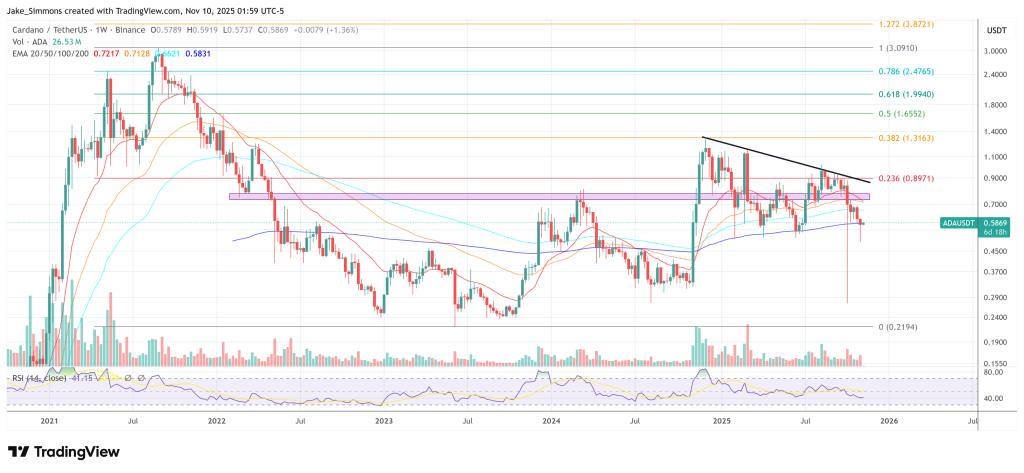
At press time, Cardano (ADA) traded at $0.5869.
Cardano price
Cardano finds support at the 200 week EMA again, 1-week chart | Source: ADAUSDT on TradingView.com
Featured image created with DALL.E, chart from TradingView.com
Editorial Process for bitcoinist is centered on delivering thoroughly researched, accurate, and unbiased content. We uphold strict sourcing standards, and each page undergoes diligent review by our team of top technology experts and seasoned editors. This process ensures the integrity, relevance, and value of our content for our readers.

Jake Simmons has been a Bitcoin enthusiast since 2016. Ever since he heard about Bitcoin, he has been studying the topic every day and trying to share his knowledge with others. His goal is to contribute to Bitcoin's financial revolution, which will replace the fiat money system. Besides BTC and crypto, Jake studied Business Informatics at a university. After graduation in 2017, he has been working in the blockchain and crypto sector. You can follow Jake on Twitter at @realJakeSimmons.

Lectures associées

Avec Ozak AI maintenant au-dessus de 7 millions de dollars levés, les analystes avertissent que le stock restant de la prévente pourrait diminuer rapidement alors que les acheteurs tardifs se précipitent pour sécuriser leurs positions.

Le projet Ozak AI, un token basé sur l'intelligence artificielle, connaît un succès significatif lors de sa prévente, ayant déjà levé plus de 7 millions de dollars. Les analystes avertissent que l'allocation restante pourrait diminuer rapidement en raison d'un afflux d'investisseurs tardifs souhaitant sécuriser des tokens avant la prochaine augmentation de prix et le listing prévu sur les principales plateformes d'échange. Le prix actuel est de 0,014 $ dans la septième phase de prévente. La technologie centrale d'Ozak AI combine blockchain et IA pour offrir des outils d'analyse prédictive en temps réel, utilisant des agents spécialisés pour les prévisions de prix, le sentiment du marché et l'analyse technique. Ces fonctionnalités alimentent la demande. Le projet renforce également son écosystème via des partenariats, par exemple avec Mira pour des flux de données vérifiés. Avec une offre limitée lors des phases de prévente et une demande croissante, les analystes estiment que retarder l'achat pourrait signifier payer plus cher pour moins de tokens. Ils évoquent un prix cible de 1 $ après le listing, suggérant un potentiel de croissance important pour les premiers investisseurs.

TheNewsCryptoIl y a 4 h

Avec Ozak AI maintenant au-dessus de 7 millions de dollars levés, les analystes avertissent que le stock restant de la prévente pourrait diminuer rapidement alors que les acheteurs tardifs se précipitent pour sécuriser leurs positions.

TheNewsCryptoIl y a 4 h

J'ai codé une application Android avec le Google vibe coding

Résumé : Google AI Studio permet désormais de générer des applications Android fonctionnelles directement depuis une fenêtre de navigateur, à l'aide de simples instructions en langage naturel. Un rédacteur de The Verge a testé cette fonctionnalité "prompt to phone" et a créé trois applications en un après-midi : un jeu d'aventure textuel, un compteur de calories et un clone de Super Mario. Le processus est simple : l'utilisateur décrit l'application souhaitée, et Gemini, l'IA de Google, génère automatiquement le code, conçoit l'interface et tente de résoudre les bugs. L'application peut être installée sur un vrai téléphone Android en quelques minutes. Cependant, l'expérience révèle les limites actuelles de l'outil. Les applications produites sont basiques, comportent des bugs persistants, des erreurs factuelles (comme des calculs de calories incorrects) et manquent de profondeur ou de fiabilité. Par exemple, le jeu de plateforme généré crashait systématiquement, et le compteur de calories utilisait des données erronées. Bien que cet outil abaisse considérablement la barrière d'entrée pour créer un logiciel personnalisé, il souligne que le chemin entre "générer une application" et "créer une *bonne* application" reste long. La qualité, la précision, le jugement esthétique et la maintenance à long terme dépendent encore largement de l'intervention et de l'expertise humaines. Google AI Studio montre la puissance de l'IA pour le prototypage rapide, mais aussi que le "dernier kilomètre" de la qualité logicielle n'est pas encore automatisable.

marsbitIl y a 5 h

J'ai codé une application Android avec le Google vibe coding

marsbitIl y a 5 h

Pourquoi les stablecoins de devises étrangères n'ont-ils jamais vraiment décollé ?

L'article analyse les raisons pour lesquelles les stablecoins de devises étrangères (FX) n'ont pas décollé, malgré leur potentiel pour les banques numériques basées sur les stablecoins. L'auteur souligne que les géants comme Tether (USDT) et Circle (USDC) bénéficient d'un effet de réseau et d'une liquidité écrasants, avec un écart de 700 fois entre le marché des stablecoins en dollars (4000 milliards $) et celui des stablecoins FX (environ 6 milliards $). Cette faible taille entraîne des problèmes de liquidité, d'ancrage fragile, d'adoption limitée et de complexité réglementaire. La solution proposée est d'adopter une approche synthétique inspirée des contrats à terme non livrables (NDF) du marché traditionnel des changes. Au lieu de créer de nouveaux stablecoins FX, les utilisateurs conserveraient des stablecoins en dollars (USDT/USDC) en sous-jacent, tandis que leur solde serait libellé dans une devise locale via un contrat NDF "mark-to-market". Cette méthode offre plusieurs avantages : un ancrage fort via des oracles, le maintien de la liquidité et des rendements du réseau dollar, une extensibilité à de nombreuses devises et une efficacité capitalistique. Les principaux cas d'usage identifiés sont : 1) Les banques numériques et portefeuilles, pour offrir des comptes multi-devises sans quitter l'écosystème dollar ; 2) Les stratégies de carry trade sur les taux d'intérêt souverains, potentiellement plus stables et évolutives que les produits cryptos comme Ethena ; 3) Les paiements d'entreprise mondiaux, permettant aux commerçants de fixer des prix dans leur devise locale tout en réglant en stablecoins dollars. En conclusion, l'infrastructure NDF sur chaîne est présentée comme la clé pour débloquer la prochaine phase d'adoption des stablecoins à l'échelle mondiale, en permettant aux banques numériques de servir efficacement les 95% de la population mondiale qui ne comptabilise pas en dollars.

链捕手Il y a 7 h

Pourquoi les stablecoins de devises étrangères n'ont-ils jamais vraiment décollé ?

链捕手Il y a 7 h

Trading

Spot
Futures

Articles tendance

Comment acheter ADA

Bienvenue sur HTX.com ! Nous vous permettons d'acheter Cardano (ADA) de manière simple et pratique. Suivez notre guide étape par étape pour commencer votre parcours crypto.Étape 1 : Création de votre compte HTXUtilisez votre adresse e-mail ou votre numéro de téléphone pour ouvrir un compte sur HTX gratuitement. L'inscription se fait en toute simplicité et débloque toutes les fonctionnalités.Créer mon compteÉtape 2 : Choix du mode de paiement (rubrique Acheter des cryptosCarte de crédit/débit : utilisez votre carte Visa ou Mastercard pour acheter instantanément Cardano (ADA).Solde :utilisez les fonds du solde de votre compte HTX pour trader en toute simplicité.Prestataire tiers :pour accroître la commodité d'utilisation, nous avons ajouté des modes de paiement populaires tels que Google Pay et Apple Pay.P2P :tradez directement avec d'autres utilisateurs sur HTX.OTC (de gré à gré) : nous offrons des services personnalisés et des taux de change compétitifs aux traders.Étape 3 : stockage de vos Cardano (ADA)Après avoir acheté vos Cardano (ADA), stockez-les sur votre compte HTX. Vous pouvez également les envoyer ailleurs via un transfert sur la blockchain ou les utiliser pour trader d'autres cryptos.Étape 4 : tradez des Cardano (ADA)Tradez facilement Cardano (ADA) sur le marché Spot de HTX. Il vous suffit d'accéder à votre compte, de sélectionner la paire de trading, d'exécuter vos trades et de les suivre en temps réel. Nous offrons une expérience conviviale aux débutants comme aux traders chevronnés.

1.0k vues totalesPublié le 2024.12.10Mis à jour le 2025.03.21

Comment acheter ADA

Discussions

Bienvenue dans la Communauté HTX. Ici, vous pouvez vous tenir informé(e) des derniers développements de la plateforme et accéder à des analyses de marché professionnelles. Les opinions des utilisateurs sur le prix de ADA (ADA) sont présentées ci-dessous.

活动图片