First Spot Dogecoin ETF Set To Go Live On November 26

bitcoinistPublié le 2025-11-07Dernière mise à jour le 2025-11-07

Résumé

Bitwise Asset Management appears to have set the clock for the first US spot Dogecoin ETF to go effective as...

Trusted Editorial content, reviewed by leading industry experts and seasoned editors. Ad Disclosure

Bitwise Asset Management appears to have set the clock for the first US spot Dogecoin ETF to go effective as early as Tuesday, Nov. 26, after invoking Section 8(a) of the Securities Act—an approach that makes a registration statement automatically effective in 20 days unless the Securities and Exchange Commission (SEC) intervenes.

Bloomberg’s senior ETF analyst Eric Balchunas flagged the maneuver on Friday, writing: “Looks like Bitwise is doing the 8(a) move for their spot Dogecoin ETF, which basically means they plan on going effective in 20 days barring an intervention.”

Countdown For A Spot Dogecoin ETF Is Now Ticking

The legal basis rests on the mechanics of Section 8(a). When an issuer removes the standard “delaying amendment” language from its S-1 registration and specifies effectiveness “in accordance with Section 8(a),” the filing is slated to become effective automatically after 20 days—unless the SEC acts to stop, delay, or require further amendments.

Context matters. In September, the SEC adopted generic listing standards that streamline the path for spot digital-asset ETFs on major exchanges, replacing the previous case-by-case 19b-4 gauntlet and compressing timelines. That policy shift has coincided with issuers increasingly leveraging 8(a) to go effective without an explicit “green light” order, as seen during October’s government shutdown when several non-BTC/ETH crypto ETFs launched after dropping their delaying amendments.

The October precedents are the real story behind Dogecoin’s timeline. On October 28, Bitwise’s Solana Staking ETF (ticker: BSOL) began trading on the NYSE, giving investors 100% direct SOL exposure with staking economics in the wrapper; within hours it established orderly primary and secondary market flow and became the reference instrument for US SOL exposure.

In parallel, Canary Capital listed a spot Hedera product on Nasdaq under ticker HBR, opening regulated access to HBAR and demonstrating that smaller-cap networks could also clear the operational bar on day one.

Those launches landed while the SEC’s capacity was constrained, and they arrived precisely because issuers had removed the delaying amendments and allowed their S-1s to go effective after 20 days.

Balchunas’s read on Dogecoin—“plan on going effective in 20 days barring an intervention”—aligns with how those October debuts actually materialized. In each case, there was no splashy, bespoke approval order; instead, the clock simply ran under 8(a) and trading commenced when the window closed without SEC objection.

That is why the implied calendar date matters here: as Bitwise pulled its delaying amendment on November 6, the statutory count points to effectiveness around Tuesday, November 26, assuming the Commission does not intercede with a stop order or a further-amendment request which could as depend on the end of the US government shutdown.

At press time, DOGE traded at $0164.
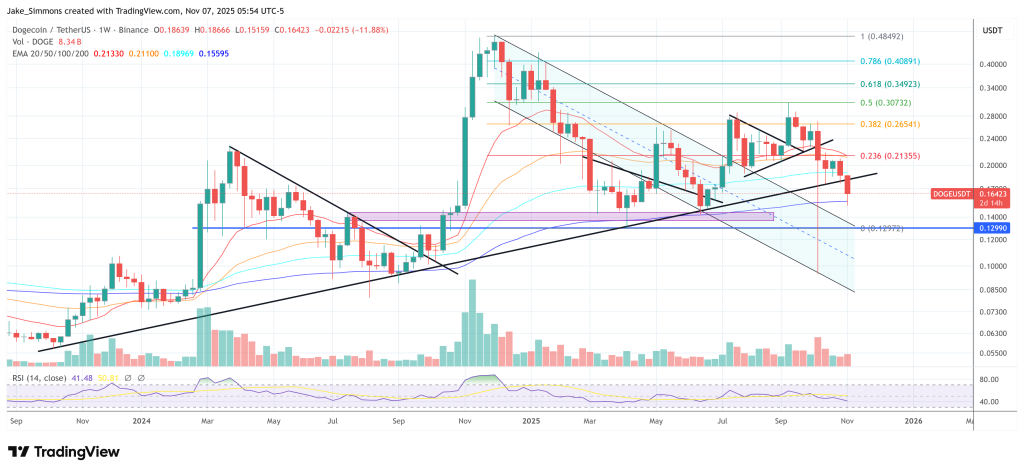
Dogecoin price
DOGE remains above the 200-week EMA, 1-week chart | Source: DOGEUSDT on TradingView.com
Featured image created with DALL.E, chart from TradingView.com
Editorial Process for bitcoinist is centered on delivering thoroughly researched, accurate, and unbiased content. We uphold strict sourcing standards, and each page undergoes diligent review by our team of top technology experts and seasoned editors. This process ensures the integrity, relevance, and value of our content for our readers.

Jake Simmons has been a Bitcoin enthusiast since 2016. Ever since he heard about Bitcoin, he has been studying the topic every day and trying to share his knowledge with others. His goal is to contribute to Bitcoin's financial revolution, which will replace the fiat money system. Besides BTC and crypto, Jake studied Business Informatics at a university. After graduation in 2017, he has been working in the blockchain and crypto sector. You can follow Jake on Twitter at @realJakeSimmons.

Lectures associées

Avec Ozak AI maintenant au-dessus de 7 millions de dollars levés, les analystes avertissent que le stock restant de la prévente pourrait diminuer rapidement alors que les acheteurs tardifs se précipitent pour sécuriser leurs positions.

Le projet Ozak AI, un token basé sur l'intelligence artificielle, connaît un succès significatif lors de sa prévente, ayant déjà levé plus de 7 millions de dollars. Les analystes avertissent que l'allocation restante pourrait diminuer rapidement en raison d'un afflux d'investisseurs tardifs souhaitant sécuriser des tokens avant la prochaine augmentation de prix et le listing prévu sur les principales plateformes d'échange. Le prix actuel est de 0,014 $ dans la septième phase de prévente. La technologie centrale d'Ozak AI combine blockchain et IA pour offrir des outils d'analyse prédictive en temps réel, utilisant des agents spécialisés pour les prévisions de prix, le sentiment du marché et l'analyse technique. Ces fonctionnalités alimentent la demande. Le projet renforce également son écosystème via des partenariats, par exemple avec Mira pour des flux de données vérifiés. Avec une offre limitée lors des phases de prévente et une demande croissante, les analystes estiment que retarder l'achat pourrait signifier payer plus cher pour moins de tokens. Ils évoquent un prix cible de 1 $ après le listing, suggérant un potentiel de croissance important pour les premiers investisseurs.

TheNewsCryptoIl y a 11 h

Avec Ozak AI maintenant au-dessus de 7 millions de dollars levés, les analystes avertissent que le stock restant de la prévente pourrait diminuer rapidement alors que les acheteurs tardifs se précipitent pour sécuriser leurs positions.

TheNewsCryptoIl y a 11 h

J'ai codé une application Android avec le Google vibe coding

Résumé : Google AI Studio permet désormais de générer des applications Android fonctionnelles directement depuis une fenêtre de navigateur, à l'aide de simples instructions en langage naturel. Un rédacteur de The Verge a testé cette fonctionnalité "prompt to phone" et a créé trois applications en un après-midi : un jeu d'aventure textuel, un compteur de calories et un clone de Super Mario. Le processus est simple : l'utilisateur décrit l'application souhaitée, et Gemini, l'IA de Google, génère automatiquement le code, conçoit l'interface et tente de résoudre les bugs. L'application peut être installée sur un vrai téléphone Android en quelques minutes. Cependant, l'expérience révèle les limites actuelles de l'outil. Les applications produites sont basiques, comportent des bugs persistants, des erreurs factuelles (comme des calculs de calories incorrects) et manquent de profondeur ou de fiabilité. Par exemple, le jeu de plateforme généré crashait systématiquement, et le compteur de calories utilisait des données erronées. Bien que cet outil abaisse considérablement la barrière d'entrée pour créer un logiciel personnalisé, il souligne que le chemin entre "générer une application" et "créer une *bonne* application" reste long. La qualité, la précision, le jugement esthétique et la maintenance à long terme dépendent encore largement de l'intervention et de l'expertise humaines. Google AI Studio montre la puissance de l'IA pour le prototypage rapide, mais aussi que le "dernier kilomètre" de la qualité logicielle n'est pas encore automatisable.

marsbitIl y a 12 h

J'ai codé une application Android avec le Google vibe coding

marsbitIl y a 12 h

Trading

Spot
Futures
活动图片