Cardano Didn’t Fail On Scalability, Says Hoskinson — Leios Coming In 2026

bitcoinistPublié le 2025-11-06Dernière mise à jour le 2025-11-06

Résumé

Charles Hoskinson used a Nov. 5 video address to rebut a renewed wave of criticism that Cardano has “failed on...

Trusted Editorial content, reviewed by leading industry experts and seasoned editors. Ad Disclosure

Charles Hoskinson used a Nov. 5 video address to rebut a renewed wave of criticism that Cardano has “failed on scalability,” centering his response on two pillars: Hydra, Cardano’s off-chain scaling stack, and Leios, a forthcoming Ouroboros upgrade that he says now has a complete design and a clear path to mainnet in 2026.

Hoskinson’s remarks were framed as a direct answer to a thread by Cyber Capital CEO Justin Bons alleging Cardano is capped at “23 transactions per second,” dismissing the impact of batching, fee markets, Hydra, and the Ouroboros Leios roadmap, and concluding that Input Output Global (IOG) has shifted focus to a new chain. “You’re entitled to an opinion, but you’re not entitled to your own facts,” Hoskinson said, calling the conclusion “blatantly wrong” and “pathetic” for ignoring public specifications and ongoing engineering work. He pushed back on claims that Leios had been abandoned: “There exists a CIP. We have the blueprint. We know how to do it.”

Cardano Has Not Failed On Scalability

Central to his argument is that Leios has moved from research to a fully specified implementation track. Hoskinson held up the CIP for Ouroboros Leios, emphasizing that the end-to-end design was completed only this year after “years of paper writing, prototyping, and simulation.”

In his telling, the protocol aims to thread the industry’s core dilemma of decentralization, security, and throughput without leaning on centralized shortcuts. “What do we care about in this industry? Do we care about decentralization or not?” he asked, warning that once systems optimize around cheap, high-throughput configurations with heavy hardware demands, “no one has any incentive to change the status quo.”

Hydra, he argued, is already live and delivering practical capacity gains that critics are “discounting.” As evidence, he cited the Glacier drop, saying “33.6 million accounts were loaded into that thing and we were able to operate no problem at all,” and that Hydra continues to “evolve and get more advanced.” While he did not present throughput figures beyond disputing the 23 TPS narrative, the thrust of his rebuttal was that Cardano’s scaling arc is cumulative: Hydra now, Leios next.

On Leios timelines, Hoskinson was unambiguous. “Yes, it will ship in 2026. No if, ands, or buts about it,” he said, adding that IOG has instituted “a 24/7 implementation, a follow-the-sun model to get Leios out in market faster.” He also previewed a dedicated Leios website “before the end of the month” to publish daily updates as the network “march[es] towards it,” and claimed “more than a dozen companies” are engaged in implementation work alongside multiple node clients. His message to the broader ecosystem was equally pointed: “In 2026, we’re going to find a path to get linear Leios on Cardano,” urging operators to “hold off on the adoption” of nodes that don’t support Leios so the feature can be activated network-wide.

Beyond scaling mechanics, the address veered into governance and industry structure. Hoskinson asserted Cardano targets “50% Byzantine resistance” while preserving decentralization, contending that no major chain—he named Bitcoin and Ethereum among others—has achieved at-scale decentralization without trade-offs. He linked scaling work to the project’s self-image as one of the few ecosystems “carrying on our backs the original dream of Satoshi,” warning that industry consolidation around ETFs, bank custody, and centralized stablecoins risks “put[ting] the chains on humanity for the rest of time.”

Marketing, Not The Technology

Hoskinson located Cardano’s bottleneck not in research or engineering but in go-to-market. “Our problem is not our technology… Our problem right now is marketing and adoption, deal making and partnerships,” he said, criticizing entities in the ecosystem that he claims received “hundreds and hundreds and hundreds of millions of ADA” or “over a billion” for adoption efforts that have been “pulling teeth.” He credited a new foundation-driven initiative—presented by critics as a “pivot” away from Cardano—as having already attracted listings, integrations, and a path to “tier one stables,” insisting such work ultimately routes back to Cardano usage.

The tone throughout was combative, reflecting frustration with narratives he sees as moving the goalposts. “Leios is going to ship. It’s a real thing. It exists. Look at CIP 164,” he said. “When we turn it on, they’ll move the goalpost and it will be something else.”

He portrayed the coming year as a campaign to close the engineering loop and reorient on adoption: “We have the technology. We have the ecosystem. We just have to invest heavily in [marketing and adoption]… and we will.” The message to skeptics was unvarnished—“You can’t discount Hydra… you can’t discount the progress made with Leios.”

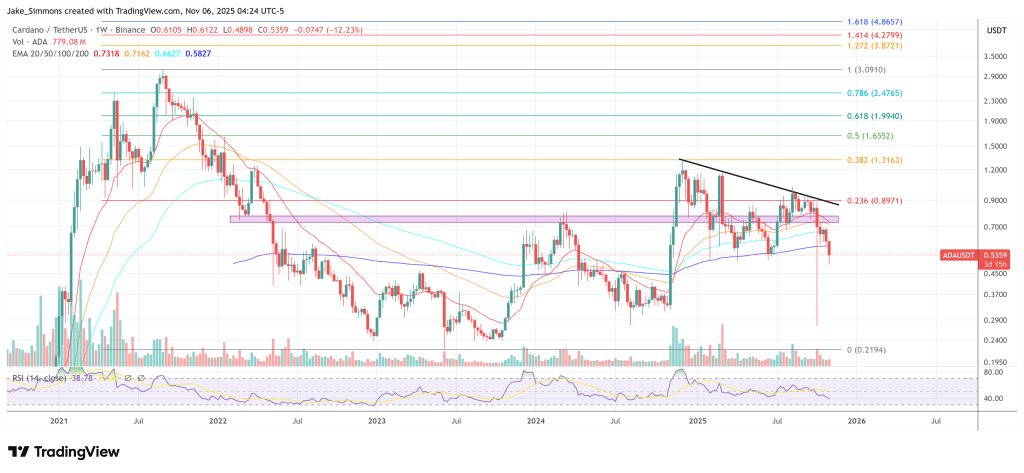
At press time, ADA traded at $.05359
Cardano price
ADA falls below the 200-week EMA, 1-week chart | Source: ADAUSDT on TradingView.com
Featured image created with DALL.E, chart from TradingView.com
Editorial Process for bitcoinist is centered on delivering thoroughly researched, accurate, and unbiased content. We uphold strict sourcing standards, and each page undergoes diligent review by our team of top technology experts and seasoned editors. This process ensures the integrity, relevance, and value of our content for our readers.

Jake Simmons has been a Bitcoin enthusiast since 2016. Ever since he heard about Bitcoin, he has been studying the topic every day and trying to share his knowledge with others. His goal is to contribute to Bitcoin's financial revolution, which will replace the fiat money system. Besides BTC and crypto, Jake studied Business Informatics at a university. After graduation in 2017, he has been working in the blockchain and crypto sector. You can follow Jake on Twitter at @realJakeSimmons.

Lectures associées

Après que 2 milliards de dollars aient été annulés, Manus envisage une introduction en bourse à Hong Kong pour rebondir ?

Après l'annulation par les autorités chinoises de l'acquisition de Manus par Meta pour 2 milliards de dollars, les fondateurs de cette startup d'IA tentent un audacieux retournement. En mai 2026, ils négocient une levée de fonds d'environ 1 milliard de dollars pour racheter leur entreprise à Meta, visant une valorisation d'au moins 2 milliards. Leur objectif ultime est une introduction en bourse à Hong Kong. Cette décision fait suite à l'interdiction historique de la transaction par la Commission nationale du développement et de la réforme, au motif de sécurité nationale, malgré la tentative de Manus de s'installer à Singapour. Le rachat s'annonce complexe, l'entreprise étant déjà intégrée dans les systèmes de Meta. Le choix de la bourse de Hong Kong (HKEX) est stratégique. En 2025, HKEX a retrouvé sa place de leader mondial des introductions en bourse, porté par une vague d'entreprises technologiques chinoises, notamment dans l'IA. Ce marché offre une plateforme de financement internationale, une tolérance aux modèles à forte croissance (même non rentables) et des mécanismes de refinancement adaptés aux besoins continus en R&D de l'IA. Pour Manus, l'IPO n'est pas une simple option, mais une nécessité. La voie de l'acquisition par un géant étranger est désormais bloquée, et le financement privé seul ne suffirait pas à assurer sa compétitivité face à des rivaux comme Zhipu, MiniMax ou ByteDance. Une entrée en bourse à Hong Kong lui fournirait le capital et la légitimité nécessaires pour poursuivre son développement de manière indépendante, transformant son récit d'une startup vendue en celui d'un leader de l'agent IA ressuscité.

marsbitIl y a 30 mins

Après que 2 milliards de dollars aient été annulés, Manus envisage une introduction en bourse à Hong Kong pour rebondir ?

marsbitIl y a 30 mins

Comment les stablecoins de change peuvent-ils émerger face à la pression des géants Tether et Circle ?

**Auteur : Nico Pei, fondateur de Supernova** **Compilation : Felix, PANews** Face à la domination des géants Tether (USDT) et Circle (USDC), comment les stablecoins de devises étrangères peuvent-ils émerger ? L'article soutient que la voie la plus réaliste et efficace n'est pas de concurrencer ces acteurs établis en émettant de nouveaux stablecoins en devises locales, mais de construire une infrastructure de **devises synthétiques** basée sur l'infrastructure solide de l'USDT/USDC. Ce système permettrait aux utilisateurs de conserver leurs avoirs en dollars numériques (USDT/USDC) tout en affichant et en utilisant leurs comptes dans leur monnaie locale préférée. **Points clés :** - **Le secteur bancaire numérique stablecoin** connaît une croissance explosive, avec une augmentation de 2400 % des dépenses par carte en 2025. Pour atteindre une adoption massive, il doit dépasser le simple compte en dollars. - Tether et Circle bénéficient d'une **liquidé, d'une distribution et d'effets de réseau** décennaux, quasi impossibles à répliquer pour de nouveaux émetteurs de stablecoins en devises étrangères. Leur valeur totale (TVL) est 700 fois supérieure à celle de tous les stablecoins de devises combinés. - Les stablecoins de devises "classiques" (au comptant) font face à des défis majeurs : manque de liquidité, ancrage instable, acceptation limitée et complexités réglementaires. **Solution proposée : les contrats NDF (Non-Deliverable Forwards) à valorisation journalière (MtM) sur la blockchain.** Inspirés des marchés des changes traditionnels (où 69 % des volumes proviennent des dérivés), ces contrats permettent une exposition synthétique à une devise sans échange physique. L'utilisateur garde ses USDT/USDC en garantie, tandis que la valeur de son compte et ses gains/pertes sont libellés dans une devise cible via un contrat réglé en dollars. **Avantages :** - **Ancrage fort** via des oracles de taux de change, non dépendant de la liquidité au comptant locale. - **Conservation des avantages** des stablecoins en dollars : liquidité profonde, accès aux rendements, large acceptation. - **Extensibilité** à toute devise disposant d'un oracle fiable, sans besoin d'infrastructure bancaire locale. - **Efficacité capitalistique**, avec règlement uniquement des différences de change. **Cas d'utilisation principaux :** 1. **Banques numériques, portefeuilles et custodians** : Pour offrir des comptes multi-devises à leurs clients internationaux, augmenter les dépôts et éviter les sorties vers le système bancaire traditionnel. 2. **Stratégies de carry trade sur devises** : Permettre aux utilisateurs de gagner le différentiel de taux d'intérêt entre devises (ex : emprunt synthétique en JPY, investissement en BRL) tout en restant sur la blockchain, avec un potentiel plus stable et évolutif que certains produits crypto. 3. **Paiements d'entreprise globaux** : Permettre aux marchands de fixer les prix et de recevoir des paiements dans leur devise locale, tout que les clients paient en stablecoins dollars, en couvrant le risque de change de manière synthétique et efficace. **Conclusion :** Plutôt que de tenter de concurrencer les géants du dollar numérique sur leur terrain, l'avenir des stablecoins de devises étrangères réside dans la construction d'une couche synthétique et dérivée exploitant leur infrastructure de liquidité déjà établie.

marsbitIl y a 31 mins

Comment les stablecoins de change peuvent-ils émerger face à la pression des géants Tether et Circle ?

marsbitIl y a 31 mins

Trading

Spot
Futures

Articles tendance

Comment acheter T

Bienvenue sur HTX.com ! Nous vous permettons d'acheter Threshold Network Token (T) de manière simple et pratique. Suivez notre guide étape par étape pour commencer votre parcours crypto.Étape 1 : Création de votre compte HTXUtilisez votre adresse e-mail ou votre numéro de téléphone pour ouvrir un compte sur HTX gratuitement. L'inscription se fait en toute simplicité et débloque toutes les fonctionnalités.Créer mon compteÉtape 2 : Choix du mode de paiement (rubrique Acheter des cryptosCarte de crédit/débit : utilisez votre carte Visa ou Mastercard pour acheter instantanément Threshold Network Token (T).Solde :utilisez les fonds du solde de votre compte HTX pour trader en toute simplicité.Prestataire tiers :pour accroître la commodité d'utilisation, nous avons ajouté des modes de paiement populaires tels que Google Pay et Apple Pay.P2P :tradez directement avec d'autres utilisateurs sur HTX.OTC (de gré à gré) : nous offrons des services personnalisés et des taux de change compétitifs aux traders.Étape 3 : stockage de vos Threshold Network Token (T)Après avoir acheté vos Threshold Network Token (T), stockez-les sur votre compte HTX. Vous pouvez également les envoyer ailleurs via un transfert sur la blockchain ou les utiliser pour trader d'autres cryptos.Étape 4 : tradez des Threshold Network Token (T)Tradez facilement Threshold Network Token (T) sur le marché Spot de HTX. Il vous suffit d'accéder à votre compte, de sélectionner la paire de trading, d'exécuter vos trades et de les suivre en temps réel. Nous offrons une expérience conviviale aux débutants comme aux traders chevronnés.

519 vues totalesPublié le 2024.12.10Mis à jour le 2025.03.21

Comment acheter T

Discussions

Bienvenue dans la Communauté HTX. Ici, vous pouvez vous tenir informé(e) des derniers développements de la plateforme et accéder à des analyses de marché professionnelles. Les opinions des utilisateurs sur le prix de T (T) sont présentées ci-dessous.

活动图片