Nasdaq CEO Shows 3 Ways Blockchain Could Change Finance Forever: Best Wallet Token Amps Up

bitcoinistPublié le 2025-11-05Dernière mise à jour le 2025-11-05

Résumé

Quick Facts: ➡️ Nasdaq’s CEO says blockchain can fix settlement and market plumbing. Wallets become the access layer for that...

Trusted Editorial content, reviewed by leading industry experts and seasoned editors. Ad Disclosure

Quick Facts:

  • ➡️ Nasdaq’s CEO says blockchain can fix settlement and market plumbing. Wallets become the access layer for that shift and need strong security and UX.
  • ➡️ Best Wallet uses Fireblocks MPC-CMP, supports multiple chains, and bundles a DEX aggregator, staking, and presale access to turn a wallet into a full crypto hub.
  • ➡️ $BEST presale shows momentum with a live price of $0.025895 and more than $16.8M raised. Tokens are payable via crypto or card with token claims post presale.
  • ➡️ Staking runs during the presale with dynamic rewards from an 8% pool, aiming to reward longer-term holders rather than short-term speculation.

Nasdaq chief Adena Friedman recently outlined three ways blockchain could upgrade global finance. Her message focused on how distributed ledgers can improve post-trade settlement, support tokenized assets, and streamline market infrastructure.

During her conversation with Ripple’s Monica Long, Friedman’s takeaway was simple. Capital markets are moving toward on-chain rails that need secure user access and intuitive wallets to reach scale.

Mobile crypto wallets sit at the top of that stack. They are the gateway to tokenized securities, DeFi liquidity, and on-chain payments. If exchanges and brokers bring issuance and settlement on chain, consumers will need mobile wallets that are both secure and easy to use.

That is why wallet UX and security architecture are fast becoming competitive moats.

Best Wallet Token ($BEST) is positioned for this shift with a mobile-first, non-custodial wallet that integrates Fireblocks MPC-CMP security, a decentralized exchange (DEX) aggregator, and a presale portal for trusted launches. The native $BEST token underpins reduced fees, staking, and governance.

As regulated markets lean into tokenization, the best crypto wallets will be those that combine enterprise-grade security with simple cross-chain action.

And Best Wallet is designed to capture the growing market with tangible holder perks, live staking during presale, and a product roadmap that expands utility beyond storage into swaps, cards, and curated presale access.

Best Wallet Token ($BEST) — Mobile First MPC Wallet With Perks

Best Wallet is a non-custodial, multi-chain wallet built around Fireblocks MPC-CMP technology. MPC removes single points of failure by splitting keys across secure computation, while the app layers biometric login and a mobile-native UX.

The wallet supports cross-chain swaps through an integrated DEX aggregator, which provides access to all major blockchains. Read our Best Wallet review for more on this game-changing crypto app.
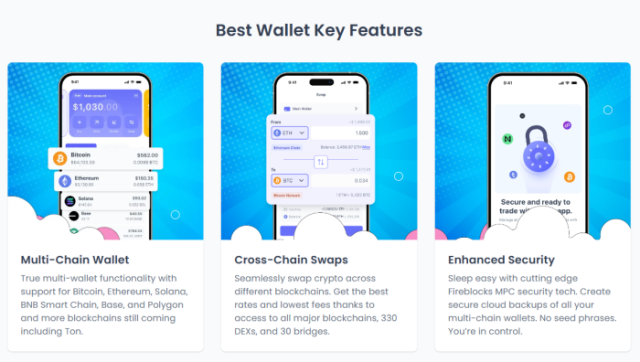
Best Wallet’s key features.

The wallet’s native token, $BEST, is now on presale with a visible raise and price tracker. At the current stage shown on the sale page, $BEST is priced at $0.025895 with more than $16.8M collected. Buyers can use $ETH, $BNB, $USDT, $USDC, or a card, and claiming will be available at the end of the presale window.

🛒 Learn how to buy $BEST here.

Utility is the core pitch rather than hype. Holding $BEST reduces fees inside the Best Wallet ecosystem, grants early access to curated presales via the ‘Upcoming Tokens’ portal, and provides governance decision rights, including what new chains and features to add to the ecosystem.

A staking pool is already available during the sale. Rewards are dynamic and funded from an 8% allocation of the total supply, which aligns incentives with long-term usage rather than short airdrops.

Token design details are straightforward. The total supply is 10B $BEST and the whitepaper outlines allocations for development, marketing, airdrops, staking rewards, exchange liquidity, community rewards, and treasury.

The contract is an ERC-20 on Ethereum and has been audited by Coinsult.

The product suite goes beyond a wallet. Over 330 DEXs and 30 bridges are embedded for same-chain and cross-chain swaps. A Best Card is also in development to enable spending $BTC, $ETH, and other major cryptos, with cashback for $BEST token holders.

The roadmap also includes a browser extension, portfolio tools, an NFT gallery, market analytics, and trading features like limit orders and DCA. The approach is to turn the wallet into a daily driver while keeping custody with the user.

For presale participants, two factors stand out. First is the ‘earn while you wait’ design. That’s because staking during presale lets early users compound exposure rather than sitting idle.

Second is the demand signal. Our $BEST price prediction suggests that the token could reach $0.62 by 2026, marking a 2,290% gain, if demand for secure wallets keeps pace with crypto adoption rates.

A multi-million-dollar raise at this early stage demonstrates traction for a wallet narrative that benefits from traditional finance’s shift toward crypto. That is the same structural change Nasdaq’s leadership is signaling.

Secure $BEST now. The presale ends November 28.

This is informational content only, not financial advice. Do your own research and consider risks. Crypto assets can lose value quickly.

Authored by Bogdan Patru, Bitcoinist: https://bitcoinist.com/best-wallet-token-presale-mpc-security-staking-benefits-best

Editorial Process for bitcoinist is centered on delivering thoroughly researched, accurate, and unbiased content. We uphold strict sourcing standards, and each page undergoes diligent review by our team of top technology experts and seasoned editors. This process ensures the integrity, relevance, and value of our content for our readers.

As a crypto writer, Bogdan’s responsibilities are split between researching and writing articles and entertaining the team with his humor bordering on the politically incorrect, an aspiring Bill Burr, if you will. Thanks to his 12+ years of writing experience in just as many fields, including tech, cybersecurity, modelling, fitness, crypto, and other topics-that-shall-not-be-named, he's become a genuine asset to the team. While his position as a senior writer at PrivacyAffairs thought him valuable lessons about the power of self-management, his entire writing career was and is an exercise in self-improvement. Now, he's ready to sink his teeth into crypto and teach people how to take control of their own money on the blockchain. With fiat as an eternally devaluing currency, Bitcoin and altcoins seem like the best-fitting alternative for Bogdan. Bogdan’s biggest professional accomplishment, aside from securing a position as a main writer for Bitcoinist, was his 5-year run as a writing manager at Blackwood Productions, where he coordinated a team of four writers. During that time, he learned the value of teamwork and that of creating a working environment that breeds efficiency, positivity, and friendship.

Lectures associées

Le financement en crypto divisé par deux au premier trimestre, comment le paiement en stablecoin attire-t-il l'argent contre la tendance ?

Le financement par capital-risque dans le secteur des crypto-monnaies a chuté d'environ 50% au premier trimestre 2026, les investisseurs se concentrant désormais sur les entreprises matures avec des revenus réels. Dans ce contexte, le secteur des paiements en stablecoins se distingue en continuant à lever des fonds importants. Les stablecoins évoluent d'un outil de trading vers une infrastructure de paiement, avec une capitalisation boursière dépassant 3170 milliards de dollars. Les investisseurs soutiennent désormais toute la pile technologique des paiements : cartes (Rain, RedotPay), paiements transfrontaliers et devises (OpenFX, Conduit), portefeuilles (Mesh), connexions bancaires (Stablecore) et infrastructures blockchain sous-jacentes. Cette attractivité s'explique par plusieurs facteurs : la résolution de problèmes d'inefficacité des paiements transfrontaliers, des modèles de revenus clairs (frais de transaction, spreads de change), l'intégration discrète des stablecoins dans des interfaces familières (WhatsApp, cartes), un cadre réglementaire plus clair élargissant la clientèle potentielle, et une visibilité accrue sur les sorties d'investissement via des acquisitions par des géants comme Stripe ou Mastercard. Cependant, l'engouement doit être nuancé. Le volume des transactions en chaîne ne reflète pas le volume des paiements réels pour des biens et services. Les financements sont concentrés sur quelques leaders, et les services de base risquent une banalisation rapide. L'expansion mondiale reste un défi, nécessitant des partenariats locaux dans chaque marché, et les institutions financières traditionnelles sont à la fois des clients et des concurrents potentielles. Les prochains investissements devraient se porter sur les paiements B2B transfrontaliers, les connexions entre banques et stablecoins, les cartes liées aux stablecoins, les couches d'orchestration multi-chaînes, et les paiements pour agents IA. En résumé, l'intérêt des investisseurs ne signale pas un retour en force des financements crypto globaux, mais un recentrement sur les infrastructures générant des revenus réels en intégrant les stablecoins au système financier traditionnel. La valeur future dépendra de la capacité à transformer le volume de transactions en paiements clients réels et rentables.

marsbitIl y a 40 mins

Le financement en crypto divisé par deux au premier trimestre, comment le paiement en stablecoin attire-t-il l'argent contre la tendance ?

marsbitIl y a 40 mins

Les 9 derniers jours de BitMart : la véritable crise d'une plateforme d'échange n'a jamais été sa fermeture

En août 2026, à 9 jours de l’arrêt définitif de ses services, BitMart fait face à une crise de confiance. Des utilisateurs et employés réclament publiquement la transparence sur les actifs, dettes, portefeuilles et réserves disponibles pour les retraits, en plus d’un plan de remboursement et d’un audit indépendant. Si le PDG Sheldon Lee dément les accusations, la controverse soulève une question cruciale : une plateforme d’échange centralisée peut-elle faire face à un retrait massif de fonds ? L’annonce initiale de fermeture progressive semblait ordonnée, mais la demande concentrée de retraits a transformé un problème commercial en test de solvabilité. L’affaire rappelle que dans un CEX, les soldes des comptes ne sont que des créances enregistrées en interne, distinctes des actifs réels sur la blockchain. La confiance inhérente au modèle est soumise à une pression extrême lors d’une fermeture. Les demandes de preuves de réserves (Proof of Reserves) seules sont jugées insuffisantes : ce qui importe, c’est la relation entre les actifs disponibles et le total des créances clients. L’industrie est appelée à réfléchir à des mécanismes de fermeture transparents et structurés, similaires à ceux des institutions financières traditionnelles. L’échéance du 19 août pour une réponse de BitMart et celle du 26 août pour l’arrêt des transactions sont des points d’attention, mais la véritable mesure de la crédité d’un exchange se joue au moment où le dernier utilisateur récupère ses actifs en toute sécurité.

marsbitIl y a 2 h

Les 9 derniers jours de BitMart : la véritable crise d'une plateforme d'échange n'a jamais été sa fermeture

marsbitIl y a 2 h

Pas de paris sur des tokens à x100, mais des paris sur les "vaches à lait" : quels projets méritent un DCA pendant le marché baissier ?

Face à la morosité du marché cryptographique actuel, l'auteur propose une stratégie d'investissement alternative à la spéculation effrénée sur les memecoins : se concentrer sur les projets générant des revenus réels et soutenus, même en période de baise. L'article analyse les performances financières de quatre protocoles en se basant sur leurs revenus nets mensuels. **Pump.fun**, plateforme de création de memecoins sur Solana, se distingue comme une véritable "machine à cash", avec 4153 M$ de revenus sur les 30 derniers jours et un cumul de 256 M$ sur les sept premiers mois de l'année. Ses revenus, provenant des frais sur les transactions et les "graduations" de jetons, fluctuent avec l'engouement pour les memes mais restent impressionnants. **Hyperliquid**, un DEX de contrats perpétuels, est encore plus performant avec 352 M$ de revenus cumulés sur la même période. Sa force réside dans un modèle économique robuste qui voit 99% de ses frais de transaction utilisés pour racheter et brûler son jeton natif HYPE, créant une pression acheteuse constante. Le vénérable **Uniswap** a réactivé ses "fees switch", permettant désormais à son protocole de capturer une partie des frais d'échange. Cela génère une revenu stable, autour de 440 à 510 M$ par mois, désormais lié à la destruction de jetons UNI, donnant une nouvelle utilité économique à l'actif. Enfin, **Chainlink**, l'infrastructure de référence pour les oracles et les services de données, montre une résilience remarquable avec des revenus mensuels stables autour de 460 à 580 M$. Son modèle, essentiel au fonctionnement de la DeFi et de la finance institutionnelle sur chaîne, en fait un "péage" quasi-incontournable dont les revenus sont progressivement convertis en LINK. La thèse centrale est qu'investir dans les jetons de ces "vaches à lait" du crypto, qui démontrent une capacité à générer des flux de trésorerie durables, pourrait être une stratégie plus fiable pour traverser le marché baissier en vue du prochain cycle haussier.

marsbitIl y a 3 h

Pas de paris sur des tokens à x100, mais des paris sur les "vaches à lait" : quels projets méritent un DCA pendant le marché baissier ?

marsbitIl y a 3 h

Trading

Spot
活动图片