Shiba Inu Team Issues Last Chance To Shibarium Hacker Before Time Runs Out

bitcoinistPublié le 2025-11-04Dernière mise à jour le 2025-11-04

Résumé

Shiba Inu’s core contributors and the K9 Finance DAO have escalated their recovery campaign with an on-chain ultimatum to the...

Trusted Editorial content, reviewed by leading industry experts and seasoned editors. Ad Disclosure

Shiba Inu’s core contributors and the K9 Finance DAO have escalated their recovery campaign with an on-chain ultimatum to the Shibarium bridge exploiter, deploying a new bounty contract funded with 20 ETH and broadcasting the terms directly to the attacker via Ethereum Input Data Messages (IDM).

Shiba Inu Team Drops Final 20 ETH Deal

The latest IDM, sent on November 3, 2025 at 06:32 UTC from a K9 developer-labeled account, lays out a trustless path to return frozen KNINE tokens and claim the reward before the offer decays and then expires. “Dear Shibarium Bridge Hacker… New 20 ETH bounty to return stolen KNINE tokens,” the message reads, specifying the bounty contract address and the atomic settlement flow: “Settlement is atomic when we call recoverKnine(). KNINE is transferred back to Shibarium bridge and ETH is transferred to you.” It also sets explicit time parameters: “Bounty will start to decrease in 21-days (Nov 18)… [and] will expire in 28 days (Nov 25).”

The 20 ETH bounty is escrowed on Ethereum at 0x5EA2…D4d0, a verified contract titled “KnineRecoveryBountyDecayAcceptMultiFunder,” which shows a current balance of 20 ETH and identifies k9dev.eth as the creator five days earlier. The contract’s read/write interfaces and verified source enable the attacker to permission the bounty contract to spend KNINE and, if desired, call an explicit accept() function to lock the deal before the team triggers the recoverKnine() settlement.

Public messaging from Shiba Inu developer Kaal Dhairya has amplified the urgency. In a post on X, Dhairya pressed the exploiter to take the on-chain offer: “Yo, Shibarium bridge attacker, wake up—grab free cash before the offer expires this time and do something right.” The remark follows weeks of damage-control updates about validator-key compromise and a multi-firm investigation.

K9 Finance confirms this is the final structured attempt to resolve the episode without litigation or further escalation. In an ecosystem post published by The Shib Magazine, the team states that the 20 ETH contract “makes good on a public promise… to extend one final, larger bounty offer to the entity behind the Shibarium Bridge exploit,” after an initial on-chain 5 ETH proposal in mid-September was rebuffed.

According to that account, the exploiter counter-demanded 50 ETH; K9 declined, reiterating that the KNINE at issue is blacklisted and unusable. The new contract, they add, is designed to close the loop “without direct communication” through an atomic exchange once approval is granted.

K9 has also warned the community to ignore opportunistic scams around the bounty discourse. “Watch out for scams, imposters, and malicious links. This is the last post in the thread,” the DAO wrote on X as it wrapped a public update sequence, underscoring there will be no token migration or “v2” related to this incident. The caution aims to preempt fake claim portals and phishing that often proliferate after high-profile exploits and bounty announcements.

The “last chance” framing reflects the arc of the incident since mid-September, when a flash-loan-aided validator capture enabled the attacker to authorize a malicious state and drain bridge assets, sparking a series of containment steps and an initial bounty. Contemporary coverage documented the 5 ETH on-chain offer and its 7-day decay/30-day expiry schedule; the new 20 ETH contract iterates on the same “code is law” design but with higher stakes and a shorter fuse on the decaying component.

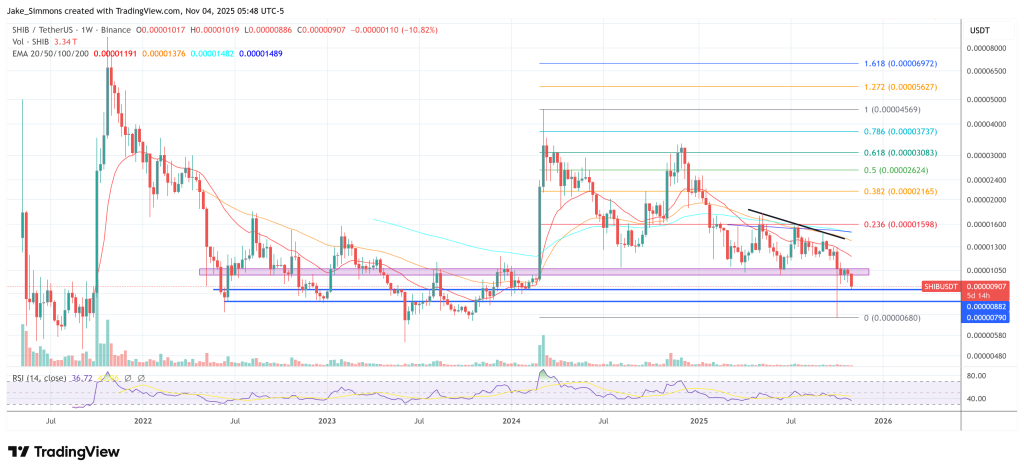
At press time, Shiba Inu traded at $0.00000907.
Shiba Inu price
Shiba Inu price, 1-week chart | Source: SHIBUSDT on TradingView.com
Featured image created with DALL.E, chart from TradingView.com
Editorial Process for bitcoinist is centered on delivering thoroughly researched, accurate, and unbiased content. We uphold strict sourcing standards, and each page undergoes diligent review by our team of top technology experts and seasoned editors. This process ensures the integrity, relevance, and value of our content for our readers.

Jake Simmons has been a Bitcoin enthusiast since 2016. Ever since he heard about Bitcoin, he has been studying the topic every day and trying to share his knowledge with others. His goal is to contribute to Bitcoin's financial revolution, which will replace the fiat money system. Besides BTC and crypto, Jake studied Business Informatics at a university. After graduation in 2017, he has been working in the blockchain and crypto sector. You can follow Jake on Twitter at @realJakeSimmons.

Lectures associées

Vitalik Buterin défend sa vision à long terme face aux inquiétudes sur le prix du token

Vitalik Buterin, co-fondateur d'Ethereum, a répondu aux préoccupations concernant le rôle de la Fondation Ethereum, soulignant que son objectif principal n'est pas la valorisation du token ETH mais la poursuite de sa vision à long terme. Il a affirmé que la Fondation resterait concentrée sur ses objectifs fondamentaux : décentralisation du protocole, sécurité informatique, recherche et résistance à la censure, plutôt que de concurrencer les blockchains à haut débit. Ces déclarations interviennent alors que le prix de l'ETH avoisine les 2 094 $, en baisse de plus de 50% par rapport à son record d'août 2025, et après des départs notables de la Fondation et des ventes d'ETH par d'importants investisseurs. Buterin a comparé les réserves de tokens, notant que la Fondation Ethereum ne détient qu'environ 0,16% de l'offre totale d'ETH, un pourcentage bien inférieur à celui d'autres fondations. Face aux critiques, notamment concernant l'impact de la mise à jour Dencun sur les revenus du réseau, Buterin a insisté sur la priorité accordée à la "longévité". Il a précisé que la Fondation utiliserait ses ressources pour soutenir la recherche, ce qui devrait réduire les ventes futures d'ETH. Bien que la Fondation ait retiré 21 270 ETH d'un protocole de staking en mai, cela ne signifie pas nécessairement qu'ils seront vendus.

TheNewsCryptoIl y a 2 h

Vitalik Buterin défend sa vision à long terme face aux inquiétudes sur le prix du token

TheNewsCryptoIl y a 2 h

DeepSeek baisse ses prix de façon permanente, mais Liang Wenfeng ne veut pas devenir le « bodhisattva cybernétique »

DeepSeek a annoncé la pérennisation d'une réduction de 75 % sur son API V4-Pro, abaissant significativement ses tarifs par token. Cette décision intervient dans un contexte où la plupart des grands acteurs de l'IA, comme OpenAI, Anthropic et Google, augmentent leurs prix en raison d'une demande croissante et de contraintes sur les ressources de calcul. Bien que salué comme un « bodhisattva cybernétique », le fondateur Liang Wenfeng est avant tout un entrepreneur. Son choix stratégique de l'open-source et des prix bas repose sur des avantages structurels profonds : des talents en IA relativement moins chers, l'utilisation de puces chinoises comme l'Ascend et, surtout, un accès à une énergie beaucoup moins chère. La Chine bénéficie de coûts électriques industriels bien inférieurs à ceux des États-Unis ou de l'Europe, ce qui réduit considérablement le coût opérationnel principal des grands modèles. Cette compétitivité par les coûts permet à DeepSeek d'offrir une alternative viable pour de nombreuses applications professionnelles qui n'exigent pas nécessairement le modèle le plus performant, mais plutôt un rapport qualité-prix et une stabilité optimaux. Alors que l'IA devient plus chère ailleurs, la proposition de valeur de DeepSeek se renforce, positionnant l'entreprise comme un acteur clé capable d'influencer les prix du marché mondial de l'IA.

marsbitIl y a 11 h

DeepSeek baisse ses prix de façon permanente, mais Liang Wenfeng ne veut pas devenir le « bodhisattva cybernétique »

marsbitIl y a 11 h

Le voile de Mythos, le levier d'Anthropic pour soulever des billions

Selon des rapports, Anthropic finaliserait une levée de fonds d'environ 300 milliards de dollars, portant sa valorisation à plus de 9000 milliards de dollars. Malgré la possession de son propre modèle Gemini, Google investirait massivement dans Anthropic, visant moins le modèle que le positionnement stratégique. L'analyse pointe la campagne de communication d'Anthropic autour de son modèle non publié "Mythos" et du projet de cybersécurité "Glasswing". Le projet prétend avoir détecté des milliers de vulnérabilités critiques, mais manque de références comparatives. En présentant la non-publication de Mythos comme une mesure de responsabilité, Anthropic cultive une aura de puissance mystérieuse et non vérifiable. Le récit gagne en crédibilité lorsque la Maison Blanche, après avoir évoqué des risques liés à Anthropic, serait en pourparlers pour permettre à des agences comme la NSA d'utiliser Claude, potentiellement Mythos. Ce retournement suggère une technologie perçue comme indispensable, offrant une validation puissante sans qu'Anthropic n'ait à le proclamer. Ces récits alimentent l'ascension financière. Anthropic annonce un chiffre d'affaires annualisé dépassant 500 milliards de dollars, tiré par les API entreprises et Claude Code. Les investissements de Google agissent comme un signal fort pour les autres capitaux. L'article conclut que le modèle économique d'Anthropic réside dans sa capacité à transformer une capacité non vérifiable (Mythos) et des partenariats non confirmés en un récit convaincant, capable de séduire les marchés, les gouvernements et les investisseurs, et de le monétiser à une échelle immense.

marsbitIl y a 13 h

Le voile de Mythos, le levier d'Anthropic pour soulever des billions

marsbitIl y a 13 h

Trading

Spot
Futures
活动图片