Token Terminal x Alea Research: A partnership to advance the quality and distribution of onchain data & research

Token TerminalPublié le 2025-09-30Dernière mise à jour le 2025-10-03

We’re excited to announce that our data is now live on Alea Research, a leader in crypto market intelligence and research.

Through this collaboration, Token Terminal will provide onchain data to Alea Research and support their platform and research reports with standardized and institutional-grade onchain data..

“Quality data is the backbone of quality research. In our research workflow, Token Terminal is the foundation we build on every week. Their end-to-end approach to onchain data collection, curation, and delivery allows us to work with data at the most granular level, which gives us the flexibility we need to do high-quality research & analysis.

We’re happy to have found a data provider that can provide us with a comprehensive suite of onchain metrics, where each metric is accompanied by a clear methodology and a transparent audit trail. For onchain data, Token Terminal is the standard.”

Alvaro, Head of Research at Alea Research

Our shared mission is to bring reliable and data-driven protocol reporting at scale to institutional investors. As crypto matures into an institutional asset class, reliable data and rigorous research will be the pillars. Token Terminal and Alea Research will be at the forefront of that transition.


Alea Research recently published an in-depth report on TON, with Token Terminal as the primary provider of onchain data.

Below are some of the key charts featured in the study:

1. Market data
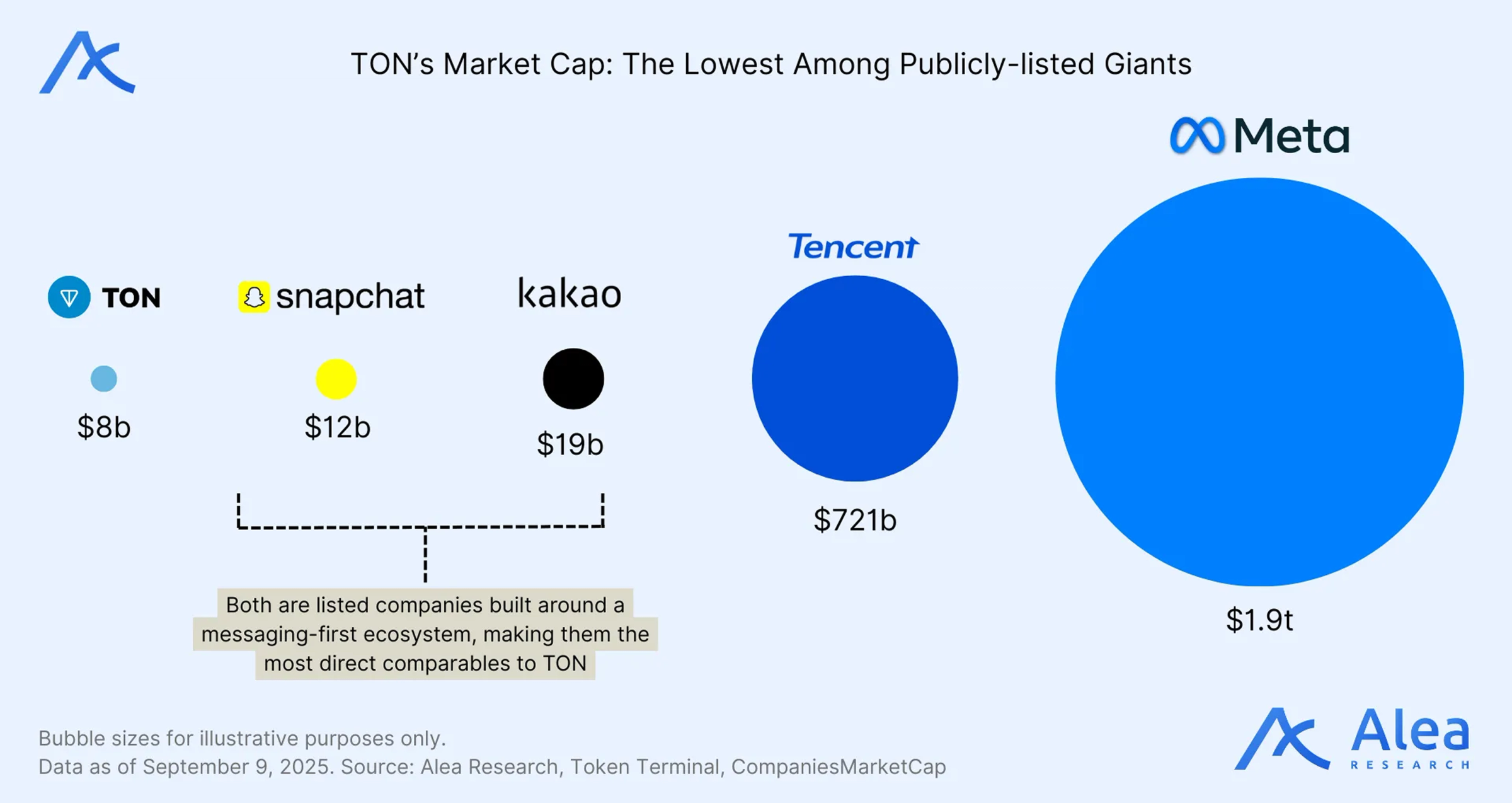
TON’s market cap of $8B remains well below messaging-first peers like Kakao ($19B) and Snapchat ($12B), and is dwarfed by Tencent ($721B) and Meta ($1.9T). Despite its ecosystem integration with Telegram, TON is still valued at the low end of comparable networks.

2. Standardized financial & usage metrics
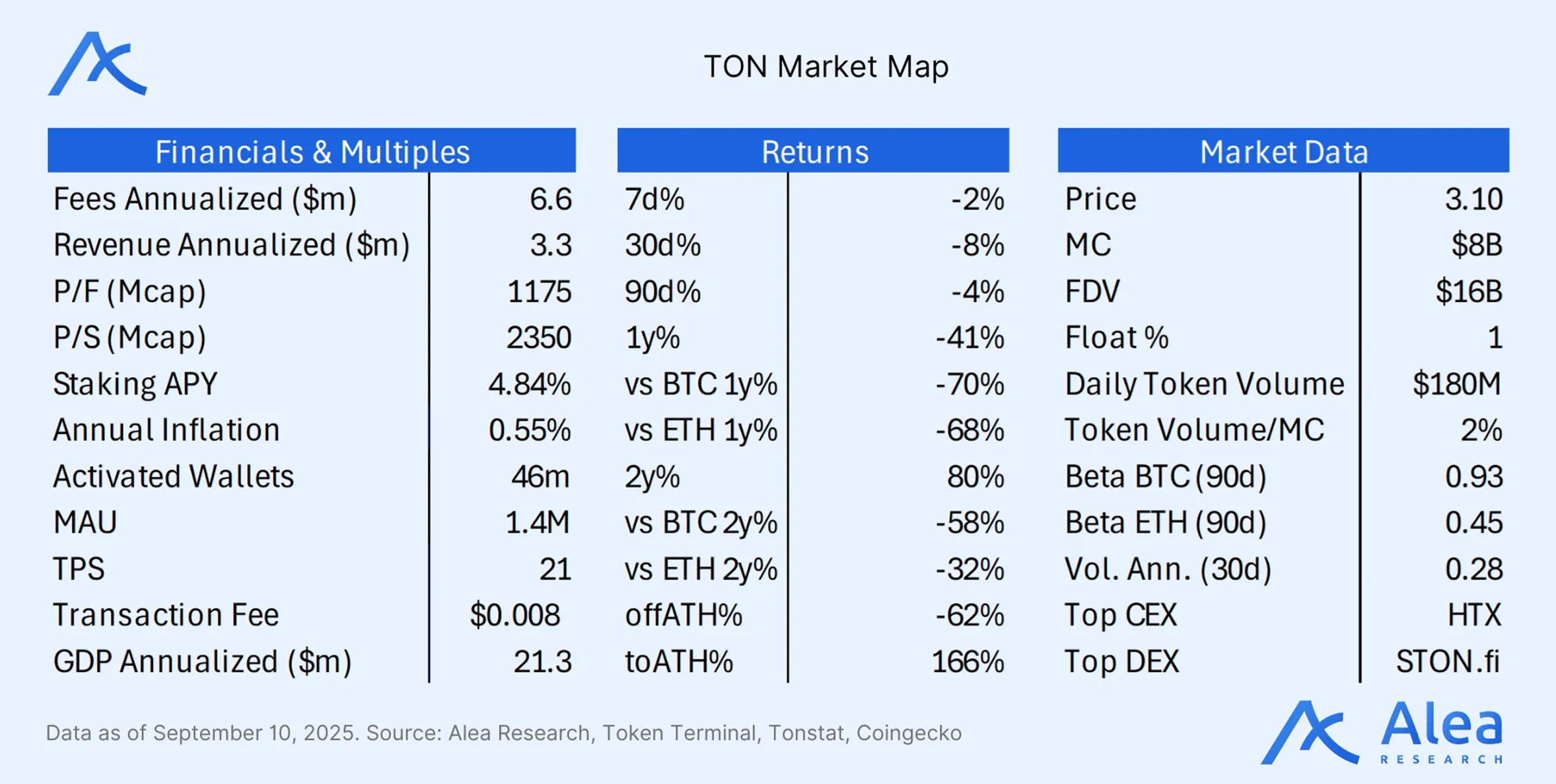
TON generates $6.6M and $3.3M in annualized fees and revenue, respectively, and trades at high multiples, with a P/F ratio of 1,175x and P/S ratio of 2,350x.
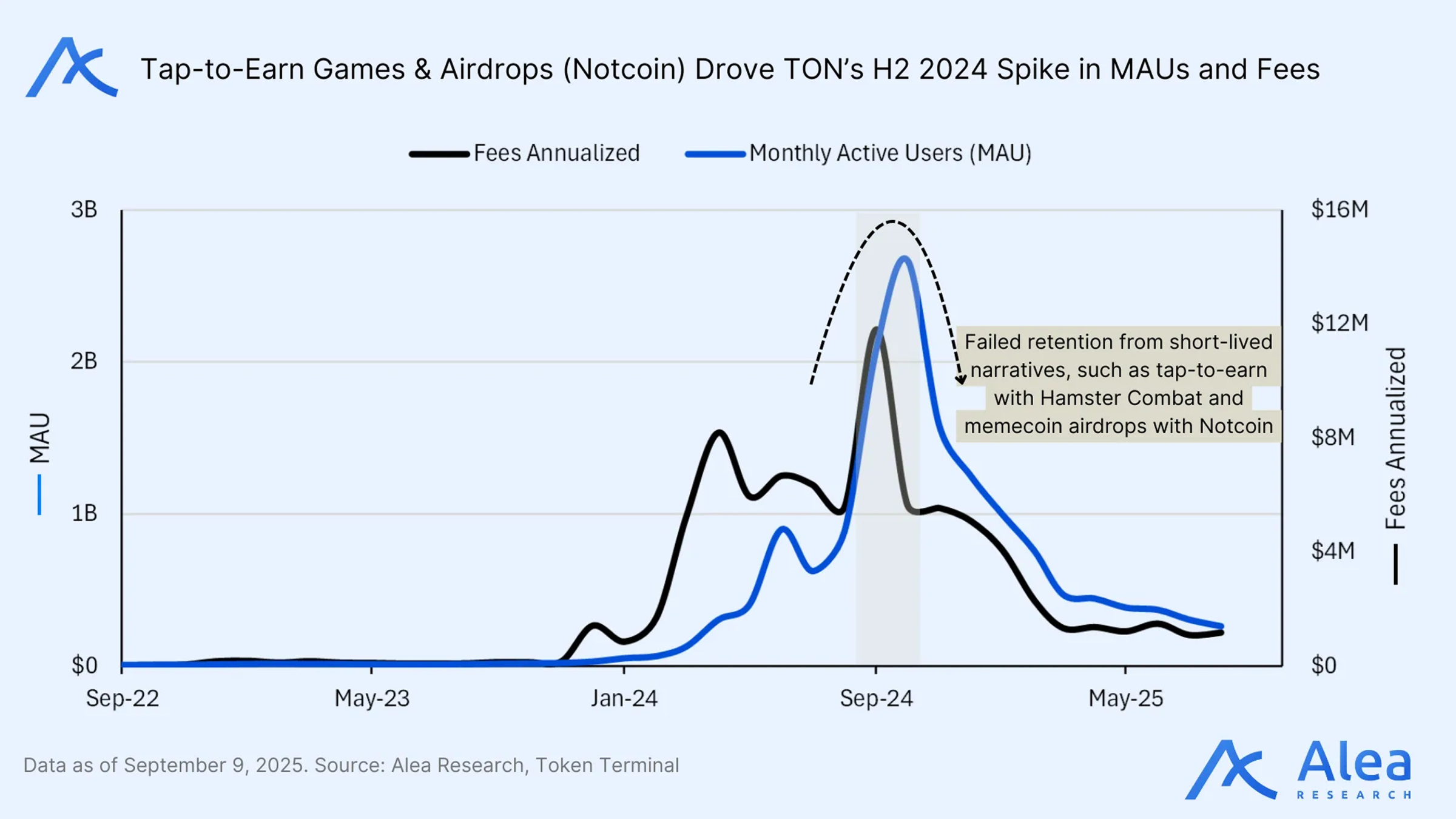
User activity and fees surged in late 2024 due to Notcoin and Hamster Combat campaigns, but the growth quickly declined after the incentives ended.
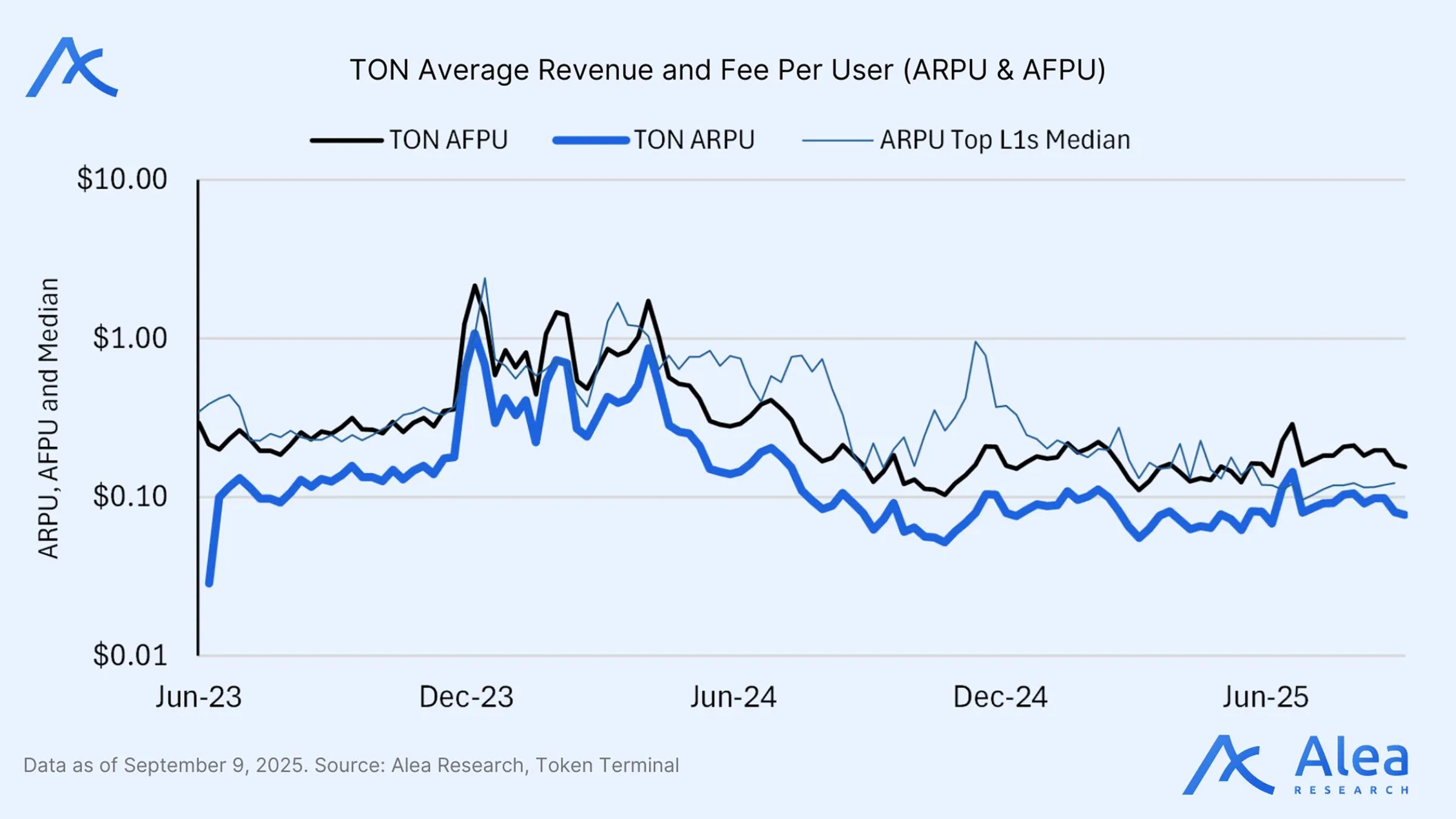
TON’s average revenue per user (ARPU) and average fee per user (AFPU) spiked in late 2023, but have since leveled off. TON’s ARPU is lower than L1 comps, reflecting modest monetization, despite a growing user base.

3. Standardized stablecoin metrics

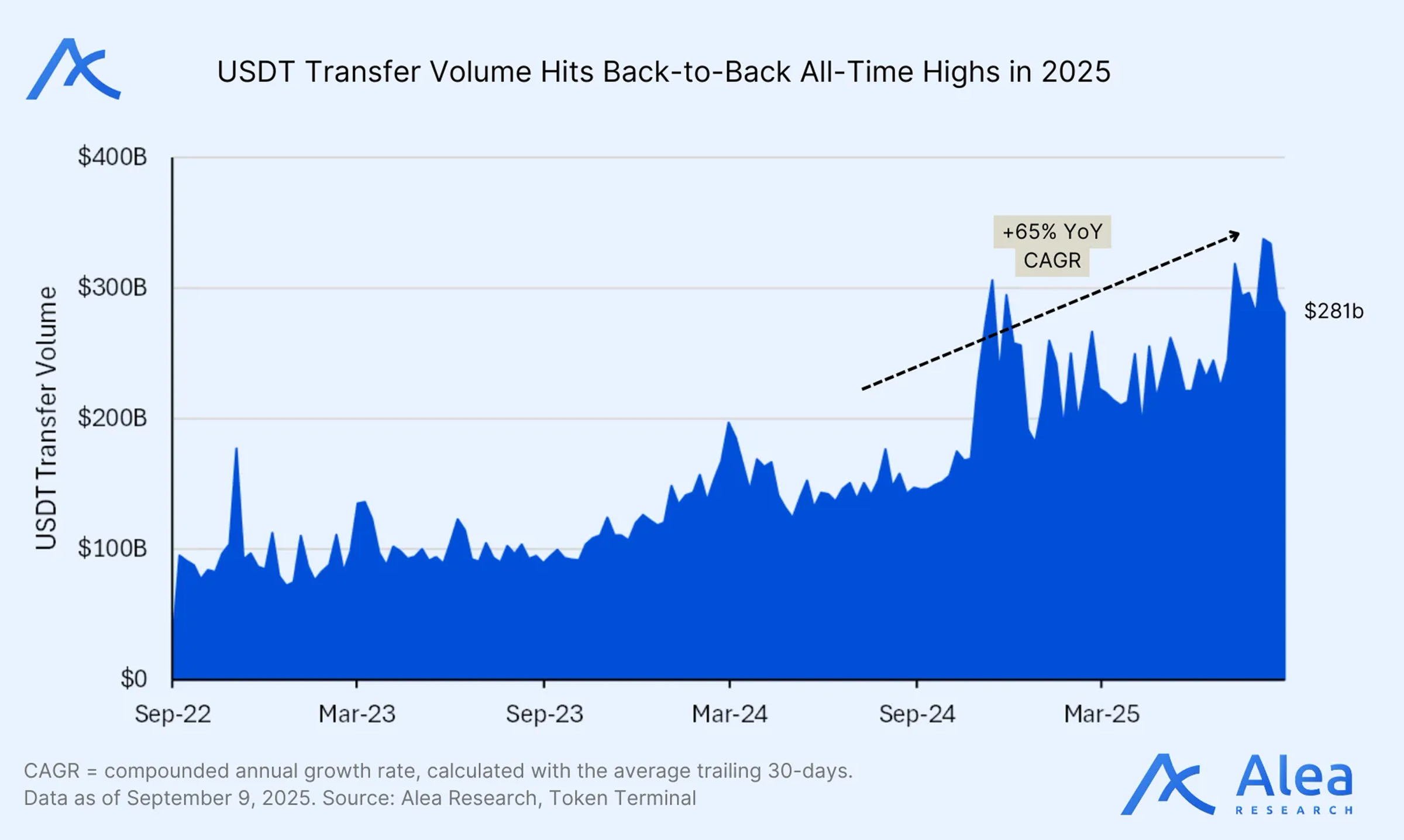
USDT transfer volume on TON hit record highs in 2025, reaching $281B with a 65% CAGR. Stablecoin transactions have become a central driver of economic activity on the chain.

4. Standardized project & ecosystem metrics
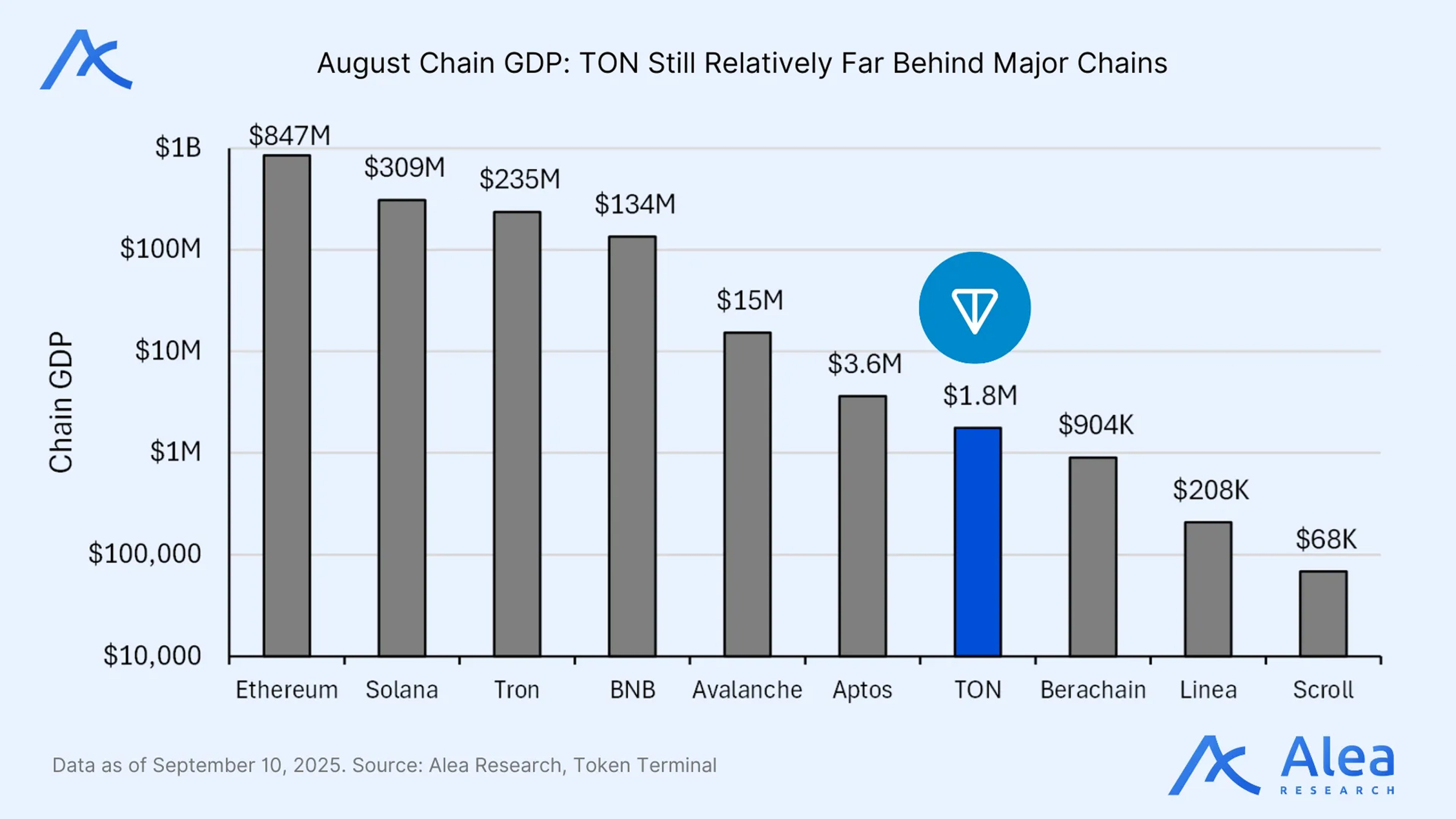
TON’s August chain GDP of $1.8M trails behind major L1s like Ethereum ($847M) and Solana ($309M). Despite strong distribution, TON’s onchain economic footprint is still small relative to its peers.

Stay tuned for more updates as we continue to build the foundation of a transparent and more data-driven crypto industry.

The authors of this content, or members, affiliates, or stakeholders of Token Terminal may be participating or are invested in protocols or tokens mentioned herein. The foregoing statement acts as a disclosure of potential conflicts of interest and is not a recommendation to purchase or invest in any token or participate in any protocol. Token Terminal does not recommend any particular course of action in relation to any token or protocol. The content herein is meant purely for educational and informational purposes only, and should not be relied upon as financial, investment, legal, tax or any other professional or other advice. None of the content and information herein is presented to induce or to attempt to induce any reader or other person to buy, sell or hold any token or participate in any protocol or enter into, or offer to enter into, any agreement for or with a view to buying or selling any token or participating in any protocol. Statements made herein (including statements of opinion, if any) are wholly generic and not tailored to take into account the personal needs and unique circumstances of any reader or any other person. Readers are strongly urged to exercise caution and have regard to their own personal needs and circumstances before making any decision to buy or sell any token or participate in any protocol. Observations and views expressed herein may be changed by Token Terminal at any time without notice. Token Terminal accepts no liability whatsoever for any losses or liabilities arising from the use of or reliance on any of this content.


Lectures associées

MiCA s'apprête à cibler les coffres-forts DeFi, mais la réglementation sera difficile

Le règlement MiCA de l'UE, initialement exempté de prêt cryptographique, fait l'objet d'une consultation pour éventuellement inclure la finance décentralisée (DeFi), notamment les « vaults » de prêt. Ces structures, canalisant des milliards vers les marchés du crédit, posent un défi réglementaire car leurs fonctions économiques sont réparties entre contrats intelligents et multiples participants, sans entité centrale claire. L'exemple du protocole Morpho illustre la complexité : son architecture Vault V2 répartit les rôles (curateur, allocateur, sentinelle), rendant difficile l'identification d'un « fournisseur de service » unique. Les experts soulignent que réglementer le « prêt DeFi » comme une catégorie unique risque de regrouper des structures aux fonctions et contrôles très différents. Les débats portent sur les critères à utiliser : le degré de décentralisation, la structure de contrôle ou l'ajout explicite du prêt/emprunt à la liste des services réglementés. Des voix comme celle du fondateur de Curve Finance plaident pour un cadre dédié, adapté aux spécificités de la DeFi. La consultation de la Commission européenne se termine le 30 septembre 2026. Son issue déterminera si ces vaults restent hors du périmètre de MiCA ou deviennent soumis à une nouvelle régulation, le défi consistant à élaborer des règles distinguant les diverses formes de prêt sur chaîne et leurs mécanismes de contrôle.

cointelegraphIl y a 1 h

MiCA s'apprête à cibler les coffres-forts DeFi, mais la réglementation sera difficile

cointelegraphIl y a 1 h

Grayscale Research : Confidentialité financière à l'ère de l'IA, pourquoi Zcash ne doit pas être ignoré ?

La confidentialité est une composante essentielle de la monnaie, et non une fonctionnalité secondaire. Le rapport de Grayscale Research souligne que l'ère de l'IA et la généralisation des stablecoins suscitent une attention renouvelée pour la confidentialité financière. Zcash, une crypto-monnaie décentralisée, se distingue en offrant des transactions masquées facultatives grâce à des preuves à connaissance zéro, permettant de valider des paiements sans divulguer l'expéditeur, le destinataire ou le montant. Contrairement aux blockchains transparentes comme Bitcoin, Zcash permet aux utilisateurs de choisir la confidentialité. Ses mises à jour successives (Sapling, Orchard, Ironwood) ont considérablement amélioré son utilité. Actuellement, 90% de ses transactions sont masquées et 25% de l'offre en circulation est dans le pool protégé, démontrant une demande réelle. Malgré une capitalisation modeste (0,6% du segment des monnaies numériques), Zcash présente un potentiel de réévaluation si le marché reconnaît la valeur fondamentale de la confidentialité. Les risques incluent le cadre réglementaire, les défis techniques hérités et l'exécution future des mises à niveau. L'opportunité d'investissement réside dans le fait que le marché sous-évalue actuellement le potentiel d'une monnaie numérique privée.

marsbitIl y a 3 h

Grayscale Research : Confidentialité financière à l'ère de l'IA, pourquoi Zcash ne doit pas être ignoré ?

marsbitIl y a 3 h

Trading

Spot
活动图片