Circle And Deutsche Börse Partner To Boost Stablecoin Adoption In Europe

bitcoinistPublié le 2025-10-01Dernière mise à jour le 2025-10-01

Résumé

Global stablecoin issuer Circle Internet Group and German multinational corporation Deutsche Börse Group have unveiled their collaboration to expand stablecoin...

Trusted Editorial content, reviewed by leading industry experts and seasoned editors. Ad Disclosure

Global stablecoin issuer Circle Internet Group and German multinational corporation Deutsche Börse Group have unveiled their collaboration to expand stablecoin adoption in Europe.

Circle Partners With Deutsche Börse For Stablecoin Expansion

On Tuesday, Circle and Deutsche Börse Group announced they had signed a Memorandum of Understanding (MoU) to integrate the global issuer’s euro and dollar stablecoins, EURC and USDC, within the international exchange organization’s financial market infrastructure.

According to the joint statement, the collaboration aims to bring “new solutions” for market participants in Europe by connecting token-based payment networks with traditional financial market infrastructure. It also seeks to advance the regulated adoption of stablecoins in European markets.

Circle and Deutsche Börse plan to initially focus on listing and trading stablecoins on the German corporation’s digital exchange 3DX and institutional provider Crypto Finance. Moreover, the partnership is set to enable institutional-grade digital asset custody via Deutsche Börse’s post-trade business, Clearstream, leveraging the German entity of Crypto Finance as sub-custodian.

Co-Founder, Chairman, and CEO of Circle, Jeremy Allaire, affirmed that the collaboration will “advance the use of regulated stablecoins across Europe’s market infrastructure—reducing settlement risk, lowering costs, and improving efficiency for banks, asset managers, and the wider market.”

“As clear rules take hold across Europe, aligning our regulated stablecoins, EURC and USDC, with trusted venues will unlock new products and streamline workflows across trading, settlement, and custody,” he added.

The partnership follows the recent initiative by nine major European banks to deploy a MiCAR-compliant stablecoin next year. As reported by Bitcoinist, Italian banking giant UniCredit, alongside ING, Banca Sella, KBC, Danske Bank, DekaBank, SEB, CaixaBank, and Raiffeisen Bank International, have formed a consortium to launch a euro-pegged stablecoin to “fill the need for a trusted, regulated solution for on-chain payments and settlement.”

EU Regulatory Landscape Faces Stablecoin Challenge

As the announcement noted, the initiative is enabled by the European Union’s (EU) Market in Crypto Assets Regulation (MiCAR), the bloc’s comprehensive framework for cryptocurrencies, which covers areas such as the issuance and custody of digital assets. Circle also highlighted its status as the first major global issuer to achieve compliance with MiCAR.

Nonetheless, recent reports affirmed that the European Central Bank (ECB) is pushing for stricter regulations, which could impact how issuers like Circle and Paxos operate across borders. As Bloomberg alleged on Tuesday, the ECB is calling for a ban on multi-issuance stablecoins in the bloc and other jurisdictions.

According to the report, the European Systemic Risk Board (ESRB) recently passed a recommendation to ban jointly issued stablecoins, people familiar with the discussions told the news media outlet.

Recently, Judith Arnal, an associate senior research fellow at the Centre for European Credit Research Institute (ECRI) and board member at the Bank of Spain, discussed the issue in an in-depth analysis for ECRI, affirming that multi-issuance stablecoins would be MiCA’s first “real credibility test”:

At the heart of this controversy lies a fundamental tension between regulatory ambition and market reality. The European Central Bank (ECB), backed by key members of the European Parliament (EP), argues that multi-issuance structures could undermine the prudential safeguards that MiCA was designed to establish, potentially exposing European holders to risks from third-country issuers and weakening EU monetary sovereignty. The European Commission, meanwhile, has sought to resolve the matter through internal administrative procedures, avoiding the political debate that the ECB and EP believe is necessary.

Despite being supported by a high-powered board of central bank governors and EU officials, the guidance is not legally binding, noted Bloomberg. However, it will reportedly pressure EU authorities to “implement the restrictions or explain how financial stability can be preserved in their absence.”

Arnal considers that “this institutional standoff has created regulatory paralysis with far-reaching consequences,” which risks “undermining MiCA’s credibility as a coherent and globally influential regulatory framework – just as other jurisdictions, notably the US, are establishing clear and competitive alternatives.”
circle, bitcoin, btc, btcusdt

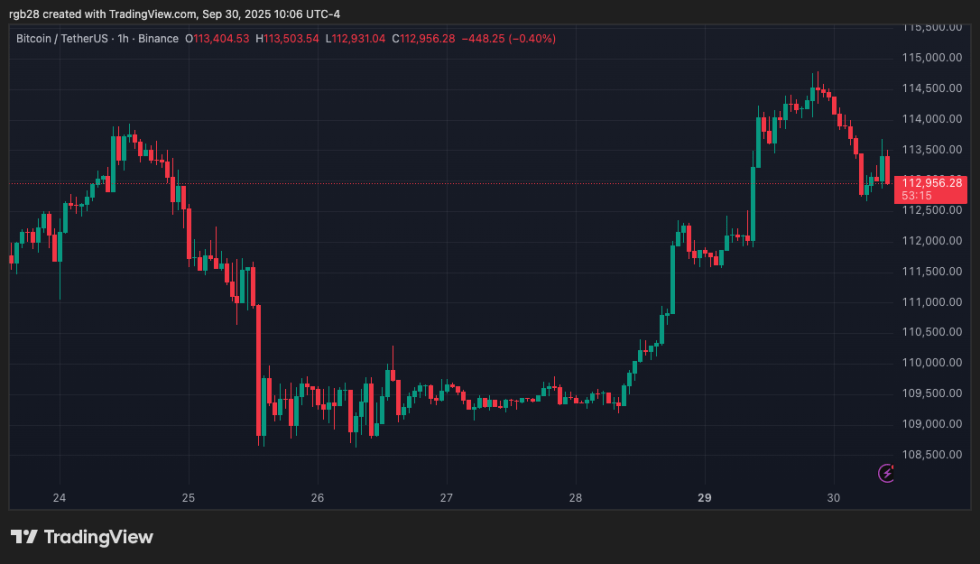
Bitcoin (BTC) trades at $112,956 in the one-week chart. Source: BTCUSDT on TradingView
Featured Image from Unsplash.com, Chart from TradingView.com
Editorial Process for bitcoinist is centered on delivering thoroughly researched, accurate, and unbiased content. We uphold strict sourcing standards, and each page undergoes diligent review by our team of top technology experts and seasoned editors. This process ensures the integrity, relevance, and value of our content for our readers.

Rubmar is a crypto enthusiast who likes learning and improving constantly. She enjoys reporting on the latest news and developments in the crypto industry. Rubmar also enjoys scrapbooking, crafting, simulation games, and watching football.

Lectures associées

BREAKING – Michael Saylor tente d'apaiser les rivalités internes du Bitcoin — Y parviendra-t-il ?

Dans un article, Michael Saylor tente d'apaiser les rivalités internes au sein de l'écosystème Bitcoin. Il affirme que Bitcoin a évolué bien au-delà d'une simple niche contestataire pour toucher désormais les individus, les entreprises, les banques et les gouvernements. Saylor identifie quatre courants principaux dans la communauté Bitcoin : les Maximalistes (qui voient Bitcoin comme une monnaie saine et un bouclier contre l'inflation), les Capitalistes (qui souhaitent son intégration au système financier traditionnel), les Technologues (focalisés sur les améliorations techniques comme l'évolutivité et la sécurité) et les Fondamentalistes (attachés à l'auto-garde, la décentralisation et la résistance à la censure). Il présente ces divergences non pas comme un signe d'effondrement, mais comme une étape normale de croissance. Son argument central est que Bitcoin peut préserver son protocole de base intact tout en permettant le développement de services financiers et de produits autour de lui. Ce plaidoyer pour l'unité intervient alors que sa société, MicroStrategy, a réalisé une vente exceptionnelle de bitcoins, alimentant les tensions sur le marché. La question posée en conclusion est de savoir si Saylor peut réellement faire cesser ces luttes internes, où s'affrontent argent, politique et principes, ou si chaque camp reste convaincu d'être le seul véritable gardien de l'essence de Bitcoin.

bitcoinistIl y a 1 h

BREAKING – Michael Saylor tente d'apaiser les rivalités internes du Bitcoin — Y parviendra-t-il ?

bitcoinistIl y a 1 h

Hoskinson dément les rumeurs de départ de Cardano : 'Je ne pars pas'

Le fondateur de Cardano, Charles Hoskinson, a fermement démenti les rumeurs selon lesquelles il quitterait l'écosystème. Lors d'un livestream le 4 juin, il a expliqué qu'il prenait simplement du recul par rapport à la communication publique en raison de la toxicité prédominante sur les réseaux sociaux, notamment X, où environ 30 % des réponses à ses publications seraient hostiles ou abusives. Hoskinson a réaffirmé son engagement continu dans les travaux techniques de Cardano, tels que RealFi et Midnight, tout en soulignant que son rôle n'a jamais été de stimuler le prix de l'ADA pour les spéculateurs. Il a dressé le constat de « deux Cardano » : d'un côté, des avancées techniques significatives depuis 2021, et de l'autre, une performance marchande médiocre qui entraîne des critiques. Pour résoudre cette dissonance, Hoskinson appelle la communauté à quitter X comme plateforme de discussion principale, à revoir les incitations pour les développeurs et à élaborer une nouvelle feuille de route. Il a également critiqué le manque de mécanismes de responsabilité au sein de la Cardano Foundation. En conclusion, Hoskinson annonce qu'il fera une pause dans les vidéos publiques et sur les réseaux sociaux pour se consacrer au travail sur Midnight et réfléchir à l'avenir de Cardano, en insistant sur la nécessité d'un environnement de communication respectueux.

bitcoinistIl y a 3 h

Hoskinson dément les rumeurs de départ de Cardano : 'Je ne pars pas'

bitcoinistIl y a 3 h

Anthropic lance son IPO : miracle commercial ou bulle d'évaluation ?

Anthropic, l'une des principales entreprises d'IA, a déposé une demande d'introduction en bourse (IPO) secrète, visant une introduction dès octobre. Sa valorisation pré-IPO est estimée à 965 milliards de dollars, approchant le seuil des 1 000 milliards. Contrairement à la bulle Internet des années 2000, les investisseurs soulignent que sa valorisation repose sur des fondamentaux commerciaux solides et une croissance des revenus sans précédent. Le chiffre d'affaires annuel récurrent (ARR) d'Anthropic est passé de 1 milliard de dollars début 2025 à 47 milliards en mai 2026, avec un objectif de 100 milliards d'ici fin d'année. L'entreprise a atteint sa première rentabilité opérationnelle au deuxième trimestre 2026. Avec environ 3 000 employés, sa productivité par tête dépasse 10 millions de dollars. Sa clientèle comprend de grandes entreprises telles que Netflix, Spotify et Salesforce, et son produit Claude Code domine le marché de la programmation assistée par IA. L'auteur soutient que cette valorisation élevée reflète une transition économique plus profonde : le passage d'une économie basée sur le "carbone" (ressources humaines) à une économie mixte "carbone-silicium", où la puissance de calcul et l'intelligence artificielle deviennent des moteurs essentiels de productivité et de compétitivité. L'IPO d'Anthropic symboliserait donc l'ancrage de ce nouveau paradigme.

链捕手Il y a 5 h

Anthropic lance son IPO : miracle commercial ou bulle d'évaluation ?

链捕手Il y a 5 h

Trading

Spot
Futures
活动图片