7 XRP ETFs Draw Close To Their Decision Deadlines With The SEC – Here Are The Dates

bitcoinistPublié le 2025-09-30Dernière mise à jour le 2025-09-30

Résumé

The race to launch XRP ETFs in the US is reaching a critical stage, with several issuers awaiting final decisions...

Trusted Editorial content, reviewed by leading industry experts and seasoned editors. Ad Disclosure

The race to launch XRP ETFs in the US is reaching a critical stage, with several issuers awaiting final decisions from the Securities and Exchange Commission (SEC). Multiple applications, filed by some of the world’s largest asset managers, are already approaching strict approval deadlines in October. 

SEC Faces Wave Of XRP ETF Deadlines In October

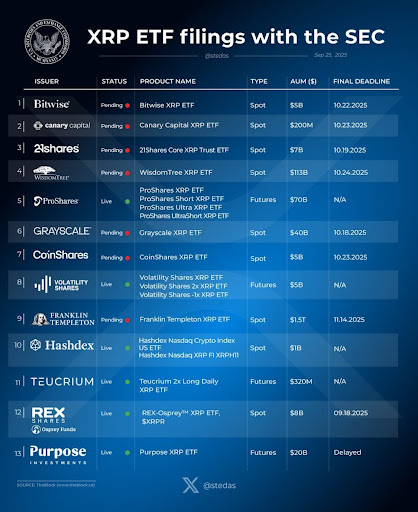
According to a recent update from crypto analyst Stedas, seven XRP ETF applications are now pending with the US SEC. These filings represent a mix of major institutional players and crypto-focused firms, all seeking to secure a first-mover advantage in what could be one of the most competitive markets for digital asset ETFs. 

The earliest deadline falls on October 18, when the SEC must issue a decision on Grayscale’s XRP ETF application, which seeks to leverage the firm’s $40 billion Assets Under Management (AUM). Just a day later, 21Shares will face its own deadline on October 19, with a proposal for its Core XRP Trust ETF backed by $7 billion AUM. Bitwise, another well-known crypto asset manager, will follow on October 20 with its ETF filing and a $5 billion AUM.

CoinShares is expected to enter the spotlight on October 23, with its $5 billion product pending SEC judgement. On the same day, Canary Capital, a smaller but equally ambitious issuer with $200 million in AUM, will also face a final ruling. WisdomTree, with an eye-watering $113 billion AUM, rounds out the October deadlines on October 24, as the SEC decides the fate of its proposed XRP ETF. 
XRP
Source: Chart from Stedas on X

Notably, Franklin Templeton, which oversees approximately $1.5 trillion in assets, will not face its deadline until November 14, giving the firm slightly more runway than its October competitors. Collectively, these ETF applications highlight the broader institutional demand for XRP-based investment vehicles. 

Although REX-Shares and Osprey Funds were the first to launch an XRP ETF in the US, they did so in a collective bundle with the Dogecoin ETF. Furthermore, future-based products from companies such as ProShares, Volatility Shares, and Purpose Investments, among other issuers, are already live. 

Could A US Government Shutdown Affect The Funds Decision Dates?

While October promises to be a decisive month for the funds, concerns have been raised over whether a potential US government shutdown could disrupt the timeline of these products. Funding for the US government is set to expire at the end of Tuesday, September 30, unless an agreement is reached between Republicans and Democrats on a new spending bill. If no deal is signed, the country will enter its first government shutdown in almost seven years. 

The US SEC, as a federal agency, would not be immune to a potential government shutdown. While no official reports have confirmed whether a shutdown would impact the regulator’s ability to decide on XRP ETFs in October, the SEC’s Operations Plan, dated August 7, indicates that such an event would leave it running on a skeletal staff. This would severely restrict its capacity to review corporate filings, investigate misconduct, and oversee markets.

XRP
XRP trading at $2.87 on the 1D chart | Source: XRPUSDT on Tradingview.com
Featured image from Getty Images, chart from Tradingview.com
Editorial Process for bitcoinist is centered on delivering thoroughly researched, accurate, and unbiased content. We uphold strict sourcing standards, and each page undergoes diligent review by our team of top technology experts and seasoned editors. This process ensures the integrity, relevance, and value of our content for our readers.

Scott Matherson is a leading crypto writer at Bitcoinist, who possesses a sharp analytical mind and a deep understanding of the digital currency landscape. Scott has earned a reputation for delivering thought-provoking and well-researched articles that resonate with both newcomers and seasoned crypto enthusiasts. Outside of his writing, Scott is passionate about promoting crypto literacy and often works to educate the public on the potential of blockchain.

Lectures associées

MiCA s'apprête à cibler les coffres-forts DeFi, mais la réglementation sera difficile

Le règlement MiCA de l'UE, initialement exempté de prêt cryptographique, fait l'objet d'une consultation pour éventuellement inclure la finance décentralisée (DeFi), notamment les « vaults » de prêt. Ces structures, canalisant des milliards vers les marchés du crédit, posent un défi réglementaire car leurs fonctions économiques sont réparties entre contrats intelligents et multiples participants, sans entité centrale claire. L'exemple du protocole Morpho illustre la complexité : son architecture Vault V2 répartit les rôles (curateur, allocateur, sentinelle), rendant difficile l'identification d'un « fournisseur de service » unique. Les experts soulignent que réglementer le « prêt DeFi » comme une catégorie unique risque de regrouper des structures aux fonctions et contrôles très différents. Les débats portent sur les critères à utiliser : le degré de décentralisation, la structure de contrôle ou l'ajout explicite du prêt/emprunt à la liste des services réglementés. Des voix comme celle du fondateur de Curve Finance plaident pour un cadre dédié, adapté aux spécificités de la DeFi. La consultation de la Commission européenne se termine le 30 septembre 2026. Son issue déterminera si ces vaults restent hors du périmètre de MiCA ou deviennent soumis à une nouvelle régulation, le défi consistant à élaborer des règles distinguant les diverses formes de prêt sur chaîne et leurs mécanismes de contrôle.

cointelegraphIl y a 1 h

MiCA s'apprête à cibler les coffres-forts DeFi, mais la réglementation sera difficile

cointelegraphIl y a 1 h

Grayscale Research : Confidentialité financière à l'ère de l'IA, pourquoi Zcash ne doit pas être ignoré ?

La confidentialité est une composante essentielle de la monnaie, et non une fonctionnalité secondaire. Le rapport de Grayscale Research souligne que l'ère de l'IA et la généralisation des stablecoins suscitent une attention renouvelée pour la confidentialité financière. Zcash, une crypto-monnaie décentralisée, se distingue en offrant des transactions masquées facultatives grâce à des preuves à connaissance zéro, permettant de valider des paiements sans divulguer l'expéditeur, le destinataire ou le montant. Contrairement aux blockchains transparentes comme Bitcoin, Zcash permet aux utilisateurs de choisir la confidentialité. Ses mises à jour successives (Sapling, Orchard, Ironwood) ont considérablement amélioré son utilité. Actuellement, 90% de ses transactions sont masquées et 25% de l'offre en circulation est dans le pool protégé, démontrant une demande réelle. Malgré une capitalisation modeste (0,6% du segment des monnaies numériques), Zcash présente un potentiel de réévaluation si le marché reconnaît la valeur fondamentale de la confidentialité. Les risques incluent le cadre réglementaire, les défis techniques hérités et l'exécution future des mises à niveau. L'opportunité d'investissement réside dans le fait que le marché sous-évalue actuellement le potentiel d'une monnaie numérique privée.

marsbitIl y a 3 h

Grayscale Research : Confidentialité financière à l'ère de l'IA, pourquoi Zcash ne doit pas être ignoré ?

marsbitIl y a 3 h

Trading

Spot
活动图片