Whales Inject an Extra $329K+ Into Bitcoin Hyper Ahead of Uptober – The Next 1000x Crypto?

bitcoinistPublié le 2025-09-30Dernière mise à jour le 2025-09-30

Résumé

With ‘Uptober’ just around the corner (literally tomorrow), anticipation is building for what could be a pivotal moment for $BTC....

Trusted Editorial content, reviewed by leading industry experts and seasoned editors. Ad Disclosure

With ‘Uptober’ just around the corner (literally tomorrow), anticipation is building for what could be a pivotal moment for $BTC.

October is historically one of the strongest months for the world’s largest crypto, with average returns at 21.89%.

So, what better time for the Bitcoin Hyper Layer-2 (L2) to soon go live? Suppose this peak demand takes shape, it could position itself as a go-to solution for scaling Bitcoin, precisely when the network needs it most.

It’s no surprise, then, that whales have latched on. Just yesterday, three invested $113.8K, $109.9K, and $105.4K into the ecosystem’s $HYPER presale, signaling strong confidence in the L2’s potential.

Suppose this buzz continues, $HYPER might even become the next 1000x crypto.

$BTC Rockets 4.5% in One Month, Before Possible October Rally

Since last month, $BTC has increased by over 4.5%, a sign that bullish momentum may already be underway.

Yes, $BTC has plummeted from $114K to $113K since just yesterday. But it’s not all doom and gloom for the #1 crypto.

Even during the most challenging market cycles, October is often a turning point where $BTC sentiment flips from bearish to bullish.

Take 2023 as a prime example. After a modest 3.91% gain in September, it soared by 28.52% the following month.
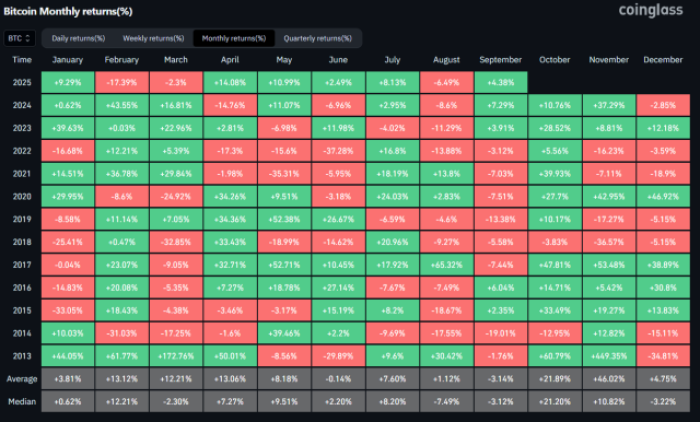
Bitcoin monthly returns on Coinglass.
Source: Coinglass

Given this, it’s no wonder that institutions are positioning themselves for what might be another legendary spike.

Just yesterday, Michael Saylor announced that his firm – Strategy (formerly MicroStrategy) – has acquired an additional 196 $BTC, worth roughly $221M.

As of September, Strategy now holds an eye-boggling 640,031 $BTC valued at $47.35B+. The average price per token is approximately $73,983.

Michael Strategy announced Strategy’s most recent BTC acquisition on X.
Source: X (Michael Saylor)

Strategy isn’t the only public company acquiring sizable amounts of $BTC in the hope of capitalizing on the next bull run.

Over the past 30 days, MARA Holdings has boosted its stack to 52,477 $BTC valued at nearly $5.94B.

XXI also bets big on the crypto leader jumping to greater heights. In total, it owns 43,515 $BTC, currently worth approximately $4.92B.
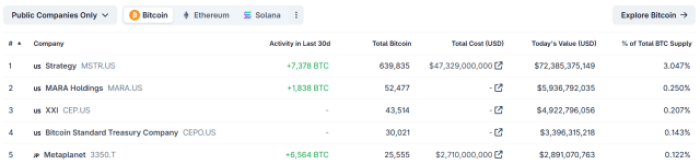
BTC held by public companies on CoinGecko.
Source: CoinGecko

When firms commit billions to $BTC, it validates the asset’s role as a store of value as opposed to being yet another speculative asset.

In turn, they fuel demand for $BTC and boost market confidence. But there’s a hitch: as the coin’s popularity surges and transaction volumes increase, the network often faces mounting pressure.

Bitcoin Processes Fees 43%+ Slower Than Ethereum

Bitcoin’s no stranger to scalability challenges. Today, the network can process just 12.47 transactions per second (tps), 43.32% lower than Ethereum’s 22.01 tps.

Even at its record level, Bitcoin has only managed 13.2 tps – a far cry from Ethereum’s 62.34 tps and nowhere near Solana’s 65K tps.

The network’s limited throughput often causes higher gas costs during peak activity. Following the halving event last October, average transaction fees rose as high as $8.36 one month later.

While fees have since dropped to just $0.84, they’re still no stranger to fluctuating. This makes it tricky for everyday traders to rely on Bitcoin for everyday transactions.
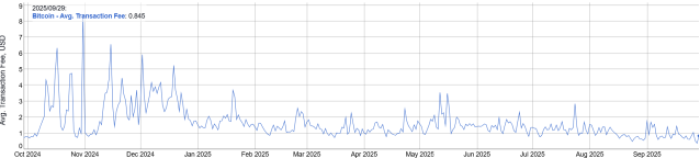
Average Bitcoin transaction fee.
Source: BitInfoCharts

Thankfully, there’s a solution. It’s Bitcoin Hyper, and it’s getting set to launch this quarter to address the network’s bottlenecks.

Bitcoin Hyper L2 to Bring Solana’s Speeds to Bitcoin

Built on the Solana Virtual Machine (SVM), Bitcoin Hyper strives to deliver Solana-level speeds and scalability to Bitcoin. In turn, it’ll enable thousands of tps at a lower price tag.

For even faster, cheaper, and more versatile transactions, the L2 will leverage a Canonical Bridge. But that’s not all; it’ll help turn Bitcoin into a hub for DeFi, dApps, launchpads, and even the best meme coins.
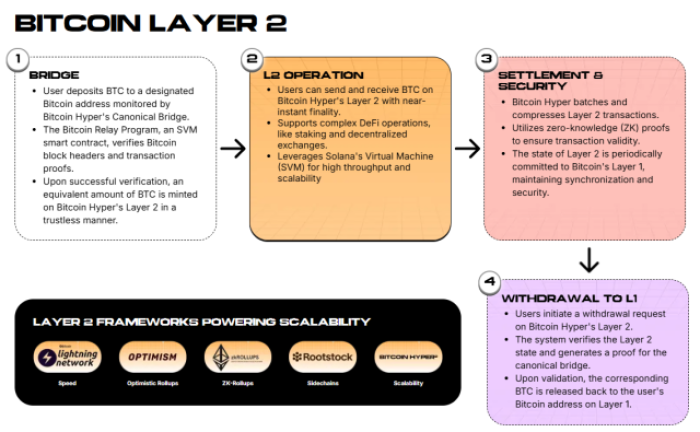
How the Bitcoin Hyper bridge works.
Source: Bitcoin Hyper

All is achieved by enabling $BTC to move seamlessly between the Bitcoin base layer and the Hyper L2 ecosystem. And once bridged, $BTC can interact directly with smart contracts, dApps, and liquidity protocols.

$HYPER Fuels L2 Growth & 61% Staking Rewards

$HYPER is at the heart of the entire ecosystem, supercharging every aspect of its utility and growth. A sizable 30% of its total token supply is allocated to fund development, after all.

Also fueling its long-term growth is an additional 25% of $HYPER being earmarked for the ecosystem treasury.
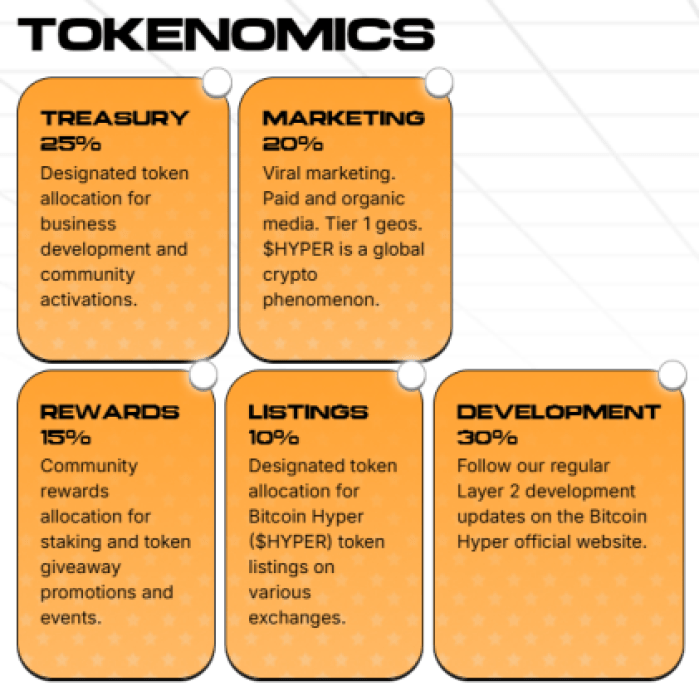
30% of Bitcoin Hyper goes to development funding.
Source: Bitcoin Hyper

Holding $HYPER doesn’t only mean you’ll contribute to the project’s sustainability; it also unlocks meaningful utility.

By purchasing $HYPER on presale – now available for $0.013005 – you’ll gain governance rights, enjoy reduced gas fees, and can stake your token at a 61% APY.

But time is of the essence: the APY will nosedive as more investors lock up their tokens. So, now’s an opportune moment to start staking $HYPER for the greatest possible gains.

Our Bitcoin Hyper price prediction also anticipates $HYPER to surpass $0.32 this year, following its listing on major CEXs. So, joining now could generate 20 times the returns (and that’s not even counting the staking rewards).

Join Bitcoin Hyper today.

We’re not financial advisors. Always do your own research and never invest more than you’d be sad to lose. 

Authored by Leah Waters, Bitcoinist – https://bitcoinist.com/bitcoin-hyper-next-1000x-crypto-whales-buy-329k/

Editorial Process for bitcoinist is centered on delivering thoroughly researched, accurate, and unbiased content. We uphold strict sourcing standards, and each page undergoes diligent review by our team of top technology experts and seasoned editors. This process ensures the integrity, relevance, and value of our content for our readers.

Leah is a British journalist with a BA in Journalism, Media, and Communications and nearly a decade of content writing experience. Over the last four years, her focus has primarily been on Web3 technologies, driven by her genuine enthusiasm for decentralization and the latest technological advancements. She has contributed to leading crypto and NFT publications – Cointelegraph, Coinbound, Crypto News, NFT Plazas, Bitcolumnist, Techreport, and NFT Lately – which has elevated her to a senior role in crypto journalism. Whether crafting breaking news or in-depth reviews, she strives to engage her readers with the latest insights and information. Her articles often span the hottest cryptos, exchanges, and evolving regulations. As part of her ploy to attract crypto newbies into Web3, she explains even the most complex topics in an easily understandable and engaging way. Further underscoring her dynamic journalism background, she has written for various sectors, including software testing (TEST Magazine), travel (Travel Off Path), and music (Mixmag). When she's not deep into a crypto rabbit hole, she's probably island-hopping (with the Galapagos and Hainan being her go-to's). Or perhaps sketching chalk pencil drawings while listening to the Pixies, her all-time favorite band.

Lectures associées

MiCA s'apprête à cibler les coffres-forts DeFi, mais la réglementation sera difficile

Le règlement MiCA de l'UE, initialement exempté de prêt cryptographique, fait l'objet d'une consultation pour éventuellement inclure la finance décentralisée (DeFi), notamment les « vaults » de prêt. Ces structures, canalisant des milliards vers les marchés du crédit, posent un défi réglementaire car leurs fonctions économiques sont réparties entre contrats intelligents et multiples participants, sans entité centrale claire. L'exemple du protocole Morpho illustre la complexité : son architecture Vault V2 répartit les rôles (curateur, allocateur, sentinelle), rendant difficile l'identification d'un « fournisseur de service » unique. Les experts soulignent que réglementer le « prêt DeFi » comme une catégorie unique risque de regrouper des structures aux fonctions et contrôles très différents. Les débats portent sur les critères à utiliser : le degré de décentralisation, la structure de contrôle ou l'ajout explicite du prêt/emprunt à la liste des services réglementés. Des voix comme celle du fondateur de Curve Finance plaident pour un cadre dédié, adapté aux spécificités de la DeFi. La consultation de la Commission européenne se termine le 30 septembre 2026. Son issue déterminera si ces vaults restent hors du périmètre de MiCA ou deviennent soumis à une nouvelle régulation, le défi consistant à élaborer des règles distinguant les diverses formes de prêt sur chaîne et leurs mécanismes de contrôle.

cointelegraphIl y a 2 h

MiCA s'apprête à cibler les coffres-forts DeFi, mais la réglementation sera difficile

cointelegraphIl y a 2 h

Grayscale Research : Confidentialité financière à l'ère de l'IA, pourquoi Zcash ne doit pas être ignoré ?

La confidentialité est une composante essentielle de la monnaie, et non une fonctionnalité secondaire. Le rapport de Grayscale Research souligne que l'ère de l'IA et la généralisation des stablecoins suscitent une attention renouvelée pour la confidentialité financière. Zcash, une crypto-monnaie décentralisée, se distingue en offrant des transactions masquées facultatives grâce à des preuves à connaissance zéro, permettant de valider des paiements sans divulguer l'expéditeur, le destinataire ou le montant. Contrairement aux blockchains transparentes comme Bitcoin, Zcash permet aux utilisateurs de choisir la confidentialité. Ses mises à jour successives (Sapling, Orchard, Ironwood) ont considérablement amélioré son utilité. Actuellement, 90% de ses transactions sont masquées et 25% de l'offre en circulation est dans le pool protégé, démontrant une demande réelle. Malgré une capitalisation modeste (0,6% du segment des monnaies numériques), Zcash présente un potentiel de réévaluation si le marché reconnaît la valeur fondamentale de la confidentialité. Les risques incluent le cadre réglementaire, les défis techniques hérités et l'exécution future des mises à niveau. L'opportunité d'investissement réside dans le fait que le marché sous-évalue actuellement le potentiel d'une monnaie numérique privée.

marsbitIl y a 4 h

Grayscale Research : Confidentialité financière à l'ère de l'IA, pourquoi Zcash ne doit pas être ignoré ?

marsbitIl y a 4 h

Trading

Spot
活动图片