BlackRock’s global head of digital assets, Robbie Mitchnick, was pressed on the prospect of a spot XRP exchange-traded fund during an interview with Nate Geraci on the “Crypto Prime” podcast.
Will BlackRock Launch A Spot XRP ETF?
While he offered no product reveal, he did spell out precisely how BlackRock is thinking about what could come next after its blockbuster Bitcoin and Ether launches.
Geraci noted on air that he has “publicly predicted that BlackRock would file for a spot XRP ETF and a spot Solana ETF,” then asked how the firm evaluates “future product development around crypto-related ETFs.”
Mitchnick declined to speak to any specific tickers but was explicit about the decision framework: “There’s a lot of factors that go into that decision-making process obviously, but the biggest driver ultimately is our clients… What is the level of investor demand? What is the logic and investment thesis for investors and for our clients around these potential products? What problem are we solving for them?”
He added that BlackRock weighs “market cap, liquidity, [and] maturity,” along with “clarity of investment thesis and overall… portfolio considerations,” describing it as “a constant evaluation process,” not a single point in time.
The exchange came amid a wide-ranging discussion of how quickly BlackRock’s crypto business has scaled and how starkly the firm differentiates Bitcoin from Ether in client portfolios.
My conversation w/ BlackRock’s @robbiemitchnick…
We discuss:
-Massive success of IBIT & ETHA
-Btc & eth in broader portfolio
-Staking in spot eth ETFs
-Generic listing standards
-Crypto ETF development
-Tokenization
-Stablecoinshttps://t.co/54NgVDFpVJvia @CryptoPrimePod pic.twitter.com/N5H4EnI7Q7
— Nate Geraci (@NateGeraci) September 25, 2025
BlackRock Exec On Bitcoin Vs. Ethereum
Geraci highlighted the growth figures—“[IBIT] launched in early January 2024. It’s over $85 billion in assets… [ETHA] launched in July… around $16 billion”—and asked whether Ethereum’s trajectory matched expectations after Bitcoin’s record start.
Mitchnick pushed back on early narratives that Ether ETFs were a “bust” only because they were “being compared against the extraordinary record-setting numbers” of Bitcoin, pointing out that ETHA became “the third fastest ETF in history to reach $10 billion.”
Mitchnick drew a bright line between the two assets from a portfolio-construction perspective. Bitcoin, he said, functions for many allocators as “this sort of digital gold type instrument,” a “global scarce decentralized non-sovereign asset” with distinct risk and return drivers.
Ethereum is “a more nuanced, more technical discussion,” effectively “a bet around blockchain adoption and digital assets more broadly,” with competitive dynamics and questions about “value capture in the Ether token versus the activity level on the Ethereum blockchain.” As a result, Bitcoin has seen “much greater penetration” among institutional and wealth advisory channels, while Ether ownership remains “overwhelmingly” in the direct investor segment.
On the gating factors that could unlock the next wave of demand, Mitchnick said it is “still early days” for both institutions and wealth platforms in the United States. Many large firms allow execution-only access, but “the vast majority of advisers… still do not have the ability to make decisions on this on behalf of their clients.”
He described “various stages of approving this” across the wirehouses, including one firm “starting to put it in model portfolios,” and noted that BlackRock’s own model-portfolio team “early in 2025… put IBIT allocations into one of our model portfolios.” For institutions, he argued that further episodes of Bitcoin “decoupling from equities in a… distressed market environment” would be “critical” in cementing its role as a diversifier.
Asked about the SEC’s recent move to approve generic listing standards for commodity-based ETPs—the category that includes spot crypto ETFs—Mitchnick called it “a pragmatic step” that “streamlin[es] the process,” with clear, transparent standards that “support innovation.”
Taken together, Mitchnick’s comments sketched the contours of BlackRock’s next steps without tipping its hand. On an XRP ETF, he didn’t confirm or deny anything—but he gave a clear readout of the bar any new product must clear: credible client demand, a defensible investment thesis, sufficient market depth and maturity, and a well-defined role in diversified portfolios.
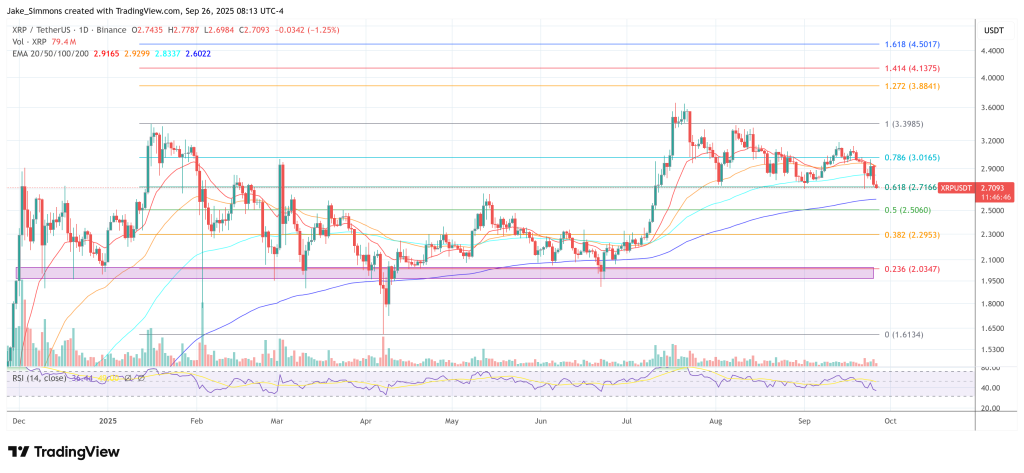
At press time, XRP traded at $2.71.

Related Posts