Tether And Circle Print $1.5B In Hours: Fresh Liquidity Incoming

bitcoinistPublié le 2025-09-24Dernière mise à jour le 2025-09-24

Résumé

The stablecoin market is once again making headlines as two of the largest issuers, Tether (USDT) and Circle (USDC), significantly...

Trusted Editorial content, reviewed by leading industry experts and seasoned editors. Ad Disclosure

The stablecoin market is once again making headlines as two of the largest issuers, Tether (USDT) and Circle (USDC), significantly expanded supply in just hours. According to data shared by Lookonchain, Tether minted another 1 billion USDT, while Circle printed 500 million USDC only seven hours earlier. These issuances highlight how stablecoins continue to play a central role in fueling market liquidity, often acting as precursors to major shifts in crypto price action.

Stablecoins are widely used as dry powder, giving traders and institutions instant exposure to digital assets without relying on traditional banking rails. Large-scale minting events like this are typically interpreted as a sign that capital is flowing into the ecosystem, positioning the market for heightened volatility and potentially a new wave of demand. Historically, such moves have coincided with phases of increased activity across Bitcoin, Ethereum, and major altcoins.

As crypto investors brace for the next leg of market action, the timing of this combined $1.5 billion injection into USDT and USDC supply has sparked speculation. Many analysts believe the market is preparing to absorb this liquidity, setting the stage for what could be a decisive period in the weeks ahead.

Tether $1B Mint | Source: Lookonchain

Stablecoin Expansion And Market Implications

According to CryptoQuant, the combined circulating supply of Tether (USDT) and Circle’s USD Coin (USDC) now forms a significant portion of the global stablecoin market, which sits at around $147 billion. This dominance underscores the pivotal role both issuers play in shaping crypto liquidity. With Tether minting another $1 billion and Circle adding $500 million in supply, these issuances are not random — they reflect growing demand for stable trading capital and often precede decisive market moves.

Stablecoins act as a bridge between traditional finance and the crypto ecosystem, serving as the backbone for trading activity on centralized and decentralized exchanges. When supply expands rapidly, it typically signals an increase in available liquidity, providing investors with the ability to deploy capital into risk assets quickly. For Bitcoin, which recently faced heavy volatility and a sharp pullback below $115K, this influx could offer support for a continuation trend, particularly if bulls regain momentum.

For altcoins, the impact may be even more pronounced. Historically, stablecoin inflows have fueled periods of explosive growth in non-BTC assets, as traders rotate capital in search of higher returns. With USDT and USDC issuance climbing, analysts suggest that the coming days could define whether altcoins recover strongly or remain under pressure.

Stablecoin Market Cap Dominance Analysis

The chart shows that stablecoin dominance has risen sharply to 7.99%, signaling a renewed demand for safety amid recent volatility. After weeks of consolidation between 7.4% and 7.8%, the breakout above the short-term moving averages (50-day at 7.60% and 100-day at 7.63%) confirms stronger capital rotation into stable assets. This pattern often reflects heightened investor caution, with participants opting to sit in stablecoins while waiting for clearer market direction.
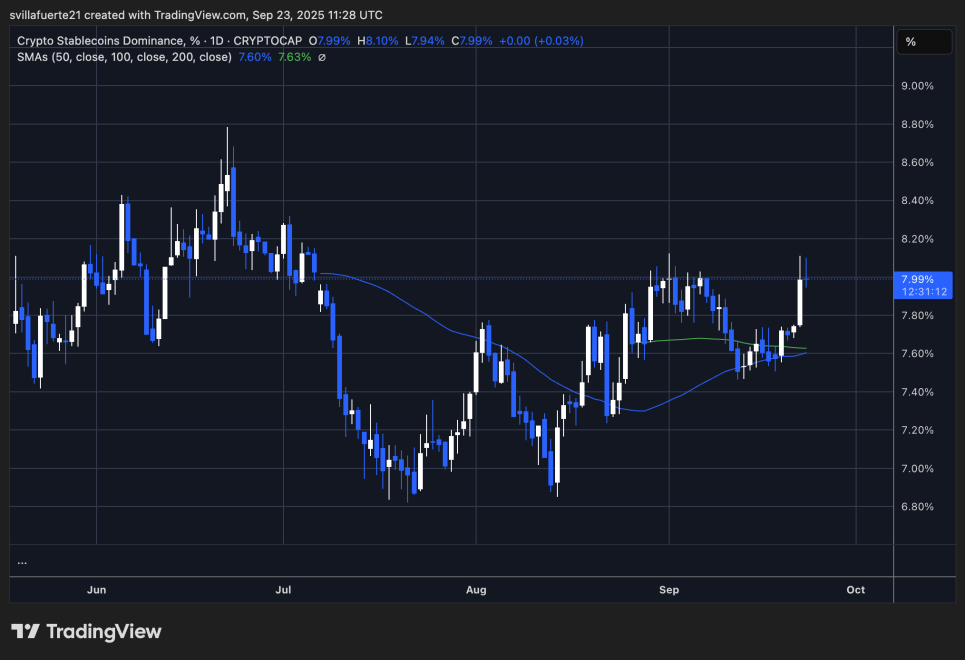
Crypto Stablecoin Dominance | Source: STABLE.C.D chart on TradingView

The move higher coincides with recent liquidations across Bitcoin and altcoins, where leveraged traders were wiped out. Historically, spikes in stablecoin dominance occur when traders de-risk, pulling capital from volatile assets. However, rising stablecoin reserves also indicate available liquidity that could quickly re-enter the market and fuel recovery once sentiment shifts.

If dominance continues to climb toward the 8.2–8.4% range, it may suggest further downside for risk assets in the short term. Conversely, stabilization below this level could mark a base for renewed inflows into Bitcoin and altcoins. The coming sessions will be key in determining whether this rise is a temporary flight to safety or the start of a deeper risk-off trend.

Featured image from Dall-E, chart from TradingView

Editorial Process for bitcoinist is centered on delivering thoroughly researched, accurate, and unbiased content. We uphold strict sourcing standards, and each page undergoes diligent review by our team of top technology experts and seasoned editors. This process ensures the integrity, relevance, and value of our content for our readers.

Sebastian's journey into the world of crypto began four years ago, driven by a fascination with the potential of blockchain technology to revolutionize financial systems. His initial exploration focused on understanding the intricacies of various crypto projects, particularly those focused on building innovative financial solutions. Through countless hours of research and learning, Sebastian developed a deep understanding of the underlying technologies, market dynamics, and potential applications of cryptocurrencies. As his knowledge grew, Sebastian felt compelled to share his insights with others. He began actively contributing to online discussions on platforms like X and LinkedIn, focusing on fintech and crypto-related content. His goal was to expose valuable trends and insights to a wider audience, fostering a deeper understanding of the rapidly evolving crypto landscape. Sebastian's contributions quickly gained recognition, and he became a trusted voice in the online crypto community. To further enhance his expertise, Sebastian pursued a UC Berkeley Fintech: Frameworks, Applications, and Strategies certification. This rigorous program equipped him with valuable skills and knowledge regarding Financial Technology, bridging the gap between traditional finance (TradFi) and decentralized finance (DeFi). The certification deepened his understanding of the broader financial landscape and its intersection with blockchain technology. Sebastian's passion for finance and writing is evident in his work. He enjoys delving into financial research, analyzing market trends, and exploring the latest developments in the crypto space. In his spare time, Sebastian can often be found immersed in charts, studying 10-K forms, or engaging in thought-provoking discussions about the future of finance. Sebastian's journey as a crypto analyst and investor has been marked by a relentless pursuit of knowledge and a dedication to sharing his insights. His ability to navigate the complex world of crypto, combined with his passion for financial research and communication, makes him a valuable asset to the industry. As the crypto landscape continues to evolve, Sebastian remains at the forefront, providing valuable insights and contributing to the growth of this revolutionary technology.

Lectures associées

Rétrospective sur le piratage de Coldcard : Le code source visible n'est pas synonyme de sécurité

L'affaire du vol de portefeuilles matériels Coldcard, entraînant la perte de plus de 150 millions de dollars en Bitcoin, a relancé le débat sur la sécurité du code open source. L'article souligne que la simple disponibilité du code source ("source available") ne garantit pas sa sécurité. Une distinction cruciale est faite entre les logiciels libres/open source (FOSS/FLOSS), qui offrent les quatre libertés fondamentales, et le code simplement lisible, qui peut restreindre l'usage commercial et donc les incitations à un audit approfondi. Le cas Coldcard illustre ce problème : son firmware, sous licence MIT avec restrictions, n'a pas bénéficié d'un examen significatif de la communauté pendant des années, laissant passer une faille critique. Cela démontre que la sécurité dans l'open source repose non sur la transparence passive, mais sur l'existence d'incitations économiques et de compétences pour réaliser des audits continus. Des projets comme Bitcoin Core montrent le modèle fonctionnel, avec un développement et une révision collégiale entièrement publics. L'article analyse aussi l'économie de l'open source : la plupart des utilisateurs s'appuient sur l'hypothèse que "quelqu'un d'autre vérifie", ce qui peut mener à une tragédie des biens communs si les incitations sont mal alignées. Enfin, l'émergence de l'IA modifie la donne. D'un côté, des outils comme le Bitcoin Red Team prouvent que l'IA peut accélérer massivement la détection de vulnérabilités. De l'autre, le flux de code généré par l'IA accable les mainteneurs de projets. Dans ce nouveau paysage, seuls les logiciels faisant l'objet d'audits rigoureux et continus, qu'ils soient open source ou privés, pourront résister à la pression accrue des attaques financières et technologiques.

marsbitIl y a 33 mins

Rétrospective sur le piratage de Coldcard : Le code source visible n'est pas synonyme de sécurité

marsbitIl y a 33 mins

Les ETF spot sur le Bitcoin et l'Ethereum attirent 2,6 milliards de dollars en une semaine : un record depuis octobre 2025

Les ETF spot américains sur Bitcoin et Ethereum ont attiré 2,6 milliards de dollars d'afflux net de capitaux en une semaine, un record depuis octobre 2025. Les ETF Bitcoin ont reçu 1,9 milliard de dollars, tandis que les fonds Ethereum ont attiré 697,2 millions de dollars, des chiffres records pour l'année 2026. Ce résultat marque un renversement notable par rapport à la semaine précédente, qui avait enregistré un retrait de 392 millions de dollars. L'activité de trading des ETF Bitcoin a plus que triplé, atteignant 22,1 milliards de dollars, et leurs actifs sous gestion ont augmenté de 25,4% pour atteindre 96,1 milliards de dollars. Les achats se sont concentrés les 19 et 20 août, avec le fonds IBIT de BlackRock captant à lui seul 503 millions de dollars sur 606,3 millions d'afflux en une journée. Les ETF sur Ethereum ont également connu leur meilleure semaine depuis octobre 2025, avec un volume de trading en hausse de 259,4% à 6,9 milliards de dollars et des actifs sous gestion en progression de 35,9% à 14,3 milliards de dollars. Cependant, malgré cette semaine exceptionnelle, les catégories Bitcoin et Ethereum affichent toujours des retraits nets depuis le début de l'année 2026, respectivement de 2,9 milliards et 191,8 millions de dollars. L'analyse souligne que la forte concentration des flux vers un seul fonds, comme l'IBIT, peut constituer à la fois un signe de confiance et une vulnérabilité structurelle, capable d'inverser rapidement la tendance en cas de changement de sentiment.

cryptonews.ruIl y a 44 mins

Les ETF spot sur le Bitcoin et l'Ethereum attirent 2,6 milliards de dollars en une semaine : un record depuis octobre 2025

cryptonews.ruIl y a 44 mins

Pourquoi le Trésor américain intensifie ses rachats de dette à long terme, et pourquoi l'or et le Bitcoin montent-ils ?

Le Trésor américain a annoncé un doublement du programme de rachat de ses obligations à long terme à partir du 9 septembre, une mesure visant à soutenir la liquidité du marché. Cette décision, intervenue dans un contexte de hausse continue des rendements obligataires et d'affaiblissement du dollar, a ravivé les craintes d'une dépréciation de la devise américaine, servant de catalyseur principal à une forte hausse du bitcoin et de l'or. Le bitcoin a connu une progression particulièrement marquée, avec des gains quotidiens d'environ 6% pendant trois séances consécutives. L'or a également bénéficié de la faiblesse du dollar, franchissant sa moyenne mobile sur 200 jours. Les analystes expliquent que l'annonce du Trésor a relancé le "trade de dépréciation monétaire", poussant les investisseurs vers des actifs considérés comme des valeurs refuges face à l'érosion anticipée du pouvoir d'achat du dollar. Cependant, le marché obligataire est resté sceptique, les rendements des obligations à 10 et 30 ans étant rapidement revenus à leurs niveaux d'avant l'annonce. Cette réaction met en doute l'efficacité réelle de l'opération pour soulager la pression sur les taux à long terme. Des facteurs supplémentaires, comme une réunion à la Maison Blanche sur la régulation des cryptomonnaies et des rachats forcés de positions vendeuses sur le bitcoin, ont aussi contribué à la hausse. En définitive, bien que l'intervention du Trésor ait provoqué un mouvement de fuite vers les actifs tangibles, elle ne semble pas avoir modifié les dynamiques fondamentales du marché obligataire, où persistent les inquiétudes concernant le déficit budgétaire, l'inflation et le fardeau de la dette publique américaine.

华尔街日报Il y a 3 h

Pourquoi le Trésor américain intensifie ses rachats de dette à long terme, et pourquoi l'or et le Bitcoin montent-ils ?

华尔街日报Il y a 3 h

Trading

Spot
活动图片