Altcoin OI Crash Signals Market Stress Beyond Bitcoin – $8B Wiped Out

bitcoinistPublié le 2025-09-23Dernière mise à jour le 2025-09-23

Résumé

Altcoins are facing a crucial test after the broader crypto market experienced a sharp selloff triggered by leveraged liquidations. Ethereum,...

Trusted Editorial content, reviewed by leading industry experts and seasoned editors. Ad Disclosure

Altcoins are facing a crucial test after the broader crypto market experienced a sharp selloff triggered by leveraged liquidations. Ethereum, the second-largest cryptocurrency, slipped below the $4,200 level, signaling weakness across the sector. Meanwhile, Solana and several other major altcoins shed more than 10% of their value within hours, underscoring the speed and intensity of the correction.

This wave of liquidations has fueled debate among investors and analysts about whether the market is entering a deeper corrective phase or simply resetting before another leg higher. With billions of dollars wiped from altcoin valuations in a single session, the event has heightened uncertainty and left traders on edge.

Top analyst Maartunn highlighted that the Altcoin flush accelerates, pointing to the scale of liquidations as evidence that overleveraged positions are being forced out of the market. While painful in the short term, such resets are often viewed as healthy for long-term price stability, flushing out excess speculation.

Altcoin Open Interest Wipeout

According to data shared by top analyst Maartunn, altcoins faced one of their most severe flushes in months as $8.0 billion in open interest was wiped out in a matter of hours. By comparison, Bitcoin saw a much smaller reduction of around $1.5 billion, highlighting the disproportionate impact the selloff had on altcoins. This means that traders, many of whom were highly leveraged, bore the brunt of the liquidation event.
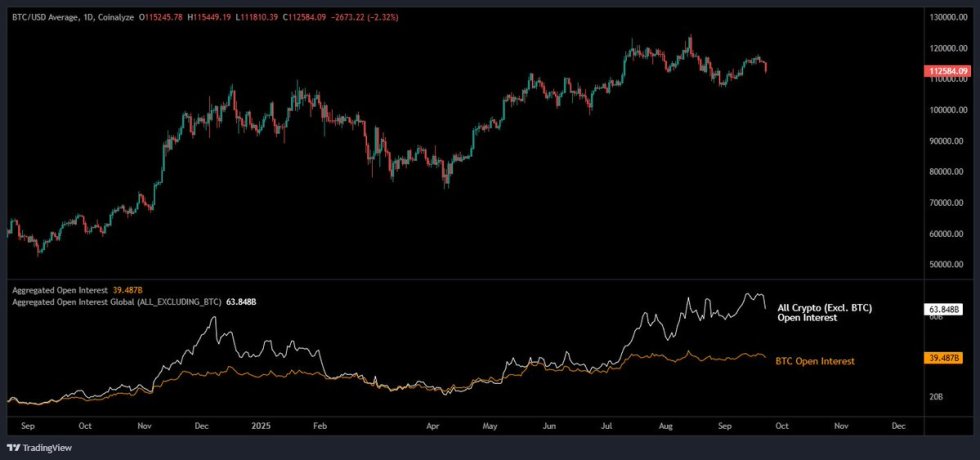
$8.0B in Altcoin Open Interest wiped out | Source: Maartunn

The scale of the wipeout is telling. Altcoin open interest losses were more than five times greater than Bitcoin’s, suggesting that speculative positions in the sector were far riskier and more vulnerable to sharp downside moves. While Bitcoin remains the market’s anchor, the gap between Bitcoin and the broader altcoin market is beginning to close, reflecting a shift in positioning and risk exposure.

For investors, this raises important questions. On one hand, such a dramatic flush often clears excess leverage from the system, paving the way for healthier price action in the medium term. On the other hand, the sheer scale of the altcoin losses could signal lingering fragility and the potential for further volatility if confidence does not return quickly.

The coming days will be decisive. Analysts are watching closely to see whether altcoins can stabilize around key support levels or whether bearish pressure will drive another leg lower. With Bitcoin showing relative resilience, altcoins must now prove they can withstand the shock and rebuild momentum in a market still reeling from billions in liquidations.

Total Market Cap Excluding Top 10 Analysis

The chart of the total crypto market cap excluding the top 10 coins shows that the altcoin sector is at a decisive moment. Currently valued at around $305 billion, the market has recovered significantly from the lows of 2022 and 2023 but remains far from its historical peak above $600 billion.
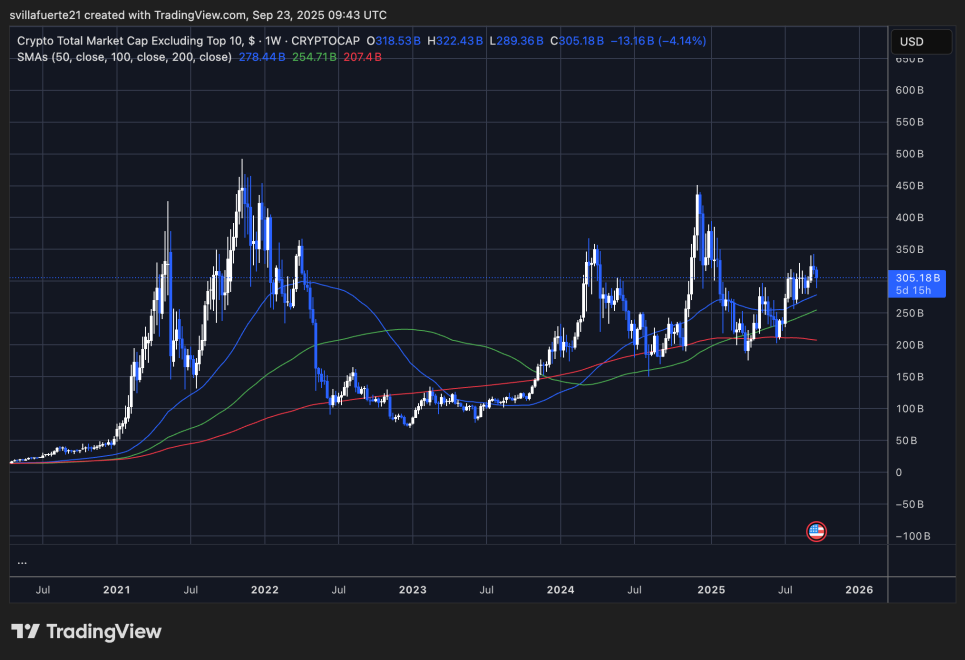
Crypto Total Market Cap Excluding Top 10 | Source: OTHERS chart on TradingView

Price action highlights that after a prolonged consolidation, altcoins have established a steady uptrend, supported by the 50-day and 100-day moving averages, which are now sloping upward. The 200-day moving average has flattened and begun to turn positive, further signaling improving structure in the broader market. Still, the recent rejection near the $320 billion resistance shows sellers remain active at higher levels.

The market’s ability to sustain above $280 billion will be critical for maintaining bullish momentum. A break below could trigger deeper retracements, but holding above this zone suggests strength and potential for expansion.

Excluding top assets like Bitcoin and Ethereum, this index reflects rising investor appetite for smaller-cap projects. The resilience of this sector despite recent volatility signals that risk appetite is returning. If broader conditions improve, altcoins outside the top 10 could lead the next phase of market growth.

Featured image from Dall-E, chart from TradingView

Editorial Process for bitcoinist is centered on delivering thoroughly researched, accurate, and unbiased content. We uphold strict sourcing standards, and each page undergoes diligent review by our team of top technology experts and seasoned editors. This process ensures the integrity, relevance, and value of our content for our readers.

Sebastian's journey into the world of crypto began four years ago, driven by a fascination with the potential of blockchain technology to revolutionize financial systems. His initial exploration focused on understanding the intricacies of various crypto projects, particularly those focused on building innovative financial solutions. Through countless hours of research and learning, Sebastian developed a deep understanding of the underlying technologies, market dynamics, and potential applications of cryptocurrencies. As his knowledge grew, Sebastian felt compelled to share his insights with others. He began actively contributing to online discussions on platforms like X and LinkedIn, focusing on fintech and crypto-related content. His goal was to expose valuable trends and insights to a wider audience, fostering a deeper understanding of the rapidly evolving crypto landscape. Sebastian's contributions quickly gained recognition, and he became a trusted voice in the online crypto community. To further enhance his expertise, Sebastian pursued a UC Berkeley Fintech: Frameworks, Applications, and Strategies certification. This rigorous program equipped him with valuable skills and knowledge regarding Financial Technology, bridging the gap between traditional finance (TradFi) and decentralized finance (DeFi). The certification deepened his understanding of the broader financial landscape and its intersection with blockchain technology. Sebastian's passion for finance and writing is evident in his work. He enjoys delving into financial research, analyzing market trends, and exploring the latest developments in the crypto space. In his spare time, Sebastian can often be found immersed in charts, studying 10-K forms, or engaging in thought-provoking discussions about the future of finance. Sebastian's journey as a crypto analyst and investor has been marked by a relentless pursuit of knowledge and a dedication to sharing his insights. His ability to navigate the complex world of crypto, combined with his passion for financial research and communication, makes him a valuable asset to the industry. As the crypto landscape continues to evolve, Sebastian remains at the forefront, providing valuable insights and contributing to the growth of this revolutionary technology.

Lectures associées

Le Bitcoin et les altcoins montent, mais un analyste prévient : ces niveaux pourraient déclencher de fortes fluctuations

Alors que le prix du Bitcoin continue de monter, les positions à effet de levier sur le marché mettent en lumière des niveaux de liquidation potentiels. L'analyste Joao Wedson d'Alphractal a identifié deux zones critiques en analysant les positions ouvertes sur les 30 derniers jours : 61 000 et 57 000 dollars. De nombreuses positions ont été ouvertes lorsque le Bitcoin évoluait entre 65 000 et 68 000 dollars, rendant le niveau des 61 000 dollars particulièrement vulnérable. Si le prix atteint ce seuil, une pression importante pourrait s'exercer sur ces positions à effet de levier. Le niveau des 57 000 dollars constitue une zone de liquidation encore plus forte, car une part significative des positions à risque à ce niveau a été ouverte lorsque le Bitcoin se négociait entre 63 000 et 66 000 dollars. Wedson souligne que ces niveaux sont cruciaux non seulement pour les liquidations, mais aussi en raison des ordres de stop-loss placés par les investisseurs autour de 61 000 et 57 000 dollars. En cas de chute brutale, le déclenchement de ces ordres pourrait amplifier la pression vendeuse. À l'inverse, des zones de liquidation potentielle existent également sur une tendance haussière. L'analyste note qu'une part importante des actifs pourrait être liquidée dans la fourchette de 85 000 à 86 000 dollars, mais la plupart de ces positions sont ouvertes depuis plus d'un mois.

cryptonews.ruIl y a 23 mins

Le Bitcoin et les altcoins montent, mais un analyste prévient : ces niveaux pourraient déclencher de fortes fluctuations

cryptonews.ruIl y a 23 mins

Rétrospective sur le piratage de Coldcard : Le code source visible n'est pas synonyme de sécurité

L'affaire du vol de portefeuilles matériels Coldcard, entraînant la perte de plus de 150 millions de dollars en Bitcoin, a relancé le débat sur la sécurité du code open source. L'article souligne que la simple disponibilité du code source ("source available") ne garantit pas sa sécurité. Une distinction cruciale est faite entre les logiciels libres/open source (FOSS/FLOSS), qui offrent les quatre libertés fondamentales, et le code simplement lisible, qui peut restreindre l'usage commercial et donc les incitations à un audit approfondi. Le cas Coldcard illustre ce problème : son firmware, sous licence MIT avec restrictions, n'a pas bénéficié d'un examen significatif de la communauté pendant des années, laissant passer une faille critique. Cela démontre que la sécurité dans l'open source repose non sur la transparence passive, mais sur l'existence d'incitations économiques et de compétences pour réaliser des audits continus. Des projets comme Bitcoin Core montrent le modèle fonctionnel, avec un développement et une révision collégiale entièrement publics. L'article analyse aussi l'économie de l'open source : la plupart des utilisateurs s'appuient sur l'hypothèse que "quelqu'un d'autre vérifie", ce qui peut mener à une tragédie des biens communs si les incitations sont mal alignées. Enfin, l'émergence de l'IA modifie la donne. D'un côté, des outils comme le Bitcoin Red Team prouvent que l'IA peut accélérer massivement la détection de vulnérabilités. De l'autre, le flux de code généré par l'IA accable les mainteneurs de projets. Dans ce nouveau paysage, seuls les logiciels faisant l'objet d'audits rigoureux et continus, qu'ils soient open source ou privés, pourront résister à la pression accrue des attaques financières et technologiques.

marsbitIl y a 1 h

Rétrospective sur le piratage de Coldcard : Le code source visible n'est pas synonyme de sécurité

marsbitIl y a 1 h

Les ETF spot sur le Bitcoin et l'Ethereum attirent 2,6 milliards de dollars en une semaine : un record depuis octobre 2025

Les ETF spot américains sur Bitcoin et Ethereum ont attiré 2,6 milliards de dollars d'afflux net de capitaux en une semaine, un record depuis octobre 2025. Les ETF Bitcoin ont reçu 1,9 milliard de dollars, tandis que les fonds Ethereum ont attiré 697,2 millions de dollars, des chiffres records pour l'année 2026. Ce résultat marque un renversement notable par rapport à la semaine précédente, qui avait enregistré un retrait de 392 millions de dollars. L'activité de trading des ETF Bitcoin a plus que triplé, atteignant 22,1 milliards de dollars, et leurs actifs sous gestion ont augmenté de 25,4% pour atteindre 96,1 milliards de dollars. Les achats se sont concentrés les 19 et 20 août, avec le fonds IBIT de BlackRock captant à lui seul 503 millions de dollars sur 606,3 millions d'afflux en une journée. Les ETF sur Ethereum ont également connu leur meilleure semaine depuis octobre 2025, avec un volume de trading en hausse de 259,4% à 6,9 milliards de dollars et des actifs sous gestion en progression de 35,9% à 14,3 milliards de dollars. Cependant, malgré cette semaine exceptionnelle, les catégories Bitcoin et Ethereum affichent toujours des retraits nets depuis le début de l'année 2026, respectivement de 2,9 milliards et 191,8 millions de dollars. L'analyse souligne que la forte concentration des flux vers un seul fonds, comme l'IBIT, peut constituer à la fois un signe de confiance et une vulnérabilité structurelle, capable d'inverser rapidement la tendance en cas de changement de sentiment.

cryptonews.ruIl y a 1 h

Les ETF spot sur le Bitcoin et l'Ethereum attirent 2,6 milliards de dollars en une semaine : un record depuis octobre 2025

cryptonews.ruIl y a 1 h

Trading

Spot
活动图片