First Dogecoin ETF ‘Coming Soon’: REX-Osprey Teases US Launch

bitcoinistPublié le 2025-09-05Dernière mise à jour le 2025-09-05

Résumé

REX Shares says it’s preparing to list what it calls the first US Dogecoin ETF, teasing the product on X...

Trusted Editorial content, reviewed by leading industry experts and seasoned editors. Ad Disclosure

REX Shares says it’s preparing to list what it calls the first US Dogecoin ETF, teasing the product on X even as multiple spot DOGE ETF applications remain pending at the Securities and Exchange Commission. Via X, REX Shares wrote on Wednesday: “The REX-Osprey™ DOGE ETF, DOJE, is coming soon! DOJE will be the first ETF to deliver investors exposure to the performance of the iconic memecoin, Dogecoin. From REX-Osprey™, the team behind $SSK, the first SOL + Staking ETF.”

The product traces back to a January 21, 2025 SEC filing for a suite of crypto funds under the ETF Opportunities Trust, which included a REX-Osprey DOGE ETF alongside BTC, ETH, SOL, XRP, BONK and TRUMP-token funds. In that registration, the DOGE fund’s mandate is explicit: it “seeks investment results, before fees and expenses, that correspond to the performance of Dogecoin.”

Can REX-Osprey Launch Their Dogecoin ETF First?

The apparent paradox—how REX can “launch” a DOGE ETF while spot Dogecoin ETPs are still in the SEC queue—comes down to structure. Most DOGE proposals on file are commodity-based grantor trusts or similar vehicles that require an exchange rule change under the Securities Exchange Act (a so-called 19b-4) before they can list.

Bitwise, for example, filed to list a Dogecoin ETF on NYSE Arca through that pathway, and Nasdaq has a pending proposal to list the 21Shares Dogecoin ETF. By contrast, REX’s DOGE product sits inside a 1940-Act open-end ETF trust, which registers under the Investment Company Act via a post-effective amendment (Form 485(a)) and, if the registration goes effective and an exchange accepts the listing under its generic ETF standards, can come to market without waiting on a bespoke 19b-4 order.

That is the same playbook REX and Osprey used to bring their Solana + Staking ETF to market in July. Basically, the structure is similar to how futures ETFs work.

The January prospectus also explains how exposure works. The DOGE fund will invest “at least 80%” of assets in Dogecoin or instruments providing DOGE exposure and may use “derivatives,” including futures and swaps. Like REX-Osprey’s other single-coin funds, it relies on a wholly owned Cayman subsidiary—the “REX-Osprey DOGE (Cayman) Portfolio S.P.”—to hold certain positions; the parent ETF’s investment in that sub is capped at 25% of total assets to preserve regulated investment company (RIC) tax treatment.

In plain terms, it’s a ‘40-Act ETF that aims to mirror DOGE’s price, using a mix of direct exposure (including via the Cayman sub) and, where available, derivatives.

Meanwhile, the “traditional” spot DOGE race is active but unresolved. NYSE Arca’s filing for a Bitwise Dogecoin ETF and Nasdaq’s proposal for a 21Shares Dogecoin ETF are both on the public docket, and Grayscale submitted an S-1 to list a Dogecoin fund in mid-August. Those products would be commodity ETPs requiring an exchange rule change before trading can begin—hence the longer timeline.

Notably, there is also a clear precedent for REX finding a regulatory niche: on July 2, 2025, the REX-Osprey Solana + Staking ETF (ticker SSK) listed on Cboe as a ‘40-Act fund that passes through native staking rewards to shareholders. Cboe’s own listing page describes it succinctly: the fund seeks the performance of Solana “plus staking rewards associated with the Reference Asset.”

REX’s release heralded it as “the first US-listed ETF to give investors exposure to Solana… plus staking rewards” in brokerage accounts. That was possible because the assets and mechanics fit within a ‘40-Act ETF framework augmented by a Cayman subsidiary and—in SSK’s early months—a C-corp tax wrapper that has since been converted to RIC status.

The parallels—up to a point—are real. REX is again using the ‘40-Act ETF chassis, the ETF Opportunities Trust umbrella and Cayman subs to pursue single-coin exposure without waiting for a new 19b-4 approval. But an important difference is technical and conclusive: Dogecoin is a proof-of-work cryptocurrency (merged-mined with Litecoin), so there is no native staking yield to pass through.

As for timing and status, REX’s X post is a teaser, not a notice of effectiveness. The January 21 filing is a subject-to-completion prospectus; the SEC must allow the registration to go effective, and an exchange must accept the listing.

Separately, the SEC is also weighing “generic” listing standards for commodity- and crypto-based ETPs—rules that, if adopted, could streamline new crypto listings generally—though those proposals are independent of REX’s ‘40-Act path. In short, REX can plausibly be first precisely because it isn’t waiting on a DOGE-specific 19b-4 approval, but the fund still needs its registration to clear and a listing venue to post a trading date.

At press time, DOGE traded at $0.2165.
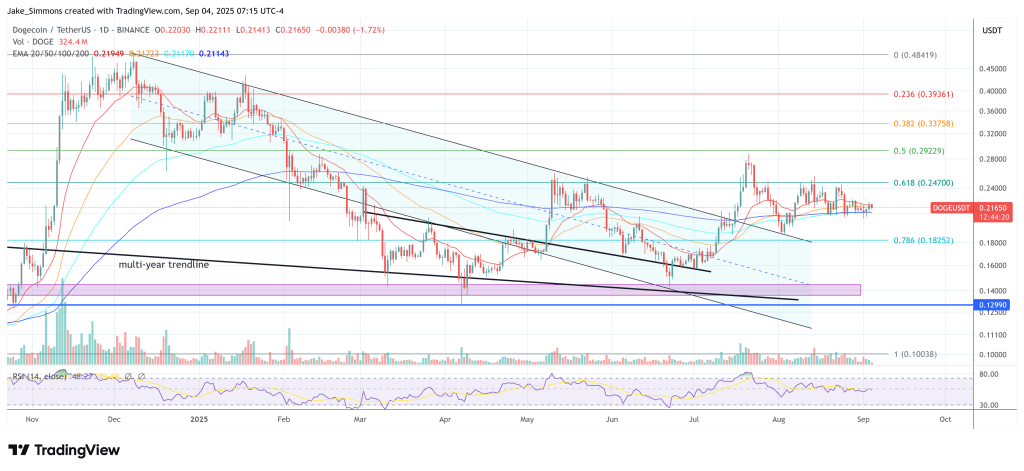
Dogecoin price
DOGE price, 1-week chart | Source: DOGEUSDT on TradingView.com
Featured image created with DALL.E, chart from TradingView.com
Editorial Process for bitcoinist is centered on delivering thoroughly researched, accurate, and unbiased content. We uphold strict sourcing standards, and each page undergoes diligent review by our team of top technology experts and seasoned editors. This process ensures the integrity, relevance, and value of our content for our readers.

Jake Simmons has been a Bitcoin enthusiast since 2016. Ever since he heard about Bitcoin, he has been studying the topic every day and trying to share his knowledge with others. His goal is to contribute to Bitcoin's financial revolution, which will replace the fiat money system. Besides BTC and crypto, Jake studied Business Informatics at a university. After graduation in 2017, he has been working in the blockchain and crypto sector. You can follow Jake on Twitter at @realJakeSimmons.

Lectures associées

Le titre de l'article

**TL;DR** * L'action Sol Strategies (STKE) cotée de gré à gré a augmenté de 22% le 26 juin 2026. * Cette hausse coïncidait avec le retour du cours du SOL au niveau des 72 dollars. * La société applique une stratégie de trésorerie d'entreprise centrée sur Solana, créant un récit d'action alternative aux altcoins. **Résumé** L'action de Sol Strategies a bondi de 22%, un mouvement survenant alors que le SOL (Solana) regagnait le seuil des 72 dollars. Cette actualité marquante du week-end se situe à l'intersection du mouvement des prix, de la structure du marché et d'un type de récit suivi de près par les traders. L'élément clé n'est pas seulement la hausse du titre STKE, mais le fait qu'elle offre au marché un nouvel indicateur pour évaluer l'environnement crypto actuel : est-il porté par une adoption réelle des réseaux, des progrès réglementaires, des changements de liquidités ou par de la spéculation à court terme ? Le développement est pertinent au-delà d'un simple jeton ou d'une seule entreprise. Il intervient à un moment où les actifs crypto tentent de définir une direction plus claire. Si la tendance sous-jacente s'avère durable, elle pourrait influencer la manière dont les investisseurs évaluent Solana et les stratégies de trésorerie d'entreprise liées à cette blockchain dans les semaines à venir. Dans le cas contraire, elle pourrait devenir un exemple supplémentaire de récit fort en week-end mais sans suite soutenue sur les marchés. Il convient désormais de surveiller si le marché reçoit des confirmations supplémentaires via des sources primaires, des tableaux de bord, des annonces officielles ou des données on-chain. La réaction de la liquidité sera également cruciale, car même des développements fondamentaux peuvent échouer à faire bouger les prix si les traders restent sur la défensive ou si les capitaux se déplacent vers d'autres secteurs. Cette histoire doit donc être lue dans le contexte plus large de la structure du marché.

bitcoinistIl y a 1 h

Le titre de l'article

bitcoinistIl y a 1 h

Après l'introduction en bourse, SpaceX émet une énorme quantité de dettes et "énerve" le marché, subissant une vente massive

Après son introduction en bourse record, SpaceX a lancé une émission obligataire massive de 25 milliards de dollars, qui s’est heurtée à de violentes ventes sur le marché secondaire. Les obligations de la société, pourtant notées investment grade (Baa1/BBB), ont vu leurs écarts de rendement (spreads) par rapport aux Treasuries s’élargir brutalement, frôlant les niveaux du marché des high-yield (« junk bonds »). En 48 heures, la perte comptable approchait les 400 millions de dollars. Cette chute rapide a surpris les acteurs du marché. Malgré une souscription initiale jugée « ardente » à près de 90 milliards de dollars, la demande provenait largement d’investisseurs cherchant un gain rapide (« fast money »), qui ont revendu dès l’admission aux transactions. Les spreads des obligations à long terme (2046, 2056) ont dépassé les 190 points de base, surpassant la moyenne des obligations notées BB. Plusieurs facteurs expliquent cette défiance des créanciers : les pertes nettes importantes de SpaceX (4,9 milliards de dollars en 2025 malgré un chiffre d’affaires de 18,7 milliards), une dépendance excessive à la personne d’Elon Musk – identifiée comme un « facteur limitant » clé par les agences de notation –, et une gouvernance perçue comme faible. Ce revers intervient dans un contexte d’afflux massif d’émissions obligataires du secteur technologique, portées par les financements des projets d’intelligence artificielle. Le levier financier agrégé des géants technologiques a doublé en quelques trimestres. Les analystes alertent sur les risques de saturation du marché, qui pourrait contraindre les cycles d’investissement futurs si les spreads continuent de se dégrader.

marsbitIl y a 2 h

Après l'introduction en bourse, SpaceX émet une énorme quantité de dettes et "énerve" le marché, subissant une vente massive

marsbitIl y a 2 h

Trading

Spot
活动图片