The White House Just Shook Up Crypto Policy — But Who Is Patrick Witt?

bitcoinistPublié le 2025-08-11Dernière mise à jour le 2025-08-11

Résumé

Bo Hines’ abrupt exit over the weekend left a vacuum at the top of the White House’s crypto apparatus. But...

Trusted Editorial content, reviewed by leading industry experts and seasoned editors. Ad Disclosure

Bo Hines’ abrupt exit over the weekend left a vacuum at the top of the White House’s crypto apparatus. But the Trump administration moved quickly. Patrick Witt is stepping in to run point on crypto policy from the West Wing as Executive Director of the President’s Council of Advisors for Digital Assets, while continuing to serve as Acting Director of the Pentagon’s Office of Strategic Capital (OSC).

Witt is not a Twitter-native crypto influencer; he’s a policy hand with one foot in national security and the other in crypto strategy. The Defense Department lists him as Acting Director of OSC, the investment office stood up to channel credit into critical technologies.

Who Is Crypto’s New Leader In The White House?

If you want to know how Patrick Witt thinks about Bitcoin, there’s only one place to look: his on-stage interview at the Bitcoin Policy Summit in late June—his sole public appearance to date in which he directly discussed Bitcoin and crypto. In that conversation, Witt moved the Strategic Bitcoin Reserve (SBR) from slogan to mechanics. “We’ve already taken some steps with the SBR,” he said. “How do we follow that up with the accumulation plan?”

Witt’s rationale for an SBR was framed as statecraft, not speculation. “Bitcoin and the digital assets ecosystem is an engine for economic growth,” he argued, adding that the administration “want[s] to be the crypto capital of the world.” He called digital assets “a tool of modern statecraft,” warning that if the United States doesn’t “actively [shape] and influence what that new construct looks like” for the next-generation financial system, it risks ceding advantage.

Crucially, Witt tied the reserve to an organized policy pipeline rather than a one-off announcement. Alongside the GENIUS Act and CLARITY, he referenced “the [now released] report on the interagency activities,” then returned to the SBR’s operational next step—“the accumulation plan.”

Why is Witt the person saying this? Because his second hat is executional. As Acting Director of the Pentagon’s Office of Strategic Capital (OSC), he described a federally backed credit window designed to rebuild industrial capacity and compete in strategic technologies. When he joined, OSC “had $984 million of capital to lend,” later expanding to “$5 billion where we currently sit,” with potential—pending legislation—to “grow to $200 billion.”

Demand already ran hot: the first notice of funding drew “$9 billion worth of requests,” eight to nine times the initial pool. Asked what might intersect with Bitcoin, Witt was careful but plain: OSC would target “enabling infrastructure… potentially more on the energy side, compute power. We want compute and energy to be domestic, secure and abundant.” Pair that with an SBR accumulation plan and a clear picture emerges: sovereign balance-sheet exposure to Bitcoin alongside public credit that lowers the cost of the physical inputs miners and broader crypto infrastructure consume.

Witt also made the hierarchy explicit. “We recognize the difference in the space… Bitcoin definitely has primacy for us,” he said, even as the White House pushes broader digital-asset policy. The request to industry was equally direct: be “a trusted partner and an objective resource,” bring research and credible projects, and accept that real legislation demands “horse trading and compromise.” That’s the practical context for any SBR rollout: the West Wing will need private-sector expertise to harden custody, automate execution, and publish transparent reporting that markets can trust.

Bitcoin Softwar Thesis Playing Out?

This interview also lands squarely in a national-security conversation many in Bitcoin already know: Major Jason Lowery’s “Softwar” thesis. Lowery argues that proof-of-work is a non-kinetic form of power projection that secures property in cyberspace—an energy-grounded deterrence mechanism. Witt never cites Lowery, but his vocabulary rhymes with it: Bitcoin as “statecraft,” domestic “mining” as priority, capital markets as a national-security asset, and public credit aimed at energy and compute.

It’s why some community reaction highlighted his dual roles—White House crypto lead and OSC chief—and urged, “If you haven’t read ‘Software’ [sic] by Major Jason Lowery, you might want to give it a go.” Whether or not the administration embraces Softwar’s strongest claims, Witt’s only public remarks suggest the reserve is being treated as strategic infrastructure, not a talking point.

Strip it down, and the signal is clean. The White House seems to have made a strategic pivot: it’s a strategic pivot. Trump’s Bitcoin and crypto plans are steered by someone who views it not as an asset class but as critical infrastructure to be controlled. Bo Hines got replaced by a Pentagon-linked strategist.

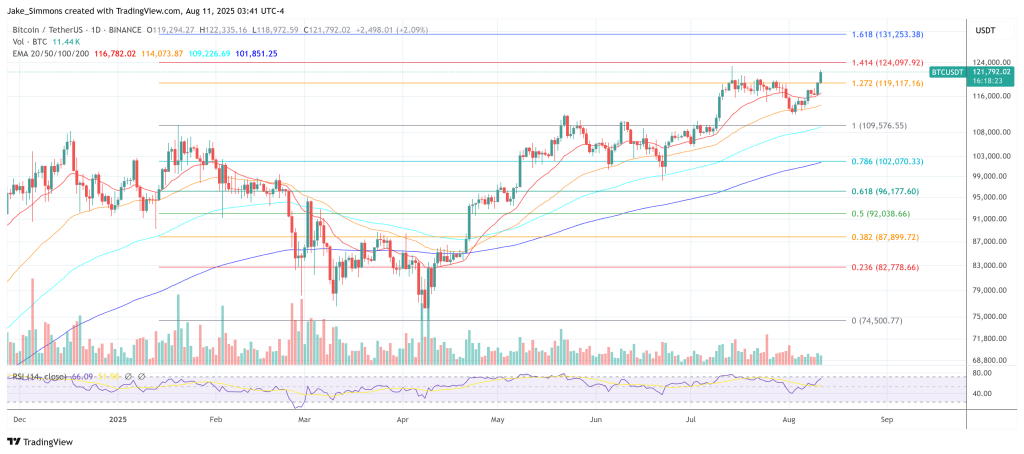
At press time, BTC traded at $121,792.
Bitcoin price
BTC surges above 1.272 Fib, 1-day chart | Source: BTCUSDT on TradingView.com
Featured image created with DALL.E, chart from TradingView.com
Editorial Process for bitcoinist is centered on delivering thoroughly researched, accurate, and unbiased content. We uphold strict sourcing standards, and each page undergoes diligent review by our team of top technology experts and seasoned editors. This process ensures the integrity, relevance, and value of our content for our readers.

Jake Simmons has been a Bitcoin enthusiast since 2016. Ever since he heard about Bitcoin, he has been studying the topic every day and trying to share his knowledge with others. His goal is to contribute to Bitcoin's financial revolution, which will replace the fiat money system. Besides BTC and crypto, Jake studied Business Informatics at a university. After graduation in 2017, he has been working in the blockchain and crypto sector. You can follow Jake on Twitter at @realJakeSimmons.

Cryptos en tendance

Lectures associées

L'ancienne équipe institutionnelle de la Fondation Ethereum lance Ethereum Institutional

L'ancienne équipe chargée des relations avec les entreprises au sein de la Fondation Ethereum lance Ethereum Institutional, une organisation à but non lucratif indépendante. Sa mission est d'accélérer l'adoption institutionnelle d'Ethereum, de ses réseaux de couche 2, de ses applications et de son écosystème élargi. Ethereum Institutional servira de point de contact neutre pour les institutions financières, leur offrant des conseils techniques, une veille écosystémique et un accompagnement. L'organisation met en avant la neutralité d'Ethereum comme un atout majeur, tout en soulignant le besoin d'une entité crédible et indépendante pour guider les acteurs traditionnels dans leurs décisions d'infrastructure liées à la tokenisation, aux stablecoins et à la finance sur chaîne. L'équipe fondatrice, qui avait développé la fonction "Entreprise" de la Fondation Ethereum, étend désormais ses activités de façon autonome autour de cinq axes : engagement institutionnel, renseignement institutionnel, marketing de l'écosystème Ethereum et de l'ETH, analyse des besoins du secteur, et organisation d'événements. Le lancement bénéficie du soutien de Bitmine, SharpLink et du co-fondateur d'Ethereum Joseph Lubin, parmi d'autres soutiens. Cette initiative fait suite à la récente restructuration de la Fondation Ethereum et à la création d'Ethlabs, reflétant une stratégie plus large de développement de l'écosystème via des organisations spécialisées et indépendantes.

ambcryptoIl y a 1 h

L'ancienne équipe institutionnelle de la Fondation Ethereum lance Ethereum Institutional

ambcryptoIl y a 1 h

« La plus grande mise à niveau depuis The Merge » ? Comment Glamsterdam va impacter Ethereum et les utilisateurs lambda ?

La prochaine mise à niveau majeure d'Ethereum, baptisée "Glamsterdam" (combinaison des mises à jour de consensus "Glas" et d'exécution "Amsterdam"), est prévue pour le second semestre 2026. Considérée comme la plus importante depuis "The Merge", elle vise à réformer en profondeur l'architecture du réseau principal (L1) pour en augmenter la capacité et l'efficacité, sans compromettre sa décentralisation. Trois changements principaux sont au cœur de cette mise à niveau : 1. **L'ePBS (Enshrined Proposer-Builder Separation)** : Intègre la séparation entre proposeurs et constructeurs de blocs directement dans le protocole, éliminant le besoin d'intermédiaires de confiance externes (Relays). Cela prolonge la fenêtre de traitement des blocs, permettant d'augmenter la limite de gaz (Gas Limit) et donc la taille des blocs. 2. **Les listes d'accès au niveau des blocs (Block-Level Access Lists - BALs)** : Fournissent une "carte" préalable des données d'état que les transactions d'un bloc vont lire ou modifier. Cela permet un traitement parallèle des transactions non conflictuelles et accélère la synchronisation des nœuds, ouvrant la voie à une exécution plus rapide. 3. **La reprix du gaz** : Introduit un modèle de tarification plus précis pour mieux refléter le coût réel des ressources, en distinguant le coût de calcul instantané du coût de stockage permanent des données d'état. Cela vise à contrôler l'expansion incontrôlée de l'état du réseau. **Impact pour les utilisateurs :** * **Frais de transaction** : Une capacité de bloc accrue devrait globalement réduire la congestion et stabiliser les frais, en particulier pour les transferts simples. Cependant, les opérations créant beaucoup de données d'état (comme le déploiement de contrats complexes) pourraient voir leurs coûts augmenter. * **Expérience utilisateur** : Les portefeuilles pourront estimer les frais de gaz avec plus de précision, réduisant les échecs de transaction. Les mouvements internes d'ETH seront plus faciles à tracer. * **Couche 2 (L2)** : La capacité accrue à traiter les "blobs" de données bénéficiera à long terme aux Rollups, pouvant stabiliser leurs coûts. * **Nœuds et décentralisation** : En optimisant les processus sous-jacents plutôt qu'en exigeant simplement plus de puissance de calcul, Glamsterdam cherche à augmenter le débit tout en préservant la possibilité pour des particuliers de faire tourner des nœuds. En résumé, Glamsterdam ne se contente pas d'augmenter la taille des blocs. Il restructure les fondations d'Ethereum pour permettre une future expansion durable du réseau principal, en équilibrant performances accrues et préservation des principes de décentralisation.

marsbitIl y a 3 h

« La plus grande mise à niveau depuis The Merge » ? Comment Glamsterdam va impacter Ethereum et les utilisateurs lambda ?

marsbitIl y a 3 h

Trading

Spot

Articles tendance

Comment acheter HOUSE

Bienvenue sur HTX.com ! Nous vous permettons d'acheter Housecoin (HOUSE) de manière simple et pratique. Suivez notre guide étape par étape pour commencer votre parcours crypto.Étape 1 : Création de votre compte HTXUtilisez votre adresse e-mail ou votre numéro de téléphone pour ouvrir un compte sur HTX gratuitement. L'inscription se fait en toute simplicité et débloque toutes les fonctionnalités.Créer mon compteÉtape 2 : Choix du mode de paiement (rubrique Acheter des cryptosCarte de crédit/débit : utilisez votre carte Visa ou Mastercard pour acheter instantanément Housecoin (HOUSE).Solde :utilisez les fonds du solde de votre compte HTX pour trader en toute simplicité.Prestataire tiers :pour accroître la commodité d'utilisation, nous avons ajouté des modes de paiement populaires tels que Google Pay et Apple Pay.P2P :tradez directement avec d'autres utilisateurs sur HTX.OTC (de gré à gré) : nous offrons des services personnalisés et des taux de change compétitifs aux traders.Étape 3 : stockage de vos Housecoin (HOUSE)Après avoir acheté vos Housecoin (HOUSE), stockez-les sur votre compte HTX. Vous pouvez également les envoyer ailleurs via un transfert sur la blockchain ou les utiliser pour trader d'autres cryptos.Étape 4 : tradez des Housecoin (HOUSE)Tradez facilement Housecoin (HOUSE) sur le marché Spot de HTX. Il vous suffit d'accéder à votre compte, de sélectionner la paire de trading, d'exécuter vos trades et de les suivre en temps réel. Nous offrons une expérience conviviale aux débutants comme aux traders chevronnés.

517 vues totalesPublié le 2025.04.27Mis à jour le 2026.06.02

Comment acheter HOUSE

Discussions

Bienvenue dans la Communauté HTX. Ici, vous pouvez vous tenir informé(e) des derniers développements de la plateforme et accéder à des analyses de marché professionnelles. Les opinions des utilisateurs sur le prix de HOUSE (HOUSE) sont présentées ci-dessous.

活动图片