Crypto Prices Dump as FTX Plans September Payout: $SNORT Is a Smart Buy Now

bitcoinistPublié le 2025-07-24Dernière mise à jour le 2025-07-24

Résumé

The entire crypto market is on a down-drift after what seems to be a prolonged market correction, forcing Bitcoin down...

Trusted Editorial content, reviewed by leading industry experts and seasoned editors. Ad Disclosure

The entire crypto market is on a down-drift after what seems to be a prolonged market correction, forcing Bitcoin down to $118,148 after a 0.40% slip over the past 24 hours.

While there are multiple proposed reasons for the current market shift, one of them seems to connect to FTX’s payment plan set to come into effect in September.

The now-defunct exchange will release another court-approved payment round of at least $1.9B through the same third-party entities: Kraken, Payoneer, and BitGo.

This marks the third big payout in 2025 as part of FTX’s efforts to repay their creditors and redistribute $14.5B in damages.

FTX’s upcoming payment could explain, at least in part, the current market shift by digging up the doubt and fear linked to the disgraced exchange, following Sam Bankman-Fried’s scam.

Bitcoin’s $86M Outflows Force the Market Sentiment Down

An even bigger factor for the current market sentiment seems to be Bitcoin’s $86M in outflows, with BlackRock ($IBIT) and Fidelity ($FBTC) bearing most of the burden, with $142.48M and $227.24M respectively.

Trader T is the bearer of bad news, keeping track of Bitcoin’s performance and highlighting the three consecutive days of consistent outflows.

Trader T X postThe outflows aren’t bad on their own, but their impact on the market is. Entities like Fidelity, for instance, may be forced to liquidate their Bitcoin holdings to cover the withdrawals, which could increase the sell pressure, amplify price volatility, and push market sentiment even lower.

But what are the triggers behind this sudden market shift, given that FTX’s payment plan couldn’t account for it on its own?

Several factors may contribute to the current market shift:

  • The economic uncertainty linked to the persistent inflation, geopolitical tensions, and the US Federal Reserve increasing interest rates
  • Profit-taking behavior following the market’s recent rally, which saw Bitcoin pushing above $123K and triggering the sell mentality once it stabilized below $120K
  • Portfolio rotation, as investors flee the stagnant Bitcoin to more promising altcoins
  • Caution and uncertainty relating to the still-ambiguous legal framework for stablecoins, partially stemming from the SEC delaying several ETF approvals

However, while the market is on the back foot, it’s unlikely to backpedal for too long. The Fear and Greed Index is already telling half the story, with the community sentiment still borderline extremely greedy.
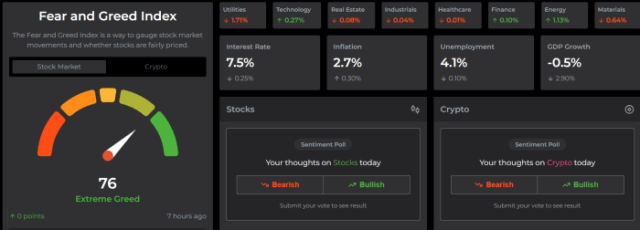
Fear and Greed IndexTrader Tardigrade seems to nourish similar sentiments, stating that, based on the market’s performance, crypto is set to become the largest asset in the world.

Another crypto analyst, Titan of Crypto, hints at a second Breakout coming, which would be the final hurdle before Altcoin Season 3.0.

With the market winding for a coming rally, some assets may experience higher gains than others, especially those with blockchain utility and massive long-term potential.

Snorter Token is one of them, introducing the Snorter Bot, the trading companion which snipes hot tokens milliseconds after liquidity appears.

How Snorter Token ($SNORT) Makes Coin Hunting Easy and Rewards

Snorter Token’s ($SNORT) Snorter Bot promises to become the most proficient coin hunter, thanks to its ease of use, integrated scam alerts, protecting against suspicious projects, and its appetite for hot and booming tokens.
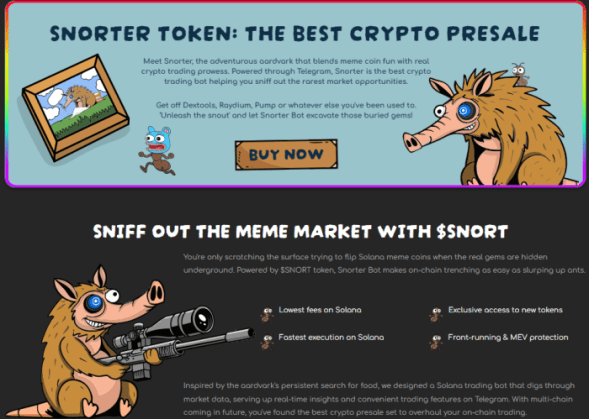
Snorter Token presale pageThe Aardvark sniper is the perfect solution to manual coin hunting, which demands high technical knowledge and subjects you to potential scams like honeypots and rug pulls.

The Bot operates in its Telegram chat-only, centralizing its activity in one place and rendering the need for multiple wallets, plug-ins, and browser extensions obsolete.

You only need to instruct the Bot accordingly and watch it claim its victims milliseconds after liquidity becomes available. This reaction time puts UIs like Raydium, Pump Fun, and Jupiter to shame.

Based on these facts, Snorter Token is set to become one of the best meme coins on the market, following successful implementation and witnessing widespread adoption.

The project is currently in presale, having accumulated over $2.3M with a token price of $0.0991.

Given Snorter Bot’s roadmap and efficiency, we expect the project to witness growing success post launch. In that context, $SNORT could easily push to $0.94 shortly after its public listing.

A 2030 price point of $3.25 or higher is also expected in a pro-crypto context and following mass adoption. Based on today’s price point of $0.0991, this translates into a 5-year ROI of 3,179%.

If you want to support the project and buy yourself some $SNORT, go to the presale page and place your order today.

Is the Crypto Market in Recession?

Despite the heavy Bitcoin outflows and the perceived market uncertainty, the bullish market sentiment seems to suggest that what we’re seeing is not recession, but rather market correction, following the recent generalized rally.

We expect Bitcoin to push again soon, once it clears the psychological threshold of $120K, at which point projects like Snorter Token ($SNORT) will also steam up.

Remember, this isn’t financial advice. Do your own research (DYOR) and invest wisely.

Editorial Process for bitcoinist is centered on delivering thoroughly researched, accurate, and unbiased content. We uphold strict sourcing standards, and each page undergoes diligent review by our team of top technology experts and seasoned editors. This process ensures the integrity, relevance, and value of our content for our readers.

As a crypto writer, Bogdan’s responsibilities are split between researching and writing articles and entertaining the team with his humor bordering on the politically incorrect, an aspiring Bill Burr, if you will. Thanks to his 12+ years of writing experience in just as many fields, including tech, cybersecurity, modelling, fitness, crypto, and other topics-that-shall-not-be-named, he's become a genuine asset to the team. While his position as a senior writer at PrivacyAffairs thought him valuable lessons about the power of self-management, his entire writing career was and is an exercise in self-improvement. Now, he's ready to sink his teeth into crypto and teach people how to take control of their own money on the blockchain. With fiat as an eternally devaluing currency, Bitcoin and altcoins seem like the best-fitting alternative for Bogdan. Bogdan’s biggest professional accomplishment, aside from securing a position as a main writer for Bitcoinist, was his 5-year run as a writing manager at Blackwood Productions, where he coordinated a team of four writers. During that time, he learned the value of teamwork and that of creating a working environment that breeds efficiency, positivity, and friendship.

Lectures associées

Dernier article long de Fei-Fei Li : Lorsque la génération vidéo, la robotique et NVIDIA se disent tous des modèles du monde, nous avons besoin d'une taxonomie

Dans un article, Li Fei-Fei propose une taxonomie pour clarifier le terme largement utilisé et souvent confus de « modèle du monde » en IA. Elle s'appuie sur le cadre classique du POMDP (processus de décision markovien partiellement observable) où un agent exécute des actions qui modifient l'état du monde, et reçoit en retour des observations. Elle distingue trois catégories fonctionnelles de « modèles du monde » selon leur sortie dans cette boucle : 1. **Le moteur de rendu (Renderer)** : Génère des observations (pixels visuels). Son critère est la fidélité visuelle (ex : Sora, Genie). Commercialement mature, il a une limite car la beauté ne garantit pas l'exactitude physique. 2. **Le simulateur (Simulator)** : Génère ou modélise des états du monde, avec une représentation géométrique et physiquement précise (ex : Omniverse de NVIDIA). C'est le pont clé et sous-estimé, car il sert à la fois aux humains (visualisation) et aux machines (entraînement de robots, planification). Il travaille sur la structure même du monde (géométrie, physique). 3. **Le planificateur (Planner)** : Génère des actions. À partir d'une observation et d'un but, il détermine la prochaine action d'un agent (ex : modèles vision-langage-action). C'est le plus excitant mais le moins mature, avec un écart important entre les démonstrations en labo et un déploiement réel fiable. Li Fei-Fei argue que le simulateur est le pivot crucial, car la maîtrise de la simulation fournit une base pour le rendu et la planification. La tendance actuelle est à la fusion de ces trois catégories, reposant sur l'idée qu'elles partagent une compréhension sous-jacente commune du monde. L'objectif final est un modèle du monde unifié capable de basculer entre ces fonctions. Cette convergence redéfinira l'intelligence spatiale, permettant aux machines non seulement de parler du monde (via le langage) mais de le comprendre, de l'imaginer et d'interagir avec lui.

marsbitIl y a 42 mins

Dernier article long de Fei-Fei Li : Lorsque la génération vidéo, la robotique et NVIDIA se disent tous des modèles du monde, nous avons besoin d'une taxonomie

marsbitIl y a 42 mins

Forbes : Les paiements transfrontaliers en stablecoins sont plus rapides, mais pas encore moins chers

L'article examine la croissance rapide du secteur des paiements transfrontaliers en stablecoins, tout en soulignant un décalage entre la promesse de réduction des coûts et la réalité actuelle. Lors d'une conférence à Mexico, les professionnels ont confirmé que la technologie est mature, la régulation s'améliore et les volumes augmentent. Les stablecoins offrent des avantages en termes de vitesse, d'accessibilité 24/7 et de fiabilité. Cependant, ils ne sont pas encore significativement moins chers que les méthodes traditionnelles (frais de 60-70 points de base via les courtiers en devises). La raison principale est l'absence de pools de liquidités profonds et institutionnels nécessaires pour matérialiser la promesse théorique de frais de 2 à 5 points de base. Imran Ahmad de Bitso Business estime que les prix ne baisseront que lorsque les banques interviendront directement. Un autre obstacle majeur est la confiance. Les entreprises entretiennent souvent des relations de longue date avec leurs courtiers en devises, valorisant la fiabilité plus que les économies marginales. Ezra Kebrab, PDG de Caliza, une entreprise de paiements, insiste sur l'importance de la confiance et de l'exactitude des transactions, surtout pour les paiements aux fournisseurs où une erreur peut bloquer une cargaison. Contrairement à certains récits, les entreprises performantes comme Caliza ne cherchent pas à remplacer les infrastructures existantes comme Swift, mais à les compléter. Elles utilisent les stablecoins pour la vitesse tout en s'appuyant sur Swift pour la standardisation et la précision des informations requises. Cette approche a permis à Caliza une croissance mensuelle supérieure à 40%. En conclusion, le secteur est en forte croissance mais doit surmonter les défis de la liquidité, de la confiance et de l'intégration avec les systèmes traditionnels pour réaliser pleinement son potentiel de réduction des coûts. Une consolidation future est attendue, où seules les entreprises disposant de licences, de corridors fiables fiat-crypto et de liquidités solides survivront.

链捕手Il y a 50 mins

Forbes : Les paiements transfrontaliers en stablecoins sont plus rapides, mais pas encore moins chers

链捕手Il y a 50 mins

Dernier article de Fei-Fei Li : Alors que la génération vidéo, la robotique et NVIDIA revendiquent tous le titre de "modèle du monde", nous avons besoin d'une taxonomie

L'article de Fei-Fei Li propose une taxonomie pour clarifier le concept de « modèle du monde », de plus en plus utilisé de manière disparate dans l'IA. En s'appuyant sur le cadre classique du POMDP (Processus de Décision Markovien Partiellement Observable), elle distingue trois fonctions distinctes : 1. **Le moteur de rendu** : Il génère des observations visuelles (pixels) à partir d'actions ou de prompts. Son objectif est la fidélité visuelle, mais il ne garantit pas l'exactitude physique (ex. : Sora, Genie). 2. **Le simulateur** : Il produit un **état** du monde précis sur les plans géométrique, physique et dynamique. Il sert à la fois aux humains (conception, visualisation) et aux programmes (entraînement de robots, tests). C'est le pivot crucial, sous-estimé, car il fournit la base structurelle pour le rendu et la planification. 3. **Le planificateur** : À partir d'une observation et d'un objectif, il détermine les **actions** à exécuter. C'est le plus excitant mais le moins mature, l'écart entre les démonstrations en laboratoire et les déploiements réels restant important (ex. : modèles vision-langage-action). L'article souligne que ces trois catégories, bien que distinctes, partagent une compréhension sous-jacente commune du monde (géométrie, physique). La tendance actuelle est à leur **fusion**. Un modèle unifié pourrait, à terme, basculer entre ces modes selon les besoins. Le simulateur y joue un rôle central : maîtriser la simulation permet de dériver à la fois le rendu et la planification, l'inverse n'étant pas vrai. La vision finale est un modèle de base unique capable de rendre, simuler et planifier, redéfinissant ainsi l'intelligence spatiale des machines.

链捕手Il y a 54 mins

Dernier article de Fei-Fei Li : Alors que la génération vidéo, la robotique et NVIDIA revendiquent tous le titre de "modèle du monde", nous avons besoin d'une taxonomie

链捕手Il y a 54 mins

Trading

Spot
活动图片