Best Wallet Now WalletConnect Certified – Self-Custody Just Got a Major Upgrade

bitcoinistPublié le 2025-07-03Dernière mise à jour le 2025-07-03

Résumé

Best Wallet, a top-tier self-custodial wallet, just got a major stamp of approval: It’s now officially WalletConnect certified. Such certification...

Trusted Editorial content, reviewed by leading industry experts and seasoned editors. Ad Disclosure

Best Wallet, a top-tier self-custodial wallet, just got a major stamp of approval: It’s now officially WalletConnect certified.

Such certification demonstrates that Best Wallet has seamless dApp integration, intuitive-enough design, and rock-solid infrastructure crypto inter-connectivity and trading.
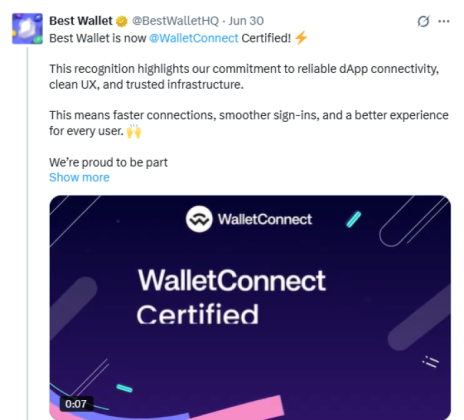
Best Wallet WalletConnect certification
Source: X (Best Wallet)

Highlighting the significance of this achievement, it places Best Wallet alongside some of the most trusted and reputable names in the crypto industry.

Major industry giants – MetaMask, Trust Wallet, Ledger, Uniswap, and 1inch – are certified by WalletConnect.

The latest additions to receive such verification, however, include BitPay, Bitcoin.com, and Blockchain.com.

To get WalletConnect’s nod of approval, crypto wallets must be among the top 50 in terms of usage and fully integrated with major blockchain networks, such as Bitcoin and Ethereum.

Of course, Best Wallet takes that step further by supporting other major chains, such as BNB Chain, Base, and Polygon, too. It aims to support 60 chains in the near future.

Best Wallet Stands Out With No-KYC & User Experience

Best Wallet doesn’t just meet top standards; it seeks to redefine them.

It’s ranked as a #1 anonymous crypto wallet due to the fact that it doesn’t require Know-Your-Client (KYC) verification to make an account.

Additionally, it gives you complete self-custody over your private keys (for extra security), so you don’t need to worry about third-party control, frozen funds, or losing access to your assets.

Built for easy and accessible crypto management on mobile, this wallet goes far beyond just buying, selling, and managing over 1K tokens.

Designed for modern users, it combines clean UX with powerful tools, like multi-wallet management, in-app staking, and cross-chain swaps.
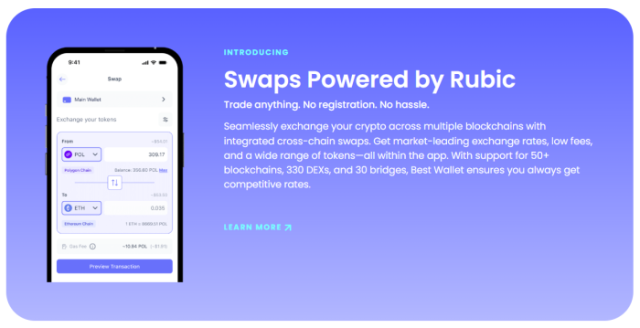
Best Wallet cross-chain swaps
Source: Best Wallet

That, coupled with its unique project directory for discovering and investing in crypto presales, makes it one of the best crypto wallets.

And it has numerous exciting developments in the pipeline, including a powerful crypto wallet portfolio management feature.

Soon, you’ll be able to track real-time profits and losses, import or create wallets, and organize your holdings with customized labels.

Also in development is Best Card, a seamless crypto debit card that’ll enable you to spend your Best Wallet holdings while on the move.

$BEST Unlocks Cheaper Gas Fees & Governance Rights

To get the most out of Best Wallet, you’ll want to hold $BEST, its native token which has already raised over $13.6M on presale.

$BEST is the key to unlocking premium features in the Best Wallet ecosystem. This includes early access to presales, reduced transaction fees, higher staking rewards (currently at a 101% APY, not to be sneezed at), and governance rights.
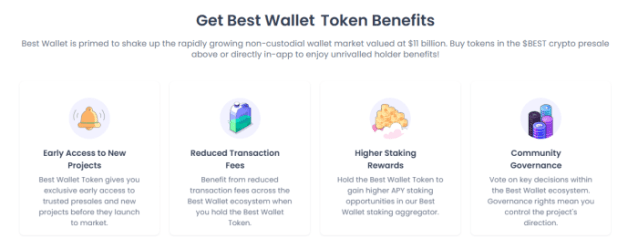
Best Wallet token benefits
Source: Best Wallet Token

Having the ability to vote on the project’s future is a major boon, as you can actively vote on Best Wallet’s upcoming features, token utility, and the long-term direction of the platform.

It also demonstrates that the Best Wallet ecosystem genuinely has the community’s best interests at heart.

Buy $BEST Now for Possible 184% Gains

Best Wallet goes beyond being just another self-custodial solution; it’s quickly establishing itself as a leader in crypto wallets.

From its WalletConnect certification and cross-chain capabilities to its sleek mobile experience and upcoming features, it’s clear that Best Wallet is built for serious growth.

To get the most out of the Best Wallet ecosystem, you can buy $BEST on presale for just $0.025275.

Driven by new app developments, it’s anticipated to reach $0.072, making now the perfect time to join the presale for potential gains of over 184%.

Still, as with all crypto investments, make sure you DYOR and don’t invest more than you’d be sad to lose. After being listed on exchanges, crypto prices can fluctuate as quickly as they rise.

Editorial Process for bitcoinist is centered on delivering thoroughly researched, accurate, and unbiased content. We uphold strict sourcing standards, and each page undergoes diligent review by our team of top technology experts and seasoned editors. This process ensures the integrity, relevance, and value of our content for our readers.

Leah is a British journalist with a BA in Journalism, Media, and Communications and nearly a decade of content writing experience. Over the last four years, her focus has primarily been on Web3 technologies, driven by her genuine enthusiasm for decentralization and the latest technological advancements. She has contributed to leading crypto and NFT publications – Cointelegraph, Coinbound, Crypto News, NFT Plazas, Bitcolumnist, Techreport, and NFT Lately – which has elevated her to a senior role in crypto journalism. Whether crafting breaking news or in-depth reviews, she strives to engage her readers with the latest insights and information. Her articles often span the hottest cryptos, exchanges, and evolving regulations. As part of her ploy to attract crypto newbies into Web3, she explains even the most complex topics in an easily understandable and engaging way. Further underscoring her dynamic journalism background, she has written for various sectors, including software testing (TEST Magazine), travel (Travel Off Path), and music (Mixmag). When she's not deep into a crypto rabbit hole, she's probably island-hopping (with the Galapagos and Hainan being her go-to's). Or perhaps sketching chalk pencil drawings while listening to the Pixies, her all-time favorite band.

Lectures associées

Décortiquer la liste des partenaires d'Open USD : Suivre les entrées pour comprendre où vont les capitaux

L'article examine le vaste partenariat de l'Open USD, un nouveau stablecoin lancé avec plus de 140 partenaires fondateurs, en soulignant que cette liste révèle plus que le projet lui-même. Elle inclut des géants comme BlackRock, Stripe, Visa, Mastercard, Shopify, Google, IBM, ainsi que des banques (BNY Mellon, Bank of America) et des entreprises crypto (Coinbase, Ripple, Aave). L'analyse par catégories montre les motivations stratégiques : BlackRock vise la gestion des réserves lucratives ; Shopify cherche à réduire les coûts de transaction et à monétiser les soldes ; les banques adoptent une position défensive pour retenir les dépôts et les flux ; les entreprises technologiques comme Google anticipent les paiements programmables ; les acteurs crypto apportent liquidité et infrastructure. La présence simultanée de concurrents directs (Visa/Mastercard, Coinbase/Ripple) indique une peur commune d'être exclus d'une future infrastructure financière partagée, surpassant leurs rivalités. Cette alliance représente une évolution du stablecoin, d'un produit vendu par une seule entreprise (comme Circle ou Tether) vers une infrastructure collective. L'absence de ces derniers et des grandes banques de détail américaines est tout aussi significative. Le défi sera une gouvernance collective potentiellement lente, mais la liste des partenaires démontre une conviction partagée : posséder collectivement ce canal est préférable à le louer ou à en être absent.

Foresight NewsIl y a 19 mins

Décortiquer la liste des partenaires d'Open USD : Suivre les entrées pour comprendre où vont les capitaux

Foresight NewsIl y a 19 mins

IOSG : compte à rebours du Q-Day, l'informatique quantique mettra-t-elle fin aux cryptomonnaies ?

Le calcul quantique représente une menace existentielle pour la cryptographie sous-jacente aux blockchains, en particulier les algorithmes de chiffrement à clé publique comme ECDSA, vulnérables à l'algorithme de Shor. Le « Q-Day », moment où un ordinateur quantique corrigeant les erreurs (CRQC) pourrait casser ces systèmes, est estimé entre 2035 et 2045. Pour les blockchains, dont Bitcoin et Ethereum, le risque est accentué par la nature immuable et publique du grand livre : les actifs liés à des clés publiques déjà exposées sont les plus vulnérables. La migration vers une cryptographie post-quantique (PQC), avec des algorithmes standardisés par le NIST comme ML-KEM et ML-DSA, est impérative. Cependant, le défi est moins technique que socio-gouvernance. Pour Bitcoin, la migration progressive via un soft fork se heurte à l'inflation de la taille des signatures et au dilemme politique sur le sort des UTXO historiques inactifs. Pour Ethereum, la stratégie repose sur l'agilité cryptographique, l'abstraction de compte et des mises à niveau couches par couches (exécution, consensus, données). L'industrie dispose d'une fenêtre de 5 à 8 ans pour coordonner cette transition à l'échelle de l'écosystème. L'enjeu n'est pas l'effondrement soudain, mais une course contre la montre pour restructurer les fondations cryptographiques avant que la menace ne devienne économiquement viable, sous peine de réévaluation sévère par le marché.

marsbitIl y a 44 mins

IOSG : compte à rebours du Q-Day, l'informatique quantique mettra-t-elle fin aux cryptomonnaies ?

marsbitIl y a 44 mins

Trading

Spot
活动图片