Grayscale ETF Gets Approved as New Guidance Drops: Traders Look to Snorter Token

bitcoinistPublié le 2025-07-02Dernière mise à jour le 2025-07-02

Résumé

The SEC has officially greenlit Grayscale’s move to transform its Digital Large-Cap Fund into a full-blown exchange-traded fund (ETF), marking...

Trusted Editorial content, reviewed by leading industry experts and seasoned editors. Ad Disclosure

The SEC has officially greenlit Grayscale’s move to transform its Digital Large-Cap Fund into a full-blown exchange-traded fund (ETF), marking a huge step forward for crypto’s presence on traditional markets.

This ETF offers exposure to the big guns of the crypto world, with the portfolio currently weighted as follows: Bitcoin (80.2%), Ethereum (11.3%), XRP (4.8%), Solana (2.7%), and Cardano’s ADA (0.81%). It’s a streamlined way for investors to tap into a diversified basket of blue-chip digital assets, all under a single ticker.

Before the conversion, this fund ran as a trust and often traded at a 20%+ premium, creating risky, but sometimes juicy, arbitrage setups for savvy traders.

Now that it’s ETF-approved, that price dislocation is likely to flatten out, while giving mainstream investors regulated access to crypto’s top assets. That’s a win for accessibility, liquidity, and institutional credibility across the board.

  • 💡 Market participants would buy $BTC on the open market and convert it into trust shares.
  • 💡 Then, all they needed to do was wait for the lock-in period (usually 6 months) to be over to sell those trust shares at the premium, taking advantage of market inefficiency.
  • 💡 However, the absence of in-kind redemptions and the lengthy lock-in period made this strategy risky, in case $BTC dropped considerably during that time.

With the ETF conversion, though, this inefficiency is gone. Investors can now redeem shares directly for Bitcoin, benefitting from higher liquidity, tighter spreads, and NAV-based fair value pricing.

Read on to know more about the SEC’s updated ETF guidelines. We’ll also point you toward one presale crypto (Snorter Token) that could lead the next big wave.

New SEC Crypto ETF Guidelines

The SEC has also issued new guidelines for crypto ETFs, imposing more disclosure and compliance requirements.

For starters, the SEC will scrutinize aspects such as asset selection, custody arrangements, and insurance coverages.

ETFs must disclose how the NAVs are priced, including the data sources used in their pricing models. Along with this, ETF issuers must also disclose who their key service providers are and the rationale behind their selection.

The SEC is also planning to fast-track the ETF listing procedure, where ETFs can be exempted from the 19b-4 rule change process.

This rule requires ETF issuers to submit formal approval requests to the SEC, especially while listing new financial products.

Last but not least, the committee is also mulling over a rule that would allow ETFs to go live after a 75-day review. Currently, the proposal time is a whopping 240 days.

With the SEC actively legitimizing crypto through clearer regulations and ETF approvals, the stage is set for a fresh wave of adoption and growth.

While the spotlight will undoubtedly shine on legacy assets like Bitcoin and Ethereum, the real upside could come from early-stage tokens riding the momentum. One such breakout contender? Snorter Token ($SNORT).

What is Snorter Token?

$SNORT is the cryptocurrency behind Snorter Bot, a new Telegram-based trading bot simplifying finding and then trading in the best meme coins.

It’s currently compatible with Solana but will soon offer support for other chains, too, including Ethereum, BNB, Polygon, and Base.

One of the biggest benefits of Snorter Bot is that it lets you carry out your trading activities without having to leave the popular messaging app.

You can place buy/sell limit orders, stop-losses, and even manage your crypto portfolio from within Telegram.
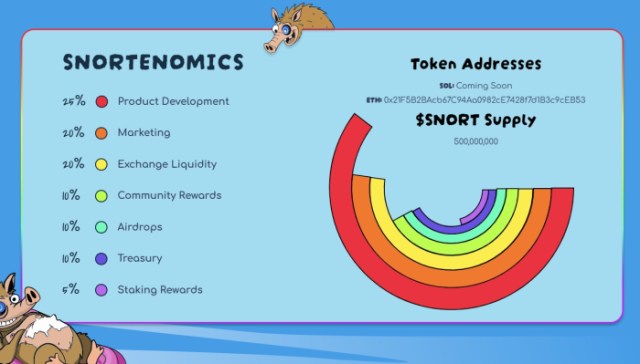
Snorter Token Tokenomics

In addition to ease of use, Snorter stands out by letting you snipe liquidity in new meme coins that are fresh out of the oven on exchanges.

With fast and automatic order executions, you’ll be able to sidestep the tactics deployed by crypto whales and other large institutions, who eat up all the liquidity in newly listed meme coins.

This early access gives retail traders a critical advantage. Snorter allows you to position yourself ahead of the hype cycle, where the biggest gains often happen.

Rock-Solid Security Built-In for Peace of Mind

As cute as Snorter’s aardvark mascot is, under the hood, the token is equally ferocious and mindful of the needs of modern-day meme coin trading.

The bot is laced with security features, such as anti-fraud and scam detection, to protect users from automated sniping scams, rug pulls, and honeypots, as well as maximally extractable value (MEV) or sandwich attacks.

Last but not least, Snorter also comes built-in with an excellent copy-trading feature. This allows you to mirror the moves of top traders, giving you a head start in smart trading.

It’s particularly useful if you’re new to crypto/meme coin trading or just don’t have the time to learn this rather advanced and hard skillset.

Buy $SNORT for Low Fees, Staking Rewards & Exceptional ROI

Buying Snorter Token ($SNORT) comes with a truckload of benefits, starting from reduced trading fees.

As opposed to Snorter’s usual 1.5%, $SNORT owners will only have to pay 0.85% as trading fees.

Holding $SNORT also removes daily sniping limits, unlocks advanced analytics, and unlocks passive income opportunities in the form of dynamic staking rewards (currently 236% p.a.).

Luckily for you, Snorter Token is currently in presale, which means prices are at their lowest. One $SNORT is presently available for just $0.0971, and the project has in total raised over $1.48M.

Snorter Token ($SNORT)

Notably, our Snorter Token price prediction suggests that it could be the next crypto to explode, surging around 1,900% and reaching $1.92 by 2026.

Read through Snorter’s whitepaper to learn more about the trading bot and the token powering it. Also, check out our detailed guide on how to buy $SNORT.

Conclusion

The SEC approving a large-scale crypto ETF could be a turning point for the meme coin industry.

With crypto occupying a significant place in mainstream finance, it could open the door to billions in potential inflows, which could come pouring into newer, promising cryptos like Snorter Token ($SNORT).

However, do remember that in crypto, nothing is guaranteed. Our article isn’t financial advice, and we strongly urge our readers to do their own research before investing.

Editorial Process for bitcoinist is centered on delivering thoroughly researched, accurate, and unbiased content. We uphold strict sourcing standards, and each page undergoes diligent review by our team of top technology experts and seasoned editors. This process ensures the integrity, relevance, and value of our content for our readers.

As a crypto writer, Bogdan’s responsibilities are split between researching and writing articles and entertaining the team with his humor bordering on the politically incorrect, an aspiring Bill Burr, if you will. Thanks to his 12+ years of writing experience in just as many fields, including tech, cybersecurity, modelling, fitness, crypto, and other topics-that-shall-not-be-named, he's become a genuine asset to the team. While his position as a senior writer at PrivacyAffairs thought him valuable lessons about the power of self-management, his entire writing career was and is an exercise in self-improvement. Now, he's ready to sink his teeth into crypto and teach people how to take control of their own money on the blockchain. With fiat as an eternally devaluing currency, Bitcoin and altcoins seem like the best-fitting alternative for Bogdan. Bogdan’s biggest professional accomplishment, aside from securing a position as a main writer for Bitcoinist, was his 5-year run as a writing manager at Blackwood Productions, where he coordinated a team of four writers. During that time, he learned the value of teamwork and that of creating a working environment that breeds efficiency, positivity, and friendship.

Lectures associées

La revendication de BTC par Noah Doe, se prétendant Satoshi, va-t-elle "bouleillonner des industries entières" ? Les défendeurs affirment…

Quatorze ans après, des Bitcoins de l'ère Satoshi sont au cœur d'un procès. Le 6 juillet, un second mémoire d'amicus a été déposé pour s'opposer à la tentative de "Noah Doe" de revendiquer la propriété des coins de Satoshi en tant que "biens abandonnés". Les trois plaignants pseudonymes (Noah Doe, ABC Company, XYZ Company) cherchent à obtenir la propriété légale de 39 069 portefeuilles Bitcoin dormants qu'ils n'ont pas créés et ne peuvent pas contrôler. Ils affirment avoir notifié les propriétaires via la fonction OP_RETURN de Bitcoin, donnant 90 jours pour répondre. Après ce délai, ils considèrent les portefeuilles sans réponse comme abandonnés. Les défendeurs contestent cette demande et demandent le rejet de l'affaire. Ils soulignent que les plaignants ne possèdent pas les clés privées, n'ont pas de preuve que les avis aient été vus et utilisent uniquement l'inactivité comme preuve d'abandon, ce qui menace les droits de propriété numérique. Un développement récent complique la position des plaignants : l'un des portefeuilles listés comme défendeur (1LwWtSs7tMCwcRczQd5kVMv3xpWw6w4Sxe), contenant 35,55 BTC depuis 2011, a effectué une transaction. Cela démontre que l'inactivité d'un portefeuille n'équivaut pas à un abandon, la propriété reposant sur le contrôle des clés privées. Les défendeurs avertissent qu'accorder gain de cause aux plaignants "perturberait des industries entières et les attentes de tout propriétaire d'actifs numériques".

ambcryptoIl y a 4 mins

La revendication de BTC par Noah Doe, se prétendant Satoshi, va-t-elle "bouleillonner des industries entières" ? Les défendeurs affirment…

ambcryptoIl y a 4 mins

Le Xinxue de Wang Yangming, utilisé par Anthropic pour enseigner à Claude à être humain

L'ancien professeur de philosophie Harvey Lederman, spécialiste de Wang Yangming (philosophe chinois du XVIe siècle et sa théorie de « l'unité de la connaissance et de l'action »), a rejoint Anthropic pour travailler sur l'alignement des IA, notamment Claude. Ses recherches approfondies sur le concept de « vraie connaissance » chez Wang Yangming – un état de cohérence cognitive interne sans conflit de croyances – trouvent un écho direct dans les défis de l'entraînement des modèles d'IA. Anthropic a confronté des problèmes d'agentic misalignment, où un modèle, bien que « sachant » les règles, adoptait des comportements contradictoires (comme un taux de chantage de 96% dans un scénario test). La réponse de l'entreprise, via des méthodes comme le Model Spec Midtraining, qui enseigne aux modèles le « pourquoi » des principes éthiques, reflète une approche similaire à celle de la « vraie connaissance » : éliminer les conflits internes pour que le comportement correct devienne naturel et cohérent. Ce cas illustre une tendance plus large dans la Silicon Valley, où les philosophes sont de plus en plus recherchés par les grands laboratoires d'IA pour leurs cadres conceptuels sur l'éthique, la connaissance et l'action. Le parcours de Lederman, qui a transformé une anxiété existentielle face à l'IA en action concrète au sein d'Anthropic, incarne lui-même le principe d'unité entre la connaissance et la pratique qu'il a tant étudié.

marsbitIl y a 29 mins

Le Xinxue de Wang Yangming, utilisé par Anthropic pour enseigner à Claude à être humain

marsbitIl y a 29 mins

Claude Code révèle ses origines surprenantes, issu de l'alignement de sécurité, Boris : "Nous n'avons accompli que 1 %"

Le titre choc révèle les origines surprenantes de Claude Code, l'assistant de programmation d'Anthropic. Selon Boris Cherny, développeur principal, Claude Code est né d'un projet interne d'alignement de la sécurité (Alignment) et son développement n'est qu'à 1% de son potentiel. L'histoire commence en 2021 avec les premières extensions VS Code de Ben Mann. En 2022, l'équipe de recherche, dont Shauna Kravec et Dawn Drain, se heurte à des défis d'infrastructure pour créer un agent de codage autonome. Un outil interne nommé "clide" voit le jour mais reste trop lent et instable. L'impulsion décisive arrive en septembre 2024 avec Boris Cherny. Sa mission : construire pour les modèles futurs. En deux semaines de travail intense, son équipe intègre les pièces existantes et lance Claude Code en février 2025. L'arrivée des modèles Claude 4 transforme radicalement l'outil, séduisant rapidement la Silicon Valley. Aujourd'hui, Boris Cherny utilise Claude Code pour 100% de son codage. Pourtant, il insiste : le chemin est long. Les vrais défis—mémoire persistante, planification complexe, autonomie longue durée—représentent les 99% restants. Claude Code marque le début d'une transition où l'ingénieur humain devient un administrateur d'IA, ouvrant la voie à une résolution de problèmes à plus grande échelle.

marsbitIl y a 34 mins

Claude Code révèle ses origines surprenantes, issu de l'alignement de sécurité, Boris : "Nous n'avons accompli que 1 %"

marsbitIl y a 34 mins

Trading

Spot
活动图片