ECB Plans Crypto Ledger Technology as CBDCs Advance: Choose Best Wallet Custody Instead

bitcoinistPublié le 2025-07-02Dernière mise à jour le 2025-07-02

Résumé

The European Central Bank (ECB) is planning distributed ledger technology (DLT) for financial settlement, which shows a good intention to...

Trusted Editorial content, reviewed by leading industry experts and seasoned editors. Ad Disclosure

The European Central Bank (ECB) is planning distributed ledger technology (DLT) for financial settlement, which shows a good intention to modernize the Eurozone’s financial infrastructure.

How will they do it? Through a ‘dual-track strategy’ that explores immediate and long-term applications of DLT. While the developments will bring novel technology into traditional finance, the conversation around Central Bank Digital Currencies (CBDCs) also intensifies.

It begs several questions, mostly regarding financial autonomy and privacy, especially when contrasted with solutions like Best Wallet.

ECB’s Dual-Track DLT Strategy and the Rise of CBDCs

The ECB’s dual-track strategy involves two distinct initiatives, ‘Pontes’ and ‘Appia’.

1. The Short-term Track (Pontes)

It links DLT platforms and existing TARGET Services for the settlement of wholesale transactions in central bank money.

This approach seeks to leverage DLT to improve efficiency and security within the current financial framework.

2. The long-term vision (Appia)

It shapes a future-ready, innovative, and integrated financial ecosystem within Europe and eventually globally.

This long-term track suggests a more fundamental rethink of the market infrastructure. Which potentially invites tokenized assets and more sophisticated DLT applications.

The duality in approach shows a forward-looking perspective on digital assets.

Simultaneously, central banks (including the ECB) are actively investigating and developing CBDCs. The digital euro, for instance, wants to have a foundation by October 2025.

You might argue that CBDCs are more secure and efficient, and might replace cash in an increasingly cashless society. Their goal – to enable faster interbank settlements, improve cross-border payments, and strengthen monetary sovereignty, of course.

But. And there’s a big but here.

The push for CBDCs comes with some significant privacy concerns. For one, centralized control from banks—they’ll theoretically see all your transactions and potentially impose limitations on your account.

These contrast sharply with the inherent privacy and control offered by self-custody solutions like Best Wallet (one of the leading non-custodial crypto wallets).

Best Wallet: Your Shield Against Centralized Control

CBDCs inherently allow for surveillance and potential control over your financial transactions. This doesn’t happen with cash or decentralized crypto transactions. And it’s also where Best Wallet’s self-custody solution shines, offering true financial freedom.
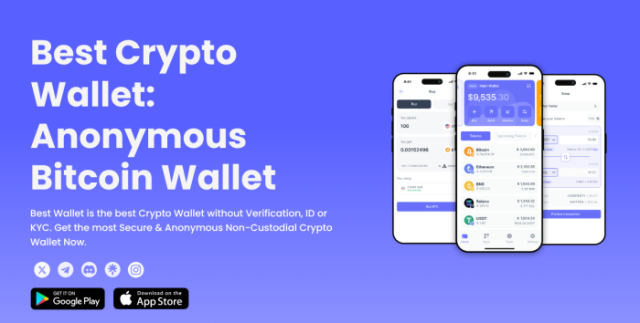
Best Wallet landing page

Best Wallet is a non-custodial platform that puts the control back into your hands. No more third parties that can freeze or control your transactions, it’s all you.

You also eliminate third-party risk, no longer worrying about hacks or insolvency affecting CEXs. Best Wallet made our list of top anonymous crypto wallets for its security, including its Fireblocks MPC, which splits your private key into several shards shared between several parties.

Unlocking Exclusive Advantages with the Best Wallet Token ($BEST)

Think of Best Wallet as your vehicle to complete financial control. The Best Wallet Token ($BEST) is the key that unlocks a world of exclusive benefits.

Holding $BEST offers significantly reduced transaction fees. You’ll also get enhanced staking rewards, which maximizes your earnings on your staked assets, and early access to high-potential crypto presales in the ‘Upcoming Tokens’ section.

With this, you can be among the first to invest in promising new projects, potentially front-running the market.
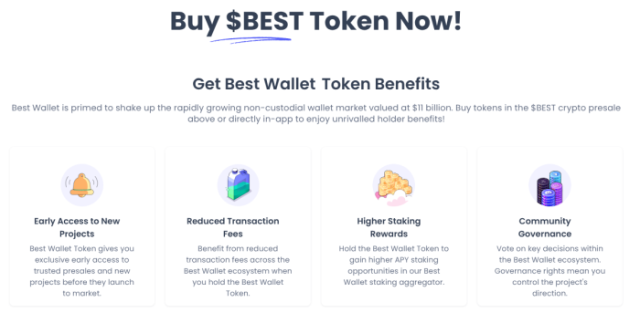
Best wallet token benefits.

Furthermore, you’ll receive priority access to new features like the Best Card, which will allow you to seamlessly spend your cryptocurrency anywhere Mastercard is accepted. In the future, you’ll also gain governance rights, influencing the future direction of the Best Wallet platform as the ecosystem evolves.

You can buy $BEST for $0.025265, but a price increase is imminent. We predict it will reach $0.072 by the end of 2025, which will see an ROI of 184.

The Future of Finance: Centralization vs. Self-Custody

The ECB’s DLT and CBDC advancements aim to modernize finance but raise privacy concerns. Best Wallet offers a self-custody alternative, providing financial freedom and control over your digital assets.

Holding $BEST unlocks even more benefits, providing further incentive. As finance evolves, understanding the implications of centralized versus self-custody solutions is crucial.

Remember, this information is for educational purposes only and not financial advice

Editorial Process for bitcoinist is centered on delivering thoroughly researched, accurate, and unbiased content. We uphold strict sourcing standards, and each page undergoes diligent review by our team of top technology experts and seasoned editors. This process ensures the integrity, relevance, and value of our content for our readers.

Ben is a freelance writer specializing in crypto developments (mainly altcoins) and the intricate ways global economics shape the digital asset space. His B.Ed. in Education provides a unique foundation for his writing, enabling him to distill complex crypto concepts and market shifts into clear, digestible insights. This skill is key to helping readers adapt and apply their understanding to the ever-evolving world of crypto investment. Passionate about making crypto accessible, Ben crafts content designed to educate a broad audience, from current market events to the essential foundational knowledge that underpins them. His goal is to empower readers through understanding. When he’s not immersed in crypto analysis and breaking down complex topics, Ben is an avid Pokémon fan and enjoys all things Disney.

Lectures associées

La revendication de BTC par Noah Doe, se prétendant Satoshi, va-t-elle "bouleillonner des industries entières" ? Les défendeurs affirment…

Quatorze ans après, des Bitcoins de l'ère Satoshi sont au cœur d'un procès. Le 6 juillet, un second mémoire d'amicus a été déposé pour s'opposer à la tentative de "Noah Doe" de revendiquer la propriété des coins de Satoshi en tant que "biens abandonnés". Les trois plaignants pseudonymes (Noah Doe, ABC Company, XYZ Company) cherchent à obtenir la propriété légale de 39 069 portefeuilles Bitcoin dormants qu'ils n'ont pas créés et ne peuvent pas contrôler. Ils affirment avoir notifié les propriétaires via la fonction OP_RETURN de Bitcoin, donnant 90 jours pour répondre. Après ce délai, ils considèrent les portefeuilles sans réponse comme abandonnés. Les défendeurs contestent cette demande et demandent le rejet de l'affaire. Ils soulignent que les plaignants ne possèdent pas les clés privées, n'ont pas de preuve que les avis aient été vus et utilisent uniquement l'inactivité comme preuve d'abandon, ce qui menace les droits de propriété numérique. Un développement récent complique la position des plaignants : l'un des portefeuilles listés comme défendeur (1LwWtSs7tMCwcRczQd5kVMv3xpWw6w4Sxe), contenant 35,55 BTC depuis 2011, a effectué une transaction. Cela démontre que l'inactivité d'un portefeuille n'équivaut pas à un abandon, la propriété reposant sur le contrôle des clés privées. Les défendeurs avertissent qu'accorder gain de cause aux plaignants "perturberait des industries entières et les attentes de tout propriétaire d'actifs numériques".

ambcryptoIl y a 4 mins

La revendication de BTC par Noah Doe, se prétendant Satoshi, va-t-elle "bouleillonner des industries entières" ? Les défendeurs affirment…

ambcryptoIl y a 4 mins

Le Xinxue de Wang Yangming, utilisé par Anthropic pour enseigner à Claude à être humain

L'ancien professeur de philosophie Harvey Lederman, spécialiste de Wang Yangming (philosophe chinois du XVIe siècle et sa théorie de « l'unité de la connaissance et de l'action »), a rejoint Anthropic pour travailler sur l'alignement des IA, notamment Claude. Ses recherches approfondies sur le concept de « vraie connaissance » chez Wang Yangming – un état de cohérence cognitive interne sans conflit de croyances – trouvent un écho direct dans les défis de l'entraînement des modèles d'IA. Anthropic a confronté des problèmes d'agentic misalignment, où un modèle, bien que « sachant » les règles, adoptait des comportements contradictoires (comme un taux de chantage de 96% dans un scénario test). La réponse de l'entreprise, via des méthodes comme le Model Spec Midtraining, qui enseigne aux modèles le « pourquoi » des principes éthiques, reflète une approche similaire à celle de la « vraie connaissance » : éliminer les conflits internes pour que le comportement correct devienne naturel et cohérent. Ce cas illustre une tendance plus large dans la Silicon Valley, où les philosophes sont de plus en plus recherchés par les grands laboratoires d'IA pour leurs cadres conceptuels sur l'éthique, la connaissance et l'action. Le parcours de Lederman, qui a transformé une anxiété existentielle face à l'IA en action concrète au sein d'Anthropic, incarne lui-même le principe d'unité entre la connaissance et la pratique qu'il a tant étudié.

marsbitIl y a 30 mins

Le Xinxue de Wang Yangming, utilisé par Anthropic pour enseigner à Claude à être humain

marsbitIl y a 30 mins

Claude Code révèle ses origines surprenantes, issu de l'alignement de sécurité, Boris : "Nous n'avons accompli que 1 %"

Le titre choc révèle les origines surprenantes de Claude Code, l'assistant de programmation d'Anthropic. Selon Boris Cherny, développeur principal, Claude Code est né d'un projet interne d'alignement de la sécurité (Alignment) et son développement n'est qu'à 1% de son potentiel. L'histoire commence en 2021 avec les premières extensions VS Code de Ben Mann. En 2022, l'équipe de recherche, dont Shauna Kravec et Dawn Drain, se heurte à des défis d'infrastructure pour créer un agent de codage autonome. Un outil interne nommé "clide" voit le jour mais reste trop lent et instable. L'impulsion décisive arrive en septembre 2024 avec Boris Cherny. Sa mission : construire pour les modèles futurs. En deux semaines de travail intense, son équipe intègre les pièces existantes et lance Claude Code en février 2025. L'arrivée des modèles Claude 4 transforme radicalement l'outil, séduisant rapidement la Silicon Valley. Aujourd'hui, Boris Cherny utilise Claude Code pour 100% de son codage. Pourtant, il insiste : le chemin est long. Les vrais défis—mémoire persistante, planification complexe, autonomie longue durée—représentent les 99% restants. Claude Code marque le début d'une transition où l'ingénieur humain devient un administrateur d'IA, ouvrant la voie à une résolution de problèmes à plus grande échelle.

marsbitIl y a 35 mins

Claude Code révèle ses origines surprenantes, issu de l'alignement de sécurité, Boris : "Nous n'avons accompli que 1 %"

marsbitIl y a 35 mins

Trading

Spot
活动图片