Big Beautiful Bill Passes Without Crypto Tax Relief – Snorter Bot Offers a Path Forward

bitcoinistPublié le 2025-07-02Dernière mise à jour le 2025-07-02

Résumé

In a tight 51–50 vote, the US Senate has passed the highly anticipated ‘One Big Beautiful Act,’ a major budget...

Trusted Editorial content, reviewed by leading industry experts and seasoned editors. Ad Disclosure

In a tight 51–50 vote, the US Senate has passed the highly anticipated ‘One Big Beautiful Act,’ a major budget reconciliation bill championed by President Donald Trump.

Despite intense lobbying from crypto leaders, the final version of the bill passed by the Senate comes without any crypto tax reforms.

The bill is to go back to the House of Representatives next for a second voting round before potentially heading to President Trump’s desk. As of right now, crypto-friendly policies are off the table.

Still, frequent crypto trader can soon enjoy the lowest fees (just 0.85%) and the fastest executions on Solana thanks to Snorter Token ($SNORT).

Senate Refuses to Lower Tax for Small Crypto Transactions

Among the most closely watched crypto proposals was an amendment from Senator Cynthia Lummis. She advocated for a de minimis capital gains exemption on crypto transactions under $300 (capped at $5K annually).

BTC Inc.’s David Bailey and Gemini’s Tyler Winklevoss also expressed strong crypto support.

Nevertheless, Lummis still believes that the bill is a ‘major step in the right direction’ and that it ‘delivers significant wins for working families across Wyoming.’

Cynthia Lummis discusses big beautiful bill on Twitter
Source: X (Cynthia Lummis)

But there’s no denying that the lack of progress on crypto tax reforms adds uncertainty about how the US treats digital assets.

This is especially true if you want to use them for everyday transactions without having to face cumbersome tax reporting.

With unclear tax treatment on small crypto transactions, many investors might avoid centralized trading platforms altogether.

This makes decentralized trading tools like Snorter Bot all the more valuable.

While regulatory clarity remains elusive, Snorter could soon give you an edge in the crypto market, delivering automated swaps, sub-second speeds, and low fees when they’re most needed.

Snorter Bot to Become Solana’s Sharpest Trading Bot

Once launched on Telegram in Q3 2025, the Snorter Bot will help you auto-snipe the next crypto to explode. It will also flag scams and potential rug pulls before they strike, keeping you safe in a still unregulated meme coin market.

Better yet, this bot executes trades faster and cheaper than any other bot on Solana. With trading fees as low as 0.85%, it undercuts big-name rivals like Maestro, Bonk Bot, and Banana Gun.
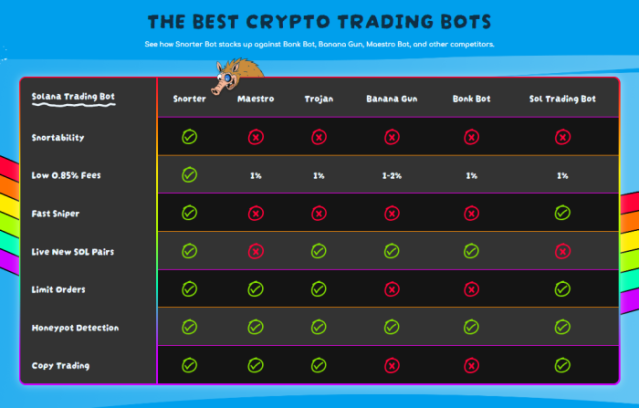
Solana trading bots
Source: Snorter Bot

Its built-in security measures, like smart contract scans and honeypot alerts, ensure you can move quickly without getting burned.

Though it’s currently focused on Solana, Snorter Bot is already preparing to expand across major EVM-compatible chains, positioning itself as a future-proof, multi-chain trading platform.

At the heart of it all is Snorter Token ($SNORT). Holding the platform’s native token unlocks reduced fees, premium bot access, and juicy staking rewards (currently at a whopping 236% APY).

And soon, by holding $SNORT, you’ll also be able to help shape the Snorter ecosystem’s future through its upcoming Decentralized Autonomous Organization (DAO).

Your token bag will enable you to vote on key feature upgrades and the platform’s general direction to boost its sustainability.

It’s not surprising that $SNORT has raised over $1.4M since launching on presale on May 28, 2025.

$SNORT to Power the Future of Crypto Trading

While the Senate’s decision to exclude crypto tax reforms from the One Big Beautiful Act may feel like a setback, it’s also a stark reminder that innovation moves faster than regulation.

The dream of seamless, everyday cryptocurrency transactions remains alive; they just require more advocacy and sharper tools. This is where Snorter Bot shines bright.

As policymakers stall, Snorter could soon empower you to make decentralized trades with unbeatable fees and genuine on-chain utility.

You can get involved by purchasing $SNORT for as little as $0.0971. After being listed on top exchanges, the Snorter token could hit $0.94. So, act fast for a potential 868% upside.

But remember: once being listed, cryptos can fall as quickly as they jump. You must always DYOR and never invest more than you’d be willing to lose.

Editorial Process for bitcoinist is centered on delivering thoroughly researched, accurate, and unbiased content. We uphold strict sourcing standards, and each page undergoes diligent review by our team of top technology experts and seasoned editors. This process ensures the integrity, relevance, and value of our content for our readers.

Leah is a British journalist with a BA in Journalism, Media, and Communications and nearly a decade of content writing experience. Over the last four years, her focus has primarily been on Web3 technologies, driven by her genuine enthusiasm for decentralization and the latest technological advancements. She has contributed to leading crypto and NFT publications – Cointelegraph, Coinbound, Crypto News, NFT Plazas, Bitcolumnist, Techreport, and NFT Lately – which has elevated her to a senior role in crypto journalism. Whether crafting breaking news or in-depth reviews, she strives to engage her readers with the latest insights and information. Her articles often span the hottest cryptos, exchanges, and evolving regulations. As part of her ploy to attract crypto newbies into Web3, she explains even the most complex topics in an easily understandable and engaging way. Further underscoring her dynamic journalism background, she has written for various sectors, including software testing (TEST Magazine), travel (Travel Off Path), and music (Mixmag). When she's not deep into a crypto rabbit hole, she's probably island-hopping (with the Galapagos and Hainan being her go-to's). Or perhaps sketching chalk pencil drawings while listening to the Pixies, her all-time favorite band.

Lectures associées

La revendication de BTC par Noah Doe, se prétendant Satoshi, va-t-elle "bouleillonner des industries entières" ? Les défendeurs affirment…

Quatorze ans après, des Bitcoins de l'ère Satoshi sont au cœur d'un procès. Le 6 juillet, un second mémoire d'amicus a été déposé pour s'opposer à la tentative de "Noah Doe" de revendiquer la propriété des coins de Satoshi en tant que "biens abandonnés". Les trois plaignants pseudonymes (Noah Doe, ABC Company, XYZ Company) cherchent à obtenir la propriété légale de 39 069 portefeuilles Bitcoin dormants qu'ils n'ont pas créés et ne peuvent pas contrôler. Ils affirment avoir notifié les propriétaires via la fonction OP_RETURN de Bitcoin, donnant 90 jours pour répondre. Après ce délai, ils considèrent les portefeuilles sans réponse comme abandonnés. Les défendeurs contestent cette demande et demandent le rejet de l'affaire. Ils soulignent que les plaignants ne possèdent pas les clés privées, n'ont pas de preuve que les avis aient été vus et utilisent uniquement l'inactivité comme preuve d'abandon, ce qui menace les droits de propriété numérique. Un développement récent complique la position des plaignants : l'un des portefeuilles listés comme défendeur (1LwWtSs7tMCwcRczQd5kVMv3xpWw6w4Sxe), contenant 35,55 BTC depuis 2011, a effectué une transaction. Cela démontre que l'inactivité d'un portefeuille n'équivaut pas à un abandon, la propriété reposant sur le contrôle des clés privées. Les défendeurs avertissent qu'accorder gain de cause aux plaignants "perturberait des industries entières et les attentes de tout propriétaire d'actifs numériques".

ambcryptoIl y a 4 mins

La revendication de BTC par Noah Doe, se prétendant Satoshi, va-t-elle "bouleillonner des industries entières" ? Les défendeurs affirment…

ambcryptoIl y a 4 mins

Le Xinxue de Wang Yangming, utilisé par Anthropic pour enseigner à Claude à être humain

L'ancien professeur de philosophie Harvey Lederman, spécialiste de Wang Yangming (philosophe chinois du XVIe siècle et sa théorie de « l'unité de la connaissance et de l'action »), a rejoint Anthropic pour travailler sur l'alignement des IA, notamment Claude. Ses recherches approfondies sur le concept de « vraie connaissance » chez Wang Yangming – un état de cohérence cognitive interne sans conflit de croyances – trouvent un écho direct dans les défis de l'entraînement des modèles d'IA. Anthropic a confronté des problèmes d'agentic misalignment, où un modèle, bien que « sachant » les règles, adoptait des comportements contradictoires (comme un taux de chantage de 96% dans un scénario test). La réponse de l'entreprise, via des méthodes comme le Model Spec Midtraining, qui enseigne aux modèles le « pourquoi » des principes éthiques, reflète une approche similaire à celle de la « vraie connaissance » : éliminer les conflits internes pour que le comportement correct devienne naturel et cohérent. Ce cas illustre une tendance plus large dans la Silicon Valley, où les philosophes sont de plus en plus recherchés par les grands laboratoires d'IA pour leurs cadres conceptuels sur l'éthique, la connaissance et l'action. Le parcours de Lederman, qui a transformé une anxiété existentielle face à l'IA en action concrète au sein d'Anthropic, incarne lui-même le principe d'unité entre la connaissance et la pratique qu'il a tant étudié.

marsbitIl y a 29 mins

Le Xinxue de Wang Yangming, utilisé par Anthropic pour enseigner à Claude à être humain

marsbitIl y a 29 mins

Claude Code révèle ses origines surprenantes, issu de l'alignement de sécurité, Boris : "Nous n'avons accompli que 1 %"

Le titre choc révèle les origines surprenantes de Claude Code, l'assistant de programmation d'Anthropic. Selon Boris Cherny, développeur principal, Claude Code est né d'un projet interne d'alignement de la sécurité (Alignment) et son développement n'est qu'à 1% de son potentiel. L'histoire commence en 2021 avec les premières extensions VS Code de Ben Mann. En 2022, l'équipe de recherche, dont Shauna Kravec et Dawn Drain, se heurte à des défis d'infrastructure pour créer un agent de codage autonome. Un outil interne nommé "clide" voit le jour mais reste trop lent et instable. L'impulsion décisive arrive en septembre 2024 avec Boris Cherny. Sa mission : construire pour les modèles futurs. En deux semaines de travail intense, son équipe intègre les pièces existantes et lance Claude Code en février 2025. L'arrivée des modèles Claude 4 transforme radicalement l'outil, séduisant rapidement la Silicon Valley. Aujourd'hui, Boris Cherny utilise Claude Code pour 100% de son codage. Pourtant, il insiste : le chemin est long. Les vrais défis—mémoire persistante, planification complexe, autonomie longue durée—représentent les 99% restants. Claude Code marque le début d'une transition où l'ingénieur humain devient un administrateur d'IA, ouvrant la voie à une résolution de problèmes à plus grande échelle.

marsbitIl y a 34 mins

Claude Code révèle ses origines surprenantes, issu de l'alignement de sécurité, Boris : "Nous n'avons accompli que 1 %"

marsbitIl y a 34 mins

Trading

Spot
活动图片