Ripple CTO Drops Bombshell On Pre-IPO Shares As Linqto Meltdown Explodes

bitcoinistPublié le 2025-07-01Dernière mise à jour le 2025-07-01

Résumé

Linqto’s once-celebrated promise to “democratize” (Ripple) pre-IPO investing is collapsing under the weight of federal probes, a looming bankruptcy filing...

Trusted Editorial content, reviewed by leading industry experts and seasoned editors. Ad Disclosure

Linqto’s once-celebrated promise to “democratize” (Ripple) pre-IPO investing is collapsing under the weight of federal probes, a looming bankruptcy filing and a furious customer base that now numbers roughly 13,000.

According to an internal review first detailed by The Wall Street Journal, investigators for the Securities and Exchange Commission and the US Department of Justice are examining allegations that former chief executive William Sarris secretly marked up Ripple shares by more than 60 percent, sold customer stock without permission and promoted deals to thousands of investors who failed to meet accredited-investor standards. New management concedes that client accounts have been frozen since February and warns that a Chapter 11 filing could leave many investors as unsecured creditors.

A March 14 press release from the company’s new leadership confirmed “pervasive securities-law violations,” the pausing of all trading and the dismissal of nearly half the staff while Linqto “explores all options to preserve value,” including court-supervised restructuring. The same statement insists that the special-purpose vehicles (SPVs) holding customers’ assets remain on issuer cap tables, but concedes that an independent forensic review is under way to verify that claim.

Into that vacuum stepped attorney John E. Deaton, who told his X followers that the situation is a “total clusterfuck” and that roughly 11,500 Linqto users bought units in SPVs that, in turn, were supposed to own Ripple shares. Deaton says as many as 5,000 of those investors are non-accredited, creating “a regulatory compliance nightmare” now squarely on the SEC’s radar. He plans to host a live session at 3 p.m. EST today to detail what he calls a “heavily involved” enforcement action and to explain why simply refunding principal would strip investors of six- and seven-figure gains booked on private-share price appreciation.

“You Never Owned Ripple Shares”— CTO

Ripple’s chief technology officer David Schwartz—better known online as “JoelKatz”—added fuel to the blaze by reminding holders that they never owned Ripple equity outright. “You don’t own the shares directly,” Schwartz wrote, “but you own a portion of a legal entity that owns the shares.” He elaborated, saying: “So if you ‘bought’ Z shares, you own X fraction of a legal entity with Y shares where X×Y=100. This generally lets you buy ‘shares’ more easily and in smaller quantities, but the equivalent per-share price is usually higher.”

This clarification dismantled a key misconception among many Linqto clients who believed they were holding Ripple stock directly. The implications are now being examined not only by the SEC but also by customers who fear their indirect ownership could be rendered illiquid or encumbered in bankruptcy court.

When pressed about whether those SPVs could be affected by Linqto’s financial collapse, Schwartz responded: “The legal entity that owns the shares that you own part of should not have exposure to Linqto going bankrupt. So a direct encumbrance on the shares to cover Linqto’s debts shouldn’t happen. But the entity may face operational challenges depending on exactly how it’s structured.”

That operational risk is precisely what has many investors on edge. If trustees, custodians, or record-keepers tied to those SPVs are forced to restructure, change providers, or liquidate assets, investors may find themselves in prolonged legal limbo with no access to their holdings—even if the shares remain technically intact on the cap table.

The Alleged George Soros Link

Complicating perceptions further, Schwartz addressed a separate thread linking billionaire George Soros to Ripple. He clarified that Soros Fund Management backed PolySign—another private company in which many Linqto users invested—during its 2022 acquisition of fund administrator MG Stover, but said he was “not aware of any Soros connection to Ripple.”

Initially, Schwartz wrote: “It wouldn’t surprise me very much since his funds own bits of almost everything (Salesforce, Amazon, Google, JP Morgan, Goldman, Uber, FedEx, and many more), but I couldn’t find any actual connection.”

However, after further reflection, he corrected himself: “Oh, wait, I remember now. Yes, Soros’ fund did invest in PolySign to help finance the acquisition of MG Stover! No connection to Ripple AFAICT though.”

The deeper regulatory concern is structural. Linqto created more than 500 SPVs, each designed to pool hundreds of retail investors while keeping the underlying issuer’s shareholder count below the 2,000-owner threshold that triggers public-reporting obligations. Internal emails obtained by investigators show former executives exhorting staff to “take no prisoners” in sales campaigns—at times buying back Ripple shares from customers at $55 each, only to flip them to Ripple for $61, banking an $8 million spread. If those shares never made it into the SPVs—as suggested in confidential memos cited by investigators—questions of beneficial ownership, tax liability and voting rights could embroil Ripple itself in discovery.

What happens next will hinge on three converging clocks: Linqto’s restructuring timetable, the SEC’s enforcement calendar and the pace at which SPV trustees can—or cannot—demonstrate clean title to almost half a billion dollars’ worth of private-company shares. Until then, thousands of would-be Ripple shareholders remain locked out of their accounts, watching from the sidelines as a legal and regulatory cyclone decides whether their “pre-IPO dream” survives or is wiped out in a courtroom ledger.

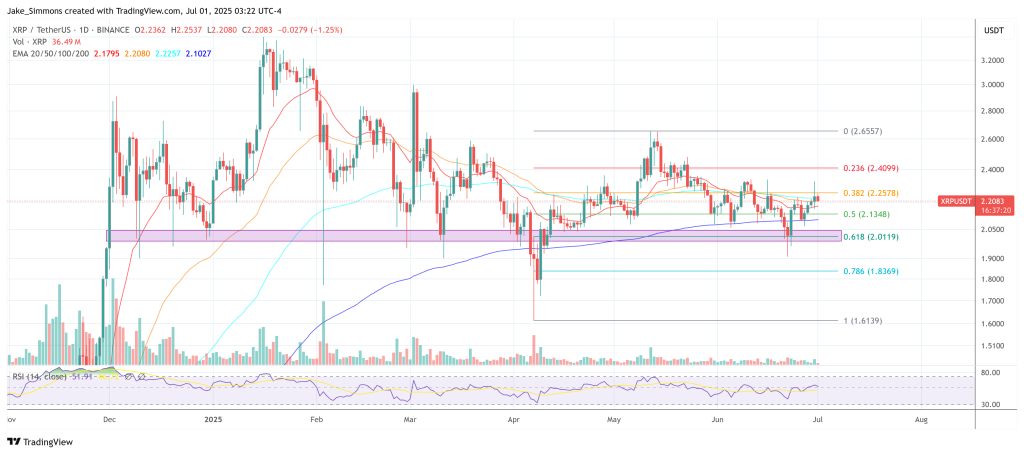
At press time, XRP traded at $2.20.
XRP price
XRP price, 1-day chart | Source: XRPUSDT on TradingView.com
Featured image created with DALL.E, chart from TradingView.com
Editorial Process for bitcoinist is centered on delivering thoroughly researched, accurate, and unbiased content. We uphold strict sourcing standards, and each page undergoes diligent review by our team of top technology experts and seasoned editors. This process ensures the integrity, relevance, and value of our content for our readers.

Jake Simmons has been a Bitcoin enthusiast since 2016. Ever since he heard about Bitcoin, he has been studying the topic every day and trying to share his knowledge with others. His goal is to contribute to Bitcoin's financial revolution, which will replace the fiat money system. Besides BTC and crypto, Jake studied Business Informatics at a university. After graduation in 2017, he has been working in the blockchain and crypto sector. You can follow Jake on Twitter at @realJakeSimmons.

Lectures associées

Fondateur de Baixing : Je ne crois qu'à moitié à l'affirmation selon laquelle les grands modèles de langage vont tout avaler

Le fondateur de Baixing Wang affirme qu'il ne croit qu'à moitié à l'idée que « les grands modèles de langage vont tout engloutir ». Selon lui, comparer les grands modèles de langage à l'électricité est plus approprié : ils constituent une base fondamentale et essentielle, semblable à une centrale électrique. Sans cette base, le développement mondial serait impossible. Cependant, ce qui compte vraiment, ce sont les applications concrètes construites sur cette base — les divers « appareils » et « machines » qui résolvent des problèmes spécifiques, comme une machine à laver a besoin d'électricité et d'eau pour fonctionner. Il reconnaît que les grands modèles de langage pourront remplacer de nombreux logiciels traditionnels, en particulier ceux basés sur des règles et des flux de travail fixes (comme les CRM, les systèmes d'information hospitalière). En revanche, de nombreux autres éléments — les informations clients, les capacités d'exécution dans le monde physique, la confiance — ne seront pas « engloutis ». La disparition de certaines couches logicielles ouvrira en fait un espace plus vaste pour de nouveaux types de logiciels, plus fluides et imaginatifs. L'auteur met en garde contre la myopie face aux nouvelles technologies : on a tendance à surestimer l'impact immédiat tout en sous-estimant les possibilités futures bien plus vastes (comme l'illustre l'exemple de l'Internet en 2004). L'essentiel est donc de reconnaître l'importance des grands modèles en tant que socle, tout en se concentrant sur les opportunités qui émergeront dans la couche supérieure des applications concrètes qui les utilisent pour changer le monde.

marsbitIl y a 45 mins

Fondateur de Baixing : Je ne crois qu'à moitié à l'affirmation selon laquelle les grands modèles de langage vont tout avaler

marsbitIl y a 45 mins

Fondateur de Baixing.com : Le modèle linguistique avalé tout, je n'y crois qu'à moitié

L'auteur, fondateur de Baixing Wang, exprime un scepticisme nuancé face à l'affirmation selon laquelle les grands modèles de langage (LLM) « dévoreront tout ». Il compare cette vision à celle, similaire, qu'on avait de l'internet, et souligne qu'aucune technologie n'absorbe réellement « tout ». Il préfère voir les LLM comme une *infrastructure fondamentale*, comparable à l'électricité ou au réseau internet. Cette infrastructure est essentielle, mais sa valeur se réalise dans les *applications concrètes* construites dessus. L'électricité seule ne lave pas le linge ; il faut un lave-linge. De même, l'intelligence de base d'un LLM doit être intégrée dans des « machines » ou des « appareils » logiciels spécifiques (comme Claude Code pour la programmation) pour résoudre des problèmes réels. Une couche d'interface (comme Harness) est souvent nécessaire pour connecter cette intelligence aux capacités d'exécution. L'auteur « croit à moitié » à l'idée de « dévorer », car il estime que les LLM remplaceront effectivement une grande partie des *logiciels traditionnels* basés sur des règles fixes, des formulaires et des flux de travail rigides (CRM, systèmes hospitaliers, etc.), tâches pour lesquelles ils sont très adaptés. Cependant, ils ne dévoreront pas tout : les données clients, les capacités d'exécution physique (comme réserver un vol), la confiance et les éléments du monde physique resteront hors de leur portée. Plus important, après avoir absorbé cette couche logicielle existante, les LLM *ouvriront un espace bien plus vaste* pour une nouvelle génération de logiciels, plus fluides et moins dépendants de règles prédéfinies. La véritable opportunité réside dans la création de ces nouvelles applications qui résoudront des problèmes concrets en utilisant cette infrastructure intelligente. L'auteur conclut en mettant en garde contre la myopie face aux nouvelles technologies, rappelant qu'en 2004, beaucoup pensaient que l'internet était mature après l'émergence des premiers portails, ignorant l'immense vague d'innovation à venir. L'essentiel n'est pas de savoir si les LLM « dévorent tout », mais d'identifier les opportunités dans les transformations qu'ils rendent possibles.

链捕手Il y a 50 mins

Fondateur de Baixing.com : Le modèle linguistique avalé tout, je n'y crois qu'à moitié

链捕手Il y a 50 mins

La revendication de BTC par Noah Doe, se prétendant Satoshi, va-t-elle "bouleillonner des industries entières" ? Les défendeurs affirment…

Quatorze ans après, des Bitcoins de l'ère Satoshi sont au cœur d'un procès. Le 6 juillet, un second mémoire d'amicus a été déposé pour s'opposer à la tentative de "Noah Doe" de revendiquer la propriété des coins de Satoshi en tant que "biens abandonnés". Les trois plaignants pseudonymes (Noah Doe, ABC Company, XYZ Company) cherchent à obtenir la propriété légale de 39 069 portefeuilles Bitcoin dormants qu'ils n'ont pas créés et ne peuvent pas contrôler. Ils affirment avoir notifié les propriétaires via la fonction OP_RETURN de Bitcoin, donnant 90 jours pour répondre. Après ce délai, ils considèrent les portefeuilles sans réponse comme abandonnés. Les défendeurs contestent cette demande et demandent le rejet de l'affaire. Ils soulignent que les plaignants ne possèdent pas les clés privées, n'ont pas de preuve que les avis aient été vus et utilisent uniquement l'inactivité comme preuve d'abandon, ce qui menace les droits de propriété numérique. Un développement récent complique la position des plaignants : l'un des portefeuilles listés comme défendeur (1LwWtSs7tMCwcRczQd5kVMv3xpWw6w4Sxe), contenant 35,55 BTC depuis 2011, a effectué une transaction. Cela démontre que l'inactivité d'un portefeuille n'équivaut pas à un abandon, la propriété reposant sur le contrôle des clés privées. Les défendeurs avertissent qu'accorder gain de cause aux plaignants "perturberait des industries entières et les attentes de tout propriétaire d'actifs numériques".

ambcryptoIl y a 1 h

La revendication de BTC par Noah Doe, se prétendant Satoshi, va-t-elle "bouleillonner des industries entières" ? Les défendeurs affirment…

ambcryptoIl y a 1 h

Trading

Spot
活动图片