Robinhood Launches US Stock Tokens in Europe: A Step Toward On-Chain Crypto Adoption

bitcoinistPublié le 2025-07-01Dernière mise à jour le 2025-07-01

Résumé

Robinhood has just taken a bold step into the future of finance by launching US stock and ETF tokens in...

Trusted Editorial content, reviewed by leading industry experts and seasoned editors. Ad Disclosure

Robinhood has just taken a bold step into the future of finance by launching US stock and ETF tokens in Europe — a move that blends traditional equities with blockchain innovation.

This isn’t just a crypto expansion; it’s a strategic push to tokenize U.S. equities, making them more accessible to European investors through simplified, blockchain-based trading. It’s a major leap toward the convergence of global finance and decentralized technology.

For European investors who have long struggled with complex systems, Robinhood’s move is a game-changer, offering a direct way to own tokens representing shares in top Nasdaq and S&P 500 companies.

And with everything running on-chain, it marks a significant step forward for both the stock and crypto markets.

As Robinhood leads the charge, assets like Best Wallet Token ($BEST) are positioned to play a key role in enhancing how we store and manage these innovative on-chain assets.

Robinhood’s Impact on Crypto and Stock Trading

Robinhood is taking its democratizing approach to the next level by launching over 200 US stock and ETF tokens for European customers.

Starting on June 30, 2025, this expansion allows users in 30 EU and EEA countries to gain exposure to major US equities, including Nasdaq and S&P 500 companies, directly from the Robinhood app.
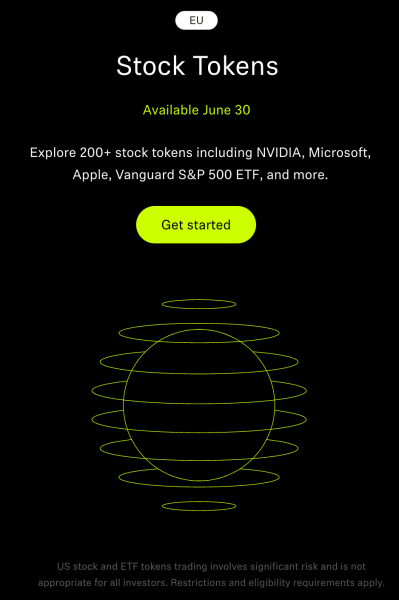
Robinhood stock tokens EU.

The newly launched stock tokens come with zero commissions and dividend support, offering users a seamless and rewarding trading experience.

What sets this move apart is Robinhood’s deep integration of blockchain technology. The tokens will initially launch on Arbitrum, with plans to migrate to Robinhood’s own Layer 2 blockchain, purpose-built for tokenizing real-world assets.

By removing the delays common in traditional stock transactions, this innovation enables faster, more transparent trades and paves the way for a more efficient, on-chain financial system.

With this bold step, Robinhood is bridging the gap between equities and crypto, placing itself at the leading edge of a financial revolution where legacy finance and blockchain work hand in hand.

What is Best Wallet Token ($BEST)?

Best Wallet Token ($BEST) is a new breed of cryptocurrency designed to enhance the user experience in the crypto space.

It’s closely tied to the Best Wallet ecosystem, a next-generation wallet that challenges legacy wallets like MetaMask by offering advanced features within an easy-to-use interface.

$BEST plays a crucial role within the platform, providing token holders with exclusive benefits. For instance, users can enjoy reduced transaction fees, early access to new crypto projects, and higher staking rewards.

One standout feature is the ‘Upcoming Tokens’ tool, which allows presale buyers to participate in crypto presales directly within the app, eliminating the risks associated with scam sites.

Best Wallet Upcoming Tokens feature

The $BEST token also delivers real utility in the iGaming space, granting holders perks like free spins, exclusive lootbox access, and deposit bonuses, adding real-world value to its digital footprint.

Backed by a rapidly expanding user base and strong community momentum, Best Wallet Token is carving out a leadership role in the competitive crypto wallet market.

Thanks to its seamless integration with the broader crypto ecosystem, $BEST is uniquely positioned to grow, especially as platforms like Robinhood accelerate the adoption of tokenized assets and decentralized finance on a global scale.

Why Buy $BEST Right Now?

Right now, you can buy $BEST for just $0.025265, and the ongoing presale has already raised $13.6M, signaling strong investor confidence.
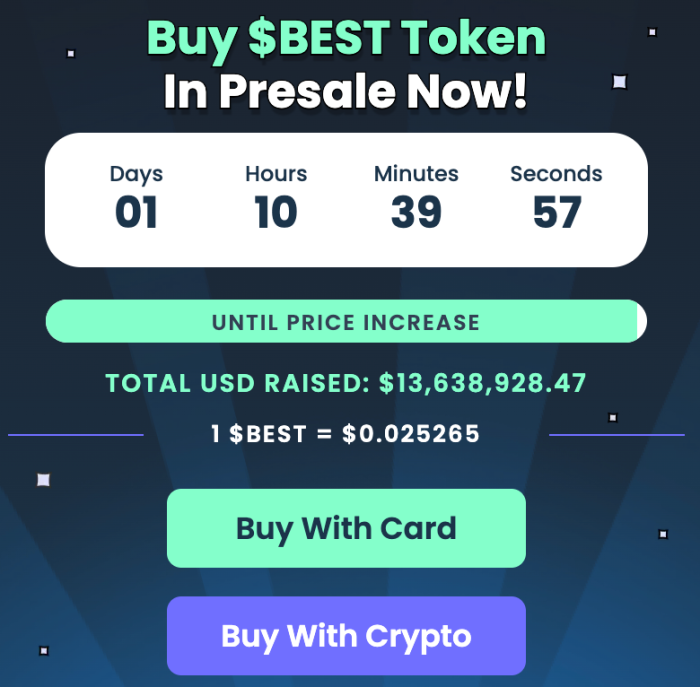
Buy Best Wallet Token in the presale phase.

With a price forecast of $0.072 by 2025, that’s a potential increase of 185% from its current value.

If you purchase and stake $BEST now, with an APY of 20%, your staked tokens could grow by 20% each year.

For example, if you stake 1K $BEST tokens at the current price, you’d earn 200 additional tokens over the next 12 months.

At the projected price of $0.072 in 2025, those 1,200 tokens would be worth $86.40. That’s a potential profit of $36.40.

If the price hits $0.62 by 2026, your staked tokens would be worth $744 – this represents a staggering 2,860% return on your initial investment.

Don’t miss the opportunity to secure these gains early.

Robinhood’s Game-Changing Move and the Future of On-Chain Finance

Robinhood’s innovative expansion into the EU with stock tokens, coupled with its integration of blockchain, is a major step forward for both traditional and crypto markets.

By offering an easy way to access US equities and introducing new crypto features, Robinhood is helping bridge the gap between these two worlds.

As more platforms follow suit, the adoption of on-chain finance could be set for a massive surge. And for anyone looking to get ahead of the curve, Best Wallet Token ($BEST) is one to watch.

Don’t forget to do your own research (DYOR) before investing in crypto. The content of this article is for informational purposes only and doesn’t constitute financial advice.

Editorial Process for bitcoinist is centered on delivering thoroughly researched, accurate, and unbiased content. We uphold strict sourcing standards, and each page undergoes diligent review by our team of top technology experts and seasoned editors. This process ensures the integrity, relevance, and value of our content for our readers.

As a crypto writer, Bogdan’s responsibilities are split between researching and writing articles and entertaining the team with his humor bordering on the politically incorrect, an aspiring Bill Burr, if you will. Thanks to his 12+ years of writing experience in just as many fields, including tech, cybersecurity, modelling, fitness, crypto, and other topics-that-shall-not-be-named, he's become a genuine asset to the team. While his position as a senior writer at PrivacyAffairs thought him valuable lessons about the power of self-management, his entire writing career was and is an exercise in self-improvement. Now, he's ready to sink his teeth into crypto and teach people how to take control of their own money on the blockchain. With fiat as an eternally devaluing currency, Bitcoin and altcoins seem like the best-fitting alternative for Bogdan. Bogdan’s biggest professional accomplishment, aside from securing a position as a main writer for Bitcoinist, was his 5-year run as a writing manager at Blackwood Productions, where he coordinated a team of four writers. During that time, he learned the value of teamwork and that of creating a working environment that breeds efficiency, positivity, and friendship.

Lectures associées

Fondateur de Baixing : Je ne crois qu'à moitié à l'affirmation selon laquelle les grands modèles de langage vont tout avaler

Le fondateur de Baixing Wang affirme qu'il ne croit qu'à moitié à l'idée que « les grands modèles de langage vont tout engloutir ». Selon lui, comparer les grands modèles de langage à l'électricité est plus approprié : ils constituent une base fondamentale et essentielle, semblable à une centrale électrique. Sans cette base, le développement mondial serait impossible. Cependant, ce qui compte vraiment, ce sont les applications concrètes construites sur cette base — les divers « appareils » et « machines » qui résolvent des problèmes spécifiques, comme une machine à laver a besoin d'électricité et d'eau pour fonctionner. Il reconnaît que les grands modèles de langage pourront remplacer de nombreux logiciels traditionnels, en particulier ceux basés sur des règles et des flux de travail fixes (comme les CRM, les systèmes d'information hospitalière). En revanche, de nombreux autres éléments — les informations clients, les capacités d'exécution dans le monde physique, la confiance — ne seront pas « engloutis ». La disparition de certaines couches logicielles ouvrira en fait un espace plus vaste pour de nouveaux types de logiciels, plus fluides et imaginatifs. L'auteur met en garde contre la myopie face aux nouvelles technologies : on a tendance à surestimer l'impact immédiat tout en sous-estimant les possibilités futures bien plus vastes (comme l'illustre l'exemple de l'Internet en 2004). L'essentiel est donc de reconnaître l'importance des grands modèles en tant que socle, tout en se concentrant sur les opportunités qui émergeront dans la couche supérieure des applications concrètes qui les utilisent pour changer le monde.

marsbitIl y a 2 h

Fondateur de Baixing : Je ne crois qu'à moitié à l'affirmation selon laquelle les grands modèles de langage vont tout avaler

marsbitIl y a 2 h

Fondateur de Baixing.com : Le modèle linguistique avalé tout, je n'y crois qu'à moitié

L'auteur, fondateur de Baixing Wang, exprime un scepticisme nuancé face à l'affirmation selon laquelle les grands modèles de langage (LLM) « dévoreront tout ». Il compare cette vision à celle, similaire, qu'on avait de l'internet, et souligne qu'aucune technologie n'absorbe réellement « tout ». Il préfère voir les LLM comme une *infrastructure fondamentale*, comparable à l'électricité ou au réseau internet. Cette infrastructure est essentielle, mais sa valeur se réalise dans les *applications concrètes* construites dessus. L'électricité seule ne lave pas le linge ; il faut un lave-linge. De même, l'intelligence de base d'un LLM doit être intégrée dans des « machines » ou des « appareils » logiciels spécifiques (comme Claude Code pour la programmation) pour résoudre des problèmes réels. Une couche d'interface (comme Harness) est souvent nécessaire pour connecter cette intelligence aux capacités d'exécution. L'auteur « croit à moitié » à l'idée de « dévorer », car il estime que les LLM remplaceront effectivement une grande partie des *logiciels traditionnels* basés sur des règles fixes, des formulaires et des flux de travail rigides (CRM, systèmes hospitaliers, etc.), tâches pour lesquelles ils sont très adaptés. Cependant, ils ne dévoreront pas tout : les données clients, les capacités d'exécution physique (comme réserver un vol), la confiance et les éléments du monde physique resteront hors de leur portée. Plus important, après avoir absorbé cette couche logicielle existante, les LLM *ouvriront un espace bien plus vaste* pour une nouvelle génération de logiciels, plus fluides et moins dépendants de règles prédéfinies. La véritable opportunité réside dans la création de ces nouvelles applications qui résoudront des problèmes concrets en utilisant cette infrastructure intelligente. L'auteur conclut en mettant en garde contre la myopie face aux nouvelles technologies, rappelant qu'en 2004, beaucoup pensaient que l'internet était mature après l'émergence des premiers portails, ignorant l'immense vague d'innovation à venir. L'essentiel n'est pas de savoir si les LLM « dévorent tout », mais d'identifier les opportunités dans les transformations qu'ils rendent possibles.

链捕手Il y a 2 h

Fondateur de Baixing.com : Le modèle linguistique avalé tout, je n'y crois qu'à moitié

链捕手Il y a 2 h

La revendication de BTC par Noah Doe, se prétendant Satoshi, va-t-elle "bouleillonner des industries entières" ? Les défendeurs affirment…

Quatorze ans après, des Bitcoins de l'ère Satoshi sont au cœur d'un procès. Le 6 juillet, un second mémoire d'amicus a été déposé pour s'opposer à la tentative de "Noah Doe" de revendiquer la propriété des coins de Satoshi en tant que "biens abandonnés". Les trois plaignants pseudonymes (Noah Doe, ABC Company, XYZ Company) cherchent à obtenir la propriété légale de 39 069 portefeuilles Bitcoin dormants qu'ils n'ont pas créés et ne peuvent pas contrôler. Ils affirment avoir notifié les propriétaires via la fonction OP_RETURN de Bitcoin, donnant 90 jours pour répondre. Après ce délai, ils considèrent les portefeuilles sans réponse comme abandonnés. Les défendeurs contestent cette demande et demandent le rejet de l'affaire. Ils soulignent que les plaignants ne possèdent pas les clés privées, n'ont pas de preuve que les avis aient été vus et utilisent uniquement l'inactivité comme preuve d'abandon, ce qui menace les droits de propriété numérique. Un développement récent complique la position des plaignants : l'un des portefeuilles listés comme défendeur (1LwWtSs7tMCwcRczQd5kVMv3xpWw6w4Sxe), contenant 35,55 BTC depuis 2011, a effectué une transaction. Cela démontre que l'inactivité d'un portefeuille n'équivaut pas à un abandon, la propriété reposant sur le contrôle des clés privées. Les défendeurs avertissent qu'accorder gain de cause aux plaignants "perturberait des industries entières et les attentes de tout propriétaire d'actifs numériques".

ambcryptoIl y a 2 h

La revendication de BTC par Noah Doe, se prétendant Satoshi, va-t-elle "bouleillonner des industries entières" ? Les défendeurs affirment…

ambcryptoIl y a 2 h

Trading

Spot
活动图片