XRP Profit-Taking From 300% Green Whales Has Paused—But For How Long?

bitcoinistPublié le 2025-06-21Dernière mise à jour le 2025-06-21

Résumé

On-chain data shows the XRP investors with more than 300% in profits took part in a significant amount of selling...

Trusted Editorial content, reviewed by leading industry experts and seasoned editors. Ad Disclosure

On-chain data shows the XRP investors with more than 300% in profits took part in a significant amount of selling earlier in the month.

XRP Whales With Over 300% Gains Are Calm For Now

In a new post on X, the on-chain analytics firm Glassnode has talked about the trend in the Realized Profit for a specific part of the Bitcoin network. The “Realized Profit” refers to a metric that measures, as its name already implies, the total amount of profit that the BTC investors as a whole are realizing through their selling.

The indicator works by going through the transaction history of each token being sold on the blockchain to see what price it was moved at prior to this. If this previous selling price for any coin is less than the spot price that it’s now being sold at, then that particular token’s sale is leading to a realization of some net profit equal to the difference between the two values.

The Realized Profit takes this difference for all profit-taking transactions and calculates their total sum to determine the situation for the network as a whole. Another indicator known as the Realized Loss tracks the sales of the opposite type.

In the context of the current topic, the Realized Loss for the entire market isn’t of interest, but rather that of only a very specific portion of it: the XRP investors carrying gains of more than 300%.

The only holders who would be in a profit of this level are those that bought the cryptocurrency prior to the asset’s explosion in November 2024. Thus, the Realized Profit of the cohort tells us about the level of profit-taking that these early buyers are participating in.

Now, here is a chart that shows the trend in the indicator over the last couple of years:
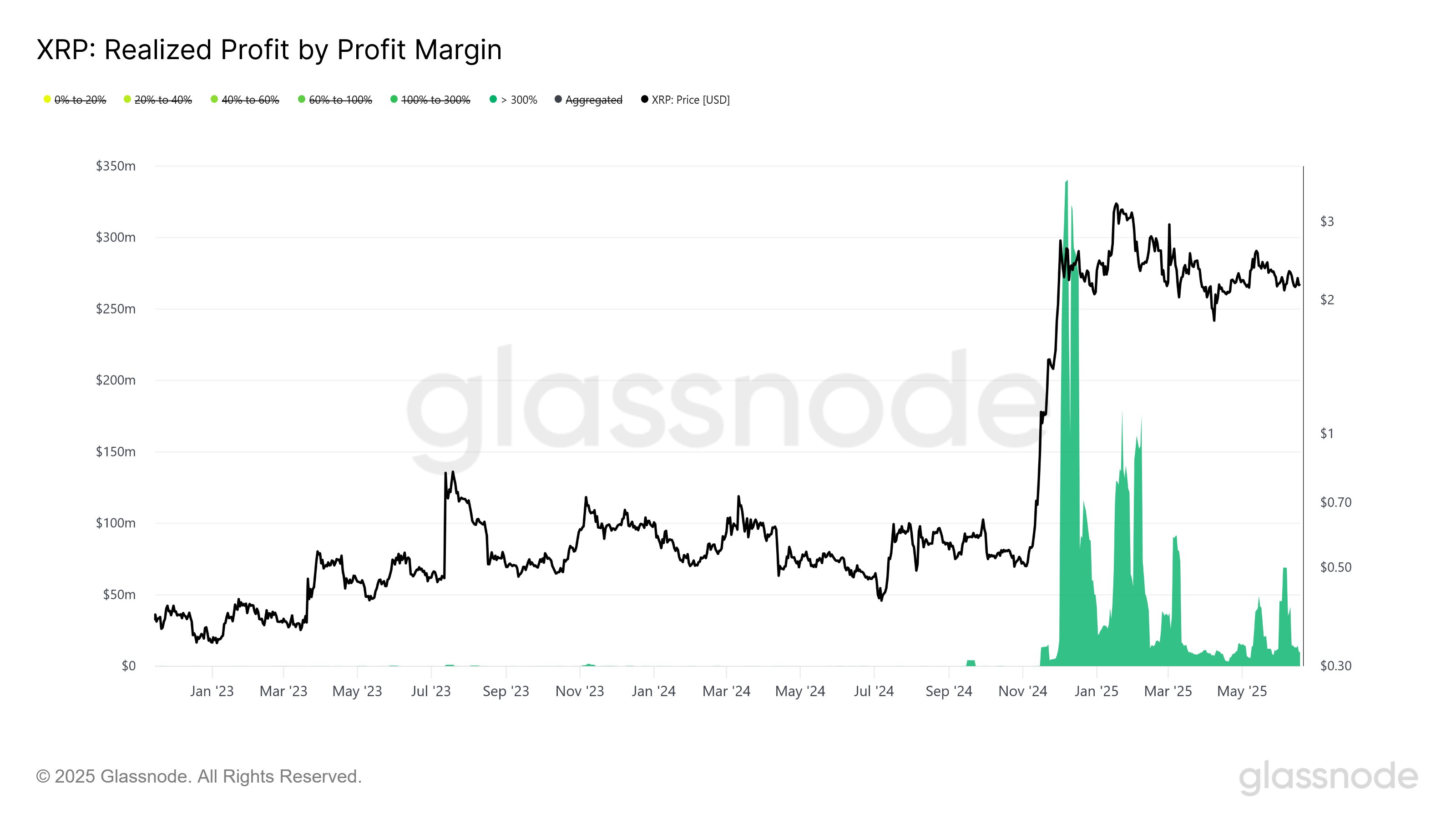
XRP Realized Profit

Looks like the value of the metric has been relatively low in recent days | Source: Glassnode on X

As displayed in the above graph, the XRP Realized Profit associated with investors carrying a profit margin of more than 300% saw a very sharp spike just after the initial price rally. This suggests that many of these early buyers didn’t wait too much to harvest their gains.

Profit-taking from the group continued in early parts of 2025, although the spikes that the indicator witnessed were of a significantly smaller scale. After March, though, selling from these investors finally calmed down.

From the chart, it’s apparent that this calm continued until this month, but the cohort ended up breaking its silence. “In early June, they began realizing profits at a pace of $68.8M per day (7D-SMA), signaling a wave of distribution by early holders,” notes Glassnode.

So far since this selling spree, things have calmed down for the XRP Realized Profit of the cohort once more, but considering that these holders have taken part in selling on a few occasions already, it’s uncertain whether this means selling pressure has become exhausted or not.

XRP Price

XRP has faced a drop of more than 2% in the last 24 hours that has brought its price back to the $2.1 level.

XRP Price Chart

The trend in the asset's price during the past five days | Source: XRPUSDT on TradingView
Featured image from Dall-E, Glassnode.com, chart from TradingView.com
Editorial Process for bitcoinist is centered on delivering thoroughly researched, accurate, and unbiased content. We uphold strict sourcing standards, and each page undergoes diligent review by our team of top technology experts and seasoned editors. This process ensures the integrity, relevance, and value of our content for our readers.

Keshav is a Physics graduate who has been employed as a writer with Bitcoinist since June 2021. He is passionate about writing and through the years, he has gained experience working in a variety of niches. Keshav holds an active interest in the cryptocurrency market, with on-chain analysis being an area he particularly likes to research and write about.

Lectures associées

Près d'une centaine de joueurs se ruent vers les données incarnées : 44,7 milliards levés en un an, qui peut vraiment gagner de l'argent en "vendant des données" ?

Près d'une centaine d'acteurs se ruent dans le secteur des données d'embodiment : 44,7 milliards de yuans levés en un an, mais qui peut vraiment gagner de l'argent en "vendant des données" ? Le secteur des données pour l'intelligence incarnée (embodiment) est en plein essor, avec 97 acteurs identifiés en Chine, dont 70 dans la collecte et 27 dans l'infrastructure. Sur un an, 15 prestataires de services indépendants spécialisés ont levé environ 44,7 milliards de yuans, un montant modeste comparé aux investissements totaux dans l'embodiment. La collecte s'organise autour de quatre approches principales : téléopération de robots physiques, collecte sans robot (via capteurs de mouvement), synthèse par simulation et distillation de vidéos internet. La plupart des acteurs combinent plusieurs méthodes. Les prestataires indépendants constituent le groupe le plus important (40%), devant les plateformes publiques (26%) et les fabricants de robots (25%). La capacité de production annuelle actuelle est estimée entre 1,6 et 1,8 million d'heures de données, avec un objectif de multiplication par 15 à 20 d'ici 1 à 3 ans. Des "usines à données" sont implantées dans 20 provinces, principalement dans les régions côtières développées. Le financement reste concentré sur des sociétés en phase précoce ; plus de la moitié des prestataires indépendants financés ont moins d'un an. La startup Lightwheel AI se distingue, ayant levé 31 milliards de yuans et atteint une valorisation de plus de 20 milliards de dollars. Cependant, les investisseurs restent prudents, aucun n'ayant effectué de pari massif sur le secteur. En résumé, le marché des données d'embodiment est devenu une piste indépendante et créatrice d'emplois, mais il en est encore à ses débuts. La viabilité commerciale d'un modèle basé sur la seule vente de données n'est pas encore démontrée. Les prochaines années seront cruciales pour vérifier si ces "vendeurs de pelles" peuvent réellement être rentables.

marsbitIl y a 1 h

Près d'une centaine de joueurs se ruent vers les données incarnées : 44,7 milliards levés en un an, qui peut vraiment gagner de l'argent en "vendant des données" ?

marsbitIl y a 1 h

Conversation avec le partenaire de Multicoin : Le marché de la cryptographie a touché le fond, trois cryptomonnaies sont prometteuses pour ce cycle

Tushar Jain, associé gérant de Multicoin Capital, estime que le marché de la cryptographie a touché le fond et entre dans un point d'inflexion, marqué par une résistance aux mauvaises nouvelles et une adoption croissante des applications. Il partage sa vision sur trois actifs principaux. Solana reste pour lui l'architecture technique idéale pour les marchés de capitaux sur internet, leader pour le trading au comptant et les actifs tokenisés. Hyperliquid domine quant à lui le segment des dérivés. Jain détient des positions importantes dans les deux, mettant en avant leurs forces complémentaires plutôt qu'une approche maximaliste. Il exprime un fort optimisme pour Zcash (ZEC), y voyant un retour aux valeurs "cypherpunk" originelles de la cryptographie et un actif de réserve de valeur au potentiel de croissance important, basé sur le consensus. Malgré un récent bug ayant provoqué une panique du marché, il considère l'incident comme mineur et a augmenté ses positions. Concernant la gestion, Jain rejette le trading actif basé sur l'analyse technique. Sa stratégie d'investissement privilégie une approche qualitative, une diversification concentrée sur les meilleures convictions, et une méthode d'accumulation en trois phases pour atténuer le risque de rater le marché. Il identifie quatre sources d'avantage concurrentiel en investissement : l'accès à l'information, l'analyse, la psychologie et les avantages structurels. Enfin, il explique que Multicoin ne vend un actif que si la thèse d'investissement est invalidée, qu'un meilleur opportunité est identifiée, ou en cas de surenchère extrême du marché, utilisant alors le Bitcoin comme réserve de valeur pour réduire le risque.

marsbitIl y a 2 h

Conversation avec le partenaire de Multicoin : Le marché de la cryptographie a touché le fond, trois cryptomonnaies sont prometteuses pour ce cycle

marsbitIl y a 2 h

Trading

Spot
活动图片