Real Vision Predicts Bitcoin Blastoff, Altcoins To Erupt Shortly: Here’s Why

bitcoinistPublié le 2025-06-21Dernière mise à jour le 2025-06-21

Résumé

Bearish exhaustion, neutral positioning, and a rare breakout in global liquidity are converging—setting the stage for what Real Vision’s Raoul...

Trusted Editorial content, reviewed by leading industry experts and seasoned editors. Ad Disclosure

Bearish exhaustion, neutral positioning, and a rare breakout in global liquidity are converging—setting the stage for what Real Vision’s Raoul Pal and chief crypto analyst Jamie Coutts describe as a potentially “violent” upside move across Bitcoin and crypto markets. In a data-heavy episode, the two analysts unpacked a sophisticated suite of models developed over the past year, culminating in a live dashboard that just flipped green on all major risk indicators.

“We’re not overheated. We’re not stretched. In fact, everything is behaving exactly as it should in a breakout regime,” said Coutts, referring to his global liquidity risk score, a framework built from central bank balance sheets, money supply aggregates, FX reserves, and US net liquidity. “And when these breakouts happen, Bitcoin’s sensitivity to liquidity can increase by a factor of five or more.”

Pal, echoing the conviction, added: “From my work, it’s straight up from here. I think we’ll be surprised to the upside—especially by how fast stuff runs.”

Bitcoin And Altcoins Set To Explode

At the heart of the discussion was Coutts’ triad of real-time market indicators: global liquidity, derivatives risk, and network profitability. These scores form the backbone of what Pal dubbed Real Vision’s “ultimate signal” for navigating crypto cycles. All three are currently sitting in a “neutral” zone, signaling neither overheating nor excessive risk—precisely the backdrop, they argue, that historically precedes massive upward repricing.

One key metric: the liquidity multiplier. Coutts explained that in typical macro regimes, Bitcoin rises roughly 7% for every 1% increase in global liquidity. But in rare post-contraction periods—like now—that multiplier jumps as high as 20%–30%. “Bitcoin becomes hypersensitive,” he said. “Every new dollar of liquidity sloshing into the system has an outsized impact.”

Importantly, the data confirms that the recent rally off April lows is supported by fundamentals. “Liquidity broke out in early April, and since then Bitcoin’s up 40%. Global liquidity is up about 2%. That’s consistent with prior breakout regimes,” Coutts observed. “People don’t realize how clean this setup is.”

Beyond Bitcoin, the conversation turned sharply toward altcoins. Using newly constructed indices—including an equal-weighted top 200 altcoin tracker—Coutts identified early signs of a “structural” alt season. His custom-built advance-decline line and MACD-style oscillator suggest breadth is quietly turning up across the crypto complex.

“Back in March and April I said the bottom was forming in alts,” he noted. “We’re now starting to see higher lows on the breadth charts. The alt season oscillator triggered in late April. It’s not explosive yet—but the structure is bullish.”

Pal concurred, pointing to the ISM and macro risk indicators as lagging but supportive. “Alt season is tightly linked to disposable income and the ISM,” he said. “Once earnings pick up and the Fed starts cutting, people will move out the risk curve. And that’s what ignites the full rotation.”

Coutts’ other key insight: on-chain data confirms that neither long-term holders nor leverage are pushing the market into frothy territory. “The derivatives risk score is low. The unrealized profit metrics are neutral. There’s no positioning blowout. If anything, the market’s underexposed,” he said.

One name that stood out across metrics was Hyperliquid, the permissionless derivatives exchange that’s drawing institutional attention. “It’s my chart of shame,” Coutts admitted. “The trend triggered at $17—I missed it—and now it’s at $42. But it has one of the cleanest product-market fits we’ve seen in crypto. The tokenomics are tight. It’s trading at a reasonable multiple. And it’s burning tokens like a growth stock.”

Other chains flagged for strong network activity and undervaluation included Tron, which generates $9 million in daily fees largely via stablecoin transfers; and L2 ecosystems that are increasingly driving Ethereum’s resurgence. While daily active addresses on Ethereum’s base chain have grown only 2% over four years, L2 adoption and ETF inflows have started to shift positioning. “Nobody owned ETH. But now flows are building,” said Coutts.

The bottom line? According to Real Vision’s top crypto minds, nearly all major signals are aligned for upside.

“Liquidity is breaking out. Positioning is clean. The altcoin breadth is improving. Fundamentals are ticking back up. The FOMO index—if we dare call it that—is low,” said Pal. “You don’t get setups like this very often. Just don’t f*** this up.”

Coutts closed with a warning and a nod to discipline: “The indicators help us know when to lean in—and when to hedge. But right now, they’re not telling us to step back. They’re telling us the runway is open.”

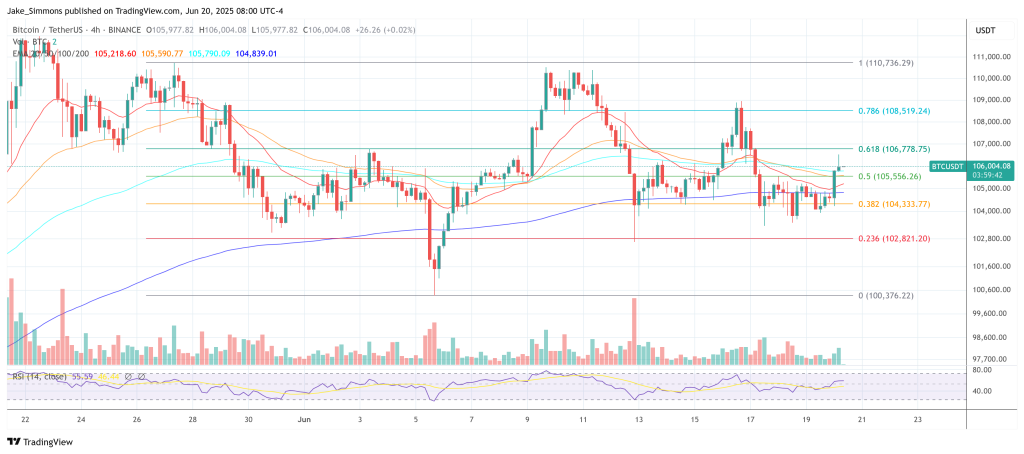
At press time, BTC traded at $106,004.
Bitcoin price
BTC rises back above the 0.5 Fib, 4-hour chart | Source: BTCUSDT on TradingView.com
Featured image created with DALL.E, chart from TradingView.com
Editorial Process for bitcoinist is centered on delivering thoroughly researched, accurate, and unbiased content. We uphold strict sourcing standards, and each page undergoes diligent review by our team of top technology experts and seasoned editors. This process ensures the integrity, relevance, and value of our content for our readers.

Jake Simmons has been a Bitcoin enthusiast since 2016. Ever since he heard about Bitcoin, he has been studying the topic every day and trying to share his knowledge with others. His goal is to contribute to Bitcoin's financial revolution, which will replace the fiat money system. Besides BTC and crypto, Jake studied Business Informatics at a university. After graduation in 2017, he has been working in the blockchain and crypto sector. You can follow Jake on Twitter at @realJakeSimmons.

Lectures associées

Près d'une centaine de joueurs se ruent vers les données incarnées : 44,7 milliards levés en un an, qui peut vraiment gagner de l'argent en "vendant des données" ?

Près d'une centaine d'acteurs se ruent dans le secteur des données d'embodiment : 44,7 milliards de yuans levés en un an, mais qui peut vraiment gagner de l'argent en "vendant des données" ? Le secteur des données pour l'intelligence incarnée (embodiment) est en plein essor, avec 97 acteurs identifiés en Chine, dont 70 dans la collecte et 27 dans l'infrastructure. Sur un an, 15 prestataires de services indépendants spécialisés ont levé environ 44,7 milliards de yuans, un montant modeste comparé aux investissements totaux dans l'embodiment. La collecte s'organise autour de quatre approches principales : téléopération de robots physiques, collecte sans robot (via capteurs de mouvement), synthèse par simulation et distillation de vidéos internet. La plupart des acteurs combinent plusieurs méthodes. Les prestataires indépendants constituent le groupe le plus important (40%), devant les plateformes publiques (26%) et les fabricants de robots (25%). La capacité de production annuelle actuelle est estimée entre 1,6 et 1,8 million d'heures de données, avec un objectif de multiplication par 15 à 20 d'ici 1 à 3 ans. Des "usines à données" sont implantées dans 20 provinces, principalement dans les régions côtières développées. Le financement reste concentré sur des sociétés en phase précoce ; plus de la moitié des prestataires indépendants financés ont moins d'un an. La startup Lightwheel AI se distingue, ayant levé 31 milliards de yuans et atteint une valorisation de plus de 20 milliards de dollars. Cependant, les investisseurs restent prudents, aucun n'ayant effectué de pari massif sur le secteur. En résumé, le marché des données d'embodiment est devenu une piste indépendante et créatrice d'emplois, mais il en est encore à ses débuts. La viabilité commerciale d'un modèle basé sur la seule vente de données n'est pas encore démontrée. Les prochaines années seront cruciales pour vérifier si ces "vendeurs de pelles" peuvent réellement être rentables.

marsbitIl y a 2 h

Près d'une centaine de joueurs se ruent vers les données incarnées : 44,7 milliards levés en un an, qui peut vraiment gagner de l'argent en "vendant des données" ?

marsbitIl y a 2 h

Conversation avec le partenaire de Multicoin : Le marché de la cryptographie a touché le fond, trois cryptomonnaies sont prometteuses pour ce cycle

Tushar Jain, associé gérant de Multicoin Capital, estime que le marché de la cryptographie a touché le fond et entre dans un point d'inflexion, marqué par une résistance aux mauvaises nouvelles et une adoption croissante des applications. Il partage sa vision sur trois actifs principaux. Solana reste pour lui l'architecture technique idéale pour les marchés de capitaux sur internet, leader pour le trading au comptant et les actifs tokenisés. Hyperliquid domine quant à lui le segment des dérivés. Jain détient des positions importantes dans les deux, mettant en avant leurs forces complémentaires plutôt qu'une approche maximaliste. Il exprime un fort optimisme pour Zcash (ZEC), y voyant un retour aux valeurs "cypherpunk" originelles de la cryptographie et un actif de réserve de valeur au potentiel de croissance important, basé sur le consensus. Malgré un récent bug ayant provoqué une panique du marché, il considère l'incident comme mineur et a augmenté ses positions. Concernant la gestion, Jain rejette le trading actif basé sur l'analyse technique. Sa stratégie d'investissement privilégie une approche qualitative, une diversification concentrée sur les meilleures convictions, et une méthode d'accumulation en trois phases pour atténuer le risque de rater le marché. Il identifie quatre sources d'avantage concurrentiel en investissement : l'accès à l'information, l'analyse, la psychologie et les avantages structurels. Enfin, il explique que Multicoin ne vend un actif que si la thèse d'investissement est invalidée, qu'un meilleur opportunité est identifiée, ou en cas de surenchère extrême du marché, utilisant alors le Bitcoin comme réserve de valeur pour réduire le risque.

marsbitIl y a 3 h

Conversation avec le partenaire de Multicoin : Le marché de la cryptographie a touché le fond, trois cryptomonnaies sont prometteuses pour ce cycle

marsbitIl y a 3 h

Trading

Spot
活动图片