In The Shadows: Two-Thirds Of Crypto Miners Still Unregistered In Russia

bitcoinistPublié le 2025-06-20Dernière mise à jour le 2025-06-20

Résumé

Russia’s Deputy Minister of Finance revealed that only one-third of crypto mining firms are operating legally despite the new law...

Trusted Editorial content, reviewed by leading industry experts and seasoned editors. Ad Disclosure

Russia’s Deputy Minister of Finance revealed that only one-third of crypto mining firms are operating legally despite the new law requiring mining entities to register with the Federal Tax Service (FTS).

Crypto Miners Operating In The Shadows

On Thursday, Russia’s state news agency TASS reported that more than half of crypto mining companies are still operating without registration with the Federal Tax Service. According to the report, Deputy Minister of Finance Ivan Chebeskov stated that only 30% of miners have registered since the new law came into effect in November 2024.

For context, the Russian government approved a law in August of last year to legalize crypto mining in the country. The legislation, enacted on November 1, 2024, aims to combat illegal mining activity and offer exclusive rights to entities registered with the FTS. By December 2024, over 100 mining companies had filed their application.

As reported by Bitcoinist, FTS’s Head Daniil Yegorov revealed that 150 firms had applied for registration just one month after the law was enacted. However, he considered the number was low and expected a larger number of applicants in the coming months.

Seven months later, the number is still low, as only one-third of mining entities have applied to register. Another two-thirds need to come clean and enter the register,” Chebeskov affirmed at the 28th St. Petersburg International Economic Forum (SPIEF).

The Deputy Minister of Finance asserted that the goal was to legalize the mining sector and “bring this industry out of the shadows as much as possible.” He also noted that they have not achieved their objective, adding that the Ministry will work to complete it.

We have not yet completed this process. So far, only 30% of all miners have been entered into the register maintained by the Federal Tax Service, and this process is still far from complete (…) Therefore, we will work to complete this process.

Russian Authorities To Tighten Rules

Notably, the Ministry of Digital Development is reportedly working on adding a new article to the Code of Administrative Offenses (CoAO) to provide fines for illegal mining and failure to provide information about mined crypto.

According to recent reports, the amendment, which is undergoing interdepartmental review, could introduce four types of offenses, three of which will be related to crypto mining.

Additionally, judges would gain the authority to confiscate crypto assets from anyone mining illegally, aiming to stop unregistered operations in Russia. The amendment would also tackle crypto payments, imposing fines on those who transact outside the Central Bank’s Sandbox.

In April, Russian Finance Minister Anton Siluanov announced a plan to establish a dedicated exchange for “highly qualified investors” alongside the Bank of Russia (BOR), aiming to “legalize crypto assets and bring crypto operations out of the shadows.”
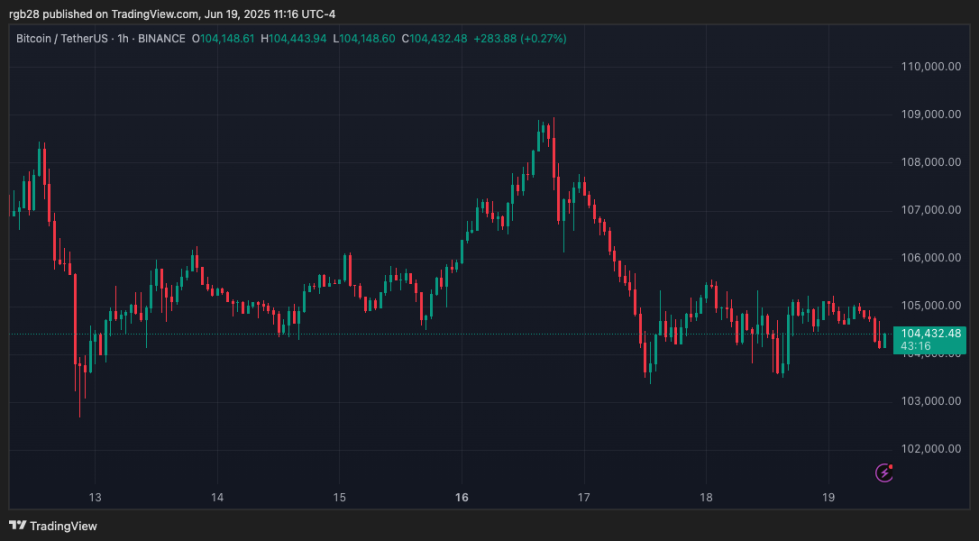
crypto, Bitcoin, BTC, BTCUSDT

Bitcoin (BTC) trades at $104,432 in the one-week chart. Source: BTCUSDT on TradingView.
Featured Image from Unsplash.com, Chart from TradingView.com
Editorial Process for bitcoinist is centered on delivering thoroughly researched, accurate, and unbiased content. We uphold strict sourcing standards, and each page undergoes diligent review by our team of top technology experts and seasoned editors. This process ensures the integrity, relevance, and value of our content for our readers.

Rubmar is a crypto enthusiast who likes learning and improving constantly. She enjoys reporting on the latest news and developments in the crypto industry. Rubmar also enjoys scrapbooking, crafting, simulation games, and watching football.

Lectures associées

Près d'une centaine de joueurs se ruent vers les données incarnées : 44,7 milliards levés en un an, qui peut vraiment gagner de l'argent en "vendant des données" ?

Près d'une centaine d'acteurs se ruent dans le secteur des données d'embodiment : 44,7 milliards de yuans levés en un an, mais qui peut vraiment gagner de l'argent en "vendant des données" ? Le secteur des données pour l'intelligence incarnée (embodiment) est en plein essor, avec 97 acteurs identifiés en Chine, dont 70 dans la collecte et 27 dans l'infrastructure. Sur un an, 15 prestataires de services indépendants spécialisés ont levé environ 44,7 milliards de yuans, un montant modeste comparé aux investissements totaux dans l'embodiment. La collecte s'organise autour de quatre approches principales : téléopération de robots physiques, collecte sans robot (via capteurs de mouvement), synthèse par simulation et distillation de vidéos internet. La plupart des acteurs combinent plusieurs méthodes. Les prestataires indépendants constituent le groupe le plus important (40%), devant les plateformes publiques (26%) et les fabricants de robots (25%). La capacité de production annuelle actuelle est estimée entre 1,6 et 1,8 million d'heures de données, avec un objectif de multiplication par 15 à 20 d'ici 1 à 3 ans. Des "usines à données" sont implantées dans 20 provinces, principalement dans les régions côtières développées. Le financement reste concentré sur des sociétés en phase précoce ; plus de la moitié des prestataires indépendants financés ont moins d'un an. La startup Lightwheel AI se distingue, ayant levé 31 milliards de yuans et atteint une valorisation de plus de 20 milliards de dollars. Cependant, les investisseurs restent prudents, aucun n'ayant effectué de pari massif sur le secteur. En résumé, le marché des données d'embodiment est devenu une piste indépendante et créatrice d'emplois, mais il en est encore à ses débuts. La viabilité commerciale d'un modèle basé sur la seule vente de données n'est pas encore démontrée. Les prochaines années seront cruciales pour vérifier si ces "vendeurs de pelles" peuvent réellement être rentables.

marsbitIl y a 37 mins

Près d'une centaine de joueurs se ruent vers les données incarnées : 44,7 milliards levés en un an, qui peut vraiment gagner de l'argent en "vendant des données" ?

marsbitIl y a 37 mins

Conversation avec le partenaire de Multicoin : Le marché de la cryptographie a touché le fond, trois cryptomonnaies sont prometteuses pour ce cycle

Tushar Jain, associé gérant de Multicoin Capital, estime que le marché de la cryptographie a touché le fond et entre dans un point d'inflexion, marqué par une résistance aux mauvaises nouvelles et une adoption croissante des applications. Il partage sa vision sur trois actifs principaux. Solana reste pour lui l'architecture technique idéale pour les marchés de capitaux sur internet, leader pour le trading au comptant et les actifs tokenisés. Hyperliquid domine quant à lui le segment des dérivés. Jain détient des positions importantes dans les deux, mettant en avant leurs forces complémentaires plutôt qu'une approche maximaliste. Il exprime un fort optimisme pour Zcash (ZEC), y voyant un retour aux valeurs "cypherpunk" originelles de la cryptographie et un actif de réserve de valeur au potentiel de croissance important, basé sur le consensus. Malgré un récent bug ayant provoqué une panique du marché, il considère l'incident comme mineur et a augmenté ses positions. Concernant la gestion, Jain rejette le trading actif basé sur l'analyse technique. Sa stratégie d'investissement privilégie une approche qualitative, une diversification concentrée sur les meilleures convictions, et une méthode d'accumulation en trois phases pour atténuer le risque de rater le marché. Il identifie quatre sources d'avantage concurrentiel en investissement : l'accès à l'information, l'analyse, la psychologie et les avantages structurels. Enfin, il explique que Multicoin ne vend un actif que si la thèse d'investissement est invalidée, qu'un meilleur opportunité est identifiée, ou en cas de surenchère extrême du marché, utilisant alors le Bitcoin comme réserve de valeur pour réduire le risque.

marsbitIl y a 1 h

Conversation avec le partenaire de Multicoin : Le marché de la cryptographie a touché le fond, trois cryptomonnaies sont prometteuses pour ce cycle

marsbitIl y a 1 h

Trading

Spot
活动图片