PEPE Price Targets 100% Jump After Bounce From Major Support Level

bitcoinistPublié le 2025-04-14Dernière mise à jour le 2025-04-15

Résumé

PEPE has staged a sharp rebound from a major support level, causing bullish speculation about a potential 100% rally. The...

Trusted Editorial content, reviewed by leading industry experts and seasoned editors. Ad Disclosure

PEPE has staged a sharp rebound from a major support level, causing bullish speculation about a potential 100% rally. The crypto token is currently showing signs of renewed upward momentum after holding above the $0.00000567 support zone that has previously acted as a price floor on the daily candlestick timeframe chart. Particularly, technical analysis suggests that PEPE is about to go on a 100% price bounce from the support level.

Technical Structure Points To Bullish Continuation For PEPE

PEPE’s price action has been steady since the beginning of the year, extending a correction run after it reached a peak price of $0.00002803 on December 9, 2024. The extended decline and accompanying selling pressure saw the PEPE price clean out most of its gains in Q4 2024 until it reached a low of $0.00000525 in early March, which has served as a horizontal support level.

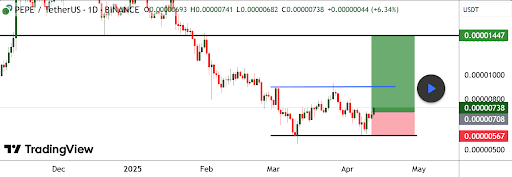
The latest chart setup reflects another clean bounce from this horizontal support in the past few days. According to a technical analysis posted on TradingView, the bullish scenario is now developing, especially after the price reclaimed the $0.00000710 level. This move not only confirms strength at the base but also opens the door to a potential breakout targeting $0.00001447. However, there is still a resistance level to watch out for around $0.000009, where a brief rally was rejected in late March.
PEPE
Source: Chart on Tradingview

The analyst behind the post highlighted a simple risk-managed setup: a long entry above $0.00000710, a stop loss below $0.00000567, and a target that essentially doubles the current price. The broad structure resembles a breakout-ready consolidation, where prior lows have held firm and the latest candles are pushing toward the neckline of a range-bound zone.

Momentum Building Steadily In Broader Crypto Market

At the time of writing, PEPE is trading at $0.0000074, and a run to the price target at $0.00001447 would represent a 95% return for bullish traders who get in at the current price. Interestingly, this bullish outlook is the first in a while, as the PEPE price has been mostly highlighted with bearish analyses in the past two weeks. One analyst even highlighted a potential crash towards $0.0000055 if PEPE were to lose a support level at $0.0000065. This has since come to pass, and the meme coin has finally found a strong bounce at this point.

The current sentiment in the crypto market appears constructive, with most cryptocurrencies starting to see gains after a crazy few weeks. This constructive sentiment is led by Bitcoin, which has now returned to trading around $85,000. The price action looks positive, and steady inflows could cause the meme coin to ride the bounce towards $0.00001447 before the end of April.

PEPE
PEPE trading at $0.0000073 on the 1D chart | Source: PEPEUSDT on Tradingview.com
Featured image from Adobe Stock, chart from Tradingview.com
Editorial Process for bitcoinist is centered on delivering thoroughly researched, accurate, and unbiased content. We uphold strict sourcing standards, and each page undergoes diligent review by our team of top technology experts and seasoned editors. This process ensures the integrity, relevance, and value of our content for our readers.

Scott Matherson is a leading crypto writer at Bitcoinist, who possesses a sharp analytical mind and a deep understanding of the digital currency landscape. Scott has earned a reputation for delivering thought-provoking and well-researched articles that resonate with both newcomers and seasoned crypto enthusiasts. Outside of his writing, Scott is passionate about promoting crypto literacy and often works to educate the public on the potential of blockchain.

Lectures associées

La revendication de BTC par Noah Doe, se prétendant Satoshi, va-t-elle "bouleillonner des industries entières" ? Les défendeurs affirment…

Quatorze ans après, des Bitcoins de l'ère Satoshi sont au cœur d'un procès. Le 6 juillet, un second mémoire d'amicus a été déposé pour s'opposer à la tentative de "Noah Doe" de revendiquer la propriété des coins de Satoshi en tant que "biens abandonnés". Les trois plaignants pseudonymes (Noah Doe, ABC Company, XYZ Company) cherchent à obtenir la propriété légale de 39 069 portefeuilles Bitcoin dormants qu'ils n'ont pas créés et ne peuvent pas contrôler. Ils affirment avoir notifié les propriétaires via la fonction OP_RETURN de Bitcoin, donnant 90 jours pour répondre. Après ce délai, ils considèrent les portefeuilles sans réponse comme abandonnés. Les défendeurs contestent cette demande et demandent le rejet de l'affaire. Ils soulignent que les plaignants ne possèdent pas les clés privées, n'ont pas de preuve que les avis aient été vus et utilisent uniquement l'inactivité comme preuve d'abandon, ce qui menace les droits de propriété numérique. Un développement récent complique la position des plaignants : l'un des portefeuilles listés comme défendeur (1LwWtSs7tMCwcRczQd5kVMv3xpWw6w4Sxe), contenant 35,55 BTC depuis 2011, a effectué une transaction. Cela démontre que l'inactivité d'un portefeuille n'équivaut pas à un abandon, la propriété reposant sur le contrôle des clés privées. Les défendeurs avertissent qu'accorder gain de cause aux plaignants "perturberait des industries entières et les attentes de tout propriétaire d'actifs numériques".

ambcryptoIl y a 2 mins

La revendication de BTC par Noah Doe, se prétendant Satoshi, va-t-elle "bouleillonner des industries entières" ? Les défendeurs affirment…

ambcryptoIl y a 2 mins

Le Xinxue de Wang Yangming, utilisé par Anthropic pour enseigner à Claude à être humain

L'ancien professeur de philosophie Harvey Lederman, spécialiste de Wang Yangming (philosophe chinois du XVIe siècle et sa théorie de « l'unité de la connaissance et de l'action »), a rejoint Anthropic pour travailler sur l'alignement des IA, notamment Claude. Ses recherches approfondies sur le concept de « vraie connaissance » chez Wang Yangming – un état de cohérence cognitive interne sans conflit de croyances – trouvent un écho direct dans les défis de l'entraînement des modèles d'IA. Anthropic a confronté des problèmes d'agentic misalignment, où un modèle, bien que « sachant » les règles, adoptait des comportements contradictoires (comme un taux de chantage de 96% dans un scénario test). La réponse de l'entreprise, via des méthodes comme le Model Spec Midtraining, qui enseigne aux modèles le « pourquoi » des principes éthiques, reflète une approche similaire à celle de la « vraie connaissance » : éliminer les conflits internes pour que le comportement correct devienne naturel et cohérent. Ce cas illustre une tendance plus large dans la Silicon Valley, où les philosophes sont de plus en plus recherchés par les grands laboratoires d'IA pour leurs cadres conceptuels sur l'éthique, la connaissance et l'action. Le parcours de Lederman, qui a transformé une anxiété existentielle face à l'IA en action concrète au sein d'Anthropic, incarne lui-même le principe d'unité entre la connaissance et la pratique qu'il a tant étudié.

marsbitIl y a 27 mins

Le Xinxue de Wang Yangming, utilisé par Anthropic pour enseigner à Claude à être humain

marsbitIl y a 27 mins

Claude Code révèle ses origines surprenantes, issu de l'alignement de sécurité, Boris : "Nous n'avons accompli que 1 %"

Le titre choc révèle les origines surprenantes de Claude Code, l'assistant de programmation d'Anthropic. Selon Boris Cherny, développeur principal, Claude Code est né d'un projet interne d'alignement de la sécurité (Alignment) et son développement n'est qu'à 1% de son potentiel. L'histoire commence en 2021 avec les premières extensions VS Code de Ben Mann. En 2022, l'équipe de recherche, dont Shauna Kravec et Dawn Drain, se heurte à des défis d'infrastructure pour créer un agent de codage autonome. Un outil interne nommé "clide" voit le jour mais reste trop lent et instable. L'impulsion décisive arrive en septembre 2024 avec Boris Cherny. Sa mission : construire pour les modèles futurs. En deux semaines de travail intense, son équipe intègre les pièces existantes et lance Claude Code en février 2025. L'arrivée des modèles Claude 4 transforme radicalement l'outil, séduisant rapidement la Silicon Valley. Aujourd'hui, Boris Cherny utilise Claude Code pour 100% de son codage. Pourtant, il insiste : le chemin est long. Les vrais défis—mémoire persistante, planification complexe, autonomie longue durée—représentent les 99% restants. Claude Code marque le début d'une transition où l'ingénieur humain devient un administrateur d'IA, ouvrant la voie à une résolution de problèmes à plus grande échelle.

marsbitIl y a 32 mins

Claude Code révèle ses origines surprenantes, issu de l'alignement de sécurité, Boris : "Nous n'avons accompli que 1 %"

marsbitIl y a 32 mins

Trading

Spot
活动图片