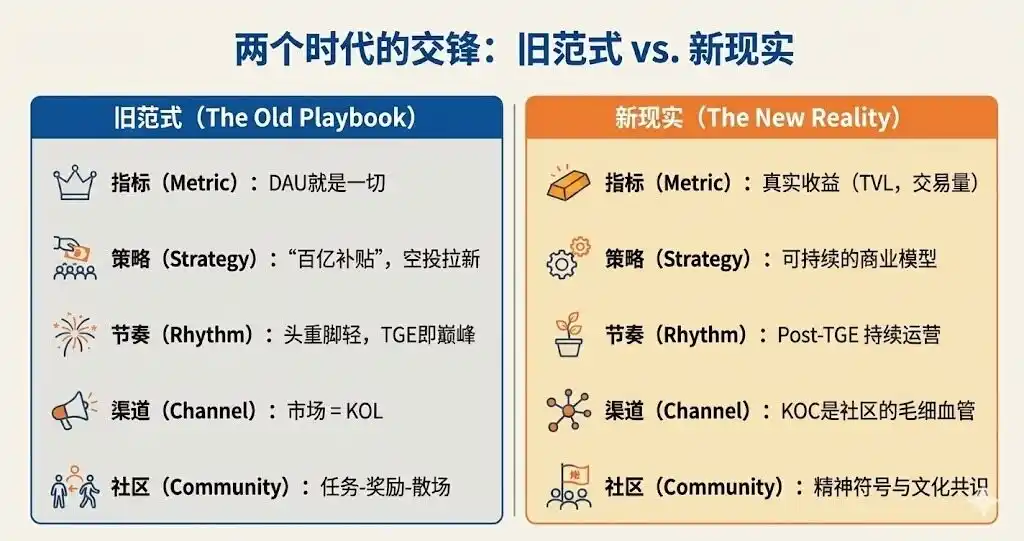
In 2025, the changes in market activities are clear: project teams are forced to shift from the previous excessive pursuit of "seemingly prosperous" DAU to pragmatic goals such as trading volume and TVL—data metrics that directly generate revenue. As a result, activity templates have decreased, activity mechanics have become simpler, and both project teams and users have adopted a more pragmatic mindset. Users are now more concerned about the safety of their principal and the certainty of returns, while project teams are more focused on obtaining real liquidity, genuine trading users, and a sustainable business growth curve that can be recognized by platforms and the market before token listing.
In a nutshell, 2025 is the "first year of new settlement metrics" and also the "first year of entrance competition." When growth goals shift to "fund retention/trading occurrence" based on actual benefits or value, competition naturally turns to "who can better retain users' fund-related behaviors within their own ecosystem."
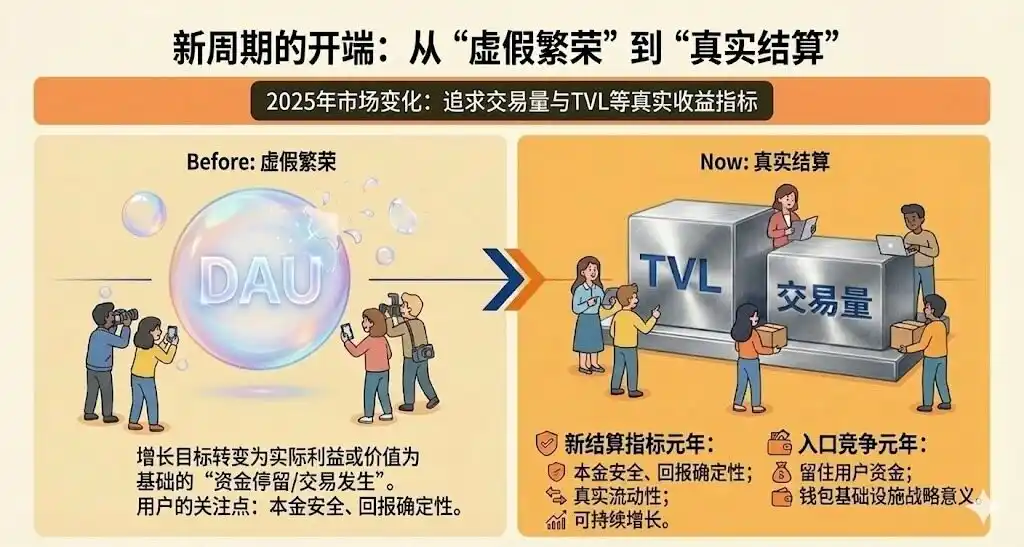
This is why wallets are being redefined in terms of strategic significance. Taking Binance as an example, the Binance Wallet has gradually become a new ecosystem entrance: main site引流, pre-listing project pools, and points and tasks that bind trading behaviors into the product. What the platform wants is not just lively participation numbers, but sustainable liquidity and users who can continuously generate trades. Activities are no longer just one-sided subsidies from project teams but a three-party interest structure involving the platform, the project, and the user: the platform uses liquidity and trading users as advantages, the project team uses tokens and budgets to exchange for traffic and trading behaviors, and users use attention and trading to obtain predictable returns.
But the harsh reality of 2025 lies here: the more pragmatic the activity expectations, the more compressed the attention cycle becomes, and the "freshness period" of new projects is incredibly short. Once TGE occurs, market attention to the project drops sharply. As a result, project teams concentrate resources on pre-TGE launches and sprints, while post-TGE continuous operations are chronically underestimated, gradually becoming a hollow zone. Whether a project continues to work and remain active after TGE is perceptible to users, but the reality is that not many projects can maintain an active state after listing. On one hand, projects with sustainable, essential business models are limited; on the other hand, project teams often do not prioritize continuous operations after TGE. Once a project enters a silent period after listing, it becomes more difficult and expensive to bring users back—this is a warning left by 2025 and a challenge that must be addressed head-on in 2026.
Deeper still is the cultural断层: many projects build impressive pre-listing numbers but neglect that long-term consensus requires culture and spiritual symbols to承接. The relationship between the community and the founding team increasingly becomes a one-time cooperation of "completing tasks—receiving rewards—disbanding." Projects are forceful in data but hollow in culture, or除了撸羊毛后一起做空砸盘外没有任何的社区共识; at the same time, project teams over-rely on KOLs. More and more activities are exclusively designed for KOLs, pulling KOLs away from the basic user群体, turning the community from participants into spectators. When projects only care about the KOL群体, it反而 creates a sense of opposition with retail investors. Additionally, KOC (Key Opinion Consumer)—core individuals in the community who participate long-term, are willing to produce content长期, and spread spontaneously—are often overlooked.
This "2025 Web3 Market Annual White Paper" will unfold around three levels:
- Review the most representative market activity types of 2025: platform-type activities, TVL deposit-type activities, community-type participation activities, simplified narrative & promotional rhythm dissemination, and clarify their respective driving mechanisms and result amplification methods.
- Summarize the共同转向 of project teams and user mindsets in 2025: users value certainty and兑现able returns more, project teams treat market activities more as tools to obtain liquidity, trading users, and pre-listing momentum, while attention cycles shorten, post-TGE空心化 expands, and culture and community management are chronically underestimated.
- Outlook for 2026: how these activity logics will continue to evolve, and the core trends and challenges that project teams need to face head-on.
- Thank you for reading this far. If you are not a project team marketing staff, you can skip directly to Part 3.
Notable Project Marketing in 2025
For project teams, because user behavior and psychological states change every year, attention flow and distribution channels also change. So before designing long-term strategic marketing, three things must be clear. First, which type of user do you want to capture? Second, what benefits can you give them? (Preferably, this benefit is not透支 your own token but provided by a third party). Jiayi has elaborated in previous posts on how to design a "wool comes from the pig" core商业长期 marketing strategy method for further reading. Third, is your activity smooth for participants to join, are there any bugs to exploit? And the art of balancing the interests of studios and current task metrics.
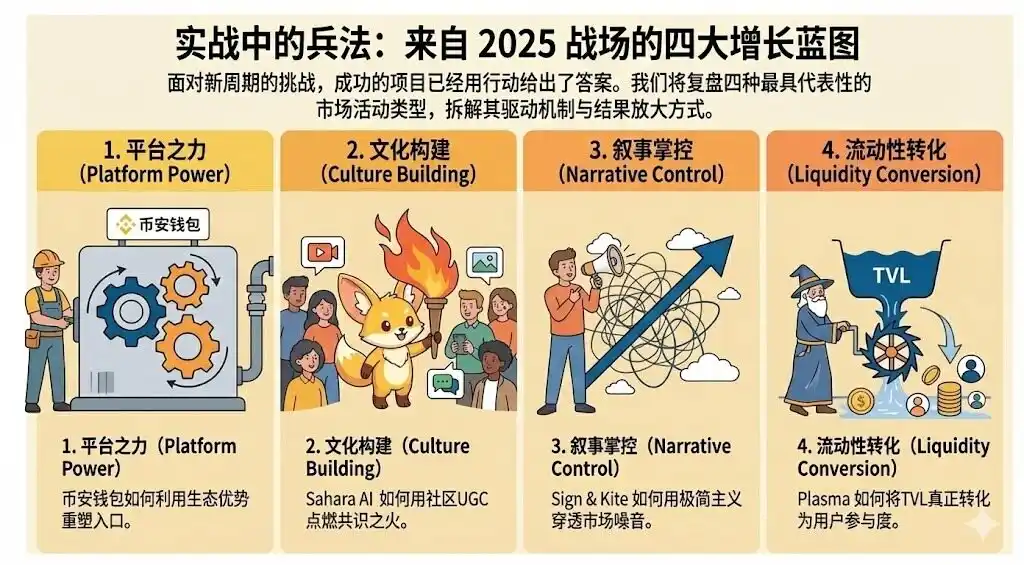
2.1 Using Core Advantages to Exchange for Target Object Token Benefits to Plunder the Market – Representative Case: Binance Wallet Overwhelmingly Surpasses OKX Wallet to Secure the Top Spot
Wallets were once passive tools but have now become marketable marketing infrastructure. @Binance Alpha is a typical case of high alignment between platform capabilities and user motivation. It also surpassed the OKX wallet and left it far behind using the aforementioned commercial long-term marketing strategy method.
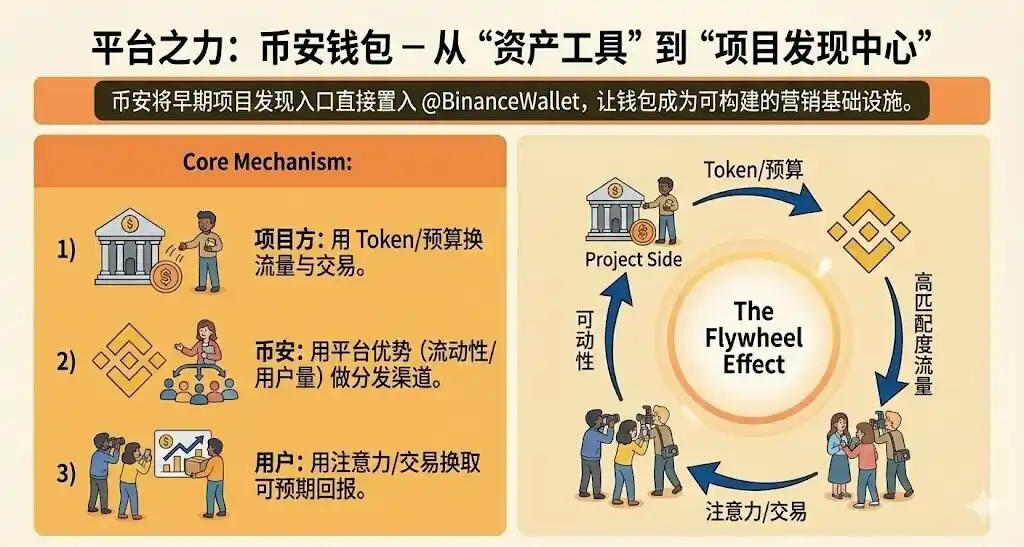
Binance Alpha is a true breakthrough innovation in crypto marketing. The key change is: wallets have changed from "asset deposit and withdrawal tools" to "project discovery centers." Binance placed the early project discovery entrance directly into @BinanceWallet. Users no longer need to go to external platforms to find new projects but can explore projects and receive incentives within the wallet. Binance Alpha highlights projects with momentum, and if a project performs well enough on Alpha, it has the opportunity to be considered for the spot list in the future. The entire system forms a positive cycle:
Projects want exposure and traffic → Users join and receive rewards → Projects get well-matched new users → Binance gains higher wallet usage and more trading activity.
In the Binance Alpha system, the most critical point is: rewards are given to users who really trade, can bring liquidity, and are willing to pursue new projects. Binance's advantage is liquidity and user volume, and Alpha只是 turns these two advantages into a more efficient distribution channel, while further squeezing the living space of second and third-tier exchanges:
- Project teams provide tokens as cost → Exchange for Binance's exposure and traffic,争取 liquidity + further listing
- Binance uses the wallet to导入 users → Users generate trading behavior
- Users trade and complete tasks → Exchange for rewards → Simultaneously contribute trading and liquidity to the project.
Binance needs to maintain the user structure within Alpha that can generate trades. As projects develop, the user structure also changes, so it is necessary to continuously optimize mechanisms and activities to let users who provide core value to projects躺赢.
2.2 From Marketing Entirely Centered on KOLs to Emphasizing Overall Community Culture Building – Different Voice Marketing Strategies from Kaito to Sahara
In the first half of 2025, an innovative project @KaitoAI that solved project teams' public traffic attention emerged, and most project teams began to围绕 Kaito activities as the main marketing channel. But Kaito's incentive structure was originally more偏向 "those with greater influence are更容易 seen and rewarded." Thus, market promotion formed a fixed route: projects want声量, cooperate with KOLs, KOLs produce content, and ordinary users come to watch. The whole process can indeed be lively for a while, but retail community participation is weak, and the common memory of the project is that it is an advertisement by KOLs for airdrops, leading to defensive awareness. And, the project's traffic is therefore first gathered to the Kaito platform. From Kaito's perspective, Kaito is undoubtedly successful. Because it is working according to the core laws of strategic activity design I mentioned before.
UGC conversion from third-party platforms to self-platform started with XDO's client @SaharaAI doing an ICO on @buidlpad. Its starting point for UGC was "to let the community play, let the community participate and benefit before the project issues tokens." Sahara's UGC activities did not rely on giving away money, nor did they let users刷 tasks, nor did they set up various leaderboards. First, they released a clear cultural symbol representing the Sahara AI community and brand—the mascot Bitsy (the ears on my avatar now represent Bitsy's big ears, really super cute, so much so that I am still using them). Then,配合 Sahara's ICO timing on @buidlpad, they encouraged community evangelists to better participate early in the ICO qualification. This group no longer only focuses on free tokens but is本身对项目有信任度的狂爱目标群体.
You will see many users not just doing homework but sincerely expressing themselves as Sahara people. Some used AI to make videos, some drew pictures, some wrote serial novels, some made promotional music and shot MVs for the community, and some even wrote diaries by hand every day, recording their点滴 in the Sahara community, why they like Bitsy and the Sahara AI team. When users are willing to use diary writing to record their story in the buidl project, it means they have already regarded the project and community as part of their own life story.
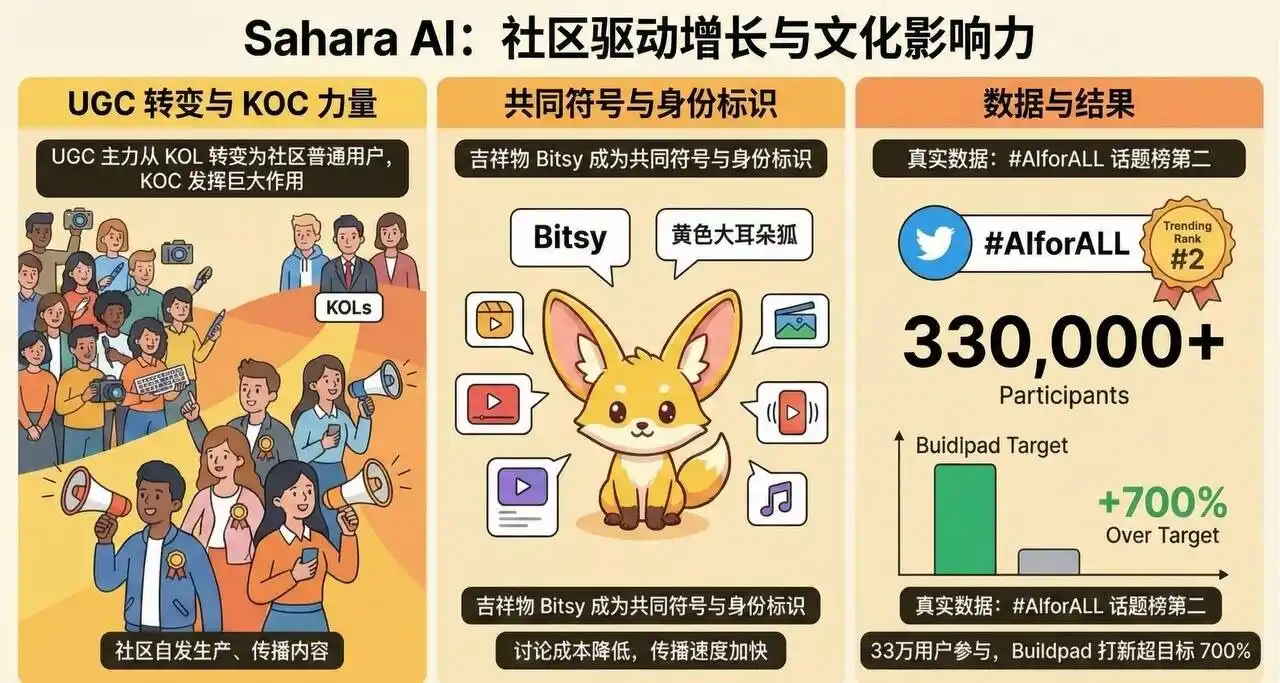
- The main force of this UGC activity shifted from the KOL群体 to ordinary community users. The KOC users I mentioned above played a huge role in this activity. Sahara AI's UGC content was no longer concentrated in the hands of a few people; the community began to spontaneously produce and spread it.
- The community had a common language, common symbols, and shared memories with the Sahara AI team. The mascot Bitsy became a meme and identity marker that everyone in the community understood. Everyone knew it was Sahara AI when they saw the yellow big-eared fox. Discussion costs decreased, and传播速度 increased.
- The real data brought by community sentiment diffusion: the activity topic #AIforALL reached second place on Twitter's trending list, and the entire activity also involved 330,000 users. Sahara's打新 on Buidlpad also exceeded the original target by 700%.
- There was no shortage of user刷量 behavior here. However, the final reward was ICO participation eligibility, and the team manually screened every UGC creator's content. So the ROI was extremely high, and based on this result and innovation, the ICO UGC activity was also continued by Buidlpad as a常规保留节目.
But Sahara AI also has a regret: Sahara's UGC activity could ignite the community for a month in the market, but it did not follow up with sustainable cultural extension, and the heat dropped back. This is a common problem for many projects: they only know how to ignite the fire but not how to add fuel. Although Sahara has proven to the market that culture can retain users, only continuous cultural output and community mechanism can become a "religious" firewall and a long-term moat. Cultural continuation after TGE must continue, even more vigorously.
2.3 Simple Slogan + Precise Rhythm Control = Beautiful Pre-listing Sentiment; Marketing Rhythm Control for Sign, Kite-type Projects (To B, weak community体感, products difficult to perceive)
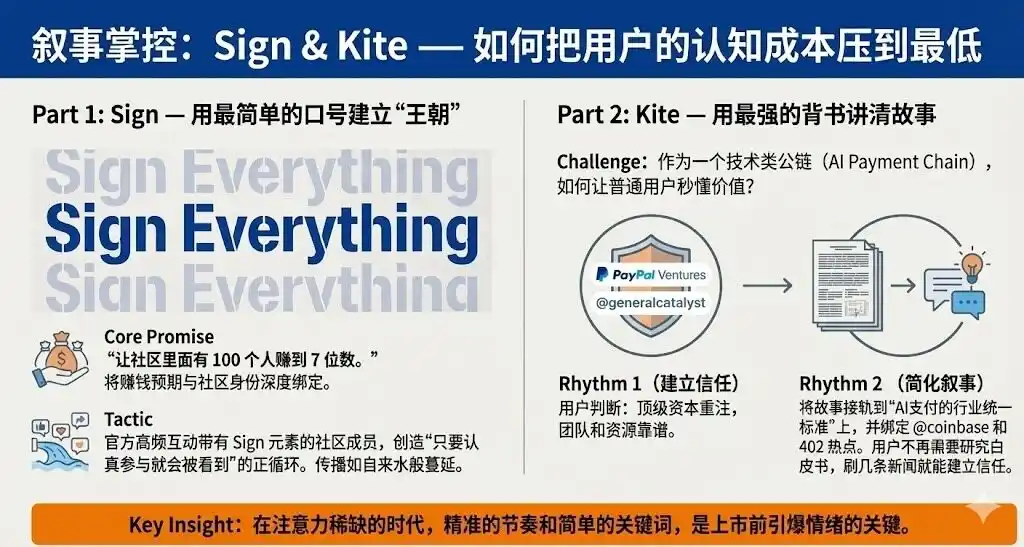
@sign created an Web3 orange dynasty through the slogan "Sign Everything." Sign's rhythm goal was to first make the core群体 big and strong, and how to use the simplest slogan洗脑式 to make users equate Sign with big projects. It must be known that for the market, Sign does not belong to the category of projects that can be quickly established as 'king' through technical or product narratives. Founder @realyanxin once said: "What is important is whether we can have 100 people in our community赚到 7 figures." He also mentioned that after TGE, the foundation will use tokens to support internal entrepreneurship within the community, essentially making the community recognize that "following Sign can make money, TGE is not the end but the beginning of the next stage."
I still remember that during the period of high Sign热度, Yan Xin and Sign's community official account interacted very frequently with users, and would优先互动 those with Sign elements on their Twitter profile page. This gave users clear feedback: as long as you participate seriously, as long as you are "one of us," you will always be seen by the official (see the sign). Being seen就有可能成为 Sign让你赚钱的社区成员之一. Sign's传播 was more like自来水, everyone does some simple things together, then the official gives full affirmation, the community shares tweets to help each other like, users optimize and package their own accounts, etc., slowly forming a positive cycle where the more users participate, the more easily they are seen, and the more willing they are to continue participating.
Another one is @GoKiteAI, which used极简 keywords and precise rhythm to convey the project's value to ordinary users and quickly 'align' community cognition. Kite, as a public chain with AI technology as its core advantage for AI-era payment, such technical projects are most worried that the project team does not speak human language, and users cannot see your differentiated value.补充一下, the early cryptocurrency industry公链 not speaking human language would make users more fomo, but this era has long been淘汰.
Kite's first拍节奏 made people see names like @PayPal Ventures, @generalcatalyst, reducing uncertainty and providing preliminary credibility anchor points, allowing users to complete a most realistic judgment in their minds: if even PayPal, the king of the payment track, is willing to heavily invest in Kite as a bet on the AI payment track, then at least it means the team's technical ability is reliable, capital resource ability is strong, and the possibility of becoming a leader is放大.
The second拍节奏 was that Kite AI connected its story to the payment standard that the AI payment industry would uniformly use, which made community users instantly understand what it was doing. Kite很清楚的是, the narrative of AI Payment Chain is本来就难讲, if乖乖给用户解释 "how AI agents pay, how to settle..." most people can't understand nor have the patience to understand. So Kite first made you believe that the project is on the path that the mainstream will take. Kite utilized the当时 402 and paypal热点, released紧凑时间内依次, 402 cooperation & @coinbase investment, paypal cooperation and other利好. By pushing x402 towards a universal standard for AI-driven payment through Coinbase, and which giant companies might become its customers in the future as imagination space before正式网上线. And when everyone sees Kite绑在一起 with the names mentioned above, they can naturally guess and feel assured about the project's layout ability.
Kite AI reduced the user's cognitive cost. The community no longer needs to read white papers or study technical details; as long as they刷到几条新闻, they begin to trust Kite AI.
2.4 Transformation Based on Behavior Mining Design – How to Turn "Liquidity" into "Participation" – Yield Projects like Plasma
In 2025, TVL-type yield projects exploded, and a large number of lock-up activities appeared on the market, but few projects could truly convert "liquidity into participation and retention." However, deposit activities with excellent effects are basically combined with staking + token issuance expectations, achieving Fomo effects quickly through cooperation with liquidity giant companies. For example, @Plasma and @zerobasezk first attracted a large amount of liquidity through activities on Binance, then pulled this liquidity into their own ecosystem, forming deep participation. This is the soul of their market design. In addition, Buidlpad's HODL—deposit to exchange for ICO quota & lower valuation series of project activities—also achieved very good results.
Plasma's strategy出发点 was to attract users by promoting stablecoin continuous存量 behavior in the ecosystem. Plasma cooperated with Binance Earn to launch an on-chain USDT yield product. Users who participated in Plasma's USD₮定期锁仓 could enter the $XPL airdrop range. This design is not one-time but is based on a daily snapshot + time-weighted持仓累积奖励机制. Longer holding periods and higher持仓都会放大最终的 XPL reward.
At that time, the entire market TVL projects were stacked very densely. Many projects' subsidies seemed "very high," but the design was still "see who冲 last." Plasma's design was time-weighted—the earlier you deposit, the longer you hold, the more you lock, the more real, quantifiable, and calculable your contribution becomes. This brings a change in the behavior incentive structure: Plasma determines allocation based on the cumulative weight of lock-up contributions. This made retail investors truly feel that even depositing 10 U could get an equivalent $XPL return, greatly lowering the threshold for small-scale participation. High subsidies + TVL design attracted many retail investors.
Zerobase similarly first established linkage with Binance Wallet, allowing users with high Alpha points in the Booster Program to participate in优先配售. This design also first uses the exchange's own points and traffic mechanism to引入 users, then uses points contribution/trading behavior to form real allocation rights, and finally brings liquidity into the self-ecosystem. Similar to Plasma above, their activity designs both emphasize user behavior thresholds.
Note: This article focuses more on the effects of activities, but excessive reward airdrops will inevitably have a certain impact on your secondary market. Our industry has long entered a cycle where both doing things and making markets must be hard.
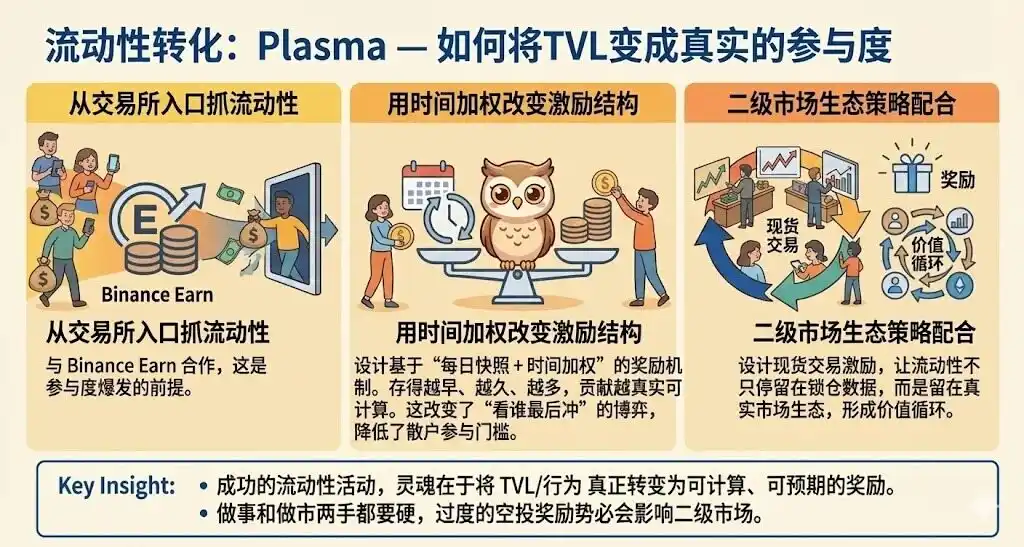
The designs of Plasma and Zerobase both indicate:
- Grabbing liquidity from the exchange entrance is the foundation – Cooperating with deep traffic channels like Binance is the prerequisite for the entire market participation爆发.
- Turning TVL/behavior into calculable rewards – Truly linking reward formulas with收益贡献.
- Secondary market strategy cannot be ignored – Plasma's spot trading incentive design ensures that liquidity does not just stay in lock-up data but remains in the real market ecosystem, forming a stronger value cycle.
The Common Shift in Project Team and User Mindset in 2025
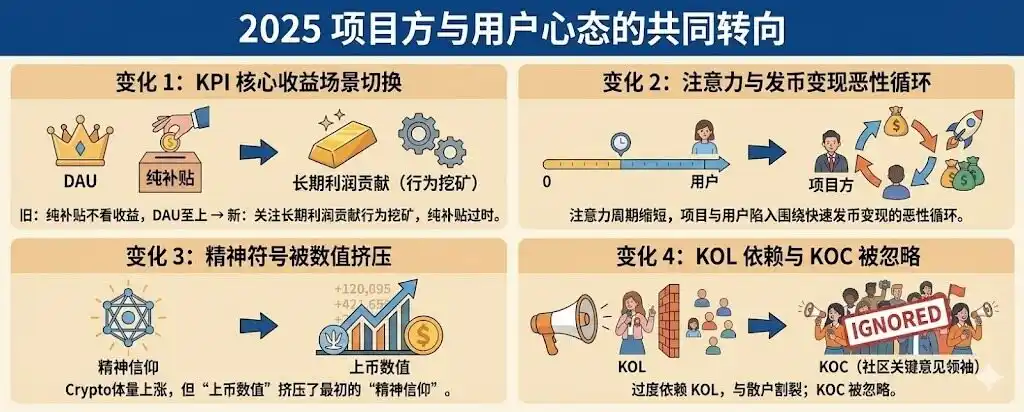
Change 1: Activity KPI shifts from "DAU" orientation to "long-term profit contribution" orientation, focusing on core收益 scenarios and sustainable behavior incentives. The approach of单纯用补贴拉活、不衡量收益回收的打法 is outdated
The "hundred billion subsidies" market logic was very疯狂 in the previous round. Project teams used airdrops, subsidies, and tasks to pull users in, making DAU look good. The previous公链 cycle therefore had a period of "prosperous on-chain" appearance, but much of the activity did not correspond to real demand scenarios, let alone sustainable revenue and retention.
So in 2025, the market重新意识到:
- DAU is no longer the goal and can no longer alone prove value
- Activity goals are more directly落地到可持续收益场景
This shift is强行固化 by platform rules and activity structures: besides the previously shared Alpha Points acquisition logic designed around "asset balance and Alpha trading behavior," this anchors the value of activities to settleable early asset流动 and trading behavior.
It also appears in the growth structure of Perp DEX / betting-type FI (like prediction markets). Most project teams' incentive mechanisms follow the path of "trading volume/deposit → points → rewards." Users either earn points by depositing funds or through continuous trading. The core of the activity is to exchange trading and fund occupancy for future rights or rewards.
And the user-side evaluation method is also changing simultaneously: because the 2025 market did not see the山寨牛市 everyone expected, participants naturally place greater importance on "principal risk" and "return certainty." When users assessed activities in 2025, they usually first looked at:
- Whether the principal is safe (will it be反撸, are there pitfalls in the rules, is exit smooth)
- Whether the return is calculable (is there a保底, is兑现 predictable)
- What remains after the subsidies stop (product retention, revenue logic, long-term demand)
The activity design form of交易即挖矿 was first introduced 7 years ago by an exchange called Fcoin, which quickly plundered a large market share and even briefly shook the exchange landscape. But due to大量刷单 leading to secondary market crash, insolvency, and the team running away, it ended. Trading mining is an effective market抢夺 activity, but there are very few projects that can play it long-term明白 or have the strength to play it well.
Change 2: Attention cycles shorten, project teams and users enter a vicious cycle围绕快速发币变现
The attention deficit is not just a problem in the币圈 but also a underlying change seen by everyone in the whole society: from长视频 needing to be sped up to even short videos being懒得看完; long articles are increasingly difficult to read completely, just like this article.
The币圈 is a leveraged microcosm of real society in terms of funds and time effects. Because industry narratives更新快, project life cycles are short. Thus, the attention cycle for projects is compressed to the extreme, and new projects can become "old projects" in two weeks. Project teams and users have formed a default consensus: the few days when TGE occurs are often the time with the best liquidity, so everyone's attention is squeezed onto the same time point. Project teams focus on pre-TGE data, users focus on TGE套现, platforms focus on trading volume. Finally, the entire industry becomes a "top-heavy" structure—extremely crowded in the first half,长期空心 in the second half; the first half relies on重视营销 to make exchanges重视来交差, the second half realizes profits through the secondary market. This mainstream operation注定山寨归零的趋势.
The consequence is that after TGE, everyone quickly turns to the next TGE. Post-TGE is systematically abandoned. Project teams lack motivation to do long-term operations, and users have even less reason to stay. Behind the appearance of new projects every day in the market, it is just存量流动性倒腾 in different pools. Truly new narratives, new products, and new scenes that can promote mass adoption反而更难生长.
For project teams, continuously maintaining community relationships, continuously retaining users, and continuously forming a positive business model should be as important as TGE, or even more important, rather than burning all the budget at the moment of TGE. Because once users scatter after listing, the cost to召回 them will be very high. This is also the biggest hidden danger I see from the 2025 market rhythm.
Change 3: The overall crypto market cap is growing, but the spiritual faith that everyone initially came with is gone – "Listing numbers" squeeze out "spiritual symbols"
In 2025, the market actions of many projects became more and more like a pure "numerical engineering": points, leaderboards, tasks, subsidies can be scheduled weekly, KPIs can be reviewed daily, growth can be broken down by funnel. But founders talked less about dreams compared to before, less willing to spend time clearly explaining "who we are, why we exist, what needs we want to solve." The community and the team also更容易 become two sets of language systems—the team is only responsible for pushing the numbers up, and the community is only responsible for completing tasks and getting rewards.
After the absence of spiritual symbols, participation感就很难沉淀成归属感. Any great business背后都会讲出来一个文化革命的符号. Blockchain, BTC, ETH, Binance all achieved today because of this cultural consensus. But today, the path taken by successful people has been快遗忘 by entrepreneurs and the market.
This is also a pit I saw many projects step into in 2025: they spent great effort to build声量和参与 in the early stage, but lacked continuous mechanisms and rhythm. After one round, they thought "the culture has been established," and then left the follow-up to the community to grow freely. But the reality is, culture这种东西跟数据不一样,
it is not something that automatically compounds after one冲刺; it is more like "repetitive labor"—you have to constantly give the community a reason to participate, a symbol that can be retold, a scene that can沉淀身份. The ROI may not be sexy enough at first, and many things are just persistence and seemingly "not精明" but can catalyze great power in the long run. Yes, I又想提到 Binance became the first exchange after the Chinese government's 94 crackdown on exchanges to propose a "not精明" plan to return profits to users, which eventually led to hundreds of users from around the world becoming Binance Angels for 8 years, becoming the core spark for Binance's community to go international.
Change 4: Over-reliance on KOLs → Fragmentation with Retail Investors; KOC (Key Opinion Consumer) is Overlooked
In 2025, I could see many project teams mistakenly believe that "market" = "KOLs."
It seems that as long as you buy up the heads,刷满 topics,堆上去热度, users will naturally stay. But KOLs ultimately serve as important发声渠道. They can amplify the voice but do not equal building relationships. They can bring up emotions but do not equal leaving consensus. When projects give resources and rights only to KOLs, ordinary users naturally feel a sense of旁观感, even feeling that they are just here to be liquidity, data, be background boards. Once this psychology forms, activities change from "拉近距离" to "制造对立".
Aster's recent Human vs AI trading competition is a very intuitive example: the official activity itself was a "quota-based" funded trading competition. Participants were not all users who could directly sign up but watched a group of KOLs trade, and there was even a ridiculous but inevitable scene of疑似 "套利一万刀" leaving. This kind of activity is of course also very strong in传播, easily forming dramatic conflict, but it also放大一个问题—when the main stage of the activity only belongs to a few people, retail investors naturally lack参与感. What is left in the end is often "watching the excitement" discussion, not a strong link related to users.
KOLs are an important part of the industry, but their value was exaggerated too much in 2025. Many projects mistakenly believe that doing market = only developing KOLs,反而忽略 the people who can catch public traffic are KOCs — KOCs may not have the greatest exposure, but they are definitely the most stable supporters, organizers, and long-term participants in the community, and can even penetrate other communities. They can坚持 turn the heat of one activity into the daily routine of a period, and can pull discussions back to a constructive direction when the project encounters fluctuations and doubts.
KOLs are very important community representative partners. But activities must be user-first, especially do not ignore the power of KOCs. Treat them as core assets to operate, and make their identity, participation path, and long-term material and spiritual incentives into mechanisms.
2026 Marketing Trends and Challenges
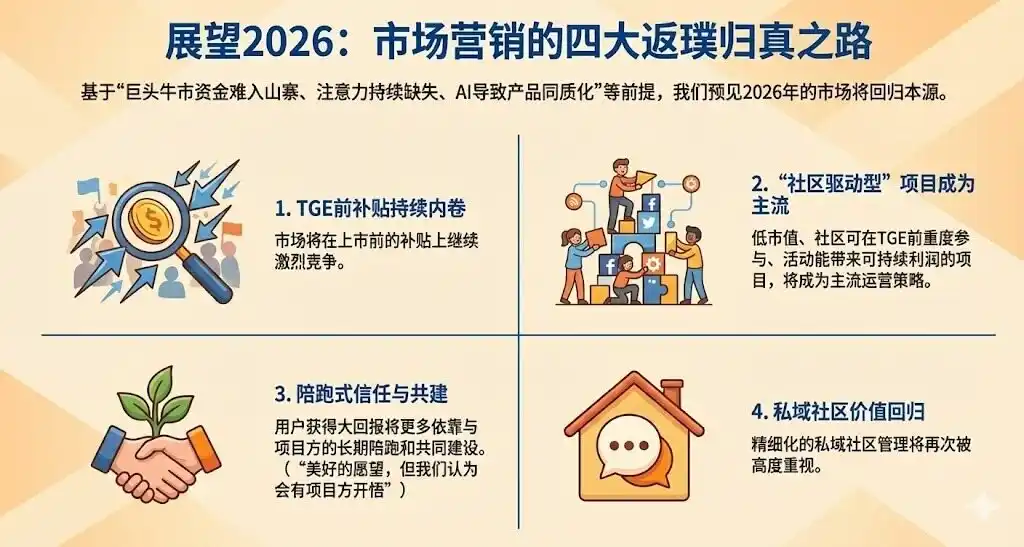
My premise for thinking about 2026 marketing trends: A bull market driven by countries and traditional capital giants will be difficult to enter the山寨 market; attention will be more lacking, and the ROI of marketing只关注公域流量 will无限接近负数; the AI era makes it harder for projects to拉开差距 from technology and products, and the "全民创作者" homogenized content on X will make users gradually lose interest; more open regulation催生 more competition for attention in other public and private domains.
Based on this, 2026, I believe, will be a return to basics:
1.The market will continue to compete in pre-TGE subsidies
2.Projects with low market cap, community can heavily participate before TGE, activities bring profits and can be long-term循环 will become the mainstream operational strategy of projects that stand out.
3.Users achieve big results through陪跑式 trust and co-construction trends (a beautiful wish, but I believe some project teams will开悟)
4.Private community management is再次被重视
Pure Sharing for Those Advancing in This Chaotic Market
In a周期 of残酷 competition and market chaos, becoming the next unicorn is extremely difficult. So, at the end of the article, I share an example of the forever market god Binance's operations, hoping to concretely give everyone some hope.
Don't forget, when Binance was established, the market environment generally also believed it was difficult to make the next centralized exchange giant; don't forget, Binance also experienced the尴尬局面 of launching a product that no one used:
When $BNB had its first ICO in July 2017, it offered 50% for public sale at a valuation of 20m. When enough chips were given to retail investors initially, retail investors才有动力 to regard themselves as "shareholder-style users" to follow the project team (low open high走). Of course, the result we can also see is that Binance did not let everyone down. In just a few years, besides securing the leading position of the exchange, BNB also rewarded holders with thousands of times of increase.
Binance captured the market by gaining user trust + strong PMF business capability. During the 94 crackdown in 2017, Chinese exchanges were completely banned. At that time, Binance quickly made the decision to shift its operational focus to overseas markets, and in the face of severe market panic and most project teams choosing to Rug, chose to repurchase tokens at high prices. And, this is the origin of Binance's global hundreds of angels, a religious-like folk community that project teams cannot imitate. From then on, Binance became their信仰. From then on, Binance began the path of快速渗透 local markets by angels from all over the world. Binance changed from a "Chinese exchange" to a global exchange.
@cz_binance and @heyibinance, the two major co-founders, had no baggage in entrepreneurship and were very clear that becoming KOLs themselves was the most cost-effective marketing. They frequently发声 on social media, maintained high exposure and communication, and added平时 AMA and deep communication with the community, truly achieving both public traffic and private domain management (angels).
Binance has developed for 8 years, and I still believe the biggest trust crisis came from the previous North Korean hacker巨额盗币 event. CZ第一时间直面市场 AMA, and SAFU also came from this and became a cultural symbol. This textbook-style crisis公关,到现在很多项目方还是没有学会. Market operations are sometimes very simple, not whether you can do it, but whether you want to do it. I have given many project teams many effective suggestions.很遗憾, the projects that eventually stepped into big pits were all because they were not brave and decisive enough.
And the growth of the Binance exchange into the world's largest所 is a positive spiral相辅相成 with the rise of BNB. The story of BNB is not just "the coin rose so it succeeded," but also turned "holding" into a reason for "using": transaction fee discounts, consumption and rights within the platform, the product side continuously giving holders clear收益预期, to BNB chain gas to growing into today's强势主流代币. These mechanisms make the token not just a trading target but, through BNB wealth effect拓新 +沉淀重视 supporters, then pull user behavior back into the platform ecosystem; the stronger the platform, the more use cases for the token, the stronger the willingness to hold the token, to the point where everyone is unwilling to sell BNB for fear of踏空. Thus, it became today's mainstream token. It also makes many who were originally只是 buyer, gradually become higher-frequency user. From "buying coins" to "using coins," then from "using coins" to "holding coins." When holders continuously gain收益体验 in usage scenarios, the platform's trading and cash flow are also更容易做大; the platform becoming stronger又会反过来 strengthen everyone's confidence in BNB—this is what I think is an excellent positive spiral of "product growth ↔ Token value" pushing each other forward.
Sincerity is always the killer skill of the market. Entrepreneurship with PMF will stand firm in the market in the long run.
If you like our content, have unique insights into the market, or hope for long-term market cooperation. You can DM me @mscryptojiayi💌