Coin price today June 16: Bitcoin turns around $25,500, altcoins and US stocks rally as investors believe the Fed is about to stop raising interest rates

Tap Chi BitcoinPublié le 2023-06-16Dernière mise à jour le 2023-06-16

Résumé

Ethereum has plunged below $1,700 during the past day. Here's the on-chain indicator that may have signaled this dip in advance. Ethereum Age Consumed Metric Saw A Spike Before The...

Bitcoin slightly rose to around $25,500 as investors believe the Fed is about to end its interest rate hike.
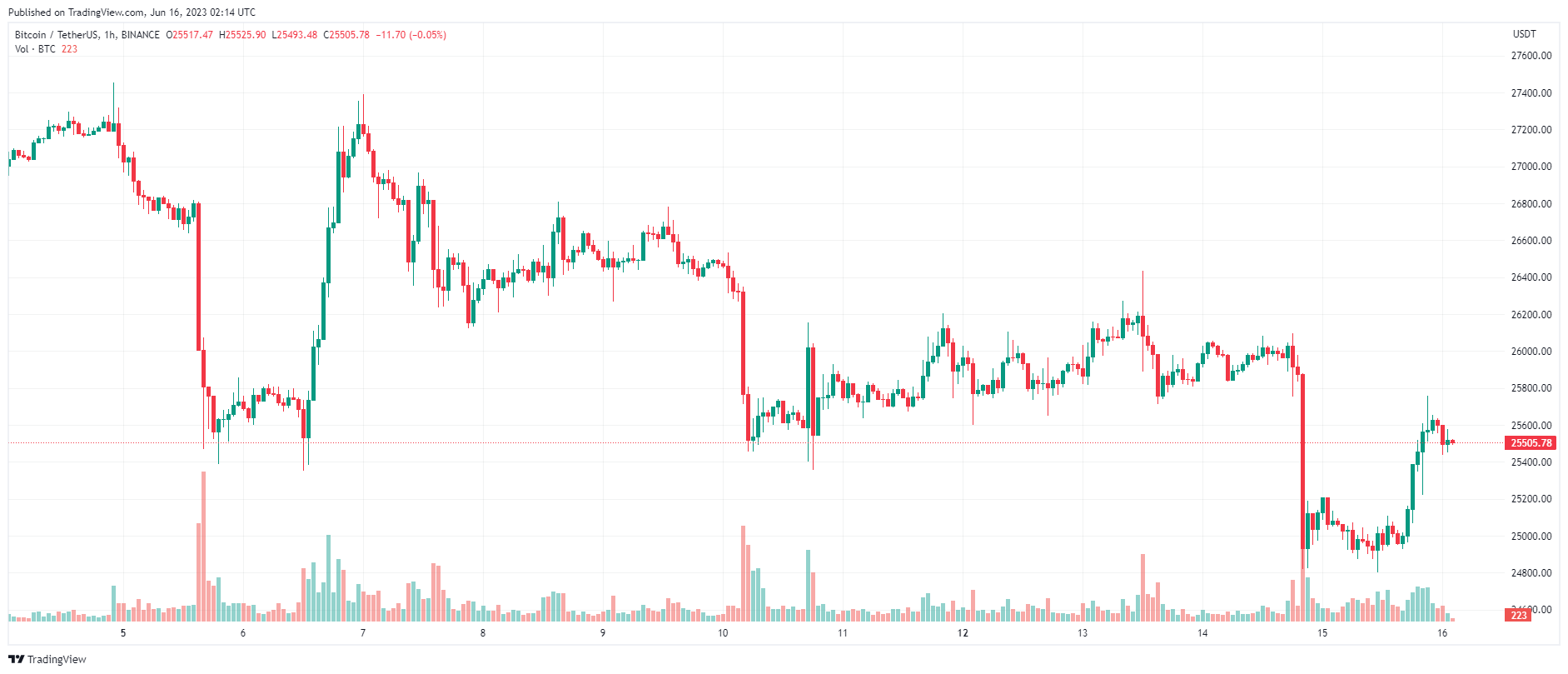
BTC Price Chart – 1 hour | Source: TradingView

Dow Jones recovered more than 400 points and S&P 500 hit a new 13-month high as investors bet that the US Federal Reserve (Fed) is about to stop raising interest rates.

At the end of the session, the Dow Jones index rose 428.73 points (equivalent to 1.26%) to 34,408.06 points; The S&P 500 climbed 1.22% and closed at 4,425.84 points; and Nasdaq Composite rose 1.15% to close at 13,782.82 points. Bond yields fell, while technology stocks continued to lead the market, in line with Wall Street trends in 2023.

Thursday's rally took the S&P 500 and Nasdaq to session highs since April 2022.

The S&P 500 is also recording its longest streak of gains since November 2021 and is about to record its biggest weekly gain since March. Compared to last October's Dip , the index is now up 23%. YTD, the S&P 500 is up 15%, while the Nasdaq technology index is also jumping more than 31% in 2023.

Regarding technology stocks, Microsoft and Oracle gained about 3.2% and 3.5% respectively, while Alibaba climbed nearly 3.2%.

On Wednesday, Fed Chairman Jerome Powell said at a news conference after the policy meeting that the Federal Open Market Committee (FOMC) would use the remaining six weeks before its next meeting to “ consider tightening monetary policy”. He added that the central bank has yet to make a decision on its July policy move.

Thursday's market rally suggests investors are still betting on potential uncertainty ahead of the FOMC's July meeting.

However, Chairman Powell confirmed that the Fed could continue to raise interest rates this year, and said that the agency will continue to assess the situation based on monthly economic data. It is known that US stocks rose and fell in Wednesday's trading session after this comment.

Economic data released on Thursday gave investors and policymakers a clearer view of the state of the labor market and consumer spending. The number of applications for unemployment benefits last week was 262,000, higher than the estimate of 245,000. Besides, retail sales increased by 0.3%.

Oil prices surged more than 3% to a weekly high on Thursday on the back of a weaker dollar and strong refining data in China, the world's top importer.

Ending Thursday's session, Brent crude oil futures rose $2.47/barrel, or 3.4%, to $75.67/bbl, while U.S. WTI crude oil futures contracts increased by 2.35 USD/barrel, or 3.4%, to 70.62 USD/barrel.

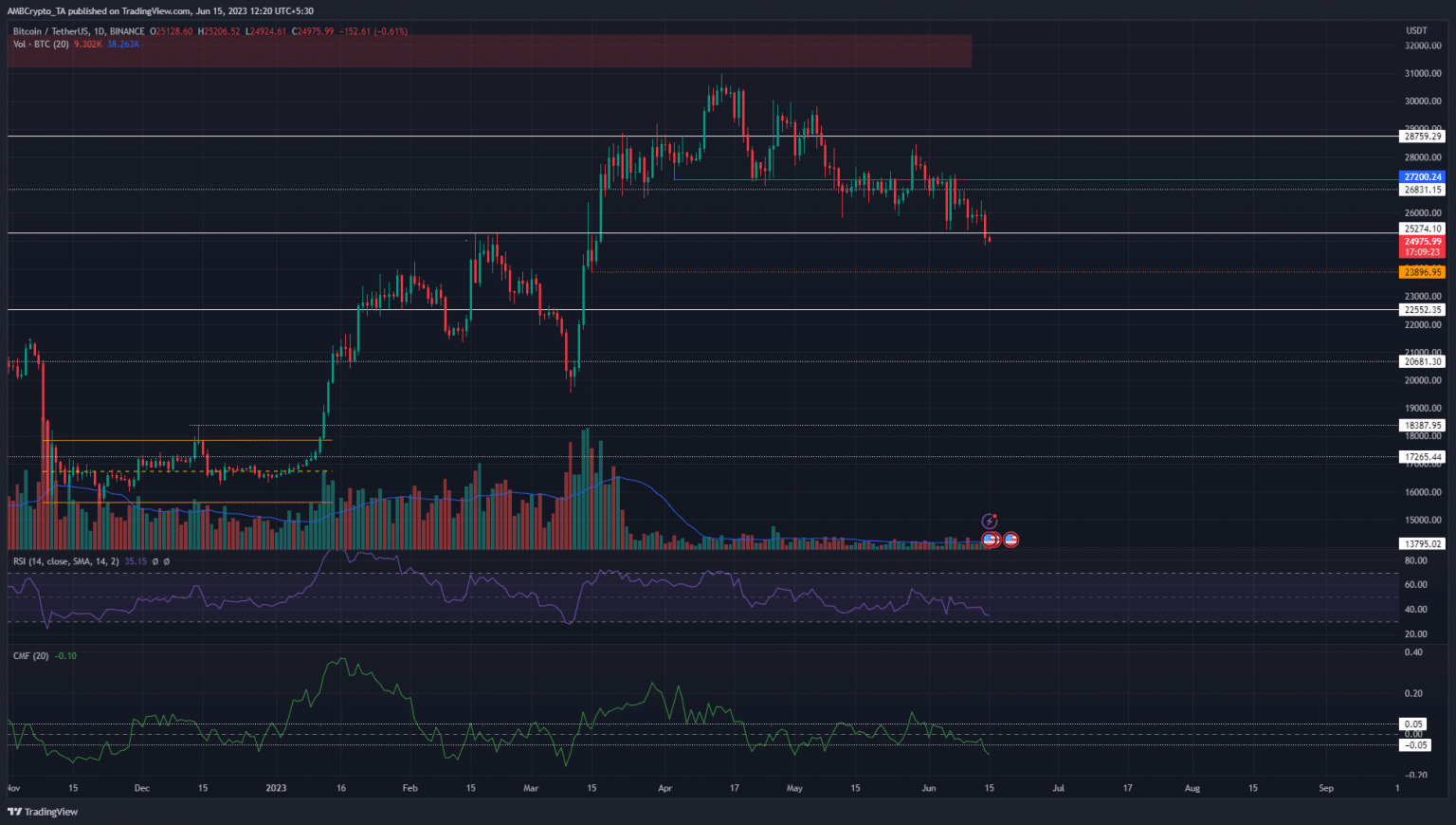
Bitcoin [BTC] has a strong bearish outlook on the higher timeframe price chart. In the short-term, however, BTC has regained key support at $25,200 and is currently trading around the $25,500 area.

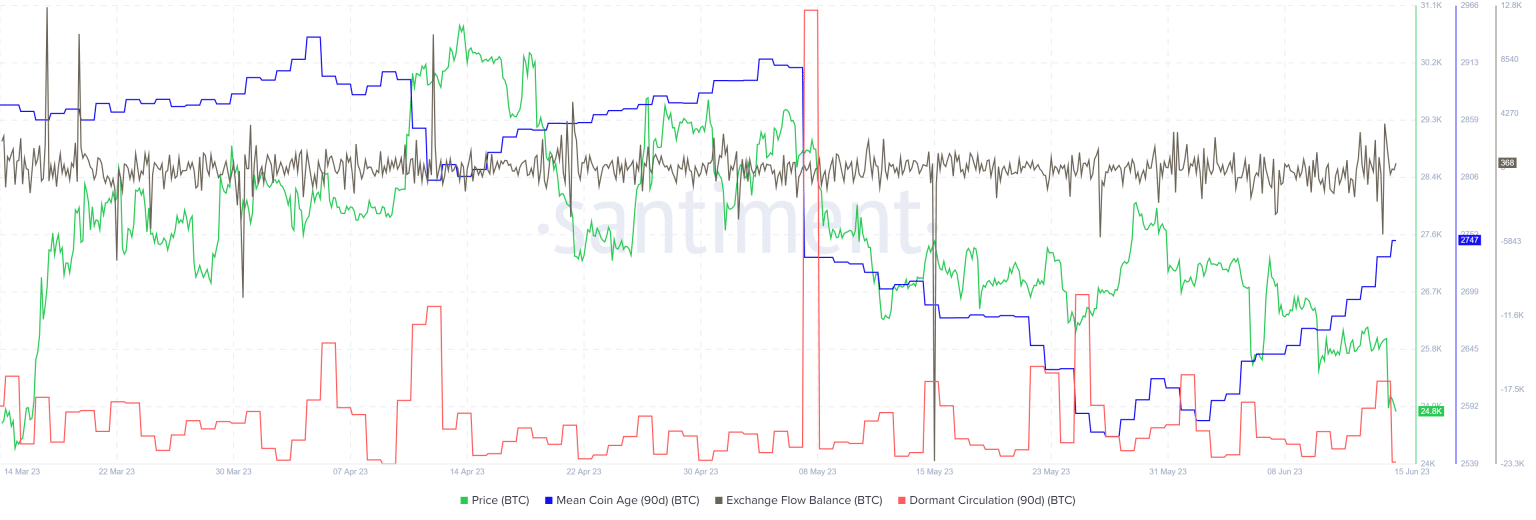
Investors have conducted massive withdrawals to their wallets, causing the supply on exchanges to decrease rapidly. This trend follows the uncertainty surrounding the SEC's lawsuit against Binance and Coinbase.
Source: TradingView

In the larger time frame, Bitcoin's bias is bearish as the market has made a series of lower highs and lower Dip after sliding below the higher Dip at $27,200 on April 24, breaking out previous bull market structure.

The majority of the RSI has been below the neutral 50 level since mid-April, showing bearish momentum. CMF dipping below -0.05 for the first time in a month shows significant Capital outflow from the Bitcoin market.

On the downside, the $23,900 – $24,000 area could offer some support. Meanwhile, $22,000 and $19,500 are the next levels to watch out for.
Source: Santiment

BTC net outflow figures on exchanges show a continuous inflow over the past 4 days. This indicates an increase in selling pressure. The Inactive Circulating Supply Index spiked on June 14. Overall, Bitcoin's price action and metrics have highlighted a bearish bias.

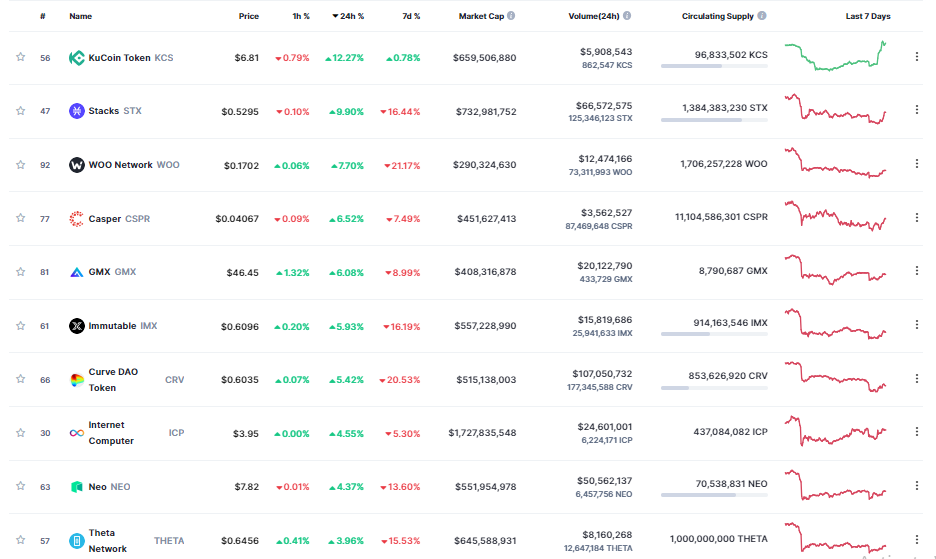
The altcoin market showed signs of a slight recovery in the short term, as BTC turned to rally after a sharp decline.

KuCoin Token (KCS) is the best performing project in the top 100, having bounced up more than 12% in the last 24 hours, erasing the week's losses completely.

Other projects such as Stacks (STX), WOO Network (WOO), Casper (CSPR), GMX (GMX), ImmutableX (IMX), Curve DAO Token (CRV), Internet Computer (ICP), Peg (Peg), Theta Network (THETA)… recovered from 3-9%.
Source: Coinmarketcap

Ethereum (ETH) has also successfully reclaimed the $1,650 level after breaking through this mark on June 14. Currently the largest smart contract Token in the market is trading around $1,660 with a slight gain of 0.5% on the day.
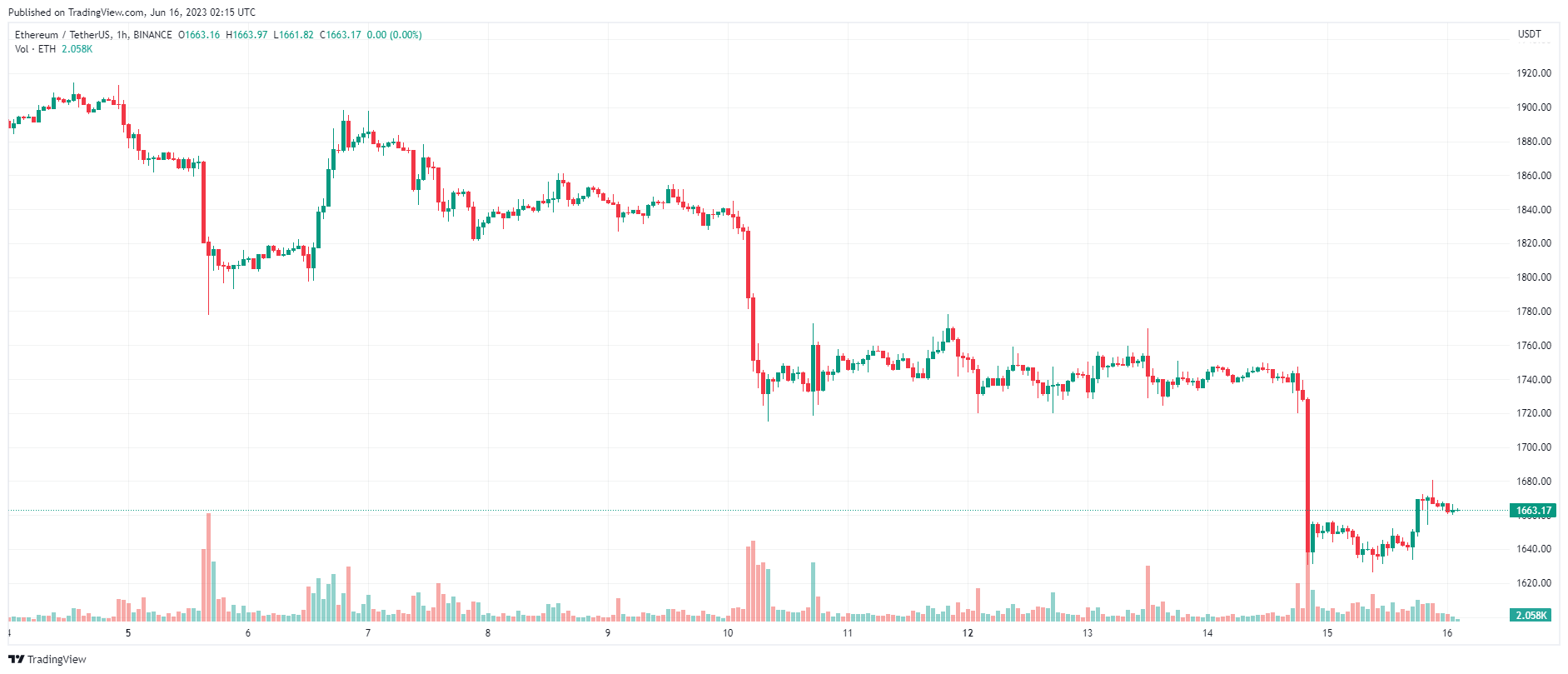
ETH price chart – 1 hour | Source: TradingView

The column “ Coin Price today” will be updated at 9:00 daily with general market news, readers are welcome to follow.

Ethereum has plunged below $1,700 during the past day. Here’s the on-chain indicator that may have signaled this dip in advance.
Ethereum Age Consumed Metric Saw A Spike Before The Price Decline
According to data from the on-chain analytics firm Santiment, institutional investors look to have been expecting the move to take place. The indicator of interest here is the “ETH age consumed,” which first finds the total number of coins moving on the Ethereum blockchain. Then it multiplies this value by the days these coins had been dormant before their movement.
So, in this way, the metric keeps track of how many coins are being sold/moved each day and uses their age as a weighting factor. This means that many old coins are moved to the network whenever this indicator’s value is high.
Naturally, low values of the metric, on the other hand, would imply that there aren’t many coins moving on the chain right now or some coins with a low average age are being transferred.
Related Reading: XRP And Ethereum Seeing Increased Social Media Talk As Bitcoin Loses Interest
Now, here is a chart that shows the trend in the Ethereum age consumed over the past month:
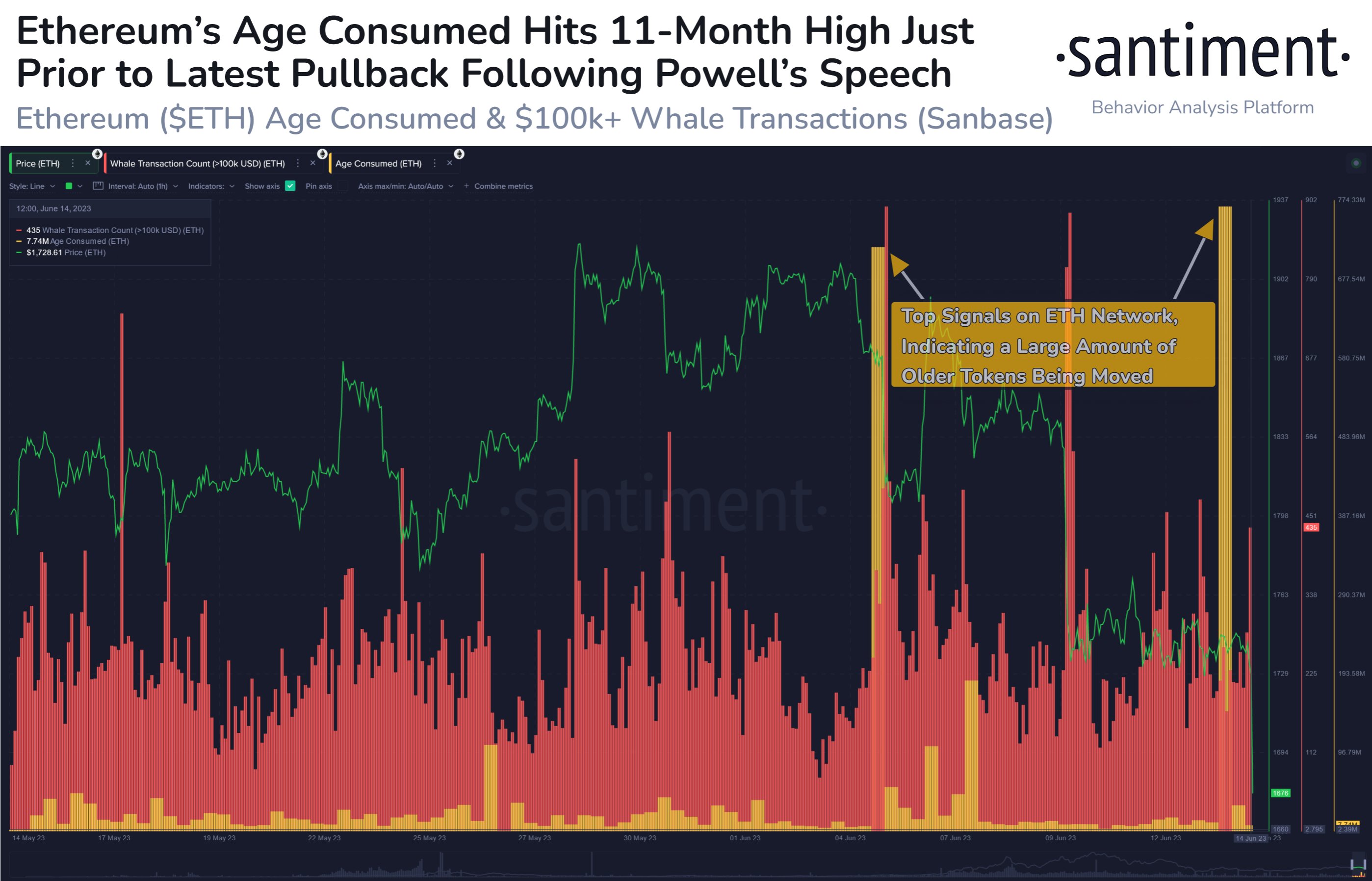
Ethereum Age Consumed


Looks like the value of the metric has been quite high in recent days | Source: Santiment on Twitter
As displayed in the above graph, the Ethereum age consumed metric had recently registered a very large spike. This would suggest the potential movement of many dormant coins on the chain during this surge.
Generally, when such large spikes in the indicator are observed, it’s a sign of selling from the long-term holders (LTHs). The LTH cohort includes all the investors holding onto their coins since more than 155 days ago.
These holders are the experienced hands in the market who don’t easily sell even when the market is distressed. Because of this reason, their movements can be something to watch out for, as when they do finally sell, it’s usually not a positive sign for the price.

The chart shows that the LTHs had also shown a large move earlier in the month. Shortly after these investors became active, the cryptocurrency price plunged.
This time, the spike in the Ethereum age consumed also seems to have preceded a price decline, as the cryptocurrency’s value has now dropped below the $1,700 level.
This latest price plunge has come after the news that the US Federal Reserve isn’t raising interest rates this time, but more hikes would be coming later in the year to fight inflation.
Santiment suggests that the spike in the age consumed metric before the price decline could imply that the institutions already expected the move, hence why they shifted their coins early.
ETH Price
At the time of writing, Ethereum is trading around $1,600, down 11% in the last week.

Ethereum Price Chart


ETH has taken a plunge recently | Source: ETHUSD on TradingView
Featured image from iStock.com, charts from TradingView.com, Santiment.net

Lectures associées

Bithumb gagne le procès en première instance dans l'affaire de compensation pour les « bitcoins disparus » ! Voici les détails

Le tribunal de première instance a donné raison à la plateforme sud-coréenne Bithumb dans la première d'une série d'affaires visant à récupérer des bitcoins envoyés par erreur. Il a ordonné le remboursement à Bithumb d'environ 194 millions de wons (145 000 $), somme issue de la vente de ces cryptomonnaies. L'incident remonte à février, lorsqu'une erreur dans une campagne de récompenses a conduit Bithumb à distribuer par inadvertance 620 000 bitcoins à ses utilisateurs, pour une valeur estimée à 5 milliards de dollars à l'époque. Après avoir identifié l'erreur, Bithumb a réussi à récupérer environ 99 % des actifs, mais a dû engager des poursuites judiciaires contre les utilisateurs n'ayant pas procédé à la restitution. Cette première décision, concernant l'une des quatre plaintes déposées, pourrait renforcer la position de Bithumb dans les trois autres affaires en cours. Les détails juridiques précis du jugement ne sont pas encore publics, et l'on ignore si l'utilisateur condamné fera appel. Cet épisode met en lumière les risques opérationnels des systèmes automatisés de distribution sur les plateformes d'échange, ainsi que l'importance des recours juridiques pour corriger les erreurs de transfert. Les verdicts à venir pourraient créer un précédent important concernant la responsabilité des utilisateurs dans de tels cas.

cryptonews.ruIl y a 34 mins

Bithumb gagne le procès en première instance dans l'affaire de compensation pour les « bitcoins disparus » ! Voici les détails

cryptonews.ruIl y a 34 mins

Livio, PDG de Sinofire Group : Les RWA deviendront le pont reliant l'humain carbone à l'IA silicium, le prochain 100 millions d'utilisateurs de la Crypto viendra des Agents IA

Lors du panel "Intégration profonde de l'IA et de la Crypto" à la conférence Bitcoin Asia, Livio Weng (CEO de Bitfire, groupe New Huo) a partagé sa vision sur la convergence de ces deux technologies. Selon lui, l'économie des agents (agential economy) en sera le thème central. Grâce aux progrès en identification d'IA, portefeuilles délégués et protocoles de paiement, les IA gagneront en autonomie pour utiliser, gérer et échanger des actifs, s'intégrant ainsi aux secteurs existants de la crypto. Livio estime que les actifs du monde réel (RWA) serviront de pont essentiel entre l'humanité "carbone" et l'IA "silicium". D'un côté, les RWA permettent de tokeniser des actifs traditionnels, les rendant accessibles aux IA. De l'autre, des actifs basés sur l'IA (puissance de calcul, données, services générés) pourront être ouverts aux humains via les RWA. Cette interaction favorisera une fusion plus profonde entre les deux sphères. Il prédit que les prochains centaines de millions d'utilisateurs de la crypto pourraient être des agents d'IA, et non des humains. Ces agents deviendront des acteurs majeurs de l'écosystème, évoluant d'assistants d'information à gestionnaires de patrimoine, et développant une capacité d'exécution autonome. Cependant, cette fusion nécessite encore des infrastructures robustes : une couche de règlement pour transactions automatiques, une couche d'identité et d'autorisation pour les IA, et un mécanisme de responsabilisation. Des protocoles comme X402 et EIP-8004 explorent ces pistes, mais des défis en sécurité, gouvernance et éthique subsistent. Sur le plan opérationnel, le groupe New Huo, via son service d'opérateur RWA et une stratégie quantitative d'actifs cryptos conforme à Hong Kong, cherche à saisir les opportunités de cette convergence. Les RWA sont vus comme une infrastructure clé pour permettre à l'IA de participer à l'économie réelle et d'interagir avec les actifs humains, ouvrant un vaste champ d'innovation pour l'économie des machines.

marsbitIl y a 39 mins

Livio, PDG de Sinofire Group : Les RWA deviendront le pont reliant l'humain carbone à l'IA silicium, le prochain 100 millions d'utilisateurs de la Crypto viendra des Agents IA

marsbitIl y a 39 mins

Les professeurs des grandes écoles s'engagent collectivement dans l'intelligence incarnée, dépassant 100 milliards de yuans de financement cette année

En 2026, le domaine de l'intelligence incarnée connaît une frénésie d'investissements, certains levées de fonds atteignant des milliards. Une force notable émerge : les universitaires. Ces « académiques » sont soit des professeurs d'universités prestigieuses (Tsinghua, Pékin, Zhejiang, etc.) qui créent leur entreprise tout en restant en poste, soit des sociétés directement incubées par des instituts de recherche. Selon un rapport cité, 18 sociétés « académiques » d'intelligence incarnée ont levé environ 15 milliards de yuans (estimation) sur les huit premiers mois de 2026. Elles se divisent en deux catégories : 1. **Entreprises fondées par des professeurs :** * **星动纪元 (Xingdong Jiyuan)** : Fondé par Chen Jianyu, professeur assistant à Tsinghua, robot humanoïde. Levé 1 milliard de yuans (série B). * **银河通用 (Yinhe Tongyong)** : Fondé par Wang He, professeur assistant à l'Université de Pékin, modèle multimodal + robot humanoïde. Levé 2,5 milliards de yuans (série B+). * **云深处 (Yun Shenchu)** : Fondé par Zhu Qiuguo, professeur associé à Zhejiang, robot quadrupède/humanoïde. En phase Pre-IPO. * **逐际动力 (Zhuiji Dongli)** : Fondé par Zhang Wei, professeur à SUSTech, robot humanoïde. Valorisation à 15 milliards de yuans. * D'autres exemples incluent **穹彻智能**, **眸深智能**, **优艾智合** (robotique mobile industrielle), et **乐聚** (humanoïde, en pré-production). 2. **Sociétés incubées par des instituts de recherche :** * **求之科技 (Qiuzhi Keji)** : Incubé par Tsinghua AIR, robot mobile à bras. * **德塔智能 (Delta Intelligence)** : Incubé par BIGAI, modèle de base et infrastructure de données. Levé près de 500 millions de yuans en 6 mois. * **星源智 (Xingyuan Zhi)** : Incubé par l'Institut Zhiyuan, modèle de cerveau incarné et architecture matériel-logiciel. Levé 1 milliard de yuans en 10 mois. * **零次方 (Ling Cifang)** : Co-incubé par Tsinghua, algorithme de préhension et robot humanoïde à roues. * **西湖交互 & 西湖机器人** : Incubées par l'Université Westlake. **Observations clés :** * L'écosystème de **Tsinghua** est extrêmement influent. * Les **fonds d'investissement universitaires** participent directement aux levées de fonds (ex: fonds de Tsinghua, Jiaoda). * La concentration de **professeurs-fondateurs** est sans précédent, leur expertise en physique, mécanique et contrôle étant cruciale pour l'intelligence incarnée. * Ce modèle représente une évolution de la transfert de technologie académique, passant de la vente de brevets à un engagement profond en capital et en incubation. Le défi pour ces « académiques » reste d'associer l'excellence technique aux impératifs commerciaux de production et de chaîne d'approvisionnement. Cette tendance devrait se poursuivre, transformant le paysage de l'innovation chinoise en intelligence incarnée.

marsbitIl y a 1 h

Les professeurs des grandes écoles s'engagent collectivement dans l'intelligence incarnée, dépassant 100 milliards de yuans de financement cette année

marsbitIl y a 1 h

Les progrès du Tchebournet : la part de l'internet mobile libre en Russie centrale est tombée à 30,5 %

Les progrès du "Tchèbournète" (Runet isolé) se concrétisent : en juillet 2026, seulement 30,5% des sessions mobiles dans le district fédéral central ont eu lieu sans restrictions. Plus de 60% des connexions sont passées par la "liste blanche" du ministère du Numérique, regroupant les sites et services russes autorisés. Depuis janvier, l'utilisation de cette liste a augmenté de 31% en moyenne dans la région. La mise en œuvre est inégale : Moscou et sa région ont encore 49% de sessions libres, tandis que dans les zones frontalières comme Briansk, Koursk et Belgorod, ce taux chute à environ 12%. Cette isolation est renforcée par des facteurs externes. Le centre de certification international GlobalSign a commencé à révoquer des certificats TLS pour des domaines russes suite à des sanctions, touchant potentiellement des milliers de sites. En réponse, les autorités russes promeuvent le passage aux certificats du Centre national de certification, déjà pris en charge par les navigateurs nationaux. Le gouvernement assure également le fonctionnement des services critiques (soins de santé, portail des services publics, systèmes de paiement) en cas de restrictions Internet. Pour les utilisateurs, surtout dans les régions frontalières, la dépendance à la liste blanche et aux certificats nationaux ne cesse de croître. Les experts soulignent un risque : les navigateurs étrangers pourraient, comme au Kazakhstan en 2019, refuser de faire confiance à ces certificats étatiques, limitant ainsi l'accès via des applications internationales.

cryptonews.ruIl y a 1 h

Les progrès du Tchebournet : la part de l'internet mobile libre en Russie centrale est tombée à 30,5 %

cryptonews.ruIl y a 1 h

Trading

Spot
活动图片