What’s Next For Ethereum Price As It Drops Below $2,000?

newsbtcPublié le 2023-04-24Dernière mise à jour le 2023-04-24

Résumé

The price of Ethereum has fallen below $1,900, dropping from the $2,000 mark that was previously held by bulls. This has led to another sell-off and the bearish influence remains...

The price of Ethereum has fallen below $1,900, dropping from the $2,000 mark that was previously held by bulls. This has led to another sell-off and the bearish influence remains strong despite attempts at recovery.
In the last 24 hours, Ethereum has risen by only 1.2%, but on the weekly chart, the altcoin has seen a significant drop of over 10%. The technical outlook for Ethereum is also in favor of the bears, as demand and accumulation for the altcoin have decreased. In order for Ethereum to make a recovery, it is crucial for it to breach the immediate resistance strength from buyers.
Despite this, most altcoins, including Ethereum, have remained bullish on the higher time-frame structure. However, bulls must defend the following support line or supply zone for Ethereum to start its recovery.

With Bitcoin struggling under the $30,000 price mark, many altcoins are also experiencing difficulty in breaking through their immediate price ceilings. On the one-day chart, the decline in the market capitalization of Ethereum indicates a decrease in buyers.
Ethereum Price Analysis: One-Day Chart
Ethereum

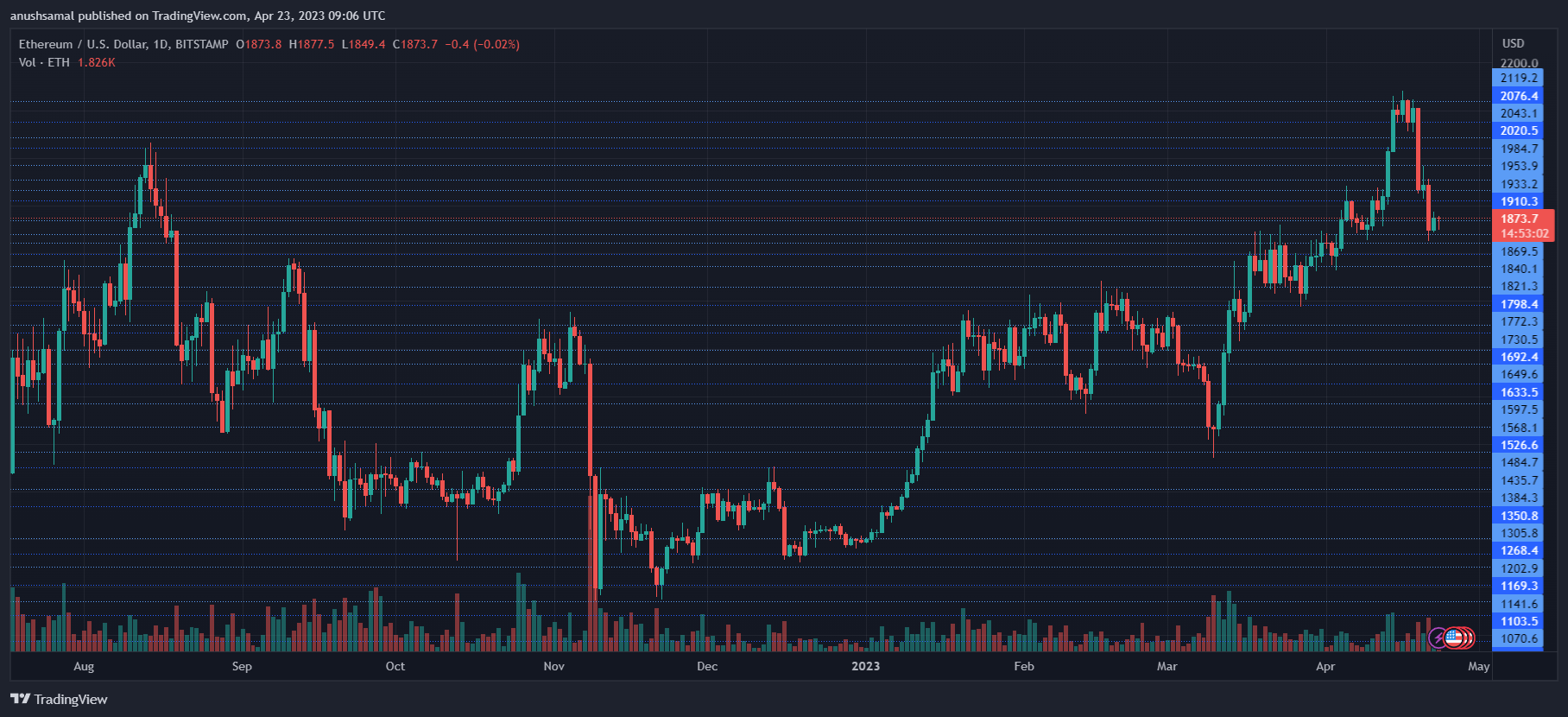
Ethereum was priced at $1,880 on the one-day chart | Source: ETHUSD on TradingView At the time of writing, ETH was valued at $1,880, having fallen below its bearish block ranging from $1,900 to $2,000. This drop in price is likely due to a routine price pullback, as Ethereum had traded above the $2,025 price mark after approximately eight months. However, as selling pressure increased, the bears have taken control.
The immediate overhead resistance for the altcoin is $1,910. A move above this level could potentially push ETH to touch $1,950, which may help to facilitate a price recovery. Conversely, the support levels for ETH are currently at $1,840 and $1,820.

During the previous session, the amount of ETH traded was in the red, indicating an increase in selling pressure.
Technical Analysis
Ethereum

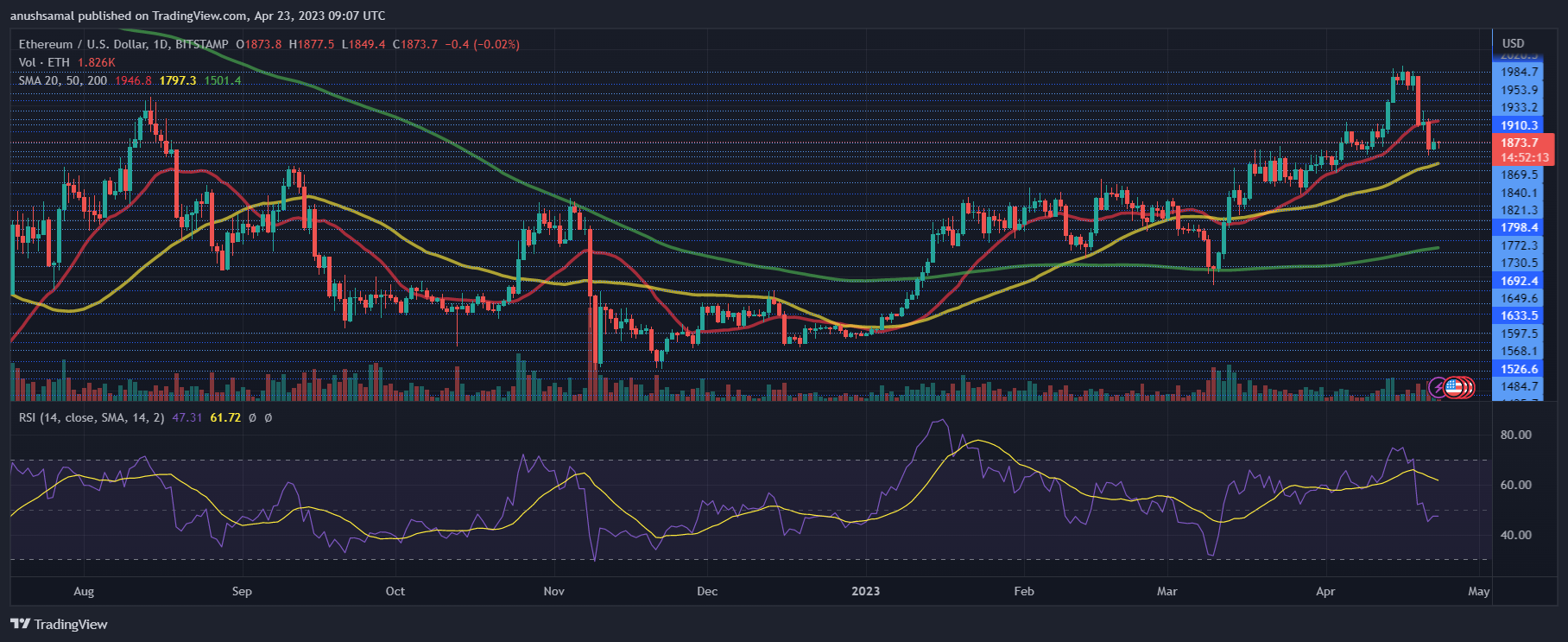
Ethereum registered a fall in buying strength on the one-day chart | Source: ETHUSD on TradingView As demand for ETH decreased, buyers also began to lose confidence in the asset. The Relative Strength Index showed that sellers outnumbered buyers on the one-day chart, as it was positioned just below the 50-mark.
Additionally, ETH dropped below the 20-Simple Moving Average line, indicating that sellers were in control and driving the price momentum in the market. However, with a slight increase in demand, ETH has the potential to trade above the 20-SMA line once again.


Ethereum

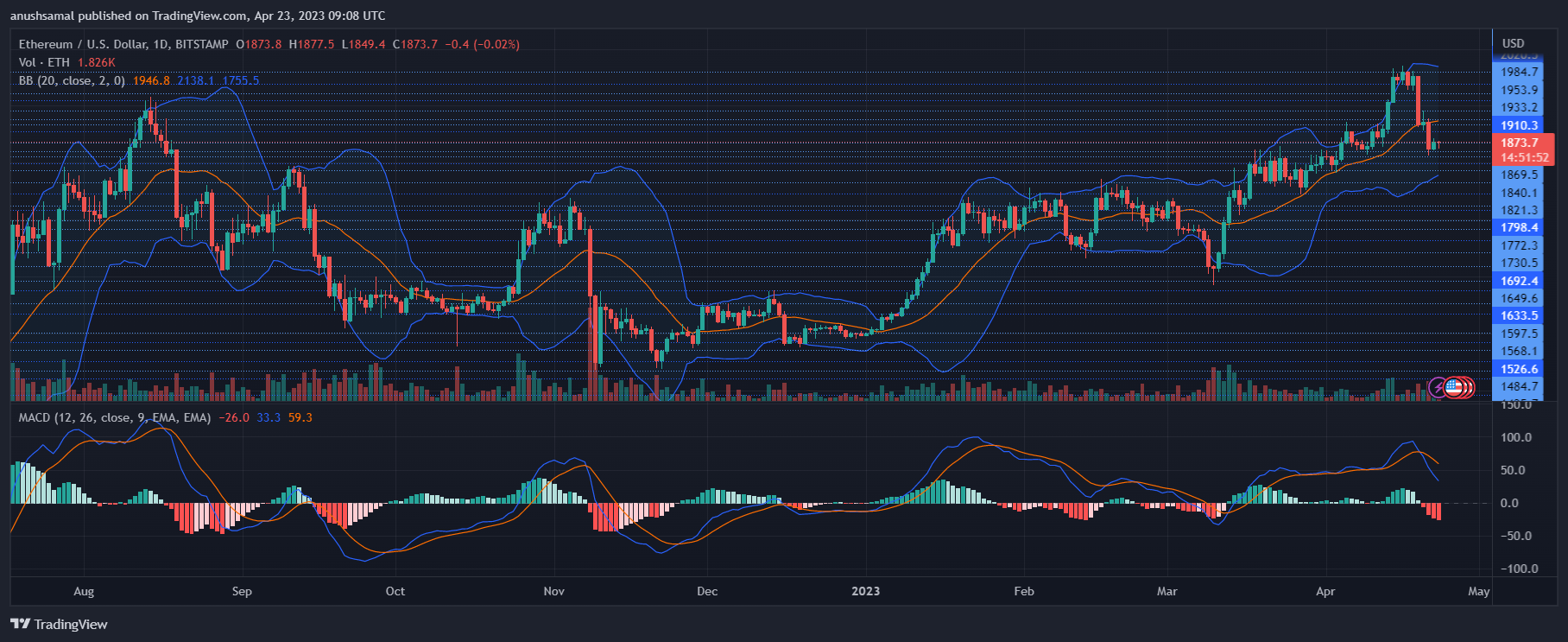
Ethereum started to display sell signals on the one-day chart | Source: ETHUSD on TradingView In line with other technical indicators, ETH began to exhibit sell signals on the one-day chart. The Moving Average Convergence Divergence, which measures price momentum and reversals, formed red histograms. This reading corresponds to sell signals for the altcoin.
Additionally, the Bollinger Bands, which gauge price volatility, were relatively far apart, but they have started to slightly converge. It suggested that ETH may trade within a specific price range over the coming trading sessions.


Lectures associées

Les gros investisseurs sont très actifs : ils achètent et vendent des altcoins majeurs aujourd'hui !

Les gros investisseurs, souvent appelés "baleines", sont très actifs sur le marché des cryptomonnaies, effectuant d'importantes transactions sur plusieurs altcoins majeurs. Un premier grand investisseur a réalisé un profit substantiel en prenant une position longue de 20 000 ETH (Ethereum) à environ 1 936 $, portant sa position à environ 50 millions de dollars pour un bénéfice non réalisé dépassant 11 millions de dollars. Le même investisseur a ensuite ouvert une nouvelle position longue sur 100 000 SOL (Solana) avec un effet de levier de 20x, à un prix d'entrée d'environ 104,5 $, pour une position totale évaluée à 10,45 millions de dollars. Parallèlement, un deuxième grand investisseur a attiré l'attention par des achats agressifs du token HYPE (Hyperliquid). Après un achat initial de 24 millions de dollars de HYPE en juin, environ 24 millions de dollars supplémentaires ont été utilisés ces dernières 24 heures pour acquérir 282 090 HYPE à un prix moyen d'environ 81,5 $. Les acquisitions totales de HYPE par les grands investisseurs atteignent désormais 4,67 millions de tokens, d'une valeur d'environ 381 millions de dollars, générant un bénéfice non réalisé d'environ 74,4 millions de dollars sur cette seule transaction. Ces mouvements importants mettent en lumière la forte activité et l'optimisme des grands porteurs sur des actifs cryptographiques comme Ethereum, Solana et Hyperliquid. *Ceci n'est pas un conseil en investissement.

cryptonews.ruIl y a 4 mins

Les gros investisseurs sont très actifs : ils achètent et vendent des altcoins majeurs aujourd'hui !

cryptonews.ruIl y a 4 mins

Pourquoi le staking de l'ethereum va changer en 2026

La validation par preuve d'enjeu (staking) de l'Ethereum devient un outil de gestion d'actifs pratique pour les conseillers financiers et les grands investisseurs, générant des revenus intégrés directement à partir de la blockchain, contrairement au Bitcoin. Pour participer, les utilisateurs peuvent devenir validateurs indépendants (nécessitant 32 ETH), ou utiliser des pools, des plateformes centralisées ou des protocoles de staking liquide. Le rendement annuel se situe généralement entre 2% et 5%, variant selon plusieurs facteurs. Le staking transforme l'ETH d'un actif passif en un actif productif. Le modèle natif verrouille les fonds pour une liquidité limitée, tandis que le staking liquide offre plus de flexibilité via des jetons représentatifs. D'ici 2026, la mise à jour majeure "Glamsterdam" visera à renforcer la décentralisation, la résilience quantique et l'évolutivité du réseau, consolidant ainsi son attractivité pour les participants institutionnels. Les avantages incluent un revenu passif et la sécurisation du réseau. Les risques couvrent les pannes techniques, les pénalités, la perte d'accès, les risques des plateformes/tiers et l'évolution réglementaire. Avant de recommander un produit, il est crucial d'examiner : la responsabilité en cas de pénalité, la robustesse de l'infrastructure, le modèle de liquidité, la composition des récompenses (part protocolaire stable vs MEV variable), la prévisibilité du rendement et les solutions de garde. Les tendances à surveiller incluent l'évolution réglementaire sur la garde d'actifs, les travaux sur la résistance quantique et les discussions législatives concernant les récompenses sur les stablecoins.

cryptonews.ruIl y a 56 mins

Pourquoi le staking de l'ethereum va changer en 2026

cryptonews.ruIl y a 56 mins

Trading

Spot
活动图片