Filecoin propels over 80% in a week – Key levels to watch for

newsbtcPublié le 2023-02-20Dernière mise à jour le 2023-02-20

Résumé

The Filecoin price has displayed a sharp rally over the past couple of days. In the past week alone, the altcoin surged more than 80% and broke past several levels...

The Filecoin price has displayed a sharp rally over the past couple of days. In the past week alone, the altcoin surged more than 80% and broke past several levels of resistance. On the daily chart, FIL appreciated by 24%.


On the development front, Filecoin is targeting the launch of a Filecoin Virtual Machine (FVM) in the upcoming month. This development will offer smart contract capabilities. This upgrade will help to amplify and accelerate the token’s value over the coming days.


The technical outlook of Filecoin has remained extremely bullish, with a major surge in demand. Buyers were in excess in number as both demand and accumulation for the altcoin shot up substantially over the past two weeks.


It is, however, too early to predict whether Filecoin’s price will continue to rise, as a price correction cannot be ruled out. FIL has to remain above a few important price levels if the coin has to maintain a positive stance.


The market capitalization of Filecoin went up, which indicated that buyers were circulating in high numbers during press time.


Despite an 80% increase in price, Filecoin is still trading 96% below its all-time high, which it secured in 2021.

Filecoin Price Analysis: One-Day Chart
Filecoin

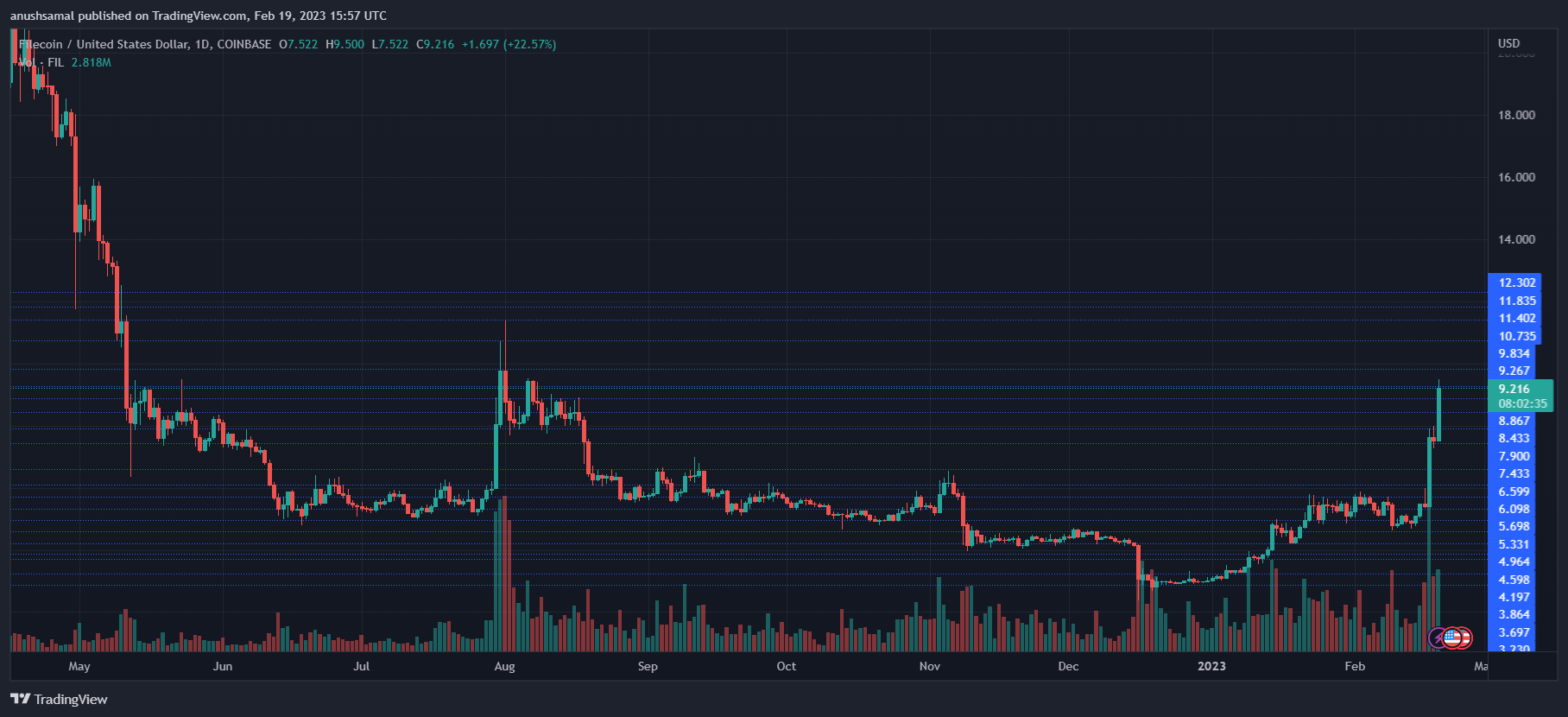
Filecoin was priced at $9.21 on the one-day chart | Source: FILUSD on TradingView

“”

FIL was trading at $9.21 at the time of writing. The coin was stuck under a crucial price resistance mark of $6.36. Finally, with the double-digit gains, Filecoin managed to breach the aforementioned price level and flip it into support for the coin. Immediate resistance for the coin stood at $9.80.


A move above the $9.80 level will take the coin to $10.70. Both $9.30 and $9.80 are crucial resistance levels. On the flip side, rather than FIL being able to topple its next resistance mark, it should remain above two important support lines.


The area of vital support lay between $7.40 and $6.30. FIL can fall to $5.69 if the price falls below $6.30. The amount of FIL traded in the last session was green, indicating an increase in buying strength.


Technical Analysis
Filecoin

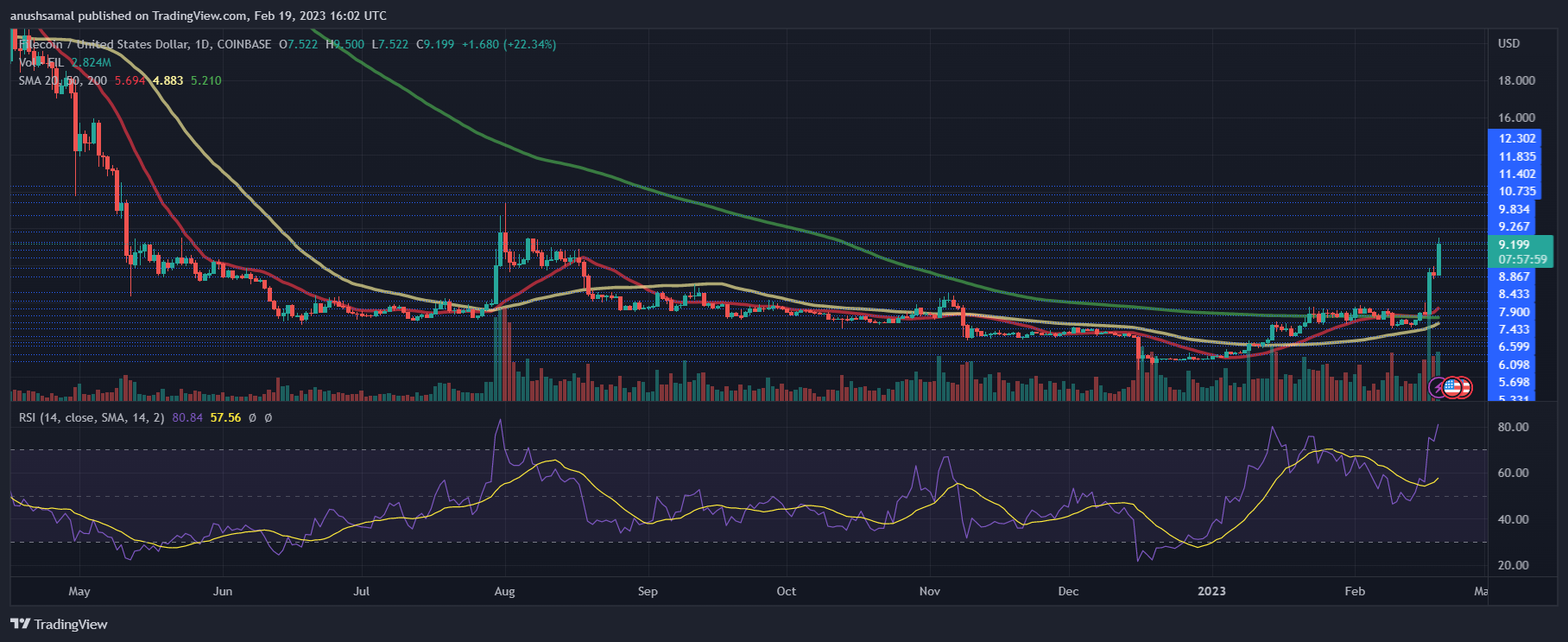
Filecoin registered overbought on the one-day chart | Source: FILUSD on TradingView

“”

Ever since FIL crossed the $7 boundary, the coin has visited the overvalued zone three times. At the moment, Filecoin is overbought. The Relative Strength Index was at 80, indicating that buyers dominated the altcoin.


Usually, overbuying tendencies lead to some form of price retracement due to a price correction. In case of that, Filecoin has to remain above the $7.40 support line.


On that note, the altcoin was above the 20-Simple Moving Average line (SMA), which meant that buyers were dominating the price momentum in the market.
Filecoin

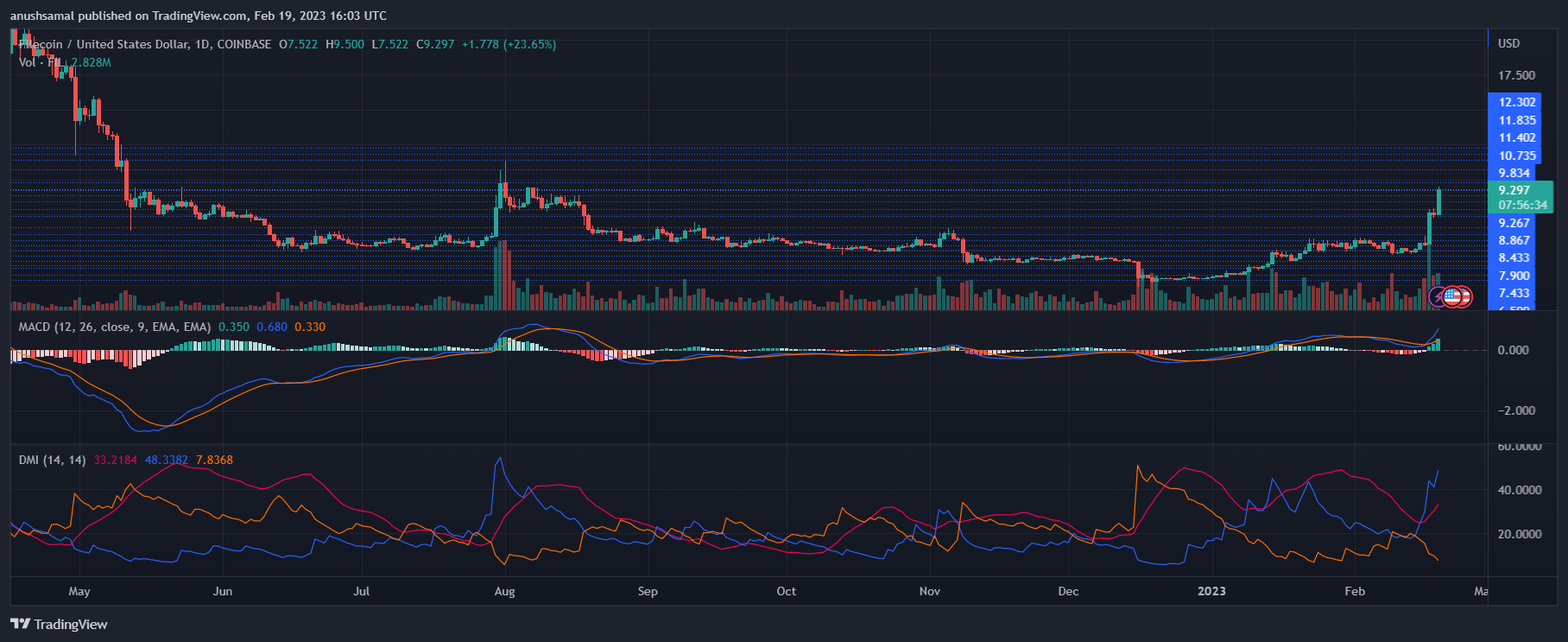
Filecoin displayed buy signals on the one-day chart | Source: FILUSD on TradingView

“”

Other technical indicators have depicted that the bulls were present in full force at the time of writing. The Moving Average Convergence Divergence indicator indicates price momentum and change. The indicator formed green signal bars, which were related to buy signals.


Buy signals are often accompanied by a further increase in price. The Directional Movement Index (DMI) registers the price direction.

DMI was positive as the +DI (blue) line crossed above the -DI (orange) line. The Average Directional Index (red) was moving up near the 40-mark, indicating that the bullish trend was building on the chart.


Lectures associées

Les États-Unis autorisent pour la première fois les contrats perpétuels cryptographiques : qu'est-ce que cela signifie pour le marché ?

Le 29 mai, la CFTC américaine a publié une directive autorisant la négociation et la compensation 24h/24 et 7j/7 pour les produits dérivés liés aux actifs cryptographiques, ouvrant effectivement le marché américain jusque-là interdit aux contrats perpétuels cryptos. Cette décision historique permet aux plateformes et aux citoyens américains d'accéder à ce marché, qui représentait entre 60 et 90 billions de dollars de volume en 2025. Les principaux bénéficiaires immédiats sont Kalshi (dont le contrat perpétuel BTCPERP a été approuvé), Coinbase (devenue le premier FCM régulé par la CFTC pour offrir ces produits) et le CME (passant à une négociation 24/7 pour ses contrats Bitcoin). La directive de la CFTC est présentée comme une mesure spécifique aux actifs numériques, distinguant les cryptomonnaies des matières premières traditionnelles comme les produits agricoles. Les réactions de l'industrie sont majoritairement positives, saluant un accès élargi et une amélioration de l'efficacité du capital. Cependant, l'organisation de protection des consommateurs Better Markets critique vivement la décision, l'accusant de négliger la protection des investisseurs particuliers face aux risques complexes des contrats perpétuels et d'agir dans l'intérêt des entreprises qu'elle est censée réguler. D'autres acteurs comme Kraken ont annoncé leur intention de lancer des produits similaires sous peu, indiquant que le marché américain des dérivés cryptos est sur le point de connaître une phase de croissance significative.

marsbitIl y a 4 h

Les États-Unis autorisent pour la première fois les contrats perpétuels cryptographiques : qu'est-ce que cela signifie pour le marché ?

marsbitIl y a 4 h

Comment la loi CLARITY redéfinit l'économie de rendement des stablecoins

Le projet de loi CLARITY, adopté en commission sénatoriale le 14 mai 2026, redéfinit fondamentalement l'économie des rendements des stablecoins. Sa section 404 élargit l'interdiction de rémunération des détenteurs (instaurée par le GENIUS Act de 2025) à tous les prestataires de services d'actifs numériques (plateformes, custodians). Elle interdit les récompenses "passives" (équivalentes à des intérêts) mais autorise celles liées à une "activité réelle" (transactions, consommation, staking). Ce changement de paradigme, du "hold-to-earn" vers du "use-to-earn", pousse l'industrie à restructurer les modèles de distribution des rendements. Trois voies principales émergent : récompenses basées sur l'activité via les exchanges (A), rendements via les protocoles DeFi non-custodiaux (B), et le canal jugé le plus robuste : la rémunération via la couche des actifs de réserve (C). Anticipant cela, les grands gestionnaires d'actifs (Morgan Stanley, BlackRock, JPMorgan) ont lancé en avril-mai 2026 des fonds monétaires tokenisés (comme le BRSRV de BlackRock) conçus spécifiquement comme actifs de réserve pour les émetteurs de stablecoins. Ces produits deviennent l'infrastructure de base pour fournir un rendement conforme dans le nouveau paradigme. L'enjeu réglementaire final réside dans la proposition de l'OCC de limiter à 20% la part d'actifs tokenisés dans les réserves. La décision finale déterminera l'ampleur du succès de la voie (C). La victoire des fonds tokenisés, tout en consolidant leur rôle d'"autoroutes à péage" de l'économie crypto-dollar, soulève également des risques nouveaux de concentration systémique autour de fonds uniques comme le BUIDL.

marsbitIl y a 6 h

Comment la loi CLARITY redéfinit l'économie de rendement des stablecoins

marsbitIl y a 6 h

Trading

Spot
Futures
活动图片