ETH tests 5-month high as whales retain this % of supply, more inside

AmbcryptoPublié le 2023-02-19Dernière mise à jour le 2023-02-19

Résumé

Ethereum rose to $1,700 on February 17. Whale and shark address holding have not slowed down their accumulation.

The price of Ethereum [ETH] reached $1,700 on 17 February after five months. Is this ascent an indicator of things to come? Or will the whale accumulation result in dumping before the Shanghai upgrade?

“”

ETH witnesses brief surge

“”

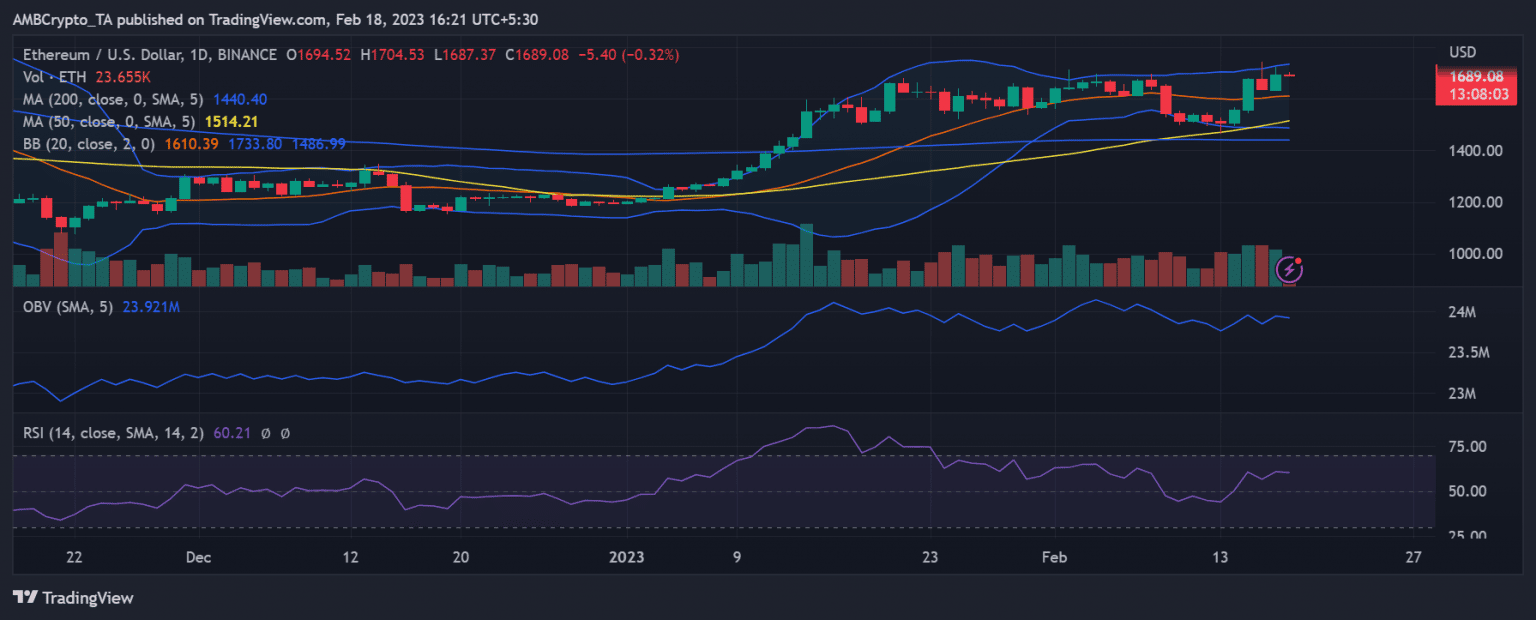
Ethereum gained 3.45% on 17 February, according to a daily period analysis of the cryptocurrency. According to additional research into that trading period, it peaked at $1,721 before ending trade at $1,694.

“”

It was five months since ETH’s price had last reached the $1,700 range during that trading period. Its price was roughly $1,694 at the time of writing.
Source: Trading View

“”

Furthermore, the Relative Strength Index (RSI) indicated that ETH was in a bull trend because its line was above the 60 mark. The price movement was also noted above both the long and short Moving Averages (blue and yellow lines). Therefore, the asset’s price moving above the (MAs) suggests a good price move and may also point to a possible future uptrend.

“”

Shark and whale hold on

“”

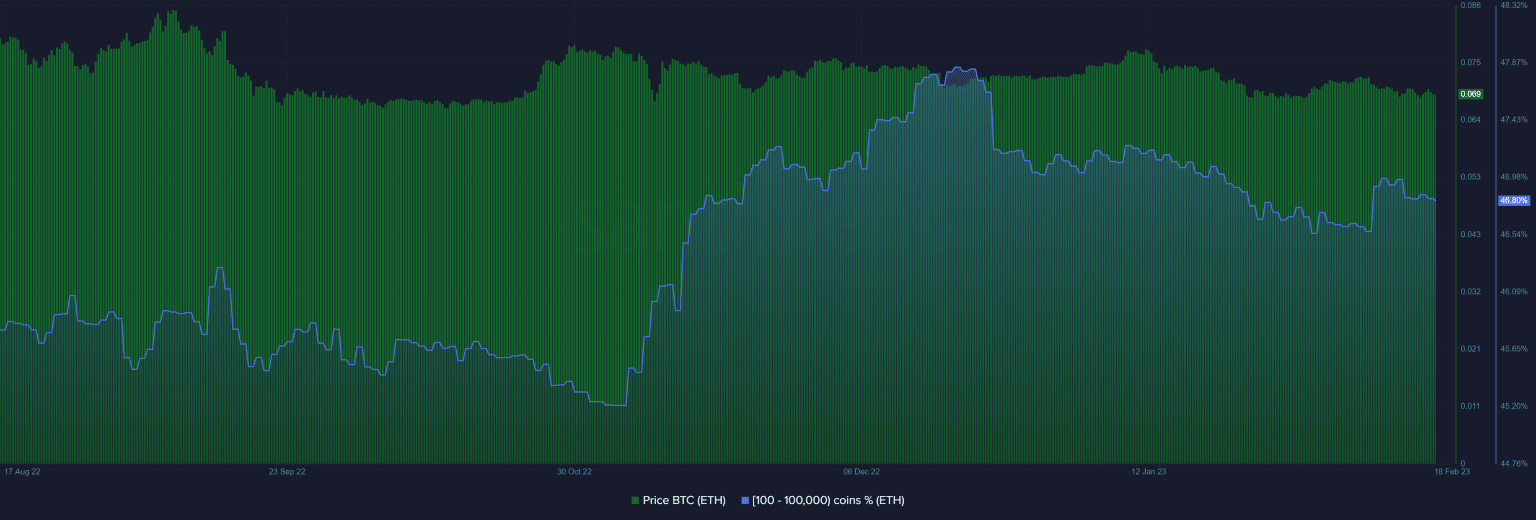
Recent data from Santiment showed that whale and shark addresses were still tightly clutching onto their ETH bags. The graph shows that whale and shark addresses with 100–100,000 ETH still retained close to 47% of the entire supply of ETH. Furthermore, the absence of a sell-off following the most recent price increase suggested that investors anticipated further price increases.
Source: Santiment

“”

In addition, an examination of the supply owned by the top addresses revealed that the addresses at the top had been on an accumulating binge. For most of January, the graph showing the quantity held by the top addresses as a proportion of the overall supply of Ethereum was rising. It has now leveled off, but at the time of writing, it was at 123.
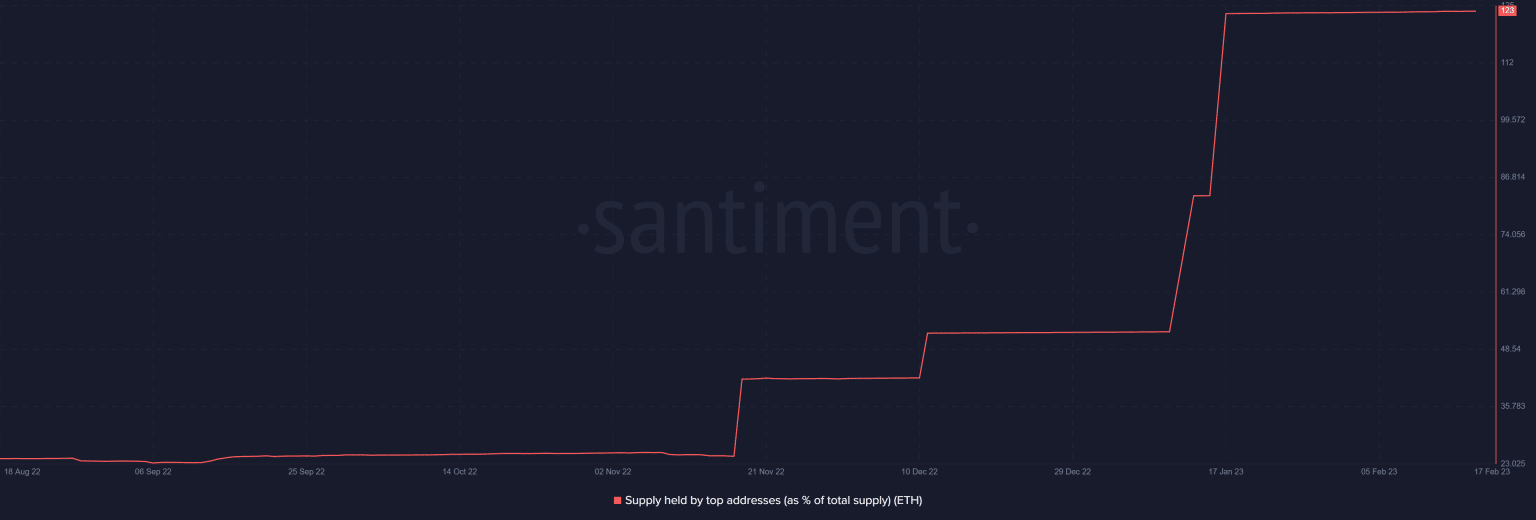
Source: Santiment

“”

Volatility incoming?

“”

Ethereum’s Shanghai upgrade will be the next big thing for the cryptocurrency sector. In March, users can withdraw more than $16.5 million worth of Ethereum (ETH) off the blockchain. The Merge was the last significant improvement to the network; however, it had little effect on the price of Ethereum.

“”

The Shanghai upgrade will affect the supply and demand of ETH, whereas the Merge was a purely technological development with no apparent economic consequences. However, because of the long-term and short-term nature of the upcoming development, it has the potential to affect the ETH price significantly.

“”

When staked ETHs are released, it is unknown how the shark and whale addresses will respond. But if they, too, decide to sell their assets, ETH’s value will plummet. So, in terms of Ethereum’s price movement, March will be a crucial month.


Lectures associées

Les États-Unis autorisent pour la première fois les contrats perpétuels cryptographiques : qu'est-ce que cela signifie pour le marché ?

Le 29 mai, la CFTC américaine a publié une directive autorisant la négociation et la compensation 24h/24 et 7j/7 pour les produits dérivés liés aux actifs cryptographiques, ouvrant effectivement le marché américain jusque-là interdit aux contrats perpétuels cryptos. Cette décision historique permet aux plateformes et aux citoyens américains d'accéder à ce marché, qui représentait entre 60 et 90 billions de dollars de volume en 2025. Les principaux bénéficiaires immédiats sont Kalshi (dont le contrat perpétuel BTCPERP a été approuvé), Coinbase (devenue le premier FCM régulé par la CFTC pour offrir ces produits) et le CME (passant à une négociation 24/7 pour ses contrats Bitcoin). La directive de la CFTC est présentée comme une mesure spécifique aux actifs numériques, distinguant les cryptomonnaies des matières premières traditionnelles comme les produits agricoles. Les réactions de l'industrie sont majoritairement positives, saluant un accès élargi et une amélioration de l'efficacité du capital. Cependant, l'organisation de protection des consommateurs Better Markets critique vivement la décision, l'accusant de négliger la protection des investisseurs particuliers face aux risques complexes des contrats perpétuels et d'agir dans l'intérêt des entreprises qu'elle est censée réguler. D'autres acteurs comme Kraken ont annoncé leur intention de lancer des produits similaires sous peu, indiquant que le marché américain des dérivés cryptos est sur le point de connaître une phase de croissance significative.

marsbitIl y a 4 h

Les États-Unis autorisent pour la première fois les contrats perpétuels cryptographiques : qu'est-ce que cela signifie pour le marché ?

marsbitIl y a 4 h

Comment la loi CLARITY redéfinit l'économie de rendement des stablecoins

Le projet de loi CLARITY, adopté en commission sénatoriale le 14 mai 2026, redéfinit fondamentalement l'économie des rendements des stablecoins. Sa section 404 élargit l'interdiction de rémunération des détenteurs (instaurée par le GENIUS Act de 2025) à tous les prestataires de services d'actifs numériques (plateformes, custodians). Elle interdit les récompenses "passives" (équivalentes à des intérêts) mais autorise celles liées à une "activité réelle" (transactions, consommation, staking). Ce changement de paradigme, du "hold-to-earn" vers du "use-to-earn", pousse l'industrie à restructurer les modèles de distribution des rendements. Trois voies principales émergent : récompenses basées sur l'activité via les exchanges (A), rendements via les protocoles DeFi non-custodiaux (B), et le canal jugé le plus robuste : la rémunération via la couche des actifs de réserve (C). Anticipant cela, les grands gestionnaires d'actifs (Morgan Stanley, BlackRock, JPMorgan) ont lancé en avril-mai 2026 des fonds monétaires tokenisés (comme le BRSRV de BlackRock) conçus spécifiquement comme actifs de réserve pour les émetteurs de stablecoins. Ces produits deviennent l'infrastructure de base pour fournir un rendement conforme dans le nouveau paradigme. L'enjeu réglementaire final réside dans la proposition de l'OCC de limiter à 20% la part d'actifs tokenisés dans les réserves. La décision finale déterminera l'ampleur du succès de la voie (C). La victoire des fonds tokenisés, tout en consolidant leur rôle d'"autoroutes à péage" de l'économie crypto-dollar, soulève également des risques nouveaux de concentration systémique autour de fonds uniques comme le BUIDL.

marsbitIl y a 6 h

Comment la loi CLARITY redéfinit l'économie de rendement des stablecoins

marsbitIl y a 6 h

Trading

Spot
Futures
活动图片