How Aavegotchi’s Gotchi Lending Takes the Scholarship Model to the Next Level

DappRadarPublié le 2022-03-29Dernière mise à jour le 2022-03-29

Résumé

Gotchi Lending is Aavegotchi’s solution for scaling up the gaming ecosystem

Gotchi Lending is Aavegotchi’s solution for scaling up the gaming ecosystem
Aavegotchi introduced Gotchi Lending as a solution to improve the existing Scholarship Model in the market. It will help to address the current issue of blockchain gaming scalability by creating a more welcoming revenue-sharing model. It is worth mentioning that Gotchi Lending is a 100% on-chain solution that leverages smart contracts.
Aavegotchi is one of the most popular games living on Polygon. A brainchild of Pixelcraft Studios, Aavegotchi is a perfect combination of DeFi and NFT games. It is an intriguing game that reminds you of the happy childhood memories of Tamagotchi, more importantly, a simple and entertaining play-to-earn journey.
With Gotchiverse launching on March 31st, the anticipation and engagement of the game have been gaining traction. As of this writing, Aavegotchi recorded a 17.88% increase in user numbers over the last seven days. Notably, it is the only gaming dapp among the top 7 on the Polygon ranking board that has achieved positive user growth for the period. 
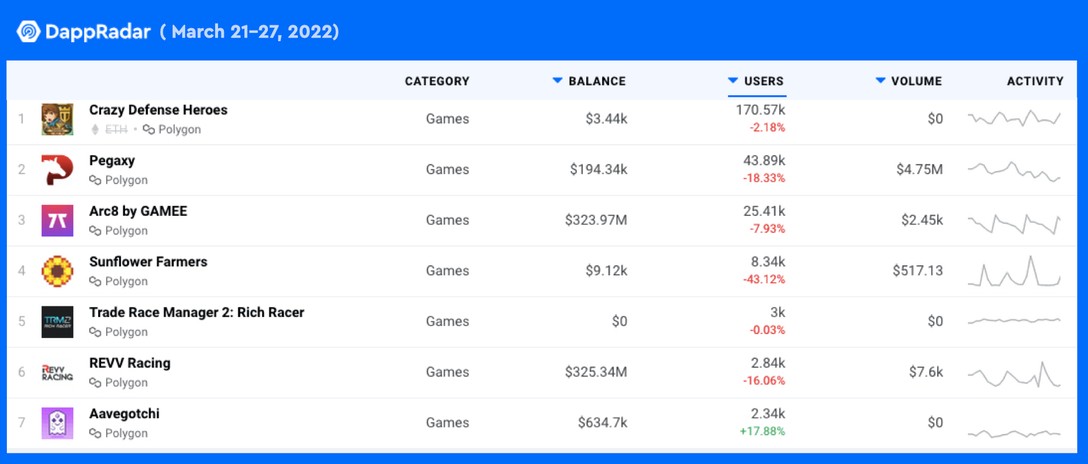
Although blockchain gaming has disrupted the traditional gaming industry, it still has a long way to become mainstream. To accelerate the mass adoption of blockchain gaming, Aavegotchi proposed Gotchi Lending. Furthermore, it is a critical move to expand the Gotchiverse beyond their core audience.
Scholarship model and its drawbacks
Axie Infinity introduced a scholarship program to onboard newcomers via a more accessible pathway. Axie holders, for example guilds like Yield Guild Games, provide so-called scholarships to new players. Specifically, they loan their assets, the Axie NFTs, to new players who don’t own any of their own. Borrowers or scholars share their revenue with the Axie owners in return. It is a revenue-sharing model where the guild invests in NFT assets and rents or loans them to newcomers. As a result, new players can start playing and earning in-game tokens without investing any money upfront.
However, the scholarship model has drawbacks that make it inadequate to scale up the game ecosystem. In essence, it depends on humans to run the Axie loaning business. The model relies heavily on humans, with manual payouts and off-chain agreements. Abusive managers are not unusual. In addition, many scholars cash out their token earnings as a daily wage. Therefore they don’t spend their earned tokens on breeding or other in-game actions, causing inflation of SLP in Axie’s case.
Gotchi Lending upgrades the scholarship model
Gotchi Lending addresses the scalability of the gaming ecosystem through a different approach, which is to keep the entire lending process 100% on the blockchain. Gotchi Lending uses a smart contract that allows owners of Aavegotchi NFTs to lend these assets out to players with limited rights.
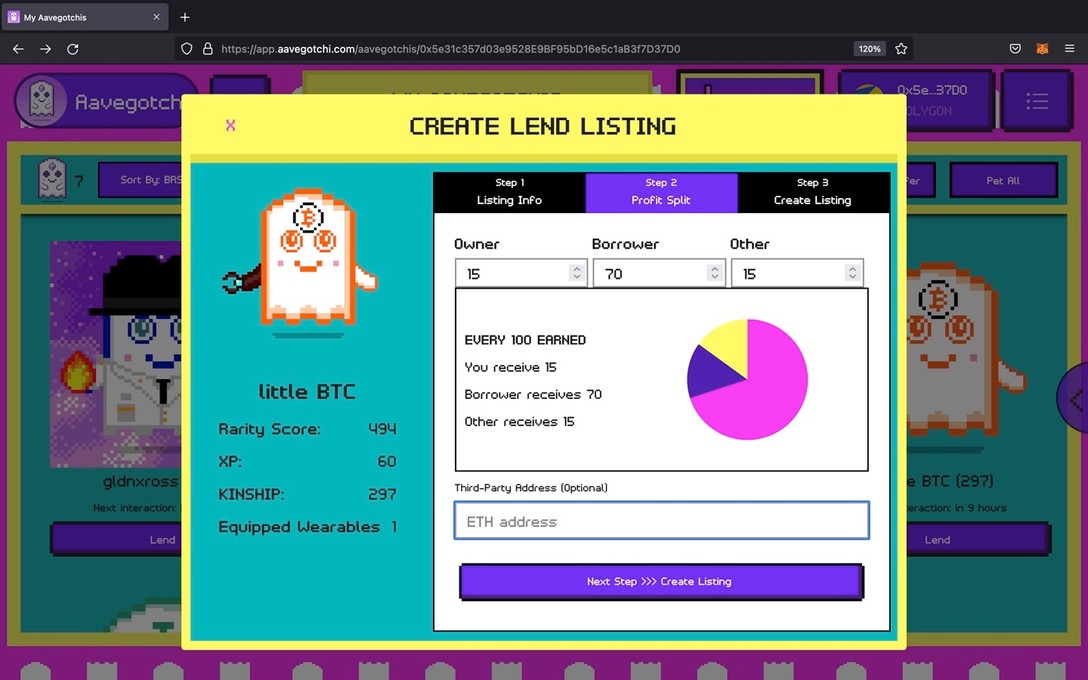
aavegotchi gotchi lending

It is worth noticing that Gotchi Lending allows the owners to have complete control over their rental agreements. They can decide the contract duration, up-front fees, and earnings splitting rules between themselves and the borrower. For example, the lenders can decide which token they’d like to split with the borrower since the upcoming Gotchiverse will introduce four new ERC tokens. And of course, GHST, Aavegotchi’s eco-governance token, is one of the options. Moreover, they can also customize what percentage to split at, i.e., 50/50, 80/20, etc.
More notably, Gotchi Lending benefits large guilds and individuals alike. Guilds can seamlessly get their Aavegotchi’s into a member’s hands by whitelisting them as trusted addresses. Individual Aavegotchi owners can leverage Gotchi Lending to earn a passive income by listing Aavegotchis on the lending market. Users can also lend them to a friend or family member to enter the Gotchiverse to try it out for themselves at no cost.
Gotchi Lending goes live on March 28th and will make the Gotchiverse one of the most accessible NFT games in the world. To explore the unlimited opportunities of the sustainable play-to-earn game, all you need is internet access and a web3 wallet. Play as usual, earn like never before!
About Aavegotchi 
Aavegotchi is an open-source, community-owned NFT gaming protocol, enabling true asset ownership for gamers. Aavegotchi NFTs are on-chain collectible ghosts staked with Aave’s interest-generating aTokens.
Compete for player rewards by earning XP, leveling up, and increasing the rarity of your Aavegotchi fren. Aavegotchi is governed by the AavegotchiDAO and the native eco-governance token GHST. Visit Aavegotchi.com today and join the future of DeFi-staked NFT avatars!
Lectures associées

À quelle distance sommes-nous de la fin du marché baissier des cryptos ?

Selon les données de Coinglass, l'indice de prime Bitcoin de Coinbase est resté négatif pendant 46 jours consécutifs, établissant un record. La vente de Bitcoin par MicroStrategy début juin a déclenché une forte baisse du marché, confirmant symboliquement le début d'un marché baissier. Le BTC a enregistré sa pire semaine depuis 2022, tombant en dessous de la moyenne mobile sur 200 semaines, un signal clé de marché baissier. Malgré des prédictions antérieures sur une fin proche du marché baissier, la chute continue du BTC et de l'ETH a contredit ces optimistes. Le désancrage de l'action privilégiée STRC de MicroStrategy et l'augmentation des pertes pour les détenteurs à long terme de BTC et d'ETH sont devenus des indicateurs clés de la persistance du marché baissier. Concernant la fin de ce cycle, certaines analyses suggèrent que les mois de juillet à août pourraient présenter une opportunité d'achat, tandis que d'autres prévoient un point bas entre octobre et décembre, avec un BTC entre 42 000 et 44 000 dollars. Des indicateurs techniques comme le prix moyen sur 4 ans du BTC et la carte thermique de la moyenne mobile sur 200 semaines suggèrent également une phase de consolidation. En l'absence de catalyseurs externes forts, ce marché baissier pourrait se prolonger encore 2 à 3 mois, avec une période charnière pour un éventuel rebond entre fin septembre et début octobre.

marsbitIl y a 42 mins

À quelle distance sommes-nous de la fin du marché baissier des cryptos ?

marsbitIl y a 42 mins

Combien de temps nous reste-t-il avant la fin du marché baissier des cryptos ?

L'indice de prime Bitcoin de Coinbase est resté négatif pendant 46 jours consécutifs, un record, signalant une pression de vente continue. Le marché baissier a été confirmé début juin après que MicroStrategy a vendu des Bitcoin, entraînant une chute des prix du BTC sous les 60 000 $ et une rupture du support clé de la moyenne mobile sur 200 semaines. Malgré des prédictions antérieures d'un potentiel fond autour de 53 600 $ ou d'une fin de marché baissier pendant la Coupe du Monde 2026, la baisse s'est poursuivie. Les indicateurs reflètent la pression du marché : l'action privilégiée STRC de MicroStrategy s'est fortement dépréciée, et une part record de détenteurs à long terme de BTC et d'ETH sont en perte. Les grands détenteurs d'ETH sont en perte pour la première fois depuis 2019. Concernant la fin du marché baissier, les avis divergent. Yi Lihua estime que juillet-août pourrait être la dernière opportunité d'achat. Jiang Zhuole prédit un creux entre 42 000 $ et 44 000 $ d'octobre à décembre. L'indice de prix sur 4 ans du BTC et la carte thermique de la moyenne mobile sur 200 semaines suggèrent également une phase de possible stabilisation. En résumé, en l'absence de catalyseurs externes majeurs, ce marché baissier pourrait se prolonger encore 2 à 3 mois, avec une période charnière pour un rebond potentiel du BTC vers fin septembre-début octobre.

Odaily星球日报Il y a 49 mins

Combien de temps nous reste-t-il avant la fin du marché baissier des cryptos ?

Odaily星球日报Il y a 49 mins

Les actions semi-conducteurs s'effondrent, mais Anthropic veut fabriquer une puce 2 nm

Selon des informations, l'entreprise d'IA Anthropic aurait initié les premiers travaux pour développer sa propre puce dédiée à l'IA, envisageant de la fabriquer en partenariat avec Samsung en utilisant sa technologie de fabrication avancée de 2 nanomètres et son emballage de pointe. Ce projet, encore à un stade précoce de définition des spécifications, pourrait être abandonné. Cette initiative s'inscrit dans un contexte où la demande de calcul pour son modèle Claude dépasse l'offre disponible. En développant une puce d'inférence personnalisée, Anthropic cherche à optimiser les performances, réduire les coûts opérationnels et gagner en indépendance. Elle rejoint ainsi d'autres géants comme OpenAI, Google et Meta dans cette course à l'autonomie matérielle. Le choix de Samsung comme partenaire de fabrication n'est pas une surprise, ce dernier étant un investisseur stratégique dans le dernier tour de table d'Anthropic. Pour Samsung, c'est l'opportunité de renforcer son activité de fonderie face à TSMC en s'associant à un acteur majeur de l'IA. Cependant, cette quête d'indépendance crée paradoxalement de nouvelles interdépendances dans la chaîne d'approvisionnement mondiale des semi-conducteurs. Anthropic maintient une stratégie de diversification de ses sources de calcul, avec des engagements à long terme massifs auprès d'Amazon AWS (puces Trainium) et de Google (TPU), ainsi que la location d'un vaste cluster de GPU NVIDIA auprès de xAI. Malgré la tendance à la personnalisation des puces, NVIDIA conserve une position dominante sur le marché de l'inférence IA.

链捕手Il y a 1 h

Les actions semi-conducteurs s'effondrent, mais Anthropic veut fabriquer une puce 2 nm

链捕手Il y a 1 h

Trading

Spot
活动图片