S&P Dow Jones and Pantera Launch Crypto Index, Excluding Bitcoin for "Not Making Money"

marsbitPublished on 2026-07-22Last updated on 2026-07-22

Abstract

S&P Dow Jones Indices and Pantera Capital have launched the S&P Pantera Digital Asset Index, a benchmark that excludes Bitcoin and meme coins like XRP. The index adopts a fundamental screening framework inspired by the S&P 500, requiring constituent tokens to demonstrate positive protocol revenue over multiple quarters, verified by on-chain data, and a clear mechanism for distributing value to token holders. This "financial viability" test is cited as the reason for Bitcoin's exclusion, as it does not generate protocol revenue. The index currently includes 18 assets, with Ethereum (ETH), BNB, Solana (SOL), Tron (TRX), and Hyperliquid (HYPE) as its top five holdings. While initially serving as a benchmark, discussions are underway with asset managers to develop associated ETFs and investment products. Pantera argues the index addresses an institutional product gap, offering a way to evaluate crypto assets based on utility and earnings rather than just market capitalization.

Author: Claude, Shenchao TechFlow

Shenchao TechFlow Briefing: S&P Dow Jones Indices has partnered with Pantera Capital to launch the S&P Pantera Digital Asset Index, which includes 18 tokens but excludes Bitcoin, XRP, and meme coins.

The screening criteria draw inspiration from the "financial viability" threshold of the S&P 500, requiring protocols to record positive revenue for multiple consecutive quarters and distribute value to token holders. This marks the first time the world's largest index compiler has introduced a fundamental screening framework in the crypto space. ETH, BNB, SOL, TRX, and HYPE are the top five holdings.
The world's largest index compiler has officially made "revenue" the entry ticket for crypto assets, and Bitcoin didn't get one.

According to an S&P Global official press release on July 21, S&P Dow Jones Indices and Pantera Capital jointly launched the S&P Pantera Digital Asset Index. This index only includes tokens and companies with real use cases and genuine revenue, excluding Bitcoin and meme coins.

S&P Dow Jones Indices CEO Cathy Clay stated that Bitcoin failed the index's core test, namely generating real protocol revenue. Pantera founder Dan Morehead pointed out in his July Blockchain Letter that institutional allocators repeatedly ask only two questions: "What service does this protocol provide" and "Does it make money".

Drawing Inspiration from S&P 500, "Financial Viability" Becomes New Benchmark for Crypto Index

The core inspiration for this screening methodology comes from the S&P 500.

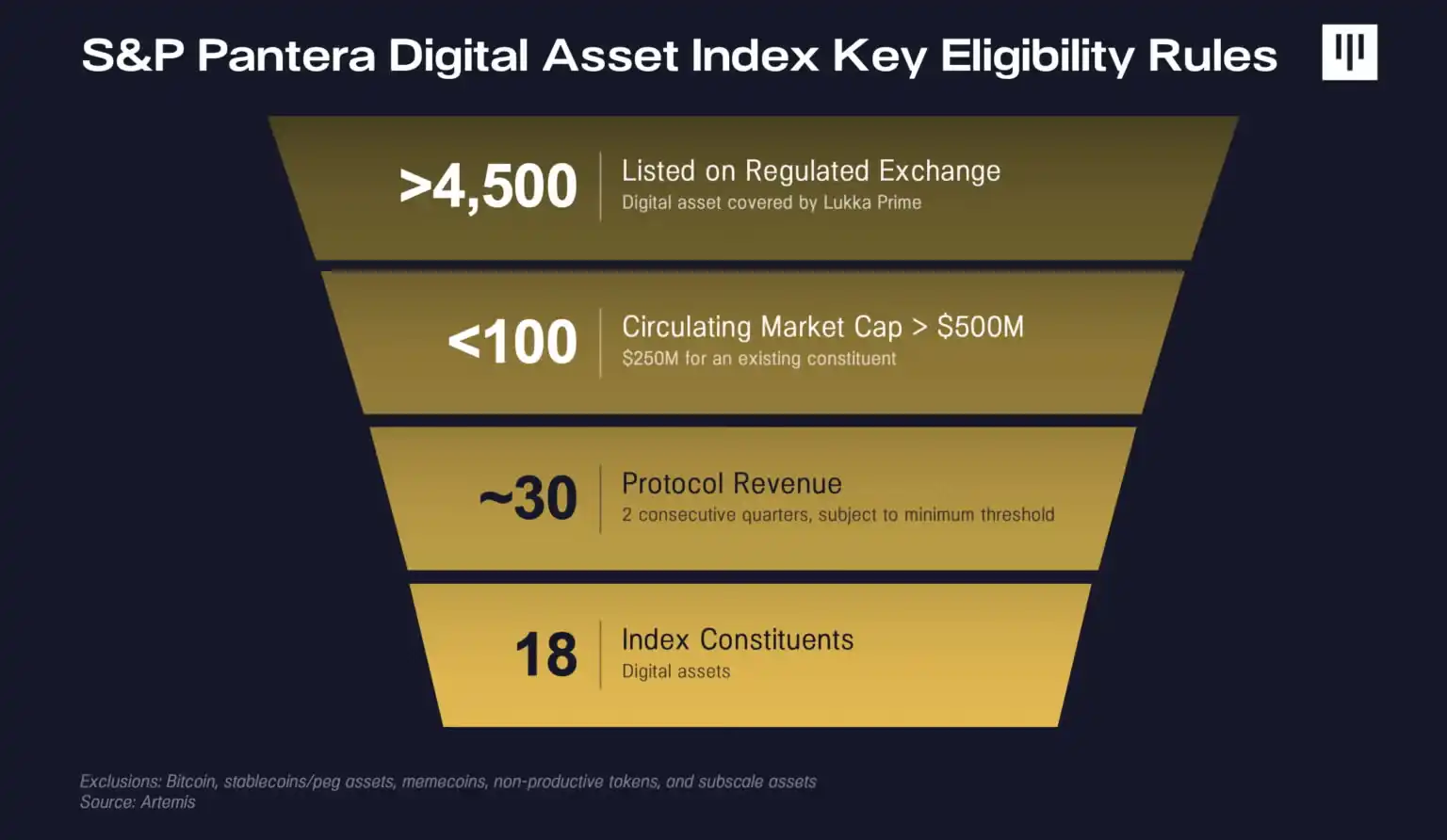
The S&P 500 requires constituent stocks to record positive GAAP profits for four consecutive quarters. The S&P Pantera Digital Asset Index transplants the same principle into the crypto space, requiring protocols to record positive protocol revenue (exceeding a minimum threshold) for multiple consecutive quarters, verified by on-chain data provider Artemis. Furthermore, the revenue must flow to token holders through mechanisms like buybacks, staking rewards net of inflation, distributions, or treasuries controlled by token holders.

After the initial screening, eligible assets are ranked by their revenue from the previous two quarters and gradually included until covering 99% of the total revenue of all eligible assets.

The index includes 18 component assets, weighted by float-adjusted market capitalization and rebalanced quarterly. A single token has a maximum weight cap of 35%, while other tokens are capped at 20%. These weight limits are consistent with the rules S&P uses for its equity indices.

Top Five Holdings: ETH, BNB, SOL, TRX, HYPE

The index's top five holdings are Ethereum (ETH), BNB, Solana (SOL), Tron (TRX), and Hyperliquid (HYPE). Pantera revealed in its Blockchain Letter that Aave is also a component of the index.

Pantera stated that all protocols in the index had combined annualized revenue exceeding $3 billion over the past two quarters. Every selected protocol provides services for which customers pay, and its token possesses a demonstrable value accrual mechanism.

The complete list of the 18 component tokens has not been publicly disclosed.
Why Was Bitcoin Excluded? Pantera Provides Three Reasons

Pantera explained in detail in its Blockchain Letter why Bitcoin was excluded.

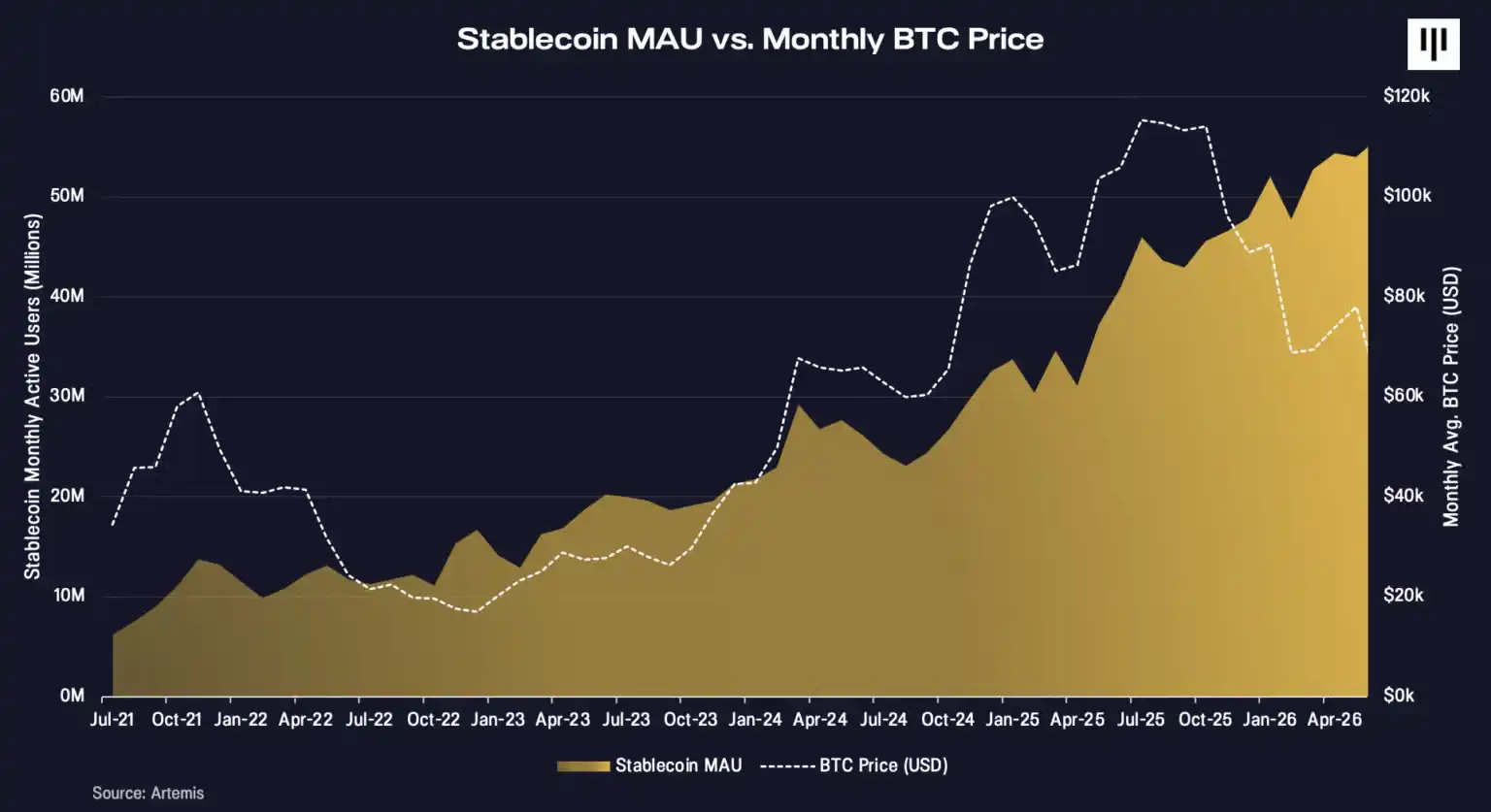
First, Bitcoin is a monetary asset, and institutional allocators often already have exposure to BTC through single-asset ETFs with established allocation policies. Second, existing crypto indices mix Bitcoin, meme coins, and truly revenue-generating protocols in one basket, making fundamental underwriting difficult for institutions. Third, Bitcoin does not generate protocol revenue and cannot pass the financial viability screening set by the index.

Pantera believes the narrative dilemma of the digital asset industry lies in the measuring stick itself. Current mainstream benchmarks only see the price of Bitcoin but fail to distinguish between a protocol with real paying users and a token with no economic function.
Currently a Benchmark Index, ETF Products Underway

The index is currently released only as a benchmark index, with no ETF or investment product tracking it yet. Pantera stated it has begun discussions with asset management firms regarding ETFs and other products based on this index.

A noteworthy detail is that Pantera Fund V is now listed on Morgan Stanley's alternative investment platform, becoming the first blockchain venture capital fund available through a top-tier global wealth management platform, accessible to over 16,000 Morgan Stanley financial advisors and their clients. Pantera's partnership with Morgan Stanley provides a ready-made distribution channel for future products based on this index targeting high-net-worth clients.

Community Discussion: Does Bitcoin's "Digital Gold" Narrative Become Stronger?

The news sparked lively discussion on the Reddit r/CryptoCurrency community (380+ upvotes), focusing on two directions.

Some Reddit users believe that future non-BTC ETFs based on this index could give altcoins greater institutional exposure, allowing investors to combine Bitcoin ETFs with separate altcoin allocations. Other users argue that Bitcoin's exclusion will instead reinforce its identity as "digital gold," while other crypto assets are increasingly viewed as utility networks or revenue-generating technology platforms.

Some users also pointed out that the index is currently just a benchmark, cannot be bought or shorted, and its actual market impact will only be visible after ETF products are launched.

Broader Context: Huge Product Gap Exists for Institutional Crypto Allocation

Pantera cited a set of data in its Blockchain Letter to illustrate the market gap: Bank of America and Fidelity currently recommend clients allocate 1% to 4% of their portfolio to digital assets, but J.P. Morgan Private Bank found that 89% of family offices still hold none; an EY survey showed 60% of institutions prefer exposure through registered investment products rather than directly on exchanges or on-chain.

Pantera believes this is not a gap in conviction, but a gap in products. Existing multi-asset products are overly concentrated in Bitcoin, purely market-cap weighted, and place meme coins alongside protocols with genuine revenue.

The launch of this index comes at a time when altcoin season signals are not yet confirmed but improving. The CoinGlass Altcoin Season Index climbed to 58 in mid-July, above the neutral watershed but still below the 75 threshold confirming a rotation.

Trending Cryptos

Related Questions

QWhat is the core criteria for an asset to be included in the S&P Pantera Digital Asset Index?

AThe core criterion is 'financial viability.' An asset must have its underlying protocol generate positive revenue (verified by Artemis) for multiple consecutive quarters, exceeding a minimum threshold, and that revenue must be distributed to token holders via mechanisms like token buybacks, inflation-adjusted staking rewards, or treasury distributions controlled by token holders.

QWhich major cryptocurrency was notably excluded from the new index, and what is the primary reason given for its exclusion?

ABitcoin (BTC) was notably excluded. The primary reason is that Bitcoin does not generate protocol revenue, which is a fundamental requirement of the index's financial viability screening process.

QWhat is the stated investment role or 'narrative' that the article suggests Bitcoin's exclusion from this index might reinforce?

AThe article suggests that Bitcoin's exclusion might reinforce its 'digital gold' narrative, solidifying its identity as a monetary asset, while other crypto assets are increasingly viewed as utility networks or revenue-generating technology platforms.

QHow many assets are included in the S&P Pantera Digital Asset Index, and name at least three of its top five holdings.

AThe index includes 18 assets. Three of its top five holdings are Ethereum (ETH), BNB, and Solana (SOL). The full list is Ethereum (ETH), BNB, Solana (SOL), Tron (TRX), and Hyperliquid (HYPE).

QWhat existing financial framework did S&P Dow Jones Indices and Pantera Capital model their new crypto index's screening methodology on?

AThey modeled the screening methodology on the S&P 500, specifically its requirement for constituents to report positive GAAP profits for four consecutive quarters. The crypto index adapted this principle to require positive protocol revenue for multiple consecutive quarters.

Related Reads

The Verdict in Choi Tae-won's Divorce Case: Revealing the Inheritance Undercurrent Behind SK Hynix's Trillion-Won Empire

SK Group Chairman Chey Tae-won's high-profile divorce case, involving a record 1.38 trillion won settlement, has drawn attention to the succession plans for Korea's second-largest conglomerate, especially its crown jewel, SK hynix. Unlike traditional chaebol scripts centered on the eldest son, Chey's three children from his marriage to former President Roh Tae-woo's daughter, Roh Soh-yeong, are carving distinct, non-traditional paths. Eldest daughter Chey Yun-jung (b. 1989) is seen as the most evident successor. With a scientific and consulting background, she holds executive roles at SK bioscience and SK Inc.'s growth support department, focusing on future strategy and biopharma. Her marriage is to an AI infrastructure entrepreneur, not a traditional business alliance. Second daughter Chey Min-jung (b. 1991) took a unique route, voluntarily serving as a South Korean naval officer, including an anti-piracy deployment. She later worked on policy and strategy for SK hynix in Washington D.C. before co-founding an AI-driven healthcare startup. She married a former U.S. Marine Corps officer, connecting her to U.S. defense and policy circles—networks crucial for a global semiconductor giant. The only son, Chey In-geun (b. 1995), who studied physics like his father, worked briefly at SK E&S before joining McKinsey. Despite fitting the traditional "heir" profile as the eldest son, he remains silent and holds no public position or shares in SK, suggesting the old succession playbook is obsolete. As SK hynix's valuation soars, becoming a geopolitical asset in the AI era, the heirs' legitimacy is no longer automatic. They must prove themselves in fields like AI biotech, global policy, and strategic consulting. Their marriages also reflect new elite networks in tech and defense, not old political alliances. Their inheritance is the complex challenge of navigating a globalized, tech-driven world, not just a corporate throne.

marsbitYesterday 09:06

The Verdict in Choi Tae-won's Divorce Case: Revealing the Inheritance Undercurrent Behind SK Hynix's Trillion-Won Empire

marsbitYesterday 09:06

From OpenSea to OpenRouter: Is Alex Atallah Repeating His 'Exit at the Peak' Playbook?

From OpenSea to OpenRouter: Is Alex Atallah Repeating His "Exit at the Peak" Playbook? According to the Wall Street Journal, payments giant Stripe is in talks to acquire the AI model aggregation platform OpenRouter in a potential deal valuing the company near $100 billion. This would mark founder Alex Atallah's second creation of a company reaching a $100 billion valuation, following his co-founding of NFT marketplace OpenSea. OpenRouter, founded just over three years ago, has grown rapidly by acting as a unified gateway for developers to access over 400 AI models. It currently has about 10 million users and processes over 200 trillion tokens monthly. While the platform's annualized revenue is around $50 million, its valuation has skyrocketed from $1.3 billion in March 2026. The potential acquisition by Stripe, a company OpenRouter's founder once likened it to, represents a major expansion into AI infrastructure for the payments leader. This move echoes Atallah's previous timing with OpenSea, where he departed before the NFT market's significant downturn. For OpenRouter, selling now may be strategic. Despite its scale, its business model—charging a 5-5.5% fee on AI inference calls—faces pressure from competition, open-source models, and potential price wars among model providers, limiting its profitability narrative for an IPO. A key asset for potential acquirers like Stripe is OpenRouter's vast repository of real-world AI usage data, which offers unique insights into model performance and developer preferences that are difficult to replicate. Whether this potential deal signifies a new valuation benchmark for AI infrastructure or another market peak signal remains to be seen.

链捕手Yesterday 08:42

From OpenSea to OpenRouter: Is Alex Atallah Repeating His 'Exit at the Peak' Playbook?

链捕手Yesterday 08:42

Trading

Spot

Hot Articles

Discussions

Welcome to the HTX Community. Here, you can stay informed about the latest platform developments and gain access to professional market insights. Users' opinions on the price of S (S) are presented below.

活动图片