Understanding Premium Rate: Stay 24 Hours Ahead of ETF Data

marsbitPublished on 2026-01-30Last updated on 2026-01-30

Abstract

Understanding ETF Premium Rates: A 24-Hour Advantage in Crypto Trading With the approval of BTC and ETH spot ETFs, daily fund flows have become a critical indicator for traders. However, this data is delayed by one day, often causing market prices to reflect the information before it is officially published. A key real-time indicator to anticipate ETF net inflows or outflows is the **ETF premium rate**. The premium rate reflects the difference between an ETF's market price and its net asset value (NAV). A positive premium suggests bullish sentiment and potential inflows, while a negative premium indicates bearish sentiment and likely outflows. Data from January 2026 showed that negative premium rates occurred on 16 out of 18 trading days, with 11 of those days resulting in net outflows. A longer-term analysis (July 2025 to January 2026) revealed an **81% accuracy rate** for negative premiums predicting outflows and **84%** for positive premiums predicting inflows. The mechanism behind this involves Authorized Participants (APs) who perform arbitrage: - A positive premium prompts APs to create ETF shares (buying underlying assets → net inflow). - A negative premium leads to share redemption (selling assets → net outflow). To use premium rates effectively: 1. Focus on **sustained trends** rather than one-day values. 2. Watch for **extreme values** (e.g., beyond ±1%), indicating strong sentiment shifts. 3. Consider **price context**—high prices with n...

Author: San, Deep Tide TechFlow

Since the approval of spot ETFs for BTC and ETH, daily ETF fund inflows and outflows have become a core indicator for many traders to gauge the market.

The logic is simple: net inflows indicate institutional buying and bullish sentiment; net outflows indicate institutional selling and bearish sentiment.

But the problem is, the ETF data we see every day is from the previous day.

By the time the data is released, the price has often already reflected it.

So, is there any way to predict whether today's ETF will have net inflows or outflows in advance?

Yes, the answer is the ETF premium rate.

It's not hard to verify this pattern; looking back at the recently concluded January 2026 is the best sample.

As of January 28, there were 18 trading days in the U.S. stock market.

Statistics show that the premium index on Coinbase remained in positive territory for two days, while the other 16 days were all in negative premium territory.

Corresponding ETF fund flows show that 11 of these 16 days ultimately recorded net outflows.

Especially from January 16 to 23, the negative premium rate continuously fell below -0.15%, corresponding to a weekly net outflow of over $1.3 billion from the ETF market, with BTC's price dropping from a high of $97,000 to around $88,000.
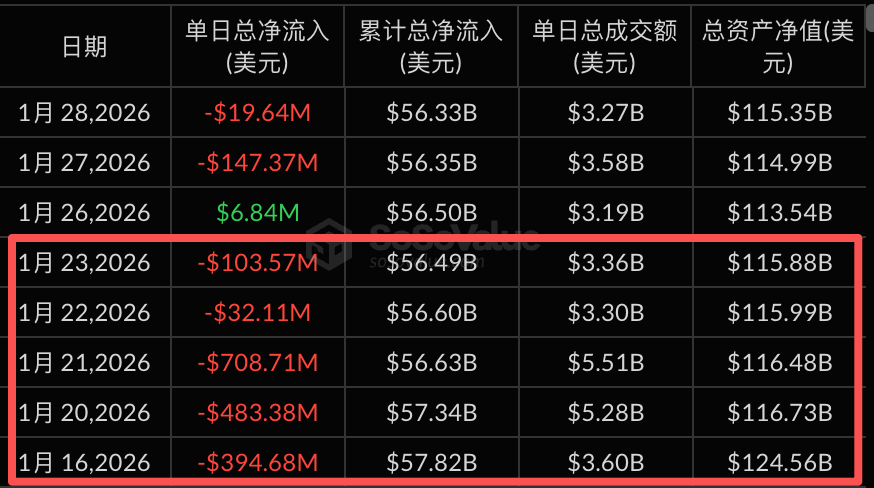
Data source: sosovalue

Let's take a broader view.

From July 1, 2025, to January 28, 2026, there were a total of 146 trading days.

· Negative premium rate occurred for 48 days, corresponding to net outflows for 39 days, with an accuracy rate of 81%.

· Positive premium rate occurred for 98 days, corresponding to net inflows for 82 days, with an accuracy rate of 84%.

This is the value of the premium rate: it allows you to see where the money is flowing earlier than most.

What Is the Premium Rate?

We've been talking about the premium rate, but what exactly is it?

Here's an analogy.

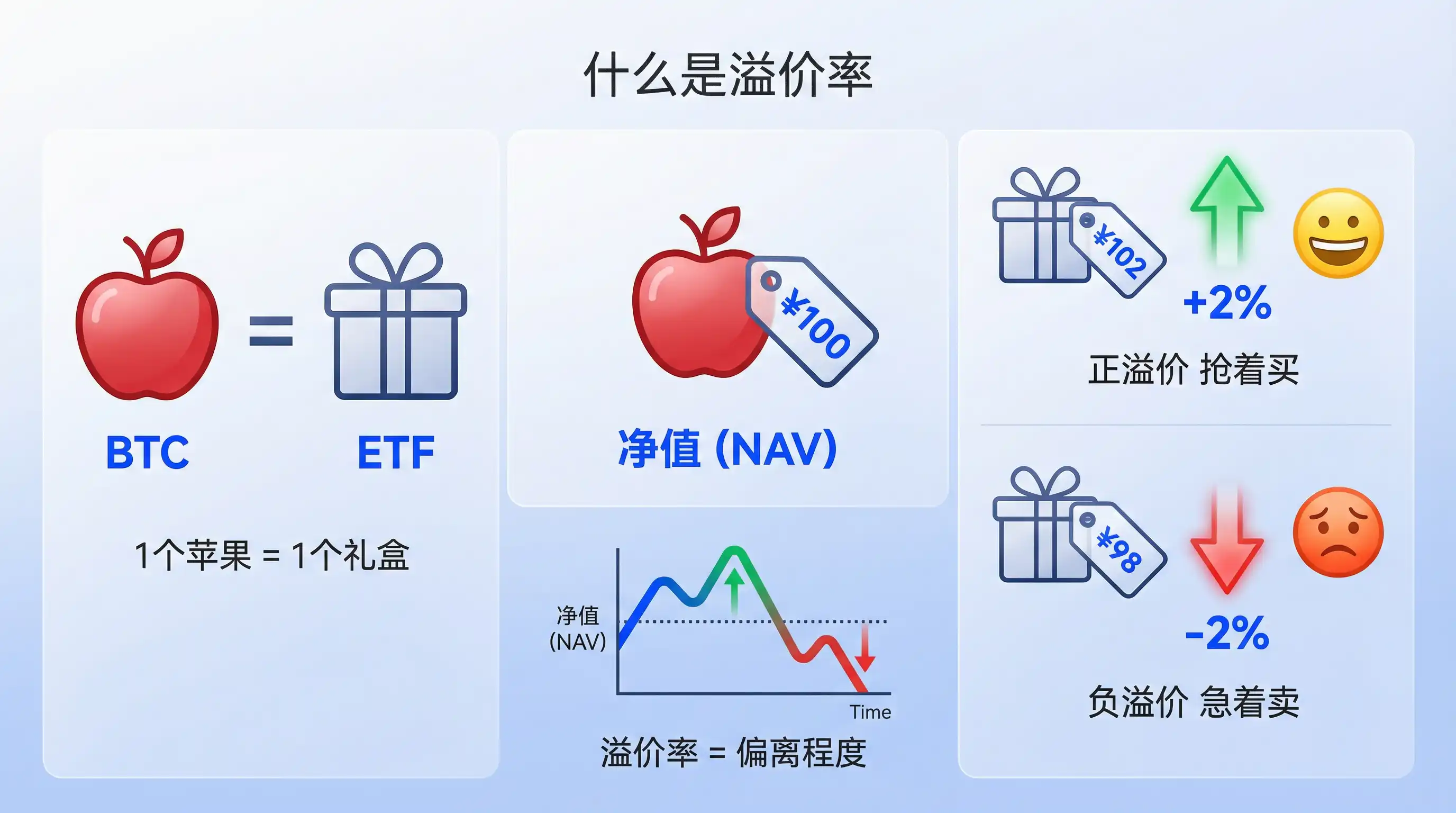
BTC is like loose apples in a grocery market, while BTC spot ETFs are like packaged apple gift boxes in a supermarket, each containing one apple.

An apple sells for $100 in the grocery market—this is the net asset value (NAV).

How much the apple gift box sells for in the supermarket depends on supply and demand.

If many people buy it, the box is driven up to $102—this is a positive premium rate, with a premium of +2%.

If many people sell it, the box drops to $98—this is a negative premium rate, with a premium of -2%.

The premium rate reflects the degree to which the ETF market price deviates from the real price of BTC.

A positive premium indicates optimistic market sentiment, with people rushing to buy.

A negative premium indicates pessimistic market sentiment, with people rushing to sell.
The Relationship Between Premium Rate and ETF Inflows/Outflows

The premium rate is not just a market sentiment indicator; it also becomes a key driver of fund flows.

The key players here are APs, or Authorized Participants, whom you can think of as privileged intermediaries.

The core logic for APs is risk-free arbitrage: they can subscribe to and redeem ETF shares in the primary market, and they can also buy and sell in the secondary market.

As long as there is a price difference, they will engage in arbitrage.

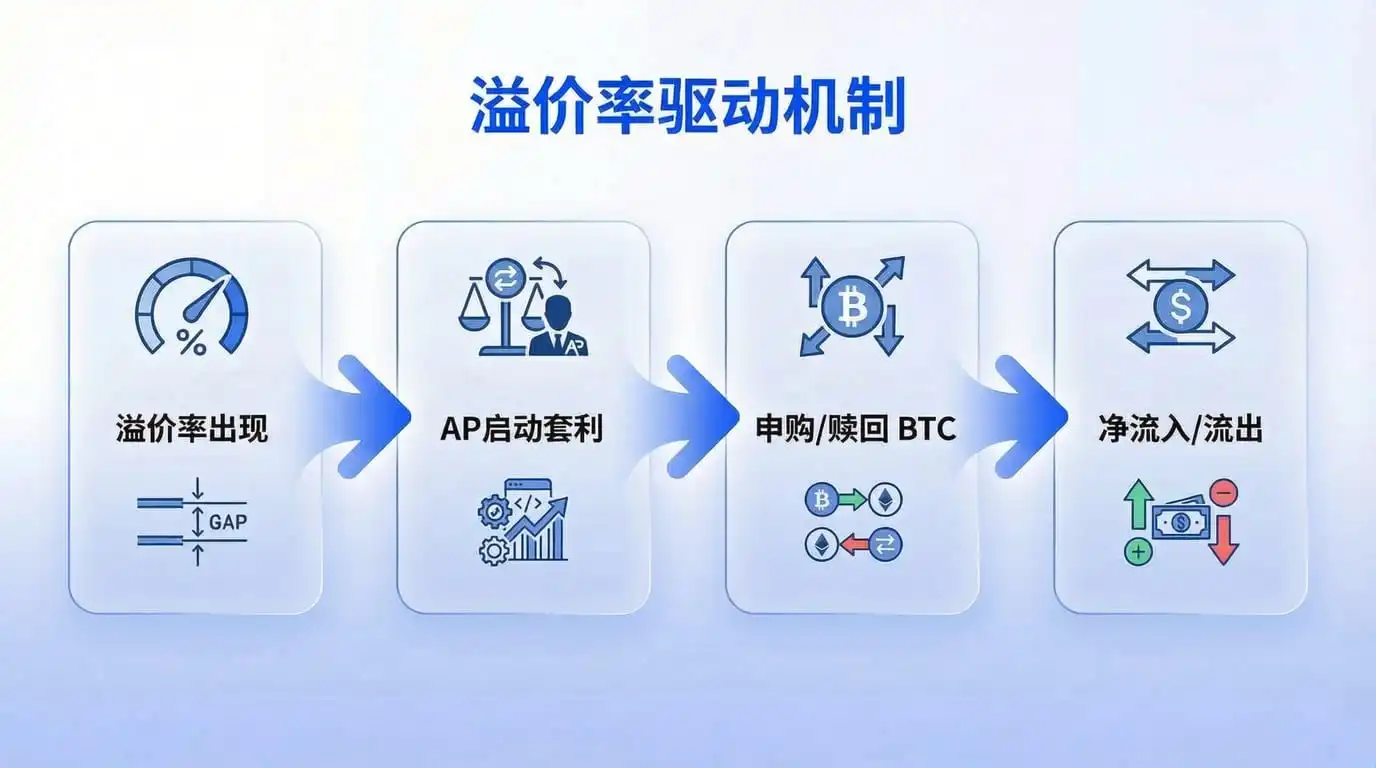
When a positive premium rate appears, the gift box is more expensive than the apple. APs will go to the primary market to buy BTC, package it into ETF shares, and then sell it in the secondary market to profit from the difference. In this process, BTC is bought, resulting in net inflows.

Conversely, when a negative premium rate appears, the gift box is cheaper than the apple. APs will buy ETFs in the secondary market, unpack them to redeem BTC, and then sell the BTC to profit from the difference. In this process, BTC is sold, resulting in net outflows.

So the logical chain is as follows:

Premium rate appears → APs initiate arbitrage → Subscription or redemption occurs → Net inflows or outflows are formed.
And the ETF fund data we see every day is published the next day after settlement.

The premium rate is real-time; the fund data is lagging.

This is why the premium rate can give you an edge over the market.

How to Apply the Premium Rate

Now that we understand the principle of the premium rate and its relationship with ETF net inflows and outflows, how can we apply it to our individual trading plans?

First, the premium rate is not an indicator to be used alone.

It can tell us the direction of funds but not the magnitude or sustainability.

Here, I suggest combining it with the following dimensions.

1. The Sustainability of the Premium Rate Is More Important Than a Single-Day Value

A single day of negative premium rate may just be short-term volatility.

But if the negative premium rate persists for multiple days, it is likely to correspond to continuous net outflows, which is worth noting.

Looking back at the five consecutive trading days of negative premium rate from January 16 to 23 this year, it corresponded to five days of net outflows, with BTC falling nearly 10%.

2. Pay Attention to Extreme Values of the Premium Rate

Generally, a premium rate fluctuating within ±0.5% is normal.

Once it breaks through ±1%, it indicates a significant deviation in market sentiment, and AP arbitrage activity intensifies, accelerating fund flows.

3. Combine with Price Levels for Judgment

A sustained negative premium rate at high levels may be an early signal of capital flight.

A sustained positive premium rate at low levels may indicate bottom-fishing capital entering the market.

The premium rate itself does not constitute a basis for buying or selling, but it can help you verify the current trend or detect turning points in advance.

Final Thoughts

Finally, there are a few points to note.

No indicator is a holy grail; the effectiveness of the premium rate is based on the normal operation of the AP arbitrage mechanism.

In extreme market conditions, such as the 10.11 crash, where market liquidity dries up, the arbitrage mechanism may fail, and the correlation between the premium rate and fund flows may decrease.

Additionally, the premium rate is just one window into ETF fund movements.

For mature investors, the premium rate is just one piece of the puzzle.

It is recommended to combine it with the following indicators for multi-dimensional cross-verification:

  1. ETF Holdings Changes: An increase in holdings indicates institutions are accumulating; a decrease indicates they are reducing positions. More direct than the premium rate, but data updates are delayed.
  2. Futures Basis and Funding Rate: A positive basis and continuously rising funding rate indicate overheated bullish sentiment, suggesting the market may be overly optimistic. The opposite indicates bearish dominance.
  3. Put/Call Ratio in the Options Market: Puts are put options; calls are call options. A rising ratio indicates increased market避险 sentiment; a falling ratio indicates dominant optimism.
  4. On-Chain Large Transfers and Exchange Net Inflows: Large BTC transfers into exchanges often signal impending selling pressure. Large transfers out of exchanges indicate accumulation.

For example.

When you observe: a continuous negative premium rate, a decrease in ETF holdings, and an increase in exchange net inflows.

Three signals point in the same direction: funds are withdrawing, and selling pressure is accumulating.

At this point, you should at least be alert and control your position, rather than buying the dip.

A single indicator cannot reveal the full picture; multi-dimensional cross-verification is needed to improve the accuracy of judgment.

In this market, the more dimensions you observe, the smaller the information gap, but the time gap will always exist.

Those who see the direction of funds first gain an extra edge.

Related Questions

QWhat is the ETF premium rate and how does it help predict fund flows?

AThe ETF premium rate is the percentage difference between the ETF's market price and its net asset value (NAV). A positive premium rate indicates market optimism and potential net inflows, while a negative rate suggests pessimism and potential net outflows. It serves as a real-time indicator that can predict the next day's official ETF flow data, giving traders a 24-hour advantage.

QHow accurate is the premium rate in predicting ETF net inflows and outflows based on the data from July 2025 to January 2026?

AFrom July 1, 2025, to January 28, 2026, covering 146 trading days, the premium rate had an 81% accuracy in predicting net outflows when negative (48 days, 39 net outflows) and an 84% accuracy in predicting net inflows when positive (98 days, 82 net inflows).

QWhat role do Authorized Participants (APs) play in the relationship between premium rate and ETF flows?

AAuthorized Participants (APs) are key players who perform risk-free arbitrage. When there's a positive premium, APs buy BTC, create ETF shares, and sell them on the secondary market for a profit, leading to net inflows. During negative premiums, APs buy ETF shares, redeem them for BTC, and sell the BTC, resulting in net outflows.

QWhat factors should be considered alongside the premium rate for better investment decisions?

AThe premium rate should be used alongside other indicators: 1) Persistence of the premium rate (sustained trends matter more than single-day values), 2) Extreme values (beyond ±0.5% signal stronger movements), 3) Price level (high prices with negative premiums may indicate early sell-offs, low prices with positive premiums may suggest accumulation), and cross-verification with ETF holdings, futures basis, funding rates, options Put/Call ratios, and on-chain large transfers.

QWhy might the premium rate's effectiveness decrease in extreme market conditions?

AIn extreme market conditions, such as severe crashes or liquidity crises (e.g., the 10.11 crash), the arbitrage mechanism may break down. APs might be unable to execute trades efficiently due to market illiquidity, reducing the correlation between the premium rate and actual ETF fund flows.

Related Reads

Trading

Spot
Futures

Hot Articles

What is $BITCOIN

DIGITAL GOLD ($BITCOIN): A Comprehensive Analysis Introduction to DIGITAL GOLD ($BITCOIN) DIGITAL GOLD ($BITCOIN) is a blockchain-based project operating on the Solana network, which aims to combine the characteristics of traditional precious metals with the innovation of decentralized technologies. While it shares a name with Bitcoin, often referred to as “digital gold” due to its perception as a store of value, DIGITAL GOLD is a separate token designed to create a unique ecosystem within the Web3 landscape. Its goal is to position itself as a viable alternative digital asset, although specifics regarding its applications and functionalities are still developing. What is DIGITAL GOLD ($BITCOIN)? DIGITAL GOLD ($BITCOIN) is a cryptocurrency token explicitly designed for use on the Solana blockchain. In contrast to Bitcoin, which provides a widely recognized value storage role, this token appears to focus on broader applications and characteristics. Notable aspects include: Blockchain Infrastructure: The token is built on the Solana blockchain, known for its capacity to handle high-speed and low-cost transactions. Supply Dynamics: DIGITAL GOLD has a maximum supply capped at 100 quadrillion tokens (100P $BITCOIN), although details regarding its circulating supply are currently undisclosed. Utility: While precise functionalities are not explicitly outlined, there are indications that the token could be utilized for various applications, potentially involving decentralized applications (dApps) or asset tokenization strategies. Who is the Creator of DIGITAL GOLD ($BITCOIN)? At present, the identity of the creators and development team behind DIGITAL GOLD ($BITCOIN) remains unknown. This situation is typical among many innovative projects within the blockchain space, particularly those aligning with decentralized finance and meme coin phenomena. While such anonymity may foster a community-driven culture, it intensifies concerns about governance and accountability. Who are the Investors of DIGITAL GOLD ($BITCOIN)? The available information indicates that DIGITAL GOLD ($BITCOIN) does not have any known institutional backers or prominent venture capital investments. The project seems to operate on a peer-to-peer model focused on community support and adoption rather than traditional funding routes. Its activity and liquidity are primarily situated on decentralized exchanges (DEXs), such as PumpSwap, rather than established centralized trading platforms, further highlighting its grassroots approach. How DIGITAL GOLD ($BITCOIN) Works The operational mechanics of DIGITAL GOLD ($BITCOIN) can be elaborated on based on its blockchain design and network attributes: Consensus Mechanism: By leveraging Solana’s unique proof-of-history (PoH) combined with a proof-of-stake (PoS) model, the project ensures efficient transaction validation contributing to the network's high performance. Tokenomics: While specific deflationary mechanisms have not been extensively detailed, the vast maximum token supply implies that it may cater to microtransactions or niche use cases that are still to be defined. Interoperability: There exists the potential for integration with Solana’s broader ecosystem, including various decentralized finance (DeFi) platforms. However, the details regarding specific integrations remain unspecified. Timeline of Key Events Here is a timeline that highlights significant milestones concerning DIGITAL GOLD ($BITCOIN): 2023: The initial deployment of the token occurs on the Solana blockchain, marked by its contract address. 2024: DIGITAL GOLD gains visibility as it becomes available for trading on decentralized exchanges like PumpSwap, allowing users to trade it against SOL. 2025: The project witnesses sporadic trading activity and potential interest in community-led engagements, although no noteworthy partnerships or technical advancements have been documented as of yet. Critical Analysis Strengths Scalability: The underlying Solana infrastructure supports high transaction volumes, which could enhance the utility of $BITCOIN in various transaction scenarios. Accessibility: The potential low trading price per token could attract retail investors, facilitating wider participation due to fractional ownership opportunities. Risks Lack of Transparency: The absence of publicly known backers, developers, or an audit process may yield skepticism regarding the project's sustainability and trustworthiness. Market Volatility: The trading activity is heavily reliant on speculative behavior, which can result in significant price volatility and uncertainty for investors. Conclusion DIGITAL GOLD ($BITCOIN) emerges as an intriguing yet ambiguous project within the rapidly evolving Solana ecosystem. While it attempts to leverage the “digital gold” narrative, its departure from Bitcoin's established role as a store of value underscores the need for a clearer differentiation of its intended utility and governance structure. Future acceptance and adoption will likely depend on addressing the current opacity and defining its operational and economic strategies more explicitly. Note: This report encompasses synthesised information available as of October 2023, and developments may have transpired beyond the research period.

363 Total ViewsPublished 2025.05.13Updated 2025.05.13

Discussions

Welcome to the HTX Community. Here, you can stay informed about the latest platform developments and gain access to professional market insights. Users' opinions on the price of BTC (BTC) are presented below.

活动图片