Bitcoin whales vs. retail panic: 3 factors define BTC’s next breakout

AmbcryptoPublished on 2026-01-25Last updated on 2026-02-10

Abstract

BTC selling pressure lingers, but the balance beneath the surface is shifting.

Bitcoin’s on-chain data highlighted a sharp behavioral split. As volatility rose, retail panic selling accelerated amid deeper drawdown fears.

Consequently, short-term holders sold below cost, locking in losses and reflecting bearish sentiment. During this phase, Short-Term Holder (STH) supply in loss expanded, confirming capitulation.

By contrast, whales accumulated steadily for several weeks. Wallets holding at least 1,000 BTC increased collective holdings by 104,340 BTC, a 1.5% rise.

That pushed total whale-held supply to 7.17 million BTC, marking a four-month high.
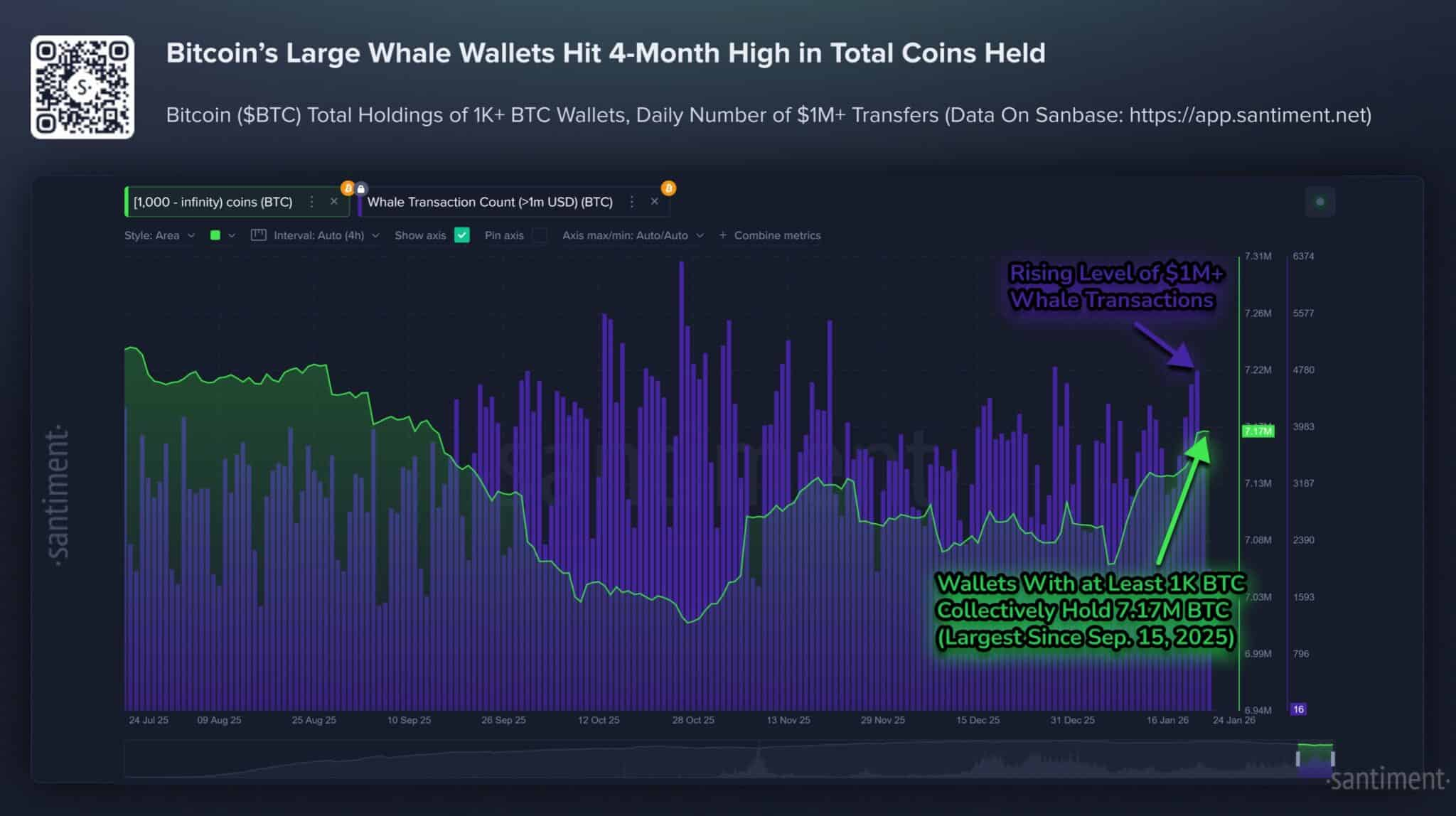
Meanwhile, over $1 million in daily transfers hit a two-month high, signaling active accumulation. This dynamic implies smart-money absorption as retail exits exhaust.

STHs capitulate as realized losses remain elevated

Bitcoin’s [BTC] Net Realized Profit and Loss analysis showed that the $4.5 billion realized loss did not occur in a single print but accumulated through repeated downside spikes.

This indicated prolonged stress rather than a single capitulation event.

As BTC price stalled near highs, distribution intensified. Consequently, losses expanded as short-term holders sold into drawdowns, driven by macro uncertainty, ETF outflows, and fading momentum.
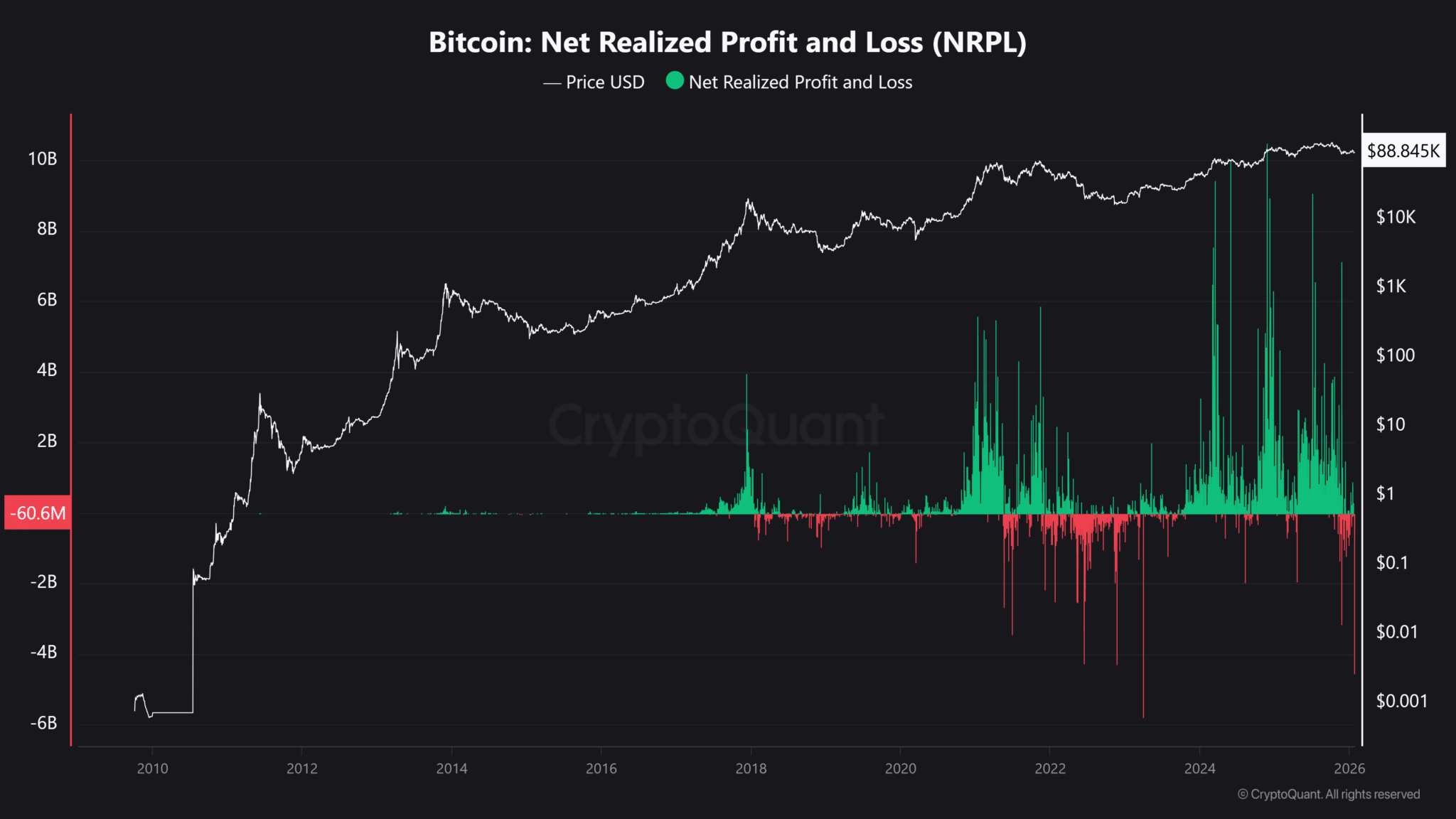
Historically, similar NRPL flushes appeared in 2018, 2020, and late 2022. Notably, the last comparable event saw Bitcoin near $28,000, followed by a long basing phase.

These losses correlate with capitulation. Recovery typically emerges once selling exhausts and accumulation absorbs supply.

Building on the spike in dollar-denominated NRPL, the 30-day realized net profit/loss in BTC terms adds clarity to who is selling and how.

The analysis showed the metric slipping below zero near late 2025, marking the first sustained negative print since September 2023.

Importantly, this selling is gradual, not abrupt, indicating pressure rather than panic.
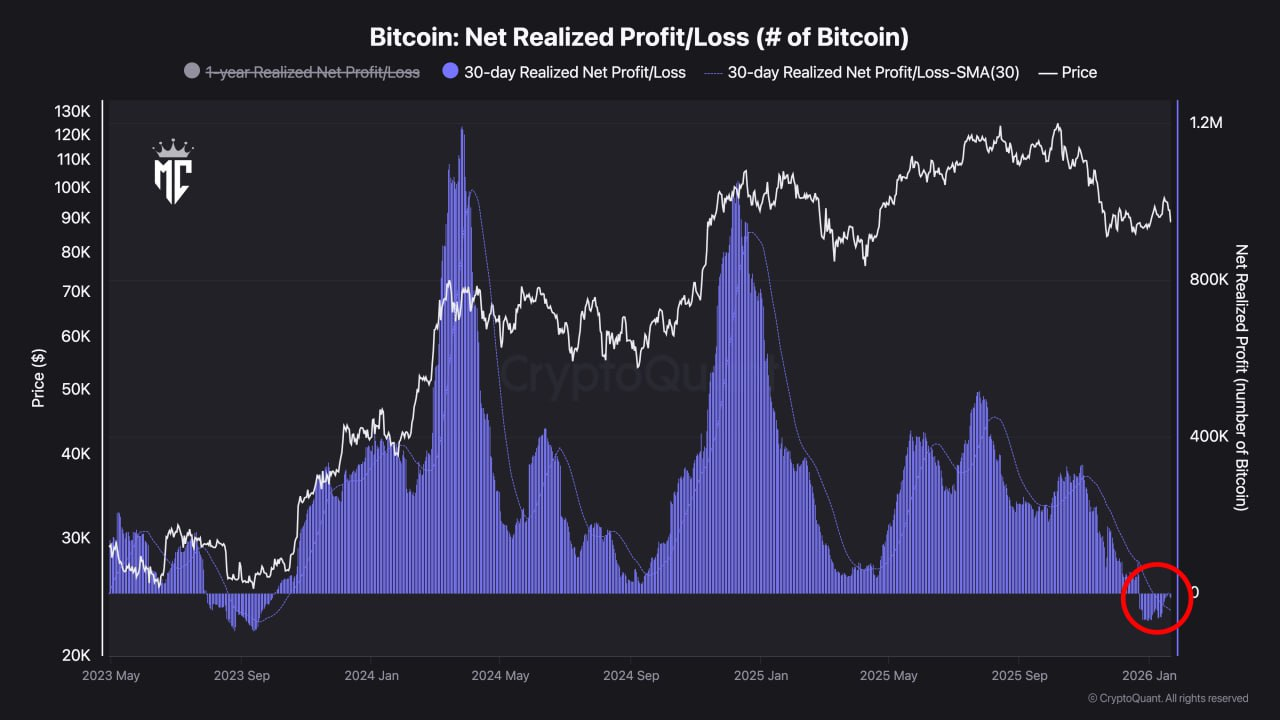
These losses largely come from short-term holders, as recent buyers sell below cost after failed breakouts above $90,000.

Macro uncertainty, ETF flow volatility, and leverage unwinds reinforce this behavior. As a result, supply caps upside and stalls price.

From a positioning perspective, bulls will have to monitor signs of loss and exhaustion, while bears remain focused on the persistence of distribution.

Range holds as losses shape structure

Short-term holder loss realization continued to shape Bitcoin’s structure, keeping the price confined within a wide consolidation range.

Selling below cost added supply during rebounds, which limits breakouts above the $95,000-$100,000 resistance zone.
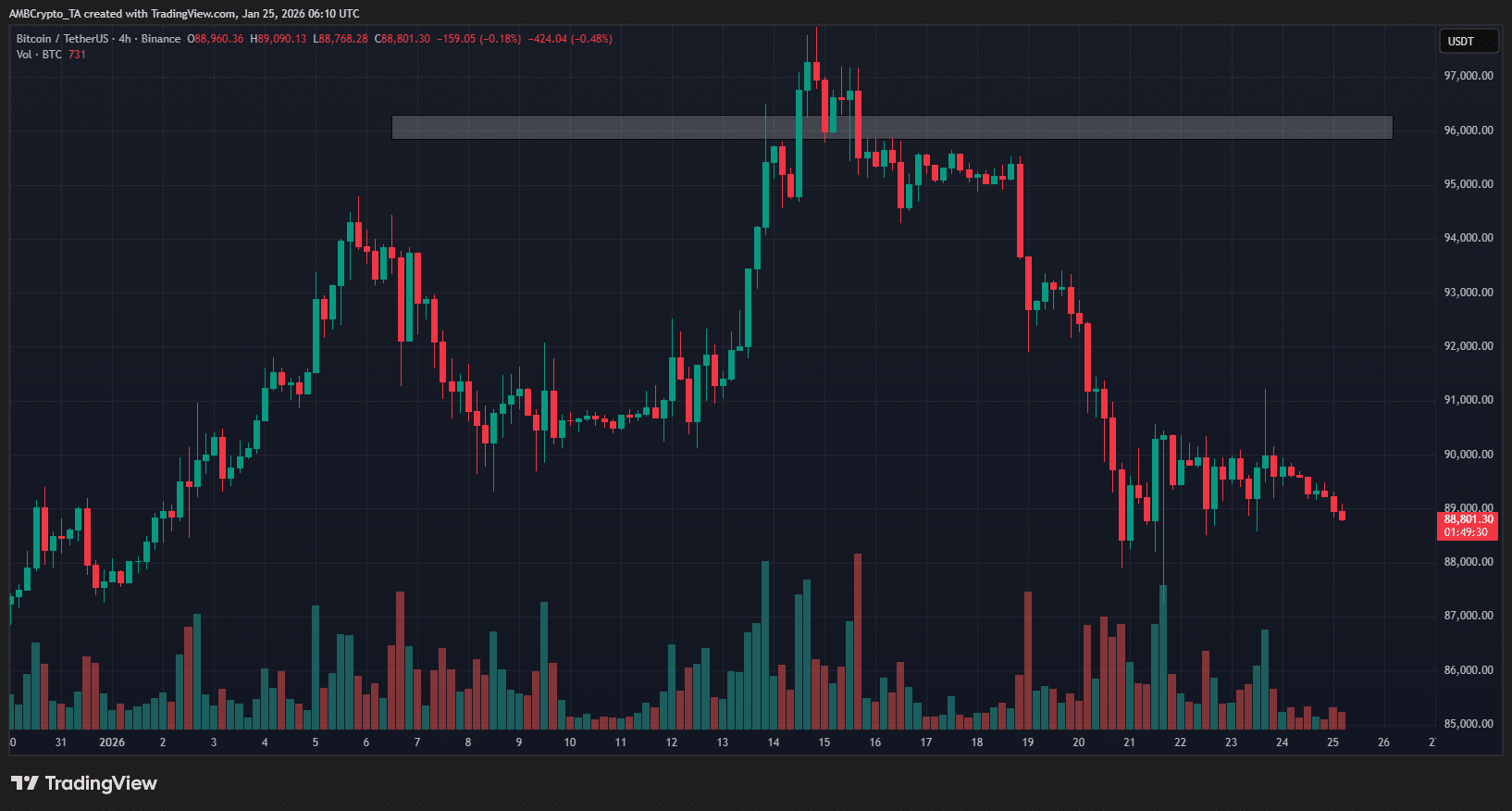
At the same time, selling pressure has eased near $85,000–88,000, where buyers have shown willingness to absorb supply.

This balance favored sideways price action rather than a sustained trend. A breakout would likely require realized losses to decline alongside stronger Spot demand.

On the downside, renewed increases in loss realization could weaken support and trigger another retest of lower levels.

Final Thoughts

  • Bitcoin’s drawdown reflected short-term holder capitulation, with realized losses transferring supply toward whales that continued accumulating despite price stagnation.
  • Persistent selling kept Bitcoin range-bound between $85,000–$88,000 support and $95,000–$100,000 resistance, leaving direction dependent on loss exhaustion and renewed Spot demand.

Related Questions

QWhat behavioral split in Bitcoin's on-chain data is highlighted in the article?

AThe article highlights a sharp behavioral split between retail investors, who engaged in panic selling due to fears of deeper drawdowns, and whales, who accumulated Bitcoin steadily over several weeks.

QHow much did wallets holding at least 1,000 BTC increase their collective holdings, and what was the percentage rise?

AWallets holding at least 1,000 BTC increased their collective holdings by 104,340 BTC, which represents a 1.5% rise.

QWhat did Bitcoin's Net Realized Profit and Loss analysis reveal about the nature of the $4.5 billion in realized losses?

AThe analysis revealed that the $4.5 billion in realized losses did not occur in a single event but accumulated through repeated downside spikes, indicating prolonged stress rather than a single capitulation event.

QAccording to the article, what is the current price range confining Bitcoin's movement, and what are its key levels?

ABitcoin is currently confined within a wide consolidation range, with support at $85,000–$88,000 and resistance at $95,000–$100,000.

QWhat factors does the article suggest are necessary for a Bitcoin breakout from its current range?

AThe article suggests that a breakout would likely require realized losses to decline alongside stronger Spot demand.

Related Reads

Behind the 2000 BTC Incident: The Fundamental Problem of CEX Ledgers

On February 6, Bithumb, a South Korean cryptocurrency exchange, mistakenly distributed 2,000 BTC each to 249 users due to a unit error during a promotional event—intending to give away 2,000 KRW (≈$1.4) per user. The total erroneous distribution amounted to 62,000 BTC, worth approximately $41.5–44 billion. Although these assets existed only in Bithumb’s internal ledger and not on-chain, they were tradable on the platform, causing BTC/KRW prices to drop nearly 17% within minutes and triggering over $400 million in derivatives liquidations. Bithumb responded within 35 minutes, freezing affected accounts and recovering over 99% of the misallocated BTC. The remaining 1,788 BTC were covered by the exchange’s own funds. The incident exposed a fundamental flaw in centralized exchanges (CEXs): their reliance on internal accounting systems that allow rapid balance adjustments without corresponding on-chain assets. This creates systemic risk, as user balances are essentially IOU entries rather than real assets. The article draws parallels with historical failures like Mt.Gox and FTX, where discrepancies between internal ledgers and actual reserves led to catastrophic collapses. While Bithumb’s quick response limited damage, the event underscores the structural vulnerabilities of CEXs, prompting South Korean regulators to consider stricter oversight. The piece concludes that such incidents highlight the inherent trust asymmetry in CEX operations, where users rely on exchanges to honor ledger entries as real assets—a risk that remains ever-present.

比推25m ago

Behind the 2000 BTC Incident: The Fundamental Problem of CEX Ledgers

比推25m ago

Trading

Spot
Futures

Hot Articles

Discussions

Welcome to the HTX Community. Here, you can stay informed about the latest platform developments and gain access to professional market insights. Users' opinions on the price of S (S) are presented below.

活动图片