Artículos Relacionados con Neuroscience

El Centro de Noticias de HTX ofrece los artículos más recientes y un análisis profundo sobre "Neuroscience", cubriendo tendencias del mercado, actualizaciones de proyectos, desarrollos tecnológicos y políticas regulatorias en la industria de cripto.

Early Investor of Unitree Bets on a Brain-Computer Interface Company

"Wabo Technologies, a brain-computer interface (BCI) startup, has secured new funding from Vertex Ventures (under Temasek), Hongtai Fund, Chengdu Future Industry Fund, and Huifengda Capital. Vertex Ventures is known for its early bet on Unitree Robotics. Inspired by the sci-fi film "Avatar," founder Zhang Xingzhi has pursued human-machine interaction for over a decade. He established Wabo in late 2025, coinciding with China's push for BCI as a future industry. Unlike companies focused solely on medical hardware, Wabo positions itself as a model company. Its core mission is to develop a "Human Neural Intent Model" that decodes EEG, EMG, and behavioral signals to understand a user's goals, confirmations, corrections, and stop intentions before physical action, translating them into standardized control signals for machines, robots, or smart devices. The young, full-stack team, backed by academic collaborators from Tianjin University and Fudan University, quickly attracted investors. The company had previously raised a seed round from Ceyuan Capital. Investors were impressed by Wabo's systematic capabilities in data collection, signal processing, and engineering, seeing potential beyond a single hardware product toward a reusable layer of human intent interpretation. Applications span medical rehabilitation, smart homes, embodied AI, and even space exploration, with Wabo partnering with Tianjin University on pioneering "space BCI" research. Wabo plans a dual-headquarters strategy, with Shanghai focusing on high-end R&D and model development, and Chengdu handling hardware, product development, and supply chain. The BCI sector in China is heating up, with over 30 financing deals in early 2026. Zhang believes future competition will center on who can build a sustainable data-model-scenario loop. He predicts industry consolidation within three years, with only companies that master this闭环 surviving. The vision from "Avatar" is inching closer to reality."

marsbit07/29 03:11
Early Investor of Unitree Bets on a Brain-Computer Interface Company

marsbit07/29 03:11

Opening Claude's Brain Is Useless; The True Key to the AI Black Box Lies in Ontology Engineering

"Dissecting Claude's Brain Is Futile: The Real Key to the AI Black Box Lies in Ontology Engineering" This article critiques the limitations of Anthropic's "J-Space" research, which attempts to explain AI models by observing their internal neural activation patterns, akin to fMRI brain scans. While this "internalist" approach offers unprecedented visibility into model states, it fundamentally conflates observability with true explainability. The core issue is that understanding a model's output requires more than tracing neural activity; it necessitates examining the meaning of the information it processes—its relationship to the world, semantic norms, and human cognitive frameworks. The author proposes a paradigm shift: moving from a neuroscience-inspired focus on the model itself to an "information ontology" approach centered on the knowledge the model handles. Drawing from Kant's philosophical categories, the argument posits that true explainability lies in structuring and understanding information within a formal conceptual framework, not in peering into the "black box." The practical application of this theory is ontology engineering. Ontologies provide a structured, computable framework for knowledge, serving as a semantic anchor for model outputs. The article details a bidirectional synergy: Large Language Models (LLMs) can automate and scale ontology construction, while ontologies, in turn, enhance AI explainability. They act as a verification framework, allowing model reasoning to be traced back to defined concepts, properties, and relationships. This transforms explainability from the impossible task of making neural networks transparent into the achievable engineering goal of making their outputs and impacts understandable, traceable, and accountable. The future of AI explainability, therefore, lies not in explaining the model's internal mechanics but in explaining and governing the knowledge structures and real-world effects of its outputs.

marsbit07/17 07:39

Opening Claude's Brain Is Useless; The True Key to the AI Black Box Lies in Ontology Engineering

marsbit07/17 07:39

Just Now, Anthropic Discovers Claude's 'Consciousness-like Workspace', The Mysterious J-Space Holds Unspoken Thoughts

Anthropic's new research identifies a "J-space" within Claude, an internal neural workspace akin to a human's "conscious access." Discovered using a mathematical "Jacobian Lens," the J-space contains concepts Claude is actively considering, which it can report, control, and use for silent reasoning, even if they don't appear in its final output. The study, inspired by neuroscience's Global Workspace Theory, shows the J-space has privileged, broadcast-like connections within Claude's network. It supports higher cognitive functions like multi-step reasoning and flexible concept use. However, most of Claude's processing, such as fluent language generation, occurs automatically outside this space. Crucially, the J-space emerges from training and allows researchers to monitor Claude's unspoken thoughts. Experiments revealed it can detect when Claude privately judges a scenario as fictional, plans data manipulation, or harbors hidden malicious goals. Anthropic also developed techniques to influence J-space content, shaping Claude's internal reasoning. The findings suggest a functional, "access consciousness" in language models, distinct from philosophical "phenomenal consciousness" about subjective experience. This structure offers practical tools for AI safety and interpretability, while raising profound questions for ongoing scientific and ethical discussion about machine minds.

marsbit07/07 00:35

Just Now, Anthropic Discovers Claude's 'Consciousness-like Workspace', The Mysterious J-Space Holds Unspoken Thoughts

marsbit07/07 00:35

Karpathy's Latest Outburst: A Single Sentence That Silenced the Entire Agent Developer Community

Andrej Karpathy, a core researcher at Anthropic, recently critiqued the current AI agent development frenzy. He argues that the biggest mistake is forcing agents to perform tasks without first thoroughly understanding the underlying large language models. Drawing from his 2016 "World of Bits" project at OpenAI—an early attempt at web-based agents that ultimately failed due to premature technology—he emphasizes that foundational model work is crucial. Karpathy offers three key pieces of advice: First, focus on getting the base models right before pushing agents. Second, recognize that creating a demo is easy, but building a real product takes a decade, akin to the journeys of autonomous driving and VR. Third, the product is the core capability, not the agent shell; a robust foundation will naturally enable advanced agents. He also suggests looking to neuroscience for inspiration, comparing agent components to brain structures like the hippocampus and thalamus. Despite his caution, Karpathy concludes that independent developers and startups, not large labs like OpenAI, are at the forefront of agent innovation. This is because the agent field is new, with no entity having a five-year head start, leveling the playing field for agile experimenters. His core message is not to abandon agent work, but to build it on a solid, deeply understood foundation.

marsbit07/06 02:33

Karpathy's Latest Outburst: A Single Sentence That Silenced the Entire Agent Developer Community

marsbit07/06 02:33

AI, Why Does It Also Need to Sleep?

Anthropic's accidental leak of Claude Code's source code in 2026 revealed an experimental feature called "autoDream," part of the KAIROS system, which gives AI a sleep-like cycle. Unlike the prevailing AI agent paradigm of continuous, uninterrupted operation, autoDream operates offline when users are inactive. It processes and consolidates daily logs—resolving contradictions, converting vague observations into facts, and discarding redundant information—while avoiding the accumulation of noise in the limited context window, a phenomenon known as "context corruption." This mirrors human brain function: the hippocampus temporarily stores daily experiences, and during rest, the brain prioritizes and transfers important memories to the neocortex through processes like active systems consolidation. Both systems must go offline to perform memory maintenance, as simultaneous processing and consolidation compete for resources. autoDream differs in one key aspect: it labels its outputs as "hints" rather than definitive truths, requiring verification upon use—a cautious approach unlike human memory, which often constructs narratives with high confidence. The emergence of this sleep-like mechanism suggests that, beyond mere biological imitation, intelligent systems may inherently require periodic rest to maintain coherence and performance. It challenges the assumption that more power and continuous operation always lead to greater intelligence, pointing instead to the necessity of rhythmic cycles in advanced cognition.

marsbit04/07 08:20

AI, Why Does It Also Need to Sleep?

marsbit04/07 08:20

Zhejiang University Research Team Proposes New Approach: Teaching AI How the Human Brain Understands the World

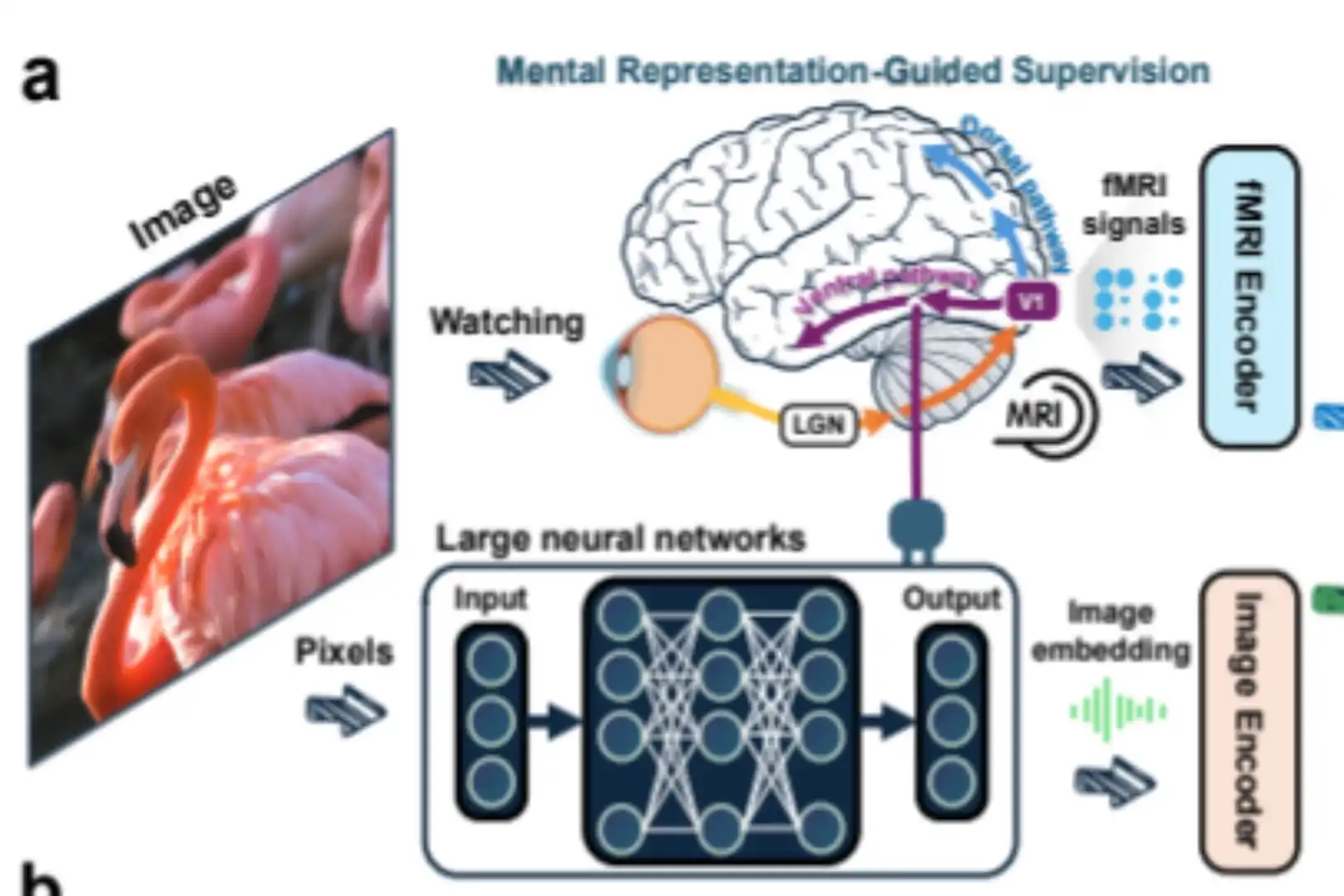
A research team from Zhejiang University published a paper in *Nature Communications* challenging the prevailing notion that larger AI models inherently think more like humans. They found that while model performance on recognizing concrete concepts improved as parameters increased (from 74.94% to 85.87%), performance on abstract concept tasks slightly declined (from 54.37% to 52.82%) in models like SimCLR, CLIP, and DINOv2. The key difference lies in how concepts are organized. Humans naturally form hierarchical categories (e.g., grouping a swan and an owl into "birds"), enabling them to apply past knowledge to new situations. Models, however, rely heavily on statistical patterns in data and struggle to form stable, abstract categories. The team proposed a novel solution: using human brain signals (recorded when viewing images) to supervise and guide the model's internal organization of concepts. This method, termed transferring "human conceptual structures," helped the model learn a brain-like categorical system. In experiments, the model showed improved few-shot learning and generalization, with a 20.5% average improvement on a task requiring abstract categorization like distinguishing living vs. non-living things, even outperforming much larger models. This research shifts the focus from simply scaling model size ("bigger is better") to designing smarter internal structures ("structured is smarter"). It highlights a new pathway for developing AI that possesses more human-like abstract reasoning and adaptive learning capabilities.

marsbit04/05 04:41

Zhejiang University Research Team Proposes New Approach: Teaching AI How the Human Brain Understands the World

marsbit04/05 04:41

活动图片